4 and 5 Days in Munich: Extended Itinerary with Day Trips
Two days in the city, three days out of it. The hour-by-hour plan, the day trips ranked, the ticket arithmetic, and exactly what to cut if you only have four days.

Five days in Munich means two days in the city and three days out of it, and if that sounds like a strange ratio for a city break, it is the correct one. Munich’s centre is small. You can see the Altstadt properly in a day and a half, and the fifth day spent looking for a sixth museum is a day wasted when the Zugspitze, Salzburg and Neuschwanstein are all within two hours of the Hauptbahnhof.
Four days is the same plan with one day trip removed, and the one to cut is easier to identify than you would think.
Below is the whole thing hour by hour, the day trips ranked against each other rather than listed, the ticket arithmetic that decides whether this trip costs €60 or €180 in transport, and the specific ways a five-day Munich trip goes wrong.
5 days in Munich at a glance
| Day | Shape | Ticket | |
|---|---|---|---|
| 1 | Altstadt on foot | Viktualienmarkt · a tower · Glockenspiel · Residenz · English Garden | None needed — it’s all walkable |
| 2 | One big indoor thing + a neighbourhood | Deutsches Museum or the Kunstareal · Olympiapark · Schwabing or Glockenbach | Zone M day ticket €10.10 |
| 3 | The mountains | Garmisch and the Zugspitze, or Berchtesgaden | Bayern-Ticket €34 / €74 for five, or the Sommerticket |
| 4 | A second country or a castle | Salzburg, or Neuschwanstein | Bayern-Ticket €34 / €74 |
| 5 | Palaces, Dachau, or the lakes | Nymphenburg + Dachau, or a lake day | Zone M or a wider-zone ticket |
| Cut for four days | Drop day 5, and move Nymphenburg into day 2 | ||
| Best days to arrive | Thursday or Friday. Never Sunday | ||
Before you book: the week has a shape
Munich’s week is not uniform, and with five days you have enough room to work with it instead of around it.
- Monday closes the art museums. The Alte Pinakothek, the Lenbachhaus, the Museum Brandhorst and the Glyptothek all shut. The Residenz, Nymphenburg and the Deutsches Museum stay open — so a Monday should be a palaces-and-technology day, or a day trip.
- Sunday is the €1 museum day. The Bavarian state collections — the Pinakotheken, the Glyptothek and others — charge a flat euro. This is the best-value day of the week and worth planning around.
- Sunday also shuts the shops, across the whole of Germany, apart from the Hauptbahnhof and the airport. Viktualienmarkt stalls close too. Saturday is the shopping day, with the Kaufingerstraße department stores running to about 20:00.
- Arrive Thursday or Friday. That gives you a full Saturday, a €1 Sunday, and no dead Monday at the end. Sunday arrivals are the weakest possible start.
On the calendar rather than the week: late April, May and September are the good months. The second half of September is the most expensive fortnight of the year because Oktoberfest roughly triples hotel rates — see the best time to visit Munich and where to stay during Oktoberfest if your dates collide with it.
Day 1: the Altstadt, entirely on foot
Everything today is within walking distance of everything else on flat ground. About seven kilometres, no transport needed until the evening.
- 08:30 — Viktualienmarkt. Coffee and a Leberkässemmel for a few euros while the stalls set up. The market’s beer garden under the maypole is the one place in Munich where bringing your own food is openly encouraged. Full guide.
- 09:30 — one tower, not two. St. Peter’s is 306 steps, no lift, around €5, and the better view. The Frauenkirche south tower reopened in 2022 and costs €7.50 — 86 steps then a lift, open Mon–Sat 10:00–17:00 and Sun 11:30–17:00, last ascent 16:30. The Olympiaturm has been closed since June 2024 and is expected to reopen during 2027, so check before you plan around it.
- 10:45 — Marienplatz. The Glockenspiel runs at 11:00 and 12:00 daily, plus 17:00 from March to October, for about 15 minutes. It is a mechanical curiosity rather than a spectacle. Watch it once, from across the square, and spend the waiting time on the Neues Rathaus facade instead.
- 11:30 — Weisswurst, before the noon bell. Two sausages, sweet mustard, a pretzel and a wheat beer. The rule about noon is genuine. See our Weisswurst guide; the Hofbräuhaus five minutes east is far better at eleven in the morning than at eight at night.
- 13:30 — the Residenz. Around €10; allow about two hours. The Antiquarium, a barrel-vaulted Renaissance hall almost 66 metres long and built in 1568–71, is the finest interior in the city. Guide.
- 16:15 — Hofgarten and Odeonsplatz. Ten minutes through the Renaissance garden to the Theatinerkirche and the Feldherrnhalle.
- 17:00 — the English Garden. Enter by the Haus der Kunst and the first thing you meet is the Eisbach standing wave, with surfers on it year-round. It reopened on 8 May 2026 after a long closure, so it is running again. Walk twenty-five minutes north to the Chinesischer Turm beer garden.
If you have arrived late and want the compressed version, one day in Munich runs the same ground in half the time.
Day 2: one big thing, then a neighbourhood
Munich has three world-class indoor collections and you have time for one properly. Choose by temperament rather than by ranking.
| Option | Cost | Time | Choose if |
|---|---|---|---|
| Deutsches Museum | €16, open 09:00–17:00 (last entry 16:30), closed 1 Jan, Good Friday, 1 May, 1 Nov, 24, 25 and 31 Dec | 3 h minimum | You like machines. 25,000 m² of them |
| The Kunstareal (Alte Pinakothek, Brandhorst, Lenbachhaus, Glyptothek) | €1 on Sundays (not at the Lenbachhaus), otherwise €6–€10 each | Half a day | You want the art. Closed Mondays |
| Nymphenburg Palace | €20 combined in summer, €16 in winter | Half a day incl. gardens | You want a palace and a park. Tram 17, 20 min |
Afternoon: the Olympiapark. The 1972 park is a short ride north on the U3 to Olympiazentrum and is the best free afternoon in Munich. The tent-roof architecture is genuinely extraordinary at close range, the Olympiastadion holds 63,118, and the Olympiaberg — the grass hill built from wartime rubble — gives you the same Alps panorama the closed Olympiaturm used to, for nothing. The SAP Garden, opened 27 September 2024 with 10,796 seats for ice hockey, sits in the same park and is home to EHC Red Bull München and FC Bayern Basketball. Next door is BMW Welt and the BMW Museum. See the Olympic quarter and the 1972 Olympics.
Evening: a neighbourhood, not the centre. The Glockenbachviertel for bars and restaurants, Haidhausen across the Isar for something quieter, or Schwabing if you have ended the day in the north. All three are better on a weeknight than anything within sight of Marienplatz.
The ticket that decides the cost of days 3, 4 and 5
Get this wrong and the trip costs an extra hundred euros for nothing.
- Zone M day ticket: €10.10, valid from validation until 06:00 the next morning. Covers everything inside the city — days 1, 2 and most of 5.
- The group day ticket covers up to five adults for roughly double the single price. Two people should almost never buy two singles.
- Bayern-Ticket: €34 for one person, €74 for a group of up to five. Unlimited regional travel — RB, RE and S-Bahn — across the whole of Bavaria for a day, plus most connecting buses, and it reaches Füssen, Garmisch, Nuremberg and, unusually, Salzburg in another country. This is the ticket for days 3 and 4.
- It is not valid before 09:00 on weekdays, and not on ICE or EC trains. Every day-trip plan here starts at 09:02 for that reason.
- Munich Airport is Zone 5. A Zone M day ticket does not cover it. S1 and S8 both run it in about 40–45 minutes. See airport to city.
- Dachau is outside Zone M too — the S2 needs a wider-zone ticket.
Our Munich travel passes guide compares the whole family, including the city cards, and the U-Bahn and S-Bahn guide explains the zones properly.
Day 3: the mountains
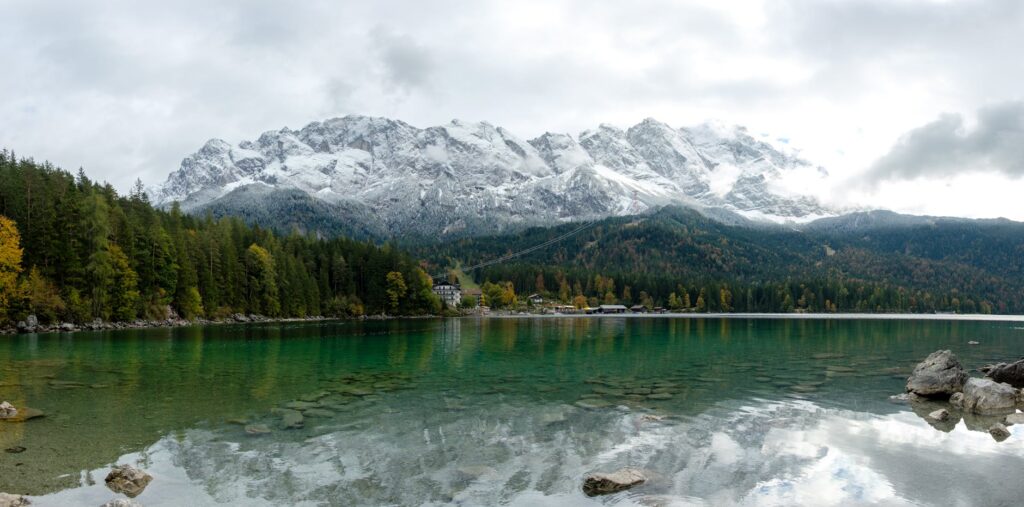
This is the day that justifies five days rather than three. Two serious options.
Garmisch-Partenkirchen and the Zugspitze
RB6 Werdenfelsbahn, direct, hourly, 1h20 to 1h26. Garmisch is the best mountain base in reach of Munich, and from it you can do the Zugspitze, the Partnachklamm gorge, or the Alpspitze.
- The Zugspitze Round Trip — cog railway up through a 4.5 km tunnel to the Zugspitzplatt at 2,600 m, a short cable car to the 2,962 m summit, and the Seilbahn Zugspitze back down to the Eibsee. The whole circuit is three to four hours. Summit return: €78 adult, €39 child 6–15.
- The ticket that beats it: the MVV Garmischer Sommerticket, on sale from 14 May 2026, bundles return travel from Munich with the lifts. Zugspitze variant €94.50 adult, €12.50 child — against €34 for a Bayern-Ticket plus €78 bought separately, which is €112. The Classic variant at €60.50 adult and €8 child covers travel plus the Alpspitzbahn, Hochalmbahn and Kreuzeckbahn, and is the one to buy for a walking day.
- Partnachklamm, about €10, is a 700-metre walkway cut into a slot canyon. Spectacular and short — combine it with the Eckbauer for a proper half day. It closes at short notice in bad weather.
Full detail in Zugspitze from Munich and the Garmisch day trip. If you would rather walk than ride, the best day hikes near Munich covers what you can reach on the same ticket.
Berchtesgaden and the Königssee
About 2h30 each way, which makes it a long day, but the Königssee is the most beautiful body of water in Germany and the electric boats have been running on it since 1909. The Eagle’s Nest is closed in winter. See the Berchtesgaden guide.
Insider tip: check the mountain webcams before you commit. A Zugspitze day in cloud costs €78 and shows you the inside of a cloud. If the forecast is poor, swap day 3 and day 5 — Dachau and Nymphenburg do not care about visibility.
Day 4: a second country, or the castle
Salzburg — the best day trip Munich has
1h35 to 2h each way, and the Bayern-Ticket is valid — €34 solo or €74 for five, to a different country. Salzburg’s Altstadt is compact enough to cover on foot, the Hohensalzburg fortress above it is among the best preserved in Europe, and the whole thing works as a single unhurried day.
The honest caveat: July and August are uncomfortable, and the Getreidegasse in high season moves at a shuffle. Full guide. If Vienna rather than Salzburg is on your mind, Munich to Vienna covers the four-hour Railjet.
Neuschwanstein — book it or don’t go
About two to two and a half hours each way by train to Füssen and bus 78, which makes it a full day of roughly ten hours door to door. Entry is timed and books out weeks ahead in season — turning up without a ticket in July means looking at the castle from the outside, which is admittedly the better view anyway.
This is the day trip that most divides people. It is the most photographed building in Germany, the interior is a half-finished nineteenth-century fantasy rather than a historic royal residence, and the tour is about thirty minutes on a conveyor belt. The setting is genuinely magnificent. Decide which of those you are going for. Guide here, and Linderhof and Oberammergau is the quieter alternative that most people prefer once they have done both.
The other candidates
- Nuremberg — 1h05 by ICE, so not a Bayern-Ticket journey unless you take the slower regional route. A medieval old town, the Documentation Centre on the Nazi rally grounds, and a genuinely different city. Guide.
- Chiemsee and Herrenchiemsee — Ludwig II’s Versailles copy on an island in Bavaria’s largest lake. Guide.
- Rothenburg ob der Tauber — the picture-book walled town, and a long day. Guide.
All of these and more are ranked against each other in day trips from Munich.
Day 5: palaces, memory, or water
The fifth day is the one with genuine choice in it, and the right answer depends on what the first four have been.
Option A: Nymphenburg and Dachau
Two halves that fit together because both are on the north-west side of the city. Nymphenburg is tram 17 from the Hauptbahnhof, about twenty minutes, with a combined palace-and-museums ticket €20 in summer and the park free. Dachau Memorial is free, about 35 to 40 minutes on the S2 plus bus 726, and outside Zone M.
Be honest with yourself about the order and the emotional weight. Dachau is not a sightseeing stop and doing it after a palace, or before a beer hall, does not work well. The memorial says some of its content may not be appropriate for children under 13. Most people who do both put Dachau in the morning and keep the afternoon light. Guide, and Munich’s wartime history for the context.
Option B: the lakes
Starnberger See is on the S6; Ammersee is on the S8 to Herrsching. Check the day’s journey times in the MVV planner. Swimming, a lake steamer, and the walk from Herrsching up the Kiental to Kloster Andechs, a monastery brewery about four kilometres and 140 metres of ascent above the lake. This is the best low-effort day out Munich has and almost no visitor does it. Guide.
Option C: the city’s other half
If the weather has broken, this is the day for it. The Müller’sches Volksbad, built 1897–1901 and on opening the largest swimming bath in the world, has a Roman-Irish steam bath at 40, 60 and 80°C — swimming €5.80, sauna including the pool €23 for four hours. Or go out to Therme Erding, 45 to 60 minutes on the S2 plus a bus, where a weekday day pass to the Vital & Sauna area is €62 and the Early Swimmer at €22 before noon is the cheapest way in. See the historic baths, Therme Erding and German sauna etiquette, which you should read before you go.
Football is the other strong option. The Allianz Arena holds 75,024, and the FC Bayern Museum plus Arena Tour combi ticket is €25 adult, €22 concession, €11 child 6–13, with the tour running 120 to 150 minutes. Match tickets are another matter entirely — see FC Bayern tickets and the Allianz Arena guide.
Four days: what to cut
Drop day 5, not one of the day trips. That is the whole answer, and here is why.
The two city days and the two out-of-town days are what make the trip. Day 5’s options — Nymphenburg, Dachau, the lakes, a spa — are all excellent and all of them are things you can find an equivalent of in a hundred other cities. The Alps and Salzburg are not. If you cut a day trip instead and spend four days in the city, you will spend the last afternoon in a museum you did not want to visit.
One adjustment: move Nymphenburg into day 2 in place of the Olympiapark, and take the tram there in the afternoon. That recovers the palace without adding a day. The four-day plan then reads: Altstadt · museum plus Nymphenburg · mountains · Salzburg.
Shorter still? Three days in Munich is two days in and one out, and two days drops the day trip entirely — at which point you are seeing a pleasant mid-sized German city and missing the reason people come.
How five days go wrong
- Two day trips back to back. Three hours of travel on consecutive days is more tiring than it looks. Put a city day between day 3 and day 4 if you can, or accept that day 5 will be slow.
- Buying a Bayern-Ticket for a solo trip without checking. At €34 solo it is excellent for Garmisch or Salzburg and unnecessary for anything inside Zone M. For a pair or a group the €74 version is almost always right.
- Trying to make a weekday 09:00 start work. The Bayern-Ticket is invalid before nine on weekdays. Plan the 09:02 departure and stop fighting it.
- Ending on a Monday with the museums as the plan. Half the Kunstareal is shut. Make Monday a day trip or a palaces day.
- Booking Neuschwanstein for the day after you arrive. Jet lag plus twelve hours door to door plus a timed entry is a bad combination. Put it on day 4.
- Assuming the beer halls are the evening plan every night. One night is right. After that go to a beer garden — the Hirschgarten seats around 8,000 and is reputedly the largest in Europe — or to a neighbourhood.
Frequently Asked Questions
Is 5 days in Munich too long?
Not if you use it properly. Five days in the city alone would be too long — the Altstadt is small and you would run out of things you actually want to see by day three. Five days built as two city days plus three day trips is close to ideal, because the Alps, Salzburg, Neuschwanstein and the lakes are all within about two hours and each is a full day in its own right.
What is the best 5-day Munich itinerary?
Day 1 the Altstadt on foot; day 2 one major museum plus the Olympiapark and a neighbourhood in the evening; day 3 Garmisch and the Zugspitze; day 4 Salzburg or Neuschwanstein; day 5 Nymphenburg and Dachau, or the lakes, or a spa. Arrive on a Thursday or Friday so you get a full Saturday and a €1 museum Sunday, and avoid ending on a Monday when the art museums close.
How much does 5 days in Munich cost?
Transport is the easy part: two Zone M day tickets at €10.10 and two Bayern-Tickets at €34 comes to under €90 for a solo traveller, and a group of five pays €74 per day-trip day rather than five times that. Entry costs are the variable — the Zugspitze at €78 is the single largest line item, and Dachau, the Olympiapark and the English Garden are free. Our Munich trip cost guide works it through properly, and Munich on a budget covers the cheap version.
How many day trips should I do in five days?
Two or three. Two is comfortable, three is achievable if one of them is short — the lakes at 40 to 50 minutes each way count as half a day trip. Avoid three long ones on consecutive days; the travel accumulates and the fifth day becomes a write-off. If you do three, make the middle one the shortest.
Do I need a car for a five-day Munich trip?
No, and you actively do not want one. Every destination in this itinerary is reachable on regional trains and buses covered by the Bayern-Ticket, Munich’s centre is largely pedestrianised, and city parking is expensive. A car only makes sense if you are touring the Alps for several days beyond this trip. See driving in Munich and getting around Munich.
Where should I stay for five days in Munich?
Somewhere within about ten minutes of the Hauptbahnhof, because three of your five days start there. The Altstadt is convenient and expensive, the area immediately around the station is cheap and functional, and Haidhausen, the Glockenbachviertel and Maxvorstadt are the best compromises between price, character and transport. See where to stay in Munich and the best neighbourhoods.
Is four days enough for Munich?
Yes, and it is a very good length. Run the same plan and drop the fifth day, moving Nymphenburg into day 2 so you do not lose it. That gives you two city days and two day trips, which is the ratio that matters. What four days cannot absorb is a second long-haul trip such as Berchtesgaden or Rothenburg on top of the Alps and Salzburg.
What if it rains for most of the five days?
Rain is possible year-round in Munich and heaviest in early summer, so this is a real question. Reorder rather than persevere: move the mountain day to the best forecast, and fill the wet days with the Deutsches Museum, the Kunstareal, the Residenz, the Müller’sches Volksbad and Therme Erding. Our weather and packing guide covers what to bring and rainy-day options the indoor alternatives.
Where to go next
Every length of Munich trip is laid out in our Munich itineraries hub, from one day upwards. For the day trips, day trips by train handles the ticketing and the Bavarian Alps from Munich covers the mountain end. Before you book anything, planning a Munich trip and the best time to visit will tell you whether your dates are the right ones.
Related Guides
- Munich Itineraries: How Many Days Do You Need? — the cluster hub
- One Day in Munich: The Perfect 24-Hour Itinerary — High-intent term; SERP is generic listicles with no destination authority
- 2 Days in Munich: The Ideal Weekend Itinerary — Biggest single itinerary term
- 3 Days in Munich: Complete Day-by-Day Itinerary — Second-biggest; the third day is a day trip, so it links hard into that pillar
- One Week in Munich and Bavaria: 7-Day Itinerary — Captures the Bavaria trip planner; feeds the onward-travel pillar