How to Get FC Bayern Tickets and See a Match
Two routes get you into the Allianz Arena at face value: the club's own sale, and its Ticket Exchange in the last ten days. Prices, the members' ballot, the Sudkurve, and what to do if you miss out.
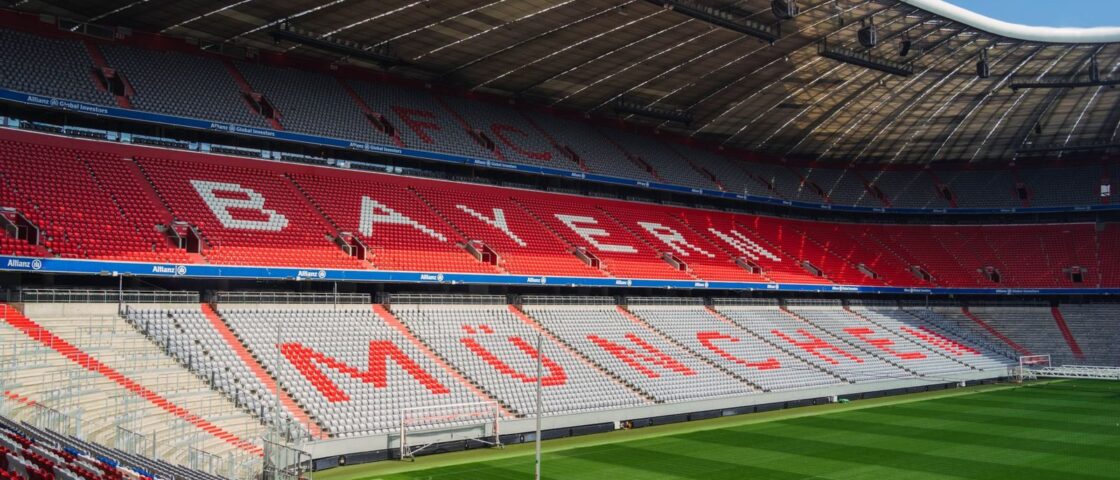
Buy from the club, or buy from the club’s own ticket exchange in the last ten days before kick-off. Those are the two routes that end with you inside the Allianz Arena at something close to face value, and everything else — the marketplaces at the top of the search results, the “guaranteed” packages, the man outside Fröttmaning station — costs two to four times as much for the same seat.
The good news is that German football is astonishingly cheap by European standards. Reported face values at the Allianz Arena run from around €15 to €120, in a stadium holding 75,024, with a standing terrace of 9,336 behind the south goal. Compare that with what a comparable fixture costs in London or Madrid and the gap is not marginal — it is the whole point of the German model.
The bad news is that Bayern have more than 430,000 members with a prior claim on the seats. Here is how the sale actually works, which matches you can realistically get into, and what to do when the answer is no.
Getting a ticket, at a glance
| Only buy from | fcbayern.com, or the club’s official Ticket Exchange |
| General sale opens | About 8 weeks before the match |
| Members’ ballot | Roughly 4–6 weeks before |
| Exchange stock appears | 2–10 days before kick-off — check daily |
| Face value (reported) | ~€15–€120+ adult, depending on category |
| Exchange surcharge | Face value +15% booking fee, plus €5 or €8 system fee |
| Membership | ~€35–€65 a year. Worth it only if you will go more than once. |
| Easiest fixtures | Midweek Bundesliga, early DFB-Pokal rounds, lower-half opposition |
| Hardest | Champions League knockouts, Dortmund, the last home game of the season |
| Standing terrace | Südkurve, 9,336 places. Bundesliga only — UEFA makes it all-seater. |
| Getting there | U6 to Fröttmaning, then a 15-minute walk on the ramp |
| If you cannot get in | The Arena Tour and museum, €25 — genuinely good |
One caveat before the detail: the club’s own price tables did not load when this guide was written, so the euro figures here come from secondary reporting rather than from fcbayern.com directly. Treat them as the right order of magnitude, and check the club’s site for the exact category prices for your fixture.
How the sale actually works
Bayern do not simply put tickets on sale and let the fastest browser win. There is a sequence, and understanding it tells you when to be at your keyboard.
| When | What happens | Can a visitor use it? |
|---|---|---|
| Season tickets | Renewed by existing holders. Waiting lists run for years. | No |
| ~8 weeks out | Match tickets released; members apply | Only if you are a member |
| 4–6 weeks out | Members’ ballot drawn and allocated | Only if you are a member |
| Remaining stock | Any unsold seats go to general sale | Yes — but rarely for big fixtures |
| 2–10 days out | Ticket Exchange: season-ticket holders return seats | Yes. This is your route. |
| Matchday | Occasional last-minute returns | Sometimes, for low-demand games |
The practical consequence: if your trip is fixed and the fixture is a big one, do not spend six weeks refreshing the general sale page. Set a reminder for ten days out and work the Exchange instead.
The Ticket Exchange, and why it is the answer
Bayern run an official resale platform where season-ticket holders who cannot attend hand their seat back to be sold on. It is the club’s only authorised resale channel and it works the way resale ought to work.
Prices are set by the club, not by the seller: the day-ticket price plus a 15% advance booking fee, plus a system fee of €5 up to a goods value of €150 and €8 above that. Nobody can list a €60 seat at €240. A €60 seat comes out at about €74.
How to use it well:
- Start checking about ten days out and check every day. Stock trickles rather than floods.
- Check in the evening. That is when people work out they cannot go.
- Be flexible on category. A single seat in the upper tier behind the goal appears far more often than two together on the halfway line.
- Have an account ready in advance, with payment details saved. Seats vanish in minutes.
- Do not wait for the price to drop. It will not — the price is fixed by formula.
The honest limitation is simple arithmetic. An exchange only holds what people hand back, and for the matches everybody wants, almost nobody hands anything back. For a Tuesday night Bundesliga game against a mid-table side you will very probably get in. For a Champions League quarter-final you very probably will not, at any price you should be willing to pay.
Is club membership worth it for a visitor?
FC Bayern has more than 430,000 members — reported as the largest membership of any sports club in the world — and joining costs roughly €35 to €65 a year depending on which category you fall into. Anyone can join from anywhere; you do not need to live in Bavaria.
What it buys you is access to the members’ ballot four to six weeks before each match, at reported prices of roughly €35 to €100 depending on section. It is not a guarantee — it is a draw, and with 430,000 members chasing a stadium of 75,024, most of whom are season-ticket holders already, the odds for a marquee fixture are not good.
The verdict: for a single trip built around one specific match, membership is not worth it — you are paying €50 for a lottery ticket you will probably lose, and the Exchange costs you nothing to try. For someone who will come back, or who is flexible about which match, it changes the odds meaningfully and pays for itself the first time it works. Note also that there is no member discount on standing tickets, which are already the cheapest thing in the building.
Which matches you can realistically get into
Not all fixtures are equally hard. Choosing the right one is worth more than any amount of refreshing.
| Fixture type | Difficulty | Note |
|---|---|---|
| Early DFB-Pokal rounds | Easiest | Lower-league opposition, midweek, often well short of a sell-out |
| Midweek Bundesliga, lower-half opposition | Easy | Your best realistic target |
| Weekend Bundesliga, mid-table opposition | Moderate | Exchange stock usually appears |
| Champions League group stage | Moderate to hard | Depends entirely on the opponent |
| Dortmund, Leverkusen, Leipzig | Hard | Der Klassiker sells out instantly |
| Champions League knockouts | Hardest | Do not build a trip around getting in |
| Final home match of the season | Hardest | Trophy-lift day. Forget it. |
Insider tip: the Bundesliga does not publish exact kick-off times until roughly six to eight weeks ahead, and matches move between Friday night, Saturday afternoon, Saturday evening and Sunday for television. If you are booking flights around a fixture, book flexible ones or accept that your Saturday match might become a Sunday one.
Where to sit, and the Südkurve
The Allianz Arena is a steep, enclosed bowl with three tiers and no running track, which means even the top row is closer to the pitch than a mid-tier seat in most English grounds. There is no genuinely bad seat.
The Südkurve behind the south goal is the thing to understand. Its lower tier is a standing terrace holding 9,336 and it is home to the Schickeria, Bayern’s principal ultra group. This is where the singing comes from, where the flags are, and where the choreographed tifo displays are put together before kick-off. It is also the cheapest area in the stadium.
Two things worth knowing. First, standing terraces are banned under UEFA regulations, so for Champions League matches the Südkurve is converted to seating and the stadium’s capacity drops accordingly. If the terrace is what you want, you need a Bundesliga or domestic cup match. Second, it is a genuine ultras’ end — you stand for ninety minutes, you sing, and you do not spend the match filming. If that is not what you are after, take a seat in the upper tier of a long side instead, where you can see the shape of the game and still hear the Südkurve perfectly well.
Away fans are allocated a block in the opposite corner, as required by German league rules, and away support at Bundesliga matches is far larger and louder than most visitors expect.
Matchday: getting there and what to expect
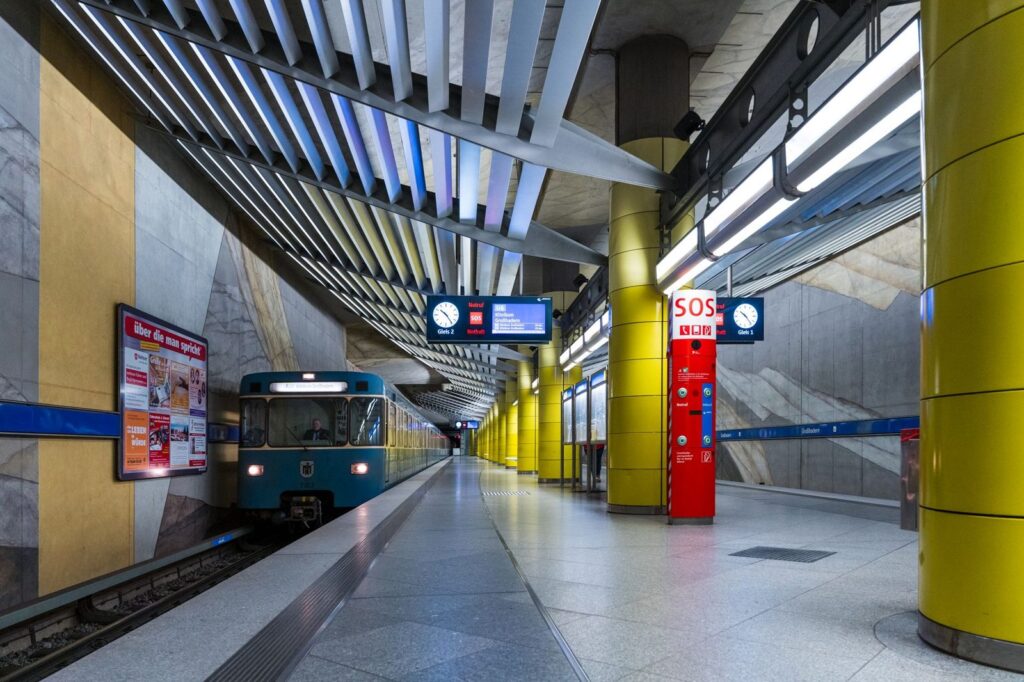
The Allianz Arena sits at Fröttmaning on the northern edge of Munich, and the transport is the easy part.
- U6 to Fröttmaning, then about 15 minutes on foot along the raised walkway. The stadium is visible the whole way and it is a good approach.
- Your match ticket usually includes public transport to and from the ground on the day — check the ticket conditions, but it is standard practice in German football and it means you may not need a separate day ticket. Our U-Bahn and S-Bahn guide covers the network.
- Arrive 60 to 90 minutes early. Not because of queues at the gate, but because the Südkurve display happens before kick-off and the walk from the U-Bahn is longer than it looks.
- Leaving is the slow part. Fröttmaning absorbs 75,000 people in about 45 minutes, which is impressive and still means a wait. Have a beer inside rather than standing on the platform.
- Cashless inside the stadium, with a refundable cup deposit on drinks. Bring a card.
- Do not drive. Parking is limited and expensive and the U6 exists — see driving in Munich if you need convincing.
Beer in the ground is a Bavarian beer at a sensible price, which after any English or Spanish stadium comes as a shock. Food is bratwurst, Leberkässemmel and pretzels, and it is fine.
Why German football is this cheap
It is worth understanding why a seat at the reigning German champions costs less than a mid-table Premier League ticket, because the reason also explains the ballot, the terrace and the atmosphere.
German clubs operate under what is universally called the 50+1 rule: the members’ association must retain a controlling stake in the club’s professional arm, so an outside investor cannot simply buy the club and run it as an asset. Bayern’s 430,000-plus members are not a fan club — they are, collectively, the owners, and they vote. A board that trebled ticket prices would face them at the annual general meeting.
The visible consequences, from a visitor’s seat:
- Standing terraces still exist. Germany never followed England into all-seater stadiums, and the Südkurve’s 9,336 places are the cheapest and loudest part of the ground.
- Season tickets are held for decades and passed down. Waiting lists run for years, which is why the Exchange has stock at all.
- Beer is sold at ordinary prices and drunk in the stands rather than smuggled in.
- Away allocations are large and away support genuinely travels. A Bundesliga away end is a spectacle in itself.
- The atmosphere is made by the crowd, not by the stadium PA. There is very little piped music and no clap-along prompting on the screens. It is closer to a beer-hall evening than to a concert.
None of this is nostalgia — it is the current model, and it is the reason a Bundesliga match is worth planning a trip around even if the football on the day is one-sided, which at the Allianz Arena it frequently is. Budget for it in the trip as a whole — our Munich trip cost breakdown puts a match alongside the rest of a weekend.
The easiest football ticket in Munich
If the men’s team is sold out and your dates will not move, look at FC Bayern Frauen. The women’s team plays most of its home fixtures at the club’s own campus ground in the north of the city rather than at the Allianz Arena, tickets are cheap and ordinarily available, and the standard of football is high — this is one of the strongest sides in Germany.
Selected big fixtures, particularly in the Champions League, do get moved to the Allianz Arena, and those are worth watching for: it is the only realistic way most visitors will see a competitive match in the main stadium. Check the club site for the venue of any specific fixture rather than assuming — it changes match by match.
The same logic applies to TSV 1860 München at the Grünwalder Stadion. Third-tier football, a ground built in the 1920s with real terracing, a crowd that has never forgiven anybody for anything, and tickets you can buy on the day. As a football afternoon it is more distinctive than a routine Bayern home win, and it costs a fraction of the price. Giesing itself is worth a wander afterwards — see our Munich neighbourhoods guide.
A matchday, hour by hour
| Before kick-off | Where to be |
|---|---|
| -3 hours | Lunch in the city — see the best restaurants in Munich. |
| -2 hours | U6 north from Marienplatz or the Hauptbahnhof. It fills up fast. |
| -1h 30 | Fröttmaning. Walk the raised ramp — the facade view is the photograph. |
| -1 hour | Through the gate. Find your block, buy a beer, watch it fill. |
| -15 min | The Südkurve display. Do not be queueing for a bratwurst. |
| Half time | 15 minutes. The queues are shorter at the far end of your concourse. |
| Full time | Stay 20 minutes. The U6 is a crush; the stadium is not. |
If you cannot get a ticket
This is where most visitors end up, and the fallback is better than it sounds.
The FC Bayern Museum plus Arena Tour combined ticket is €25 for adults (14+), €22 concession and €11 for children 6–13, with under-6s free but ticketed. The tour runs 120 to 150 minutes and takes you into the dressing rooms, the tunnel and pitchside. Museum plus Arena View is €19; the museum alone is €12 and is open 10:00–18:00 with last entry at 17:15.
The building itself repays the visit even without a match. Herzog & de Meuron completed it in 2005 at a cost of €340 million, and the facade is 2,760 ETFE cushions over 66,500 m². The illuminated section is 1,056 cushions — eleven horizontal rows by ninety-six diagonal columns — each holding 24 individually addressable LED modules, roughly 300,000 LEDs capable of sixteen million colours at forty frames a second. Crucially the colour never changes within a cushion, which is why the diamond grid stays legible instead of dissolving into a screen. Our Allianz Arena guide goes through the architecture properly.
Other live sport in Munich, all of it far easier to get into:
- EHC Red Bull München (ice hockey, DEL) and FC Bayern Basketball share the SAP Garden in the Olympiapark, which opened on 27 September 2024 and holds 10,796 for hockey and 11,500 for basketball. Tickets are ordinarily available and German ice hockey is a genuinely good night out.
- TSV 1860 München, the city’s other club, play in the third tier at the Grünwalder Stadion in Giesing — an old-fashioned ground with terracing, and the more atmospheric matchday of the two by some distance.
- The BMW Open, an ATP 500 clay tournament at MTTC Iphitos, ran 11–19 April 2026 with prize money of around €2.56m and opens the German tennis season.
- The Munich Marathon is on 11 October 2026 and finishes inside the Olympiastadion.
All of these are covered in our Munich sports guide, and the Olympiapark itself is worth an afternoon regardless — see the Olympic quarter and our piece on the 1972 Olympics. The Olympiaturm has been closed since June 2024 and is expected to reopen during 2027, so the tower is not part of that afternoon.
What to avoid
- Third-party resale marketplaces. They dominate the search results, they routinely charge two to four times face value, and Bayern’s terms allow them to cancel unauthorised resold tickets. You are paying a large premium for a real risk.
- “Hospitality packages” from unofficial agents. The club sells its own hospitality. Anything else is a middleman.
- Buying outside the ground. Illegal, unreliable, and you will not get in on a cancelled barcode.
- Assuming your ticket is transferable. Tickets can be personalised and checks do happen, particularly for high-demand matches.
- Building a trip around a Champions League knockout. Choose the trip, then find the fixture — not the other way round.
Frequently Asked Questions
Where do I buy FC Bayern tickets safely?
Only two places: fcbayern.com and the club’s own Ticket Exchange, which is the only authorised resale channel. Both charge close to face value. Anything else — marketplace listings, package agents, sellers at the ground — carries a large markup and a genuine risk of a cancelled ticket.
How much do FC Bayern tickets cost?
Reported face values run from around €15 to €120+ for adults depending on the category, with standing on the Südkurve the cheapest. On the Ticket Exchange add 15% plus a €5 or €8 system fee. The club’s own price tables were not reachable when this was written, so check fcbayern.com for exact figures for your fixture.
Can I buy tickets on the day of the match?
Sometimes, for low-demand fixtures — an early cup round or a midweek league game against a lower-half side. Never for Der Klassiker or a Champions League knockout. The Exchange occasionally throws up returns on matchday itself, so it is worth one last check before you give up.
Do I need to be a member to get tickets?
No. Members get first access through a ballot, but any remaining stock goes to general sale and the Ticket Exchange is open to everyone. Membership costs roughly €35–€65 a year and improves your odds without guaranteeing anything — worth it if you will go more than once, not worth it for a single trip.
Can I stand in the Südkurve?
For Bundesliga and domestic cup matches, yes — the lower Südkurve is a 9,336-place standing terrace and the cheapest area in the ground. For Champions League matches it is converted to seating, because UEFA does not permit standing. It is an ultras’ end: expect ninety minutes on your feet, constant singing and very limited sightlines when the flags go up.
Is the Allianz Arena tour worth doing?
Yes, and especially so if you failed to get a match ticket. The combined museum and tour at €25 runs two to two and a half hours and gets you into the dressing rooms and out at pitchside. The museum on its own is €12. Book ahead in school holidays.
How do I get to the Allianz Arena?
U6 to Fröttmaning, then a fifteen-minute walk. Match tickets typically include travel on matchday. Allow 60–90 minutes before kick-off and expect a slow exit afterwards.
Is a Bayern match suitable for children?
In the seated areas, very much so — German grounds are family-friendly, alcohol is handled sensibly, and children’s tickets are cheap. Not in the Südkurve, which is standing, crowded and loud for the full ninety minutes. Our Munich with kids and Munich for teenagers guides cover the rest of a sporting weekend.
Where to go next
The Munich sports guide is the hub for everything above, and the Allianz Arena guide covers the stadium itself, the museum and the architecture in detail. If a match is the anchor of your trip, two days in Munich shows what fits around it, and where to stay in Munich explains why staying on the U6 is worth more than staying on Marienplatz on a matchday.
Related Guides
- Sport in Munich: Stadiums, Surfing and Getting Active — the cluster hub
- Allianz Arena and the FC Bayern Museum: Visitor Guide — One of Munich’s biggest attraction terms and the site has nothing on it
- Eisbach Surfing: Munich’s River Wave Explained — Iconic, heavily searched, zero coverage on site
- Olympiapark Munich: Complete Visitor Guide — Only covered obliquely via the 1972 Olympics history post