Munich’s Olympic Quarter: Sport, Cars and Architecture
Munich's iconic 1972 Olympic Park, BMW Welt, the Olympia Tower, and the architecture of the Olympic Village.
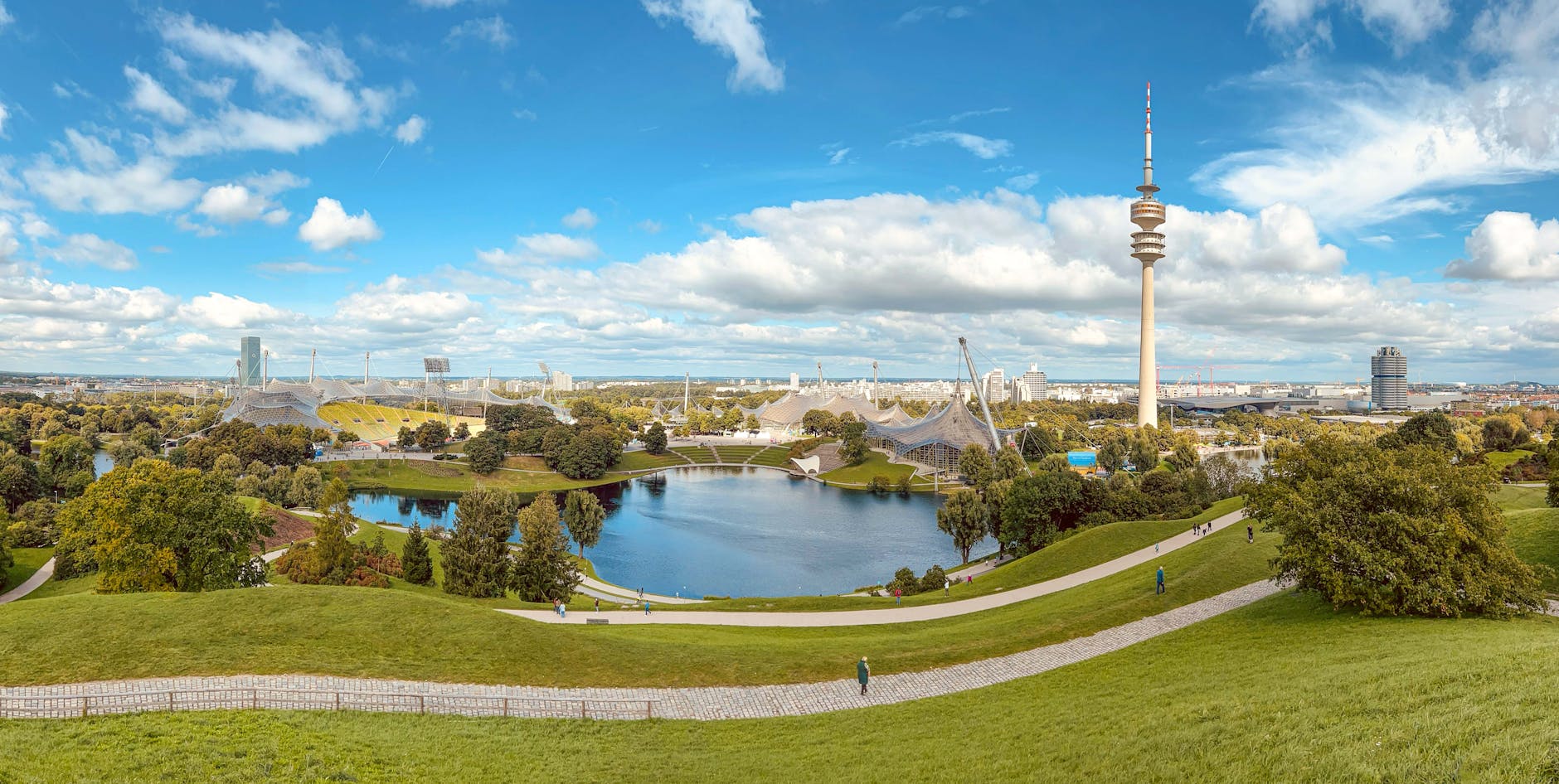
Munich’s Olympic Park Munich area, formally Olympiapark, is the city’s defining late-20th-century neighborhood — built for the 1972 Summer Olympics on a former airfield north of central Munich, anchored by the iconic tent-roof Olympic Stadium and Olympia Tower, and surrounded today by BMW Welt, the BMW Group headquarters, the residential Olympic Village, and the contemporary Olympia Einkaufszentrum mall. The 850,000-square-metre park itself is one of Munich’s largest free green spaces — runners, cyclists, picnickers, and skaters use it year-round. This guide covers the Olympic Quarter: park, museums, BMW Welt, the Olympic Village, restaurants, and how it fits into a Munich trip.
Olympic Park Munich Area: Quick Reference
| Detail | Information |
|---|---|
| Location | North-central Munich, about 5 km north of Marienplatz |
| Nearest U-Bahn | Olympiazentrum (U3) |
| Park size | 85 hectares |
| Iconic structures | Olympic Stadium, Olympic Hall, Olympic Pool, Olympia Tower (291 m) |
| Major neighbor | BMW Welt and BMW Headquarters |
| Free park access | Yes, 24/7 |
| Olympia Tower | €13 adult; observation deck |
| Olympic Pool entry | €5 adult |
| Olympic Village | Residential neighborhood; museum/memorial site |
| Best for | Architecture lovers, runners, BMW fans, family days |
Olympiapark: The Park Itself

The park is a man-made landscape created from WWII rubble — the Olympiaberg hill at the centre of the park is literally a heaped pile of bombed-out Munich, planted with grass and trees. The 7 km circular path around the park is one of Munich’s best free running and cycling routes. The Olympiasee lake, the surrounding open meadows, and the Olympiaberg viewpoint (Munich’s best free panoramic view) all justify a visit even outside event days.
Olympic Architecture: Frei Otto’s Tent Roofs
The Olympic Park’s signature feature is the cable-suspended acrylic tent roofs designed by Frei Otto and Günter Behnisch — radical lightweight architecture that became the defining visual of the 1972 Games and influenced the next 50 years of modern stadium design. The roof covers the Olympic Stadium, Olympic Hall, and the Olympic Pool, connecting them visually. The 1972 architecture has aged beautifully; the structures appear in design textbooks worldwide. Even visitors uninterested in sports walk through to admire the engineering.
BMW Welt and BMW Museum

BMW Welt (BMW World) is the company’s flagship showroom — a striking double-cone glass building opened in 2007. The interior houses current BMW models you can sit in, the legendary M and i brand display areas, and the customer-delivery centre where new BMW owners pick up their cars. Free to enter; open daily 09:00 to 18:00. Allow 60 to 90 minutes.
Next door, the BMW Museum (€10 adult, €7 child) traces the company’s history with vintage cars, motorcycles, and concept vehicles. The four BMW Group headquarters towers (the so-called Vierzylinder, ‘four-cylinder’) are visible from the Olympic Park; tours of the production plant require advance booking. The BMW Welt + BMW Museum combination is one of Munich’s best family attractions for kids 6 to 12.
Olympia Tower

At 291 metres, the Olympia Tower is Germany’s third-tallest free-standing structure and offers the best high-altitude view in Munich. The 190-metre observation deck rotates slowly (one rotation takes about 50 minutes); the restaurant on the 182-metre level rotates faster. On a clear day, the Bavarian Alps stretch across the southern horizon. €13 adult, €9 child. Open daily 09:00 to 24:00.
The free alternative for views: the Olympiaberg (the man-made hill at the park’s centre) offers a panoramic view from 60 metres’ elevation. Cheaper, more atmospheric, and you can bring a picnic. Many locals prefer the Olympiaberg to the tower.
The Olympic Village
Adjacent to the park, the Olympic Village was the athletes’ residential area during the 1972 Games. After the Games, it was converted to permanent housing — today a mixed neighborhood of student dorms, social housing, and university buildings. The 1972 Munich Massacre, in which Palestinian terrorists killed 11 Israeli athletes and coaches and a German police officer, took place at Connollystraße 31 within the Village. The site is marked by a memorial plaque; the 50-year anniversary in 2022 prompted updated commemoration. Treat the site with respect; walking through is appropriate but loud tourism is not.
Sports and Events at Olympiapark
- Olympic Stadium — Now used for major concerts and occasional sports events. Tour the stadium for €10.
- Olympic Hall — Concerts, sporting events, ice skating in winter.
- Olympic Pool (Olympia-Schwimmhalle) — Munich’s main indoor Olympic pool; €5 adult.
- Olympic Ice Stadium (Olympia-Eishockey-Stadion) — EHC Red Bull München ice hockey.
- The lake and meadows — Used for paddleboarding, picnicking, free outdoor concerts in summer.
- Sea Life Munich — Aquarium adjacent to the park; €23 adult, €18 child.
- Olympic Tower restaurant — Rotating restaurant at 182 m; reservations essential.
For football, ice hockey and the rest of Munich’s sporting calendar, see our Munich sports guide.
Walking and Running in Olympiapark
The 7 km circular Olympiaweg path is Munich’s most popular running route. Mostly flat with one significant uphill at the Olympiaberg. Free at all hours; well-lit until 23:00. Pace markers and water fountains throughout. The route connects to wider Munich cycle paths via the southern entrance toward Schwabing and the western entrance toward Neuhausen.
A Perfect Olympic Quarter Day
- 09:30 — U-Bahn U3 to Olympiazentrum.
- 09:45 — Walk through the Olympic Stadium gates; photograph the tent roofs.
- 10:30 — Climb the Olympiaberg for the panoramic view.
- 11:00 — Walk to BMW Welt for the showroom (free).
- 12:00 — Lunch at the BMW Welt rooftop café.
- 13:30 — BMW Museum (90 minutes).
- 15:00 — Coffee and break.
- 15:30 — Olympia Tower observation deck.
- 17:00 — Walking lap around the Olympic Park lake.
- 18:30 — Dinner at the Olympia-Park Bistro or in Schwabing.
Practical Tips for Olympic Quarter Visits
- Olympic Stadium tours (€10) include access to the field and the press boxes; book ahead via the Olympic Park website.
- BMW Welt is free — many visitors mistake it for paid; the showroom and architecture cost nothing.
- Combine with Olympia Schwimmhalle for swimming if you want exercise.
- Pack a picnic — the lake and Olympiaberg are excellent picnic spots.
- Watch for outdoor concerts and events in summer — Olympic Park hosts major shows.
- Sea Life Munich works well for families combining with Olympic Park.
- Get the Olympic Combo Ticket (€19) covering Olympic Park, Olympic Pool, and Sea Life if you’ll visit all three.
- Tour the BMW Group plant with advance booking; €10 per person, 2 hours, includes glass-walled production line view.
Olympic Quarter vs Other Munich Neighborhoods
The Olympic Quarter offers a distinct experience compared to Munich’s other neighborhoods. Where the Altstadt is medieval-cobbled and tourist-dense, the Olympic Quarter is modern-airy and weekend-local. Where Maxvorstadt has the Kunstareal art museums, the Olympic Quarter has the BMW industrial-design narrative. Where the English Garden is wild and immersive, the Olympiapark is designed and architectural. For visitors with multiple Munich days, the Olympic Quarter is the best afternoon-to-half-day side trip from anywhere else.
The park’s shape is inseparable from the Games that built it. Our account of the 1972 Munich Olympics covers the architecture, the massacre and the memorials on site today.
The Story of the 1972 Munich Olympics
The 1972 Munich Olympics were designed to project an open, peaceful, democratic post-war West Germany — a sharp contrast to the 1936 Berlin Games under Hitler. The ‘Cheerful Games’ (heitere Spiele) showcased Frei Otto and Günter Behnisch’s radical lightweight architecture, the playful Waldi (the dachshund mascot), and a colourful ‘rainbow’ visual identity. Athletes were housed in the new Olympic Village. Munich emerged from rubble and decades of post-war reconstruction with this confident, modernist showpiece.
On 5 September, 11 days into the Games, Palestinian terrorists from Black September took 11 Israeli athletes and coaches hostage at the Olympic Village. The botched rescue at the Fürstenfeldbruck Airbase resulted in all 11 hostages, 5 terrorists, and a German police officer dead. The Games continued after a 34-hour pause — a decision that remains controversial. The 50-year anniversary in 2022 prompted formal German apologies to victims’ families and updated memorial commemoration.
Despite this tragedy, the architectural legacy of the Games — particularly the cable-suspended tent roofs — has aged remarkably well. The Olympic Park remains in active daily use as a cultural and recreational space; the architecture continues to influence stadium design worldwide. Visiting today combines the recreational pleasure of a free urban park with the architectural significance of a 1972 monument.
BMW Welt: A Deeper Look
Built 2003-2007 by Coop Himmelb(l)au, BMW Welt is part car showroom, part architectural statement. The double-cone glass facade and the gravity-defying canopy mark a Munich landmark. Beyond the basic free showroom, BMW Welt hosts:
- Customer Delivery Centre — Glass-walled hall where new BMW owners pick up their cars in a small ceremony.
- The Showroom — Free; current BMW, MINI, and Rolls-Royce models you can sit in.
- The Junior Campus — Children’s workshops on cars, driving, and engineering.
- The M World — High-performance BMW M cars and the M heritage.
- The Driving Academy — Test-drive experiences from €100.
- Rolls-Royce showroom — Bespoke customization gallery.
- Plant tours — €10 per person, 2 hours, advance booking required.
- Restaurants — The rooftop ESS ZIMMER and casual M1 café.
Olympic Park Sample Itineraries
Family Half-Day
- 10:00 — U-Bahn to Olympiazentrum.
- 10:30 — BMW Welt; let kids sit in cars.
- 12:00 — Lunch at the BMW Welt rooftop café.
- 13:30 — Walk through Olympic Park; climb the Olympiaberg.
- 14:30 — Olympic Pool swim or Sea Life Munich.
- 17:00 — Return to centre.
Architecture Day
- Morning: BMW Welt and BMW Museum (3 hours).
- Lunch in Schwabing.
- Afternoon: Olympic Park walking tour with focus on Frei Otto tent roofs (90 min).
- Late afternoon: Olympia Tower observation deck (60 min).
- Evening: Drinks in Schwabing or central Munich.
Olympics Memorial Day
- Morning: Visit the Olympic Village memorial plaque at Connollystraße 31.
- Reflect at the lake and Olympiaberg.
- Visit the Stadtmuseum to deepen understanding of Munich’s 1972 history.
- End with quiet dinner in Schwabing.
Olympia Einkaufszentrum (OEZ): The Adjacent Shopping Mall
OEZ, originally built in 1972 as part of the Olympic-era development, is now a recently renovated mall with around 120 stores including Primark, Saturn, C&A, and a strong sports floor. Convenient if you want a non-touristy shopping break during an Olympic Park day. U-Bahn U3 to OEZ. Mostly a locals’ shopping center; less polished than the central Munich department stores but with better prices.
Living in the Olympic Quarter
Several thousand Münchners live in or adjacent to the Olympic Quarter. The post-Games residential conversion of the Olympic Village created mixed housing for students, families, and singles. The surrounding Milbertshofen and Moosach neighborhoods are working-class with a growing middle-class influx. For visitors, this means a more ‘real Munich’ feel than the polished old town — local cafés, family-run restaurants, and authentic neighborhood energy.
Best Restaurants and Cafés in the Olympic Quarter
- BMW Welt Rooftop Café — Modern lunch with floor-to-ceiling glass views.
- Olympia Tower restaurant (Restaurant 181) — Rotating restaurant at 182 m; reservations essential.
- Hippodrom Olympia — Traditional Bavarian on the Olympic Park edge.
- Tigerbar Olympia — Cocktails and brunch.
- Café in der Glashaus Olympic Park — Park-side café for after-runs.
- Adriano’s Olympia — Italian dining adjacent to the park.
- Beim Sedlmayr — Beer garden experience near the U-Bahn.
Olympic Park Through the Seasons
Spring (April-May)
Park flowers blooming; comfortable running weather; outdoor café seasons reopen. The Olympic Tower observation deck is at its clearest in spring after winter rains have cleared the air.
Summer (June-August)
Concert season; massive outdoor events at the Olympic Stadium and Olympic Hall. The lake is busy with families; outdoor cinema and festivals run weekend evenings. Hottest months bring crowds; visit early morning for the quietest experience.
Autumn (September-October)
Best park photography weather; Olympic Park forest in fall colours. Marathon and running events fill weekend mornings. October’s Lange Nacht der Münchner Museen includes BMW Museum and other Olympic Quarter sites.
Winter (November-February)
Quiet park; occasional snow makes the architecture especially photogenic. Christmas market at Olympic Village in December. Indoor venues — Olympic Pool, BMW Welt, BMW Museum, Olympia Tower — provide weather-proof experiences. Skating at the Olympic Ice Stadium.
Concerts and Events at Olympic Stadium
The Olympic Stadium hosts roughly 8 to 12 major concerts each summer — international stars from Coldplay to Beyoncé have played here. Tickets typically €80 to €250 with seating; €60 to €140 standing. Concerts attract 60,000+ attendees; book ahead for parking and U-Bahn-out timings, as crowd flow after major events can extend exits to 90 minutes. The smaller Olympic Hall (Olympiahalle) hosts 12,000-seat indoor concerts year-round with a more intimate feel.
Is there an Olympic Quarter overnight option?
Yes, several. The Hotel ibis Olympiapark, NH München-Schwabing, and the Marriott Munich City West are all within walking distance. Rates run €100 to €180 per night — less than central Munich. Stays here suit visitors prioritizing BMW Welt, family attractions, and quieter accommodation away from the tourist centre.
Combining Olympic Quarter with Other Munich Highlights
The Olympic Quarter pairs well with other northern Munich neighborhoods. A natural full-day rhythm: morning at BMW Welt and Olympic Park; lunch in nearby Schwabing; afternoon at the Kunstareal art museums in Maxvorstadt; evening drinks in Schwabing. The U3 U-Bahn line connects Olympic Park → Schwabing → Maxvorstadt → Marienplatz in 15 minutes, making this loop one of Munich’s easiest multi-neighborhood days.
What other 1972 Olympic relics exist around Munich?
Beyond the main Olympic Park, traces of 1972 dot the city. The Olympic Village stands intact as residential housing. The Olympic Hall hosts ongoing events. The Olympic Swimming Pool remains in operation. The Fürstenfeldbruck Airbase, site of the failed hostage rescue, lies 30 km west — though typically not visited by tourists. The Munich Stadtmuseum and the airport hold limited 1972-themed displays.
Is the Olympic Park accessible to wheelchair users?
Mostly yes. The flat paths and the main stadium areas are step-free. The Olympiaberg has paved switchback ramps as well as stairs. BMW Welt is fully accessible. Olympia Tower has elevators throughout. The Olympic Pool has accessible changing rooms and pool lifts. Plan ahead for the Olympic Stadium tour, which has limited wheelchair access in some areas.
Are guided Olympic Park tours worth it?
Yes for first-time architectural visitors. The €15 tour explains Frei Otto’s cable-suspended tent-roof engineering, the Park’s post-war rubble origins, and the 1972 Games narrative in 90 minutes. Self-guided visits work fine for casual tourism; guided tours suit visitors with architectural or sports-history interest.
Is BMW Welt always free even during major model launches?
Yes. BMW Welt is genuinely free year-round, including major launch events. Some special exhibitions inside BMW Welt (such as showcase concept cars) are also free. The BMW Museum next door always charges; the showroom never does.
Where do locals run in Olympic Park?
The 7 km perimeter route is universally popular. Serious runners add the Olympiaberg hill repeat for elevation work. Trail runners use the broader park paths. Most weekday mornings see 50 to 200 active runners; weekends draw running clubs and casual joggers. Cheap entry, ample lighting, and free changing-room access at the Olympic Pool make it Munich’s best urban running destination.
Final tips for an Olympic Quarter visit?
Wear comfortable shoes — the Park is bigger than it looks. Pack a small backpack for picnic supplies. Photograph the tent roofs in late afternoon for the best light. Visit BMW Welt mid-week to avoid weekend crowds.
Frequently Asked Questions
Is the Olympic Park free?
Yes. The park itself, including the Olympiaberg, the lake, the paths, and exterior views of the Olympic Stadium are all free. Olympia Tower, Olympic Pool, BMW Museum, and Sea Life all charge admission.
Can I tour the Olympic Stadium without a ticket?
The exterior and surroundings are free. Interior access requires either a ticket to an event held at the stadium or a paid guided tour (€10 adult). The guided tour includes field access and press-box visits.
Is BMW Welt suitable for families?
Excellent for families. Children love sitting in luxury cars; the architecture is genuinely impressive; the rooftop café offers a kid-friendly menu. Free admission and 90 minutes covers it comfortably.
How do I get to the Olympic Quarter?
U-Bahn U3 from Marienplatz to Olympiazentrum (15 minutes). All major attractions sit within a 5- to 15-minute walk of the U-Bahn exit. From the airport, S-Bahn to Marienplatz then U3 — allow 75 minutes door-to-door.
Is the Olympic Park crowded in summer?
Busy on summer weekends with locals using the lake and paths. Weekday mornings and evenings are calmer. Major concerts attract massive crowds; check the Olympic Park calendar before planning a visit on an event date.
How does Olympia Tower compare to the Frauenkirche tower?
Olympia Tower is dramatically higher (190 m vs 95 m at the Frauenkirche). The Frauenkirche is centrally located but the view is more old-town focused. Olympia Tower has Alpine panoramas and a wider city-and-suburb view. Many visitors do both for contrasting perspectives.
Are there events at Olympic Park in winter?
Yes. Ice hockey at the Olympia-Eishockey-Stadion (EHC Red Bull München). Outdoor ice skating in season. Christmas market at Olympic Village. Olympic Pool open year-round. Olympia Tower open year-round.
Is the Olympic Park safe at night?
Yes. The well-lit paths are popular with evening runners and walkers. The park feels safer than many European urban parks. Standard urban awareness applies, especially in the more remote western sections.
Are there guided tours of the Olympic Park?
Yes. The Olympic Park website lists architectural tours (€10 to €15), stadium tours (€10), and special-event tours. Most operate Saturdays and Sundays. Sandeman’s New Munich occasionally runs Olympic Park-themed tours.
Can I cycle in Olympic Park?
Yes. The park has designated cycle paths; cycling is permitted throughout. The 7 km perimeter route is excellent. Bring or rent a bike (MVG Rad docking stations near the U-Bahn).
Is the Olympic Quarter walkable from the old town?
Walking is possible (about 60 minutes), but most visitors take the U3 U-Bahn (15 minutes). Walking back through Schwabing is a pleasant 45-minute stroll if you’d prefer to integrate the trip into a longer exploration.
Plan Your Munich Trip
- Munich Neighborhoods Guide — master overview
- BMW Museum and BMW Welt Guide — deeper BMW dive
- Munich’s Best Parks and Gardens — Olympic Park included
- Munich with Kids — family Olympic Park options
- Free Things to Do in Munich — Olympiapark headlines the list