Munich’s Best Parks and Gardens
Complete 2026 guide to Munich's best parks — English Garden, Olympiapark, Hofgarten, Westpark, Botanical Garden, Hirschgarten, Riemer Park & more. Hours, highlights, family tips & seasonal picks.
Munich’s parks are one of the city’s most underrated treasures. The Bavarian capital is one of Europe’s greenest big cities — roughly half its area is parkland, forest, or open green space. Locals spend Sundays picnicking, surfing, swimming, sunbathing, jogging, biking, and barbecuing in these spaces year-round. From the famous English Garden (one of the world’s largest urban parks) to the Olympiapark, the Hofgarten, the Botanical Garden, and dozens of smaller neighborhood greens, this complete Munich parks guide for 2026 covers every major park, what each is best at, the best entry points, and seasonal highlights.
Munich’s 10 Best Parks at a Glance
| Park | Size | Best For | Closest U/S-Bahn |
|---|---|---|---|
| English Garden | 375 ha | All-day, water, beer garden | Universität / Münchner Freiheit |
| Olympiapark | 85 ha | Architecture, sport, climbing hill | Olympiazentrum (U3) |
| Westpark | 72 ha | Themed gardens, splash play | Westpark (U3) |
| Hofgarten | 2 ha | Quiet Renaissance walk | Odeonsplatz (U3/U4/U5/U6) |
| Botanical Garden | 22 ha | Flowers, plant variety | Botanischer Garten (Tram 17) |
| Hirschgarten | 40 ha | Family + biggest beer garden | Laim (S-Bahn) |
| Riemer Park | 200 ha | Summer swimming lake | Messestadt Riem (U2) |
| Luitpoldpark | 33 ha | View hill, sledding | Scheidplatz (U2/U3) |
| Schlosspark Nymphenburg | 200 ha | Royal Baroque gardens | Tram 17 |
| Petuelpark | 8 ha | Modern urban design | Petuelring (U3) |
1. English Garden — The Icon
At 375 hectares (3.75 km²), Munich’s Englischer Garten is one of the largest urban parks in the world — bigger than New York’s Central Park, London’s Hyde Park, or Paris’s Bois de Boulogne. Laid out from 1789 by Sir Benjamin Thompson (Count Rumford) on Enlightenment principles of a “park for the people,” it stretches 5.5 km north from the city center along the Isar.
English Garden Highlights
- The Eisbach standing wave — year-round surfing in the heart of the city
- The Chinesischer Turm — 25-meter Chinese-style pagoda with the second-largest beer garden in Munich (7,000 seats)
- The Monopteros — Greek-style temple on a small hill with the best free skyline view back over the city
- The Kleinhesseloher See — rowing-boat rental, ducks, and the romantic Seehaus beer garden
- The Schwabinger Bach — clean shallow stream perfect for paddling and floating; designated swimming sections
- The Japanese Tea House — small island with formal Japanese tea ceremonies on Sundays
- The Aumeister beer garden at the far north — quieter and more local
- The 5.5-km bike path running the full length north-to-south
English Garden Practical Info
- Hours: always open; gates are free
- Best entrances: Hofgarten/Odeonsplatz (south); Münchner Freiheit (mid-west); Studentenstadt (north)
- U-Bahn access: U3/U6 to Münchner Freiheit, Giselastraße, or Universität
- Bike rental: dense around Münchner Freiheit
- Best months: May–September; even winter is beautiful when snowy
2. Olympiapark — Architecture and Sport

Built for the 1972 Summer Olympics, the 85-hectare Olympiapark is one of Europe’s most architecturally important parks. The translucent tensile-cable canopy (Frei Otto + Günter Behnisch, 1972) over the stadium, swimming pool, and arena was structurally revolutionary at the time and remains a defining piece of post-war German architecture.
Olympiapark Highlights
- Olympiaberg — a 60-meter grass-covered hill (former WWII rubble pile) with panoramic views over Munich and (on clear days) the Alps to the south. The best free view in the city
- Olympic Pool — same pool Mark Spitz won 7 gold medals in; open to swimmers daily (€7 adult, €4 child)
- Olympic Tower — 291 m, paid elevator (€13) to the panorama deck and rotating restaurant 181 m up
- Olympic Stadium — sometimes open for tours; hosts major concerts in summer
- Olympic Lake — boating and ice skating in winter
- BMW Welt and BMW Museum next door — see our BMW guide
- Free outdoor concerts in summer (Tollwood, Kaiserwiese)
U-Bahn: U3 to Olympiazentrum. Best months: May–September for outdoor concerts and the lake; January–March for sledding the Olympic hill.
3. Hofgarten — The Royal Quiet

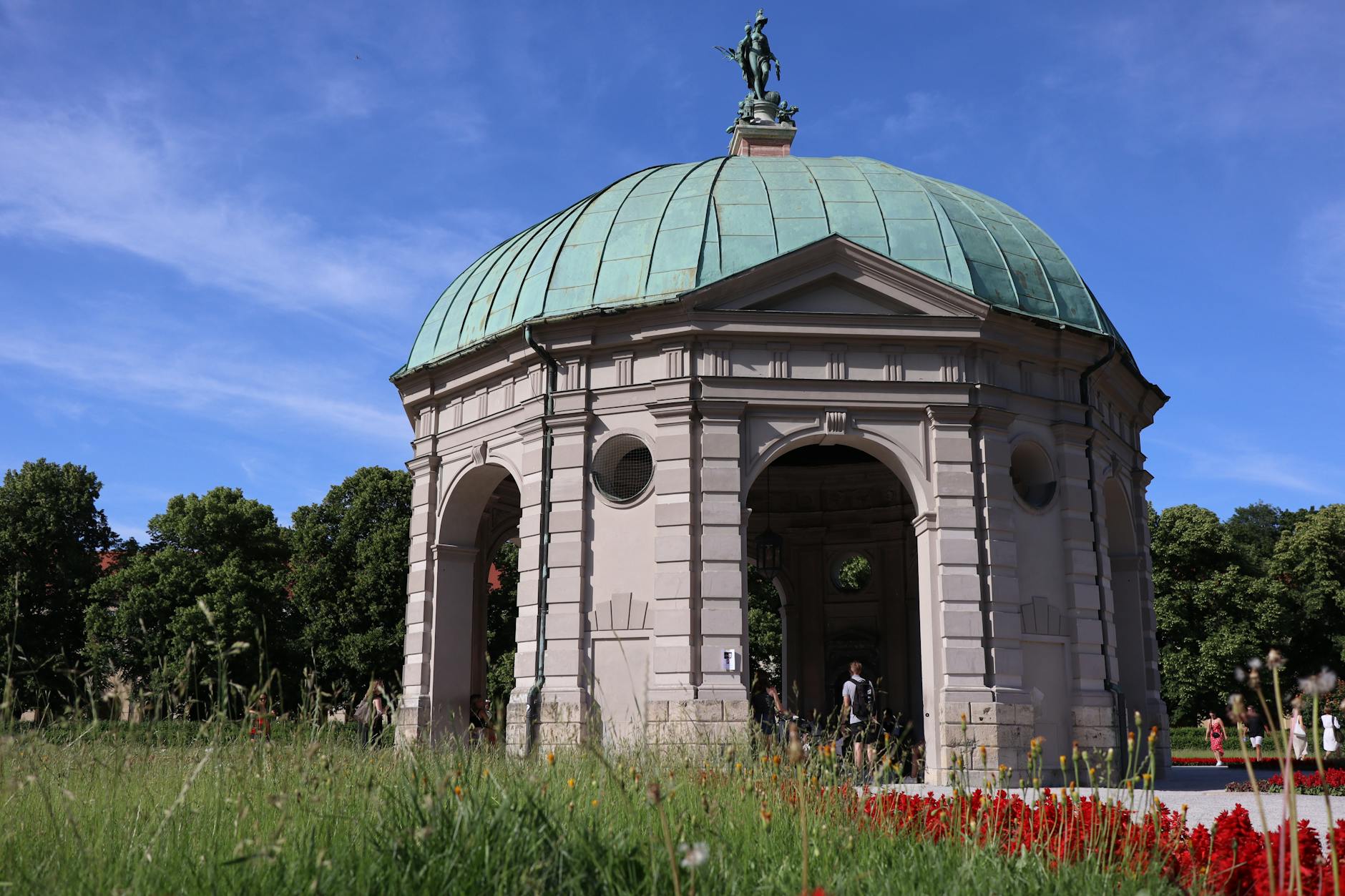
The 17th-century Hofgarten behind the Residenz palace is one of Munich’s most refined small parks. The Renaissance formal layout with a central pavilion (the Diana Tempel, 1615), gravel paths, and 19th-century arcades creates a calm escape directly off Odeonsplatz. The arcades on the south side often host free temporary exhibitions; concerts sometimes play under the pavilion in summer.
- Hours: always open; free
- U-Bahn: Odeonsplatz (U3/U4/U5/U6)
- Combine with: Residenz exterior courtyards (free), the Theatinerkirche, and the Feldherrnhalle
- Best for: 30-minute restorative walk between sightseeing stops
4. Westpark — Themed Gardens and Family Fun
Built for the 1983 International Garden Show, the 72-hectare Westpark in Sendling-West has the most varied programmed parkland in Munich. Themed gardens (Japanese, Thai, Chinese, English), a large central lake with boats, the famous adventure-castle playground, summer splash pads, outdoor cinema in summer, and a small Thai pagoda. The Mollier-See lake is a favourite Sunday picnic spot. U3 to Westpark.
Our Sendling and Westpark guide covers the surrounding neighbourhood, its market hall and where locals eat.
5. Botanical Garden

Adjacent to Nymphenburg Palace, the Botanischer Garten (Munich Botanical Garden) houses around 14,000 plant species across 22 hectares of outdoor gardens and 16 indoor greenhouses. The alpine garden, the rose garden, and the Victoria amazonica water-lily house are highlights. €6 entry; daily 09:00 to dusk.
6. Schlosspark Nymphenburg
The 200-hectare gardens of Nymphenburg Palace are part formal Baroque park, part wooded landscape garden — laid out from 1664 with long canals, statues, and four exquisite Baroque pavilions. Free to enter daily 09:00 to dusk (palace is paid). The Amalienburg hunting lodge in the park is one of the supreme masterpieces of European Rococo. Tram 17.
The full Nymphenburg Palace guide covers the state rooms, the Beauty Gallery, the carriage museum and the park pavilions.
7. Hirschgarten — Family + Beer Garden
Munich’s largest beer garden (8,000 seats!) sits at the south end of the 40-hectare Königlicher Hirschgarten — a former royal hunting park with a small enclosed deer park, vast lawns for kids, and Augustiner on tap. Sunday family picnics under the chestnuts are a Munich institution. S-Bahn to Laim. See our beer gardens guide.
8. Riemer Park
On the eastern edge of the city, the 200-hectare Riemer Park opened in 2005 as a modern green for the new Messestadt-Riem development. The Riemer See lake is clean enough for swimming with sandy beaches, lifeguards in summer, and free entry. Best summer destination for families wanting a beach day without leaving the city. U2 or S2 to Messestadt Riem.
9. Luitpoldpark
In Schwabing-West, the Luitpoldpark (33 hectares) was created on a rubble hill after WWII. Today the 37-meter Bavaria Tower viewpoint, the wooden adventure playground, and the rose garden are highlights. Winter: the sledding hill is the best in central Munich. U2/U3 to Scheidplatz.
10. Petuelpark
A modern urban park (2004) covering a sunken stretch of highway in Schwabing-Nord. Notable for its contemporary landscape design and integration of public art. Smaller, less touristy, but excellent for a calm read in good weather. U3 to Petuelring.
Lesser-Known Parks Worth Knowing
- Alter Botanischer Garten near the Hauptbahnhof — small old botanical garden, perfect for a coffee break
- Bavariapark — under the Bavaria statue at the Theresienwiese; quiet outside Oktoberfest
- Allacher Lohe — forest park on the city outskirts; great for hiking
- Ostpark in Ramersdorf — newer 56-hectare park with lake and varied programming
- Olympia-Reitanlage — equestrian park near Olympiapark
- Fasanerie-Park in Moosach — quieter alternative for picnics
Suggested Park Outings
Half-Day Park + Beer Garden
English Garden walk south-to-north: enter at Hofgarten, walk to the Eisbach surfers, continue to the Monopteros, then to the Chinesischer Turm beer garden for a Maß + Schweinsbraten. ~3 hours.
Family Day
Hirschgarten on Sunday: arrive 11:00, claim a beer-garden table, kids run free in the play area, see the deer, picnic lunch (bring food allowed on self-service side), beer for adults. ~4 hours. See our family travel guide.
Architecture + Active Day
Olympiapark: morning bike rental loop the canopies, climb Olympiaberg for the view, lunch at the Olympic Pool café, BMW Welt next door, evening concert at the Tollwood festival (June–July) or Olympia-Sea ice skating (winter). ~6 hours.
Quiet Restoration
Hofgarten + Diana Tempel + reading on a bench, then Botanical Garden + Nymphenburg garden walk + Café Tambosi for coffee. ~3 hours. Ideal for solo travelers or culture-overload recovery.
Park Etiquette and Practical Tips
- BBQ allowed on designated lawns in summer (English Garden’s Schwabinger Bach area, Hirschgarten)
- Bring your own food to any beer garden self-service section — see our beer gardens guide
- Cycling: dedicated bike paths in major parks. Use them; pedestrian paths are pedestrian-only
- Swimming: designated sections only — Eisbach is too dangerous (strong current); Schwabinger Bach and the Olympic Pool are safe
- Public WCs: at beer gardens and major intersections in big parks; €0.50
- Drinking water: free fountains in most parks April–October
- Dogs: leashed in most parks (Hellabrunn zoo is the only major exception with no dogs)
- Sunbathing/topless: legal at the Eisbach beach (very European)
- Picking flowers and disturbing wildlife: not allowed
- Drone flying: requires permit; flying without is illegal in Bavarian parks
- Free Wi-Fi: most major parks have city Wi-Fi spots
Seasonal Highlights
Spring (April–May)
Tulip bloom at the Botanical Garden (peak mid-April), magnolias at Hofgarten, daffodils throughout the English Garden. Trees green up quickly. Outdoor cafés reopen.
Summer (June–August)
Sunbathing meadows in the English Garden full from 11:00; swimming at Schwabinger Bach and Riemer See; beer gardens at peak; outdoor cinema at Westpark; Tollwood Summer Festival at Olympiapark.
Autumn (September–October)
Spectacular leaf colors in the English Garden (mid-October peak). Cool air, fewer crowds, ideal for long walks. Last chance for outdoor dining.
Winter (December–February)
Sledding at Luitpoldpark and Olympiaberg; ice skating at the Olympia-Sea; Eisbach surfers continue (in wetsuits). Christmas markets at Hirschgarten and English Garden in early December.
The parks are only the start. Our roundup of outdoor activities in Munich covers surfing the Eisbach, swimming the lakes and the alpine trips within easy reach.
Frequently Asked Questions
What is the most famous park in Munich?
The English Garden (Englischer Garten) — one of the largest urban parks in the world at 375 hectares. Famous for the Eisbach surfers, the Chinese Tower beer garden, and the Monopteros viewpoint.
Is the English Garden free?
Yes — entirely free, dawn to dusk, year-round. You only pay if you order food or drinks at the in-park beer gardens or restaurants.
Can you swim in Munich parks?
Yes — designated sections of the Schwabinger Bach in the English Garden, the Olympic Pool at Olympiapark (€7), and Riemer See lake in Riemer Park. Avoid the Eisbach standing wave (strong current; swimming forbidden) — that’s only for experienced surfers.
What’s the best park for kids in Munich?
Hirschgarten for combined beer-garden + play + deer; Westpark for themed adventure playground; Olympiapark for size and varied attractions. See our playgrounds guide.
Can I BBQ in Munich parks?
Yes — on designated lawns. Best spots: English Garden along the Schwabinger Bach south of the Chinesischer Turm, the Isar river gravel banks, and the Riemer See beach area. Bring portable grills and clean up thoroughly.
Are dogs allowed in Munich parks?
Yes — leashed in most parks. The Tierpark Hellabrunn zoo is the only major exception. Dogs are not allowed in playgrounds. Off-leash areas exist in the English Garden, Westpark, and Olympiapark.
The English Garden in Depth — A 240-Year-Old Park
The English Garden’s history is intertwined with Enlightenment ideals of public welfare. The park’s founder, Benjamin Thompson (later Count Rumford), was an American-born British scientist who became war minister to Bavaria’s Karl Theodor in 1788. Rumford proposed the radical idea of a public park designed for ordinary citizens rather than aristocrats — a stark contrast to the formal Baroque gardens that had dominated European landscape design. The project began in 1789, with Rumford selecting an unused hunting ground on the Isar’s western bank. His design philosophy borrowed from the English landscape-garden tradition (hence the park’s name), emphasizing irregular curves, natural-looking meadows, gentle hills, and “romantic” water features. The park was officially opened to the public in 1792 and was one of the first major parks in continental Europe explicitly designed for ordinary citizens.
Rumford’s collaborator Friedrich Ludwig von Sckell — a German landscape architect trained in England — refined the original design between 1804 and 1823. Sckell added the Kleinhesseloher See lake (created in 1803 with three small islands), reshaped the Schwabinger Bach stream into the gentle meander you see today, and designed the Monopteros temple — initially a wooden structure replaced with stone in 1837. The Chinese Tower beer garden’s pagoda was a later addition, built in 1789 but rebuilt several times after fire damage; the current tower dates from 1952. The Eisbach standing wave is a modern accidental feature — it formed in the 1970s when a small concrete dam created the surfable wave that has made the park internationally famous.
Olympiapark: 1972 Architecture and Beyond
The Olympiapark is among the most architecturally significant 1970s sites in Europe. Architect Günter Behnisch (1922–2010) and engineer Frei Otto (1925–2015) collaborated on the iconic tensile-cable canopy that became the defining visual element of the entire Olympic complex. The design was selected through competition in 1967 and represented a deliberate aesthetic and political break from the heavy stone architecture of the 1936 Berlin Olympics — the postwar German government wanted the 1972 Munich Games to embody “Heitere Spiele” (“Cheerful Games”) that signaled a new democratic Germany. The tensile canopy uses 80,000 square meters of acrylic glass suspended on steel cables and aluminum supports — at the time of construction the world’s largest light-permeable roof structure. The structural engineering was unprecedented; computational tools didn’t yet exist that could fully model the dynamics, so the design relied on physical scale models. The canopy still stands today, the cables and acrylic having outperformed their initial 30-year design life by over 25 years.
The park hosts several layers of cultural programming today: the Olympic Stadium hosts major rock and pop concerts (Madonna, U2, the Rolling Stones, BTS, and others have performed); the Olympic Hall hosts indoor concerts and sports events; the Olympic Pool remains an active public swimming facility where Münchners swim year-round (€7 adult); the Olympic Tower draws 700,000+ visitors annually for its panoramic viewing deck. The Olympic Lake is a popular winter ice-skating venue from December to March when temperatures permit. The Olympic Village still functions as residential housing — many original 1972 athlete apartments are now occupied by students and young professionals. The 2022 European Athletics Championships were held here, demonstrating the venue’s enduring functional capacity 50 years after construction.
The Olympic Quarter guide covers what surrounds the park — BMW Welt, the tower, and the 1972 architecture in context.
Munich’s Park Festivals and Annual Events
Munich’s parks host major annual festivals that draw hundreds of thousands of visitors. The Stadtgründungsfest (Munich Founding Festival) on June 14 commemorates Henry the Lion’s founding of the city in 1158 — free events spread across multiple parks and central squares with live music, dance, food, and reenactments. The Tollwood Summer Festival (mid-June to late July) takes over Olympiapark with five weeks of free programming — see our Tollwood guide. The Frühlingsfest (April 17 to May 3, 2026) at the Theresienwiese is essentially a smaller, locals-focused version of Oktoberfest with two beer tents and a fairground — free entry, much less crowded than the September festival. The Tollwood Winter Festival (late November through December 31) returns to the Theresienwiese.
Beyond the major festivals, smaller park events fill the cultural calendar. The Open-Air Cinema at Westpark (June-August) shows recent international films projected onto a large outdoor screen — free entry, donations accepted. The Olympic Beach (an actual sandy beach installation around the Olympic Lake from June to September) operates as a beach club with food vendors and live DJ programming — €5 entry. The Christmas Market at Hirschgarten and the Christmas Market at Aumeister in the English Garden (both small, atmospheric, locals-focused alternatives to Marienplatz) operate in early December. The German Bavarian Folk Dancing Competition rotates between Munich parks each summer — free to watch and remarkably entertaining to most foreign visitors who’ve never seen traditional Bavarian dance up close.
Getting to Munich’s Parks by Tram, U-Bahn, and Bike

None of Munich’s big parks needs a car, and most drop you at the gate. The trick is knowing which line goes where, because the English Garden alone has half a dozen sensible entrances and walking in from the wrong U-Bahn stop adds twenty minutes. The grid below pairs each park with the stop locals actually use.
| Park | Nearest stop | Why this entrance |
|---|---|---|
| English Garden (south) | U3/U6 Universität | Two minutes from the Eisbach surf wave |
| Olympiapark | U3 Olympiazentrum | Exit opens straight onto the park |
| Nymphenburg + Botanical Garden | Tram 17 | Both gardens sit on the same line |
| Hofgarten | U3/U4/U5/U6 Odeonsplatz | In the Altstadt, beside the Residenz |
| Hirschgarten | S-Bahn Hirschgarten / Tram 17 | Short walk to the giant beer garden |
A day ticket is the smart buy if you are park-hopping — bounce from Olympiapark to the English Garden to a beer garden on one fare, as our guide to Munich travel passes lays out. Better yet, see them from the saddle. The English Garden is laced with cycle paths, the Isar trail runs the length of the city, and a rented bike turns three parks into one easy afternoon; we cover routes, rental points, and the rules of the road in cycling in Munich. Insider tip: trams beat the U-Bahn for parks because you arrive above ground already looking at the greenery — line 17 to Nymphenburg is practically a sightseeing route. If you would rather plan the connections in advance, the full network map and ticketing live in the U-Bahn and S-Bahn guide and our broader getting around Munich overview.
Beer Gardens and Picnics Inside the Parks
In Munich the park and the beer garden are often the same place, which is the most Bavarian sentence you will read all day. The English Garden alone holds the Chinesischer Turm, with around 7,000 seats ringing a wooden pagoda and a brass band on the balcony, plus the lakeside Seehaus on the Kleinhesseloher See and the quieter Aumeister up at the northern tip. Out west, the Königlicher Hirschgarten is the largest beer garden on earth — roughly 8,000 seats beside a fenced enclosure of real fallow deer that keep the children busy while you order. The full rundown of who pours what is in our guide to Munich’s best beer gardens, and the Hendl-and-Brezn menu you will meet there is covered in traditional Bavarian food.
Prefer your own spread? Bavarian beer-garden law actually protects your right to bring food to the unclothed self-service tables, so locals haul a rucksack of radishes, pretzels, and rye bread and buy only the beer. For a pure picnic on the grass, the meadows of the English Garden and Hirschgarten are fair game, though open grilling is allowed only in the signed Grillzonen — look for the posts near the Schwabinger Bach. Stock up cheaply on the way in: a supermarket Brotzeit or a market stall keeps a park afternoon under €10, one of the best free things to do in Munich once the sun is out, and our cheap-eats guide flags the handiest spots to grab supplies near each gate.
Continue Exploring Munich
This parks guide is part of our deeper Munich things to do guide. For family-friendly content see our Munich with kids guide and playgrounds guide. For beer-garden-specific recommendations see our best beer gardens guide. For broader planning see our trip planner.