2 Days in Munich: The Ideal Weekend Itinerary
Two days buys you the Altstadt and one big thing. An hour-by-hour weekend plan, three second-day routes to choose between, and an explicit list of what to cut.

Two days in Munich buys you the Altstadt and one big thing. That is the honest ceiling, and the visitors who leave happy are the ones who accepted it on day one rather than discovering it at four o’clock on day two with a museum still unvisited and a train to catch.
The city centre is small — Marienplatz to the Residenz to the Hofgarten is under a kilometre, and you can walk from the Hauptbahnhof to the Isartor in twenty-five minutes. What eats a weekend is not distance. It is the Deutsches Museum, which needs three hours minimum; Nymphenburg, which is a half-day once you include the tram; and the near-universal instinct to try to fit Neuschwanstein in, which is ten to twelve hours door to door and will take one of your two days entirely.
Here is a weekend that works, hour by hour, with the three decisions that actually change it and an explicit list of what to cut.
The weekend at a glance
| Day 1 — the Altstadt | Day 2 — your one big thing | |
|---|---|---|
| Morning | Viktualienmarkt, a tower, the Glockenspiel | Deutsches Museum or Nymphenburg or the Kunstareal |
| Afternoon | The Residenz — 2½ hours, the best interior in the city | Olympiapark, Schwabing or a second museum |
| Evening | English Garden → Chinesischer Turm beer garden | Dinner in Haidhausen or the Glockenbachviertel |
| Walking | ~7 km, nearly all flat | ~5 km plus one tram or U-Bahn leg |
| Tickets | Residenz ~€10, St. Peter’s ~€5, Frauenkirche €7.50 | Deutsches Museum €16 or Nymphenburg €16–20 |
| Transport | One Zone M day ticket per day, €10.10 — or the group ticket if there are two or more of you | |
| Best two days | Friday and Saturday. Worst: Sunday and Monday. | |
Which two days you pick matters more than you think
Munich’s week has a shape, and a weekend dropped onto the wrong part of it loses you a whole category of sights.
| Two days | Verdict | Why |
|---|---|---|
| Fri + Sat | Best | Everything open, shops open Saturday to about 20:00, full nightlife both nights |
| Sat + Sun | Very good | Sunday gives you €1 entry to the state museums. Shops shut, but you are sightseeing anyway. |
| Thu + Fri | Very good | Quietest museums of the week. No shopping Saturday. |
| Sun + Mon | Worst | Sunday: shops shut. Monday: the Pinakotheken, Lenbachhaus, Brandhorst and Glyptothek all close. |
Two rules worth holding on to. Sunday is €1 day at the Bavarian state collections — the Alte and Neue Pinakothek, the Glyptothek and others charge a flat euro. And Monday closes most of the art museums, but the Residenz, Nymphenburg and the Deutsches Museum all stay open, so a Monday should be an Altstadt-and-palaces day rather than a gallery day. Our guide to free and cheap museums in Munich has the full list of what the euro covers.
If you are still choosing your dates rather than your days, the best time to visit Munich works through the months — the short version is that late April, May and September are the good ones, and the second half of September is the most expensive fortnight of the year because of Oktoberfest.
Day 1: the Altstadt, hour by hour
Everything below is within walking distance of everything else. You will not need transport until the evening, and possibly not then.
08:30 — Viktualienmarkt
Start at the market rather than at Marienplatz, three minutes away. At half past eight the stalls are setting up, the coffee is being drunk by people going to work, and you have the place more or less to yourself. A Leberkässemmel is about €4 and is the correct Munich breakfast if Weisswurst is not your thing. An Obatzda plate runs around €9.
The market’s own beer garden, in the middle under the maypole, is the one place in Munich where bringing your own food is openly encouraged — you buy the beer, you eat what you carried in from the stalls. Remember that for tomorrow’s lunch. Full detail in our Viktualienmarkt guide.
09:30 — a tower, before the queues
Two choices, ninety seconds apart, and they are not equivalent.
- St. Peter’s (Alter Peter) — 306 steps, no lift, around €5. The better view, because it looks straight across at the Neues Rathaus and the Frauenkirche domes with the Alps behind. Also the harder one, and the staircase is narrow and two-way.
- The Frauenkirche south tower — €7.50, open Mon–Sat 10:00–17:00 and Sun 11:30–17:00, last ascent 16:30. Reopened in 2022 after ten years behind scaffolding. You climb 86 steps to an intermediate level and then take a lift, which makes it the only high viewpoint in the Altstadt that most people can actually manage.
Do one, not both. If your knees are good and the sky is clear, St. Peter’s. Otherwise the Frauenkirche, without hesitation. The Olympiaturm has been closed since June 2024 for fire-safety work and lift replacement, and it is expected to reopen during 2027 — so the usual “just go up the Olympic tower” advice is dead for now. The free substitute is the Olympiaberg, the grass hill in the park, which is on day 2 if you take the palace route.
10:45 — Marienplatz and the Glockenspiel
The Glockenspiel performs at 11:00 and 12:00 daily, and at 17:00 from March to October. It runs about twelve minutes.
Here is the unflattering truth: it is a mechanical curiosity, not a spectacle. Thirty-two figures, two storeys, a jousting scene and a coopers’ dance, all of it a long way up and quite slow. Watch it once, from the far side of the square or from a first-floor café window, and do not organise your morning around being in position. The Neues Rathaus facade itself — 1867 to 1908, neo-Gothic, and covered in more carved detail than any building in Munich — is the better thing to look at while you wait.
More context on all of it in our guide to Munich’s landmarks. If you would rather have somebody explain the square, the walking tours that start here at 10:00 and 11:00 are a genuinely good use of two hours on a first morning.
12:00 — lunch, and the beer-hall question
The Hofbräuhaus is five minutes east on the Platzl and this is the hour to do it — before the coach parties, while the Weisswurst is still on, in the ground-floor Schwemme rather than the function hall upstairs. Forty-five minutes and one Maß. Our Hofbräuhaus guide explains what to order and why the evening version is a different and worse building.
If you would rather eat well than eat famously, the Weisses Bräuhaus on Tal does the best Weisswurst in the centre in a room a fifth of the size, and the market stalls behind you do it cheaper still. See cheap eats in Munich.
13:30 — the Residenz
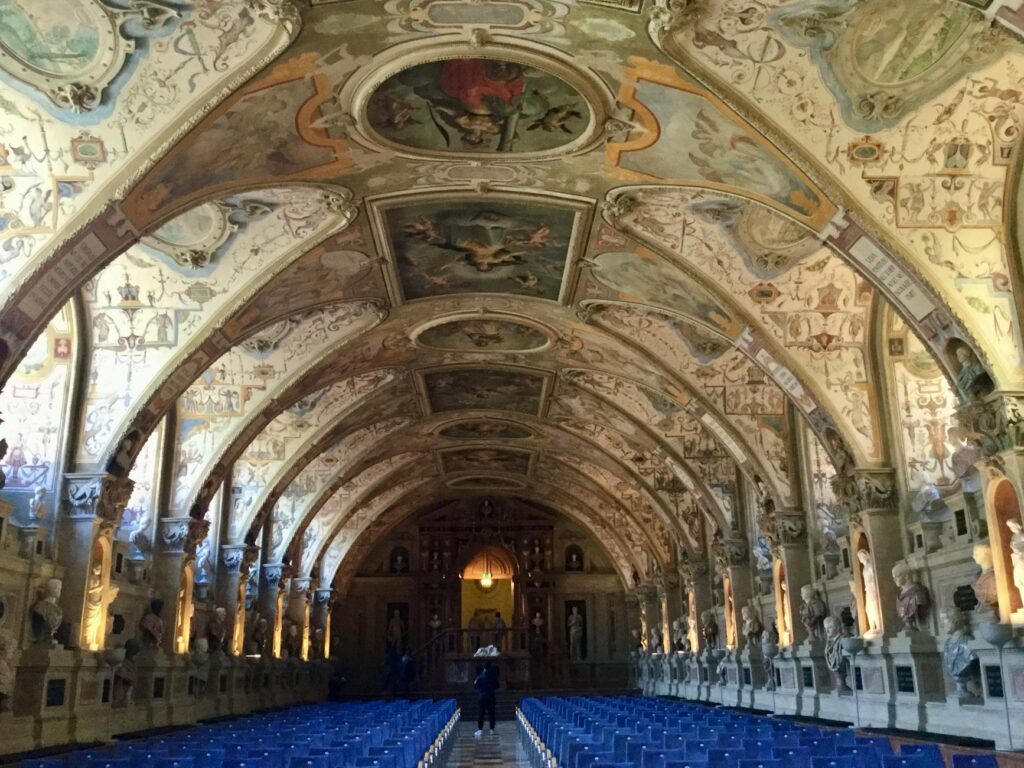
This is the afternoon and it is not negotiable. The Residenz museum is around €10 and the Wittelsbach palace behind that unremarkable Max-Joseph-Platz frontage runs to well over a hundred rooms.
The Antiquarium is the set piece — a 66-metre barrel-vaulted Renaissance hall built between 1568 and 1571, lined with antique busts and one of the largest and most magnificent of its kind north of the Alps. The Reiche Zimmer are the rococo excess. The Cuvilliés Theatre, a separate ticket, is a red-and-gold horseshoe auditorium that survived the war only because it was dismantled and stored.
Insider tip: budget two and a half hours and take the audio guide, but do not attempt every room. The Residenz is signposted along two circuits, and doing one properly beats doing both at a trot. Our Residenz guide sets out which rooms to prioritise if you only have ninety minutes.
16:15 — Hofgarten, Odeonsplatz, and north
Out of the Residenz into the Hofgarten, the Renaissance garden with the Diana pavilion at its centre, then Odeonsplatz — the Theatinerkirche in its extraordinary yellow, the Feldherrnhalle, and the point where the Altstadt stops and Ludwig I’s nineteenth-century boulevard begins. Ten minutes of walking, and one of the best short stretches in the city.
17:00 — the English Garden
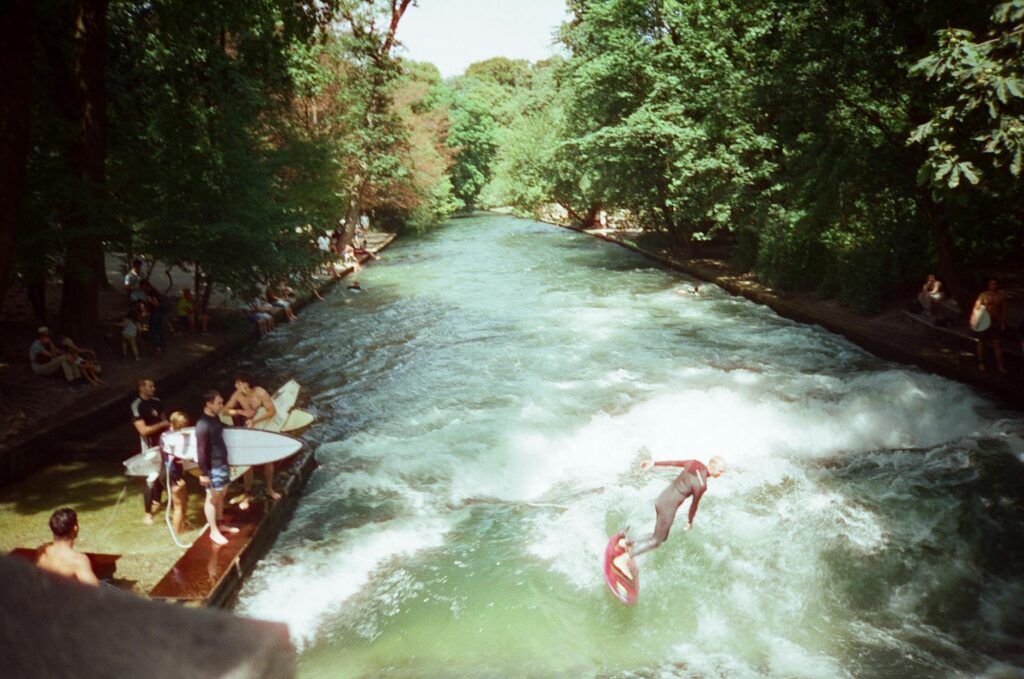
Enter at the southern tip, by the Haus der Kunst, and the first thing you see is the Eisbach standing wave — a permanent river wave with a queue of surfers on it, year-round, including in January in wetsuits. It is the single most surprising thing in Munich and it is free.
The park runs roughly five kilometres north from there. You do not need to walk all of it. Twenty-five minutes gets you to the Chinesischer Turm, the wooden pagoda with a large beer garden around it, and that is where the evening should happen — self-service, communal benches, a brass band in the tower on summer weekends. The Seehaus on the Kleinhesseloher See is fifteen minutes further and quieter.
In winter, or in rain, replace this with the Hofbräuhaus or a Schwabing pub, and read our parks and gardens guide for what the English Garden is like in the cold. The best beer gardens in Munich ranks the alternatives — the Hirschgarten, seating around 8,000, is the biggest, though it is a tram ride west rather than a walk.
Day 2: choose one route, not three
This is where two-day itineraries fall apart. There are three good second days in Munich and they do not combine. Pick by what you actually enjoy, not by what a list told you was unmissable.
| Route | Morning | Afternoon | Pick it if |
|---|---|---|---|
| A — Science | Deutsches Museum, 09:00, ~3h, €16 | Isar riverside walk, Gärtnerplatz, Glockenbachviertel | You have children over eight, or you like machines |
| B — Palaces | Nymphenburg, tram 17, ~20 min out, €16–20 | Olympiapark and BMW Welt (free entry) | You want gardens, and the Residenz left you wanting more |
| C — Art | Alte Pinakothek or Lenbachhaus, Kunstareal | Brandhorst or Glyptothek, then Maxvorstadt cafés | You like paintings, and it is not a Monday (the Lenbachhaus is free 18:00–22:00 on the first Thursday of the month) |
Route A — the Deutsches Museum
Open daily 09:00–17:00, adult entry €16, and roughly 25,000 m² of exhibition space on an island in the Isar. It is one of the largest science and technology museums in the world and three hours is the realistic floor, not the target.
Be selective or be defeated. Aeronautics, the mining tunnel and the historic instruments are the strongest halls. Get there for opening — by eleven the school groups have arrived. Our Deutsches Museum guide has a two-hour route through it if that is all you can spare.
Afterwards, walk north along the Isar. The river through Munich has been re-naturalised into gravel banks and shallows and in summer half the city is lying on it. Come up at the Gärtnerplatz for coffee, or into the Glockenbachviertel for the evening.
Route B — Nymphenburg and the Olympiapark
Tram 17 from the Hauptbahnhof, about 20 minutes, and you are at the gates of a baroque summer palace with a canal running arrow-straight at the front of it. The combined palace-and-museums ticket is around €15 in summer and less in winter.
The palace interior takes an hour. The park behind it takes as long as you let it — 200 hectares, four garden pavilions, and the Amalienburg, a small rococo hunting lodge with a mirrored hall that is arguably a finer room than anything in the main building. Our Nymphenburg guide covers the pavilions and the Marstallmuseum’s collection of state coaches.
From there, U1 or a tram to the Olympiapark: Frei Otto’s tented roof over the 1972 stadium, the Olympiaberg for a free Alps panorama, and BMW Welt next door, which is free to enter and better than its brochure suggests. The BMW Museum and Welt guide and our piece on the 1972 Olympics both cover the site properly.
Route C — the Kunstareal
Six major museums in about four streets of Maxvorstadt. The Alte Pinakothek for old masters, the Lenbachhaus for the Blaue Reiter — which is the one Munich collection that is genuinely world-leading and unavailable anywhere else — the Brandhorst for contemporary, the Glyptothek for antiquities.
Two museums is the limit for one day and even that is pushing it. On a Sunday each one costs €1, which turns this into the best-value day in the city. On a Monday they are all shut. Our Kunstareal guide and the Pinakothek museums guide tell you which collection is in which building.
What to cut, and why
The single most useful section in any two-day itinerary is the one that tells you what not to do.
- Neuschwanstein. Two to two and a quarter hours each way by train to Füssen plus bus 78, entry is timed and books out weeks ahead, and the whole thing is ten to twelve hours door to door. On a two-day trip it costs you half your holiday. Do it on three days or more — see the Neuschwanstein day trip guide.
- Dachau. Not because it is not worth it — it is essential, entry is free, and it is only 35–40 minutes away on the S2 plus bus 726. But it is emotionally a whole day, and squeezing it between a beer garden and a palace does it a disservice. Give it its own day on a longer trip. Our Dachau guide explains the practicalities, including the memorial’s own advice that some content may not suit children under 13.
- Salzburg or Nuremberg. Both are excellent and both are a full day. Not on a weekend. The day trips guide ranks them for when you have the time.
- The Olympiaturm. Closed, with a reopening expected during 2027. Do not put it on a list.
- A second beer hall. One is a landmark; two is a theme. Spend the second evening in a neighbourhood restaurant instead.
Tickets, transport and money
A Zone M day ticket is €10.10 and runs from validation until 06:00 the following morning. Buy one per day and stop thinking about it.
If there are two or more of you, buy the group day ticket instead. It covers up to five adults for roughly double the single price, which means a couple should essentially never buy two singles. This is the most commonly missed saving in Munich and it is worth about €50 across a weekend for a family of four.
Two traps. Munich Airport is in Zone 5, so a Zone M ticket does not cover the S1 or S8 in from the terminal — you need a Zone M–5 single or the Airport–City–Day–Ticket. And Dachau is outside Zone M too. Everything in this itinerary is inside Zone M. Our guides to the U-Bahn and S-Bahn, travel passes and getting from the airport into the city cover the rest.
On the city cards: for a two-day trip with two paid attractions, the arithmetic rarely works. Run your own numbers with our city card comparison before buying one on reflex.
Where to stay for a two-day trip
For forty-eight hours, location beats everything. Stay in the Altstadt or immediately around it and you delete every transport decision in this guide.
Around Marienplatz is the obvious and most expensive answer — see hotels near Marienplatz. Ludwigsvorstadt, between the Hauptbahnhof and the Theresienwiese, is the value option and a twelve-minute walk from the centre; it is scruffier at the station end and perfectly fine two streets in. Haidhausen, across the river, is the pleasant residential answer and ten minutes on the S-Bahn.
Book early for late September. Oktoberfest runs sixteen days from mid-September and hotel rates roughly triple across the whole city, not just near the Theresienwiese. Our where to stay in Munich guide breaks it down by neighbourhood and hotel booking tips covers the timing.
The two evenings
Make them different from each other. Night one is the beer garden or beer hall, because that is the thing you came for and because you will be too tired on night two to enjoy it properly.
Night two should be a neighbourhood. The Glockenbachviertel and Gärtnerplatz are the city’s best eating and drinking quarter — small kitchens, wine bars, the LGBTQ+ scene, and almost nothing aimed at visitors. Haidhausen around Wiener Platz is the calmer version, with the Hofbräukeller and its beer garden at the centre of it. Schwabing, north of the university, is where the students are. All three are ten to fifteen minutes from Marienplatz on the U-Bahn.
Book a table for a Friday or Saturday — Munich eats early and the good small rooms are full by 20:00. Our guides to the best restaurants in Munich, wine bars and craft beer and Munich nightlife cover where to go once you have picked a quarter.
If it rains
Munich gets around 130 wet days a year, concentrated in June and July, which surprises people who have booked a summer trip for the beer gardens.
The rain plan is straightforward: swap the English Garden evening for the Residenz’s second circuit or an early beer hall, and move day 2 to route A or C, both of which are entirely indoors. The Deutsches Museum can absorb a whole wet day without difficulty. If it is genuinely foul, Therme Erding is 45–60 minutes out on the S2 and a bus, and a four-hour ticket at €37 on a weekday is a better use of a washed-out afternoon than trudging round the Altstadt in a poncho — see our Therme Erding guide. Our weather and packing guide has the monthly figures.
Frequently Asked Questions
Is 2 days in Munich enough?
Enough for the city, yes. Two days covers the Altstadt properly, one major museum or palace, an English Garden evening and a beer hall, with time to sit down. It is not enough to add a day trip — Neuschwanstein, Salzburg and Dachau all need a day of their own, and trying to force one in is the mistake that ruins two-day trips. If a castle is non-negotiable, you need three days.
What are the two best days of the week to visit?
Friday and Saturday. Everything is open, the shops run to about 20:00 on Saturday, and both nights work for going out. Saturday and Sunday is a close second because Sunday brings €1 museum entry. Avoid Sunday–Monday: the shops shut on Sunday and most of the art museums shut on Monday.
Can I do Neuschwanstein in a two-day trip?
You can, and you will regret it. It is around two hours each way to Füssen plus the bus, entry is timed and sells out weeks ahead in season, and realistic door-to-door time is ten to twelve hours. That is one of your two days gone, plus the evening. On a weekend, skip it.
How much does a Munich weekend cost?
Excluding accommodation and travel to the city, budget roughly €60–€90 per person per day: two day tickets at €10.10, two or three attraction tickets between €5 and €15 each, and food. You can do it for considerably less by eating at market stalls and using the €1 Sunday. Our Munich trip cost breakdown and Munich on a budget have the detail.
Is Munich walkable in two days?
The Altstadt is entirely walkable and almost completely flat. Marienplatz to the Residenz is under a kilometre; the Hauptbahnhof to the Isartor is about twenty-five minutes. You need transport for Nymphenburg (tram 17), the Olympiapark (U3) and the airport, and nothing else in this plan. See our Munich walking guide.
What if I only have one full day plus two half days?
Treat it as one full day and compress. Run day 1 as written, drop the tower and the Residenz’s second circuit, and use the half days for Viktualienmarkt and the English Garden. Our one day in Munich itinerary is built for exactly that shape.
Does this work with children?
Well, with two swaps. Cut the Residenz to ninety minutes or drop it, and take route A on day 2 — the Deutsches Museum has a dedicated children’s area and the mining tunnel is a genuine hit. The English Garden playgrounds and the Eisbach surfers do the rest. Munich with kids and Hellabrunn Zoo cover the alternatives.
Should I book museum tickets in advance?
For the Residenz and the Deutsches Museum, no — walk up. For Neuschwanstein, absolutely and weeks ahead, though it is not in this itinerary. On a €1 Sunday the Pinakotheken get busy from about 11:00, so arrive at opening rather than booking.
Where to go next
If you have a third day, the Munich itineraries hub shows how the shape changes — day three is where a day trip finally becomes affordable, and that is what most people should spend it on. For the sights themselves, things to do in Munich is the broader list, and the neighbourhoods guide is where to look if you would rather spend day 2 walking Schwabing and Haidhausen than queueing for a palace.
Related Guides
- Munich Itineraries: How Many Days Do You Need? — the cluster hub
- One Day in Munich: The Perfect 24-Hour Itinerary — High-intent term; SERP is generic listicles with no destination authority
- 3 Days in Munich: Complete Day-by-Day Itinerary — Second-biggest; the third day is a day trip, so it links hard into that pillar
- 4 and 5 Days in Munich: Extended Itinerary with Day Trips — Long tail with almost no dedicated pages competing
- One Week in Munich and Bavaria: 7-Day Itinerary — Captures the Bavaria trip planner; feeds the onward-travel pillar