3 Days in Munich: Complete Day-by-Day Itinerary
Two days in the city, one day out of it. An hour-by-hour plan, six day trips ranked honestly, and the ticket that gets five people to the Alps for EUR 74.

Three days is the right number for Munich, and the reason is arithmetic rather than taste. Two days covers the city. The third day is what buys you the Alps, or Neuschwanstein, or Salzburg, or Dachau — and every one of those is a full day that a weekend cannot absorb.
So the shape of a three-day trip is fixed before you start: two days in, one day out. Everything else is choosing which day out, and that single decision does more to determine whether the trip was good than any restaurant booking.
Here is the plan hour by hour, six day-trip options ranked honestly against each other, and the ticket that makes the third day cost €74 for a family of five instead of €150.
The three days at a glance
| Morning | Afternoon | Evening | |
|---|---|---|---|
| Day 1 — Altstadt | Viktualienmarkt, a tower, the Glockenspiel | The Residenz, 2½ hours | English Garden → Chinesischer Turm |
| Day 2 — one big thing | Deutsches Museum or Nymphenburg or the Kunstareal | Olympiapark, Schwabing or a second museum | Glockenbachviertel or Haidhausen |
| Day 3 — out of the city | Pick one: Garmisch · Neuschwanstein · Salzburg · Dachau · Nuremberg · the lakes | Back by 19:00–21:00; beer hall | |
| Transport | Days 1–2: Zone M day ticket, €10.10. Day 3: Bayern-Ticket, €34 solo or €74 for up to five | ||
| Tickets | Residenz ~€10 · Deutsches Museum ~€16 · Nymphenburg €16–20 · day-trip entry varies | ||
| Best three days | Thursday–Saturday or Friday–Sunday | ||
Choosing your three days
Munich’s week has a shape, and with three days you have enough room to work with it rather than around it.
- Thursday to Saturday is the strongest run. Quiet museums on Thursday, everything open, shops until about 20:00 on Saturday, and two good nights out.
- Friday to Sunday is nearly as good and gives you a €1 Sunday at the Bavarian state museums — the Pinakotheken, the Glyptothek and others all charge a flat euro.
- Avoid ending on a Monday. The Alte Pinakothek, the Lenbachhaus, the Brandhorst and the Glyptothek all close. The Residenz, Nymphenburg and the Deutsches Museum stay open, so if a Monday is unavoidable, make it your palaces day and take the day trip on the Sunday.
- Most shops shut on Sundays across Germany. The Hauptbahnhof, the airport, bakeries and petrol stations are the exceptions. Viktualienmarkt stalls close too. Plan a Sunday for museums, parks or a day trip.
On dates rather than days: late April, May and September are the good months, and the second half of September is the most expensive fortnight of the year because Oktoberfest triples the hotel market. Our guide to the best time to visit Munich works through them all.
Day 1: the Altstadt on foot
Everything on this day is within walking distance of everything else, on almost entirely flat ground. You will cover about seven kilometres and need no transport until the evening.
- 08:30 — Viktualienmarkt. Coffee and a Leberkässemmel at about €4 while the stalls set up. The market’s beer garden under the maypole is the one place in Munich where bringing your own food is openly encouraged. See our Viktualienmarkt guide.
- 09:30 — a tower. St. Peter’s is 306 steps with no lift, around €5, and the better view. The Frauenkirche south tower is €7.50, reopened in 2022, and gets you up with 86 steps and then a lift — much the easier option. Do one, not both. The Olympiaturm has been closed since June 2024 and is expected to reopen during 2027, so it is not an alternative.
- 10:45 — Marienplatz. The Glockenspiel runs at 11:00 and 12:00 daily, plus 17:00 from March to October, for about 15 minutes. It is a mechanical curiosity rather than a spectacle — watch it once, from across the square, and look at the Neues Rathaus facade while you wait. More in Munich’s landmarks.
- 11:30 — Weisswurst, before the noon bell. Two sausages, sweet mustard, a pretzel and a half-litre of wheat beer. The rule about noon is real. Our Weisswurst guide explains it, and the Hofbräuhaus five minutes east is the landmark version — go now rather than at eight in the evening.
- 13:30 — the Residenz. Around €10, two and a half hours, and the best interior in the city. The Antiquarium — a 66-metre barrel-vaulted Renaissance hall from the 1570s — is the set piece. See our Residenz guide.
- 16:15 — Hofgarten and Odeonsplatz. Ten minutes of walking through the Renaissance garden to the Theatinerkirche and the Feldherrnhalle.
- 17:00 — the English Garden. Enter by the Haus der Kunst and the first thing you meet is the Eisbach standing wave, with surfers on it year-round. Walk twenty-five minutes north to the Chinesischer Turm beer garden.
If a compressed version is what you need — a late arrival, an early flight — our one day in Munich itinerary runs the same ground in half the time.
Day 2: the one big thing
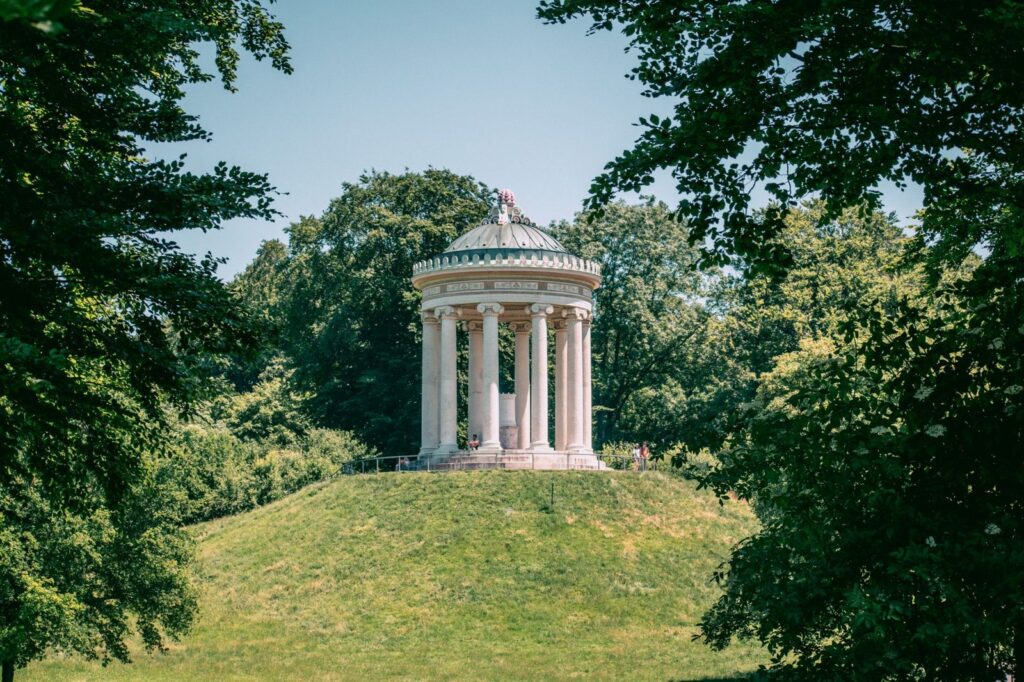
Three good second days exist in Munich and they do not combine. Pick by what you actually enjoy.
| Route | Morning | Afternoon | Choose it if |
|---|---|---|---|
| Science | Deutsches Museum — daily 09:00–17:00, ~€16, 3 hours minimum | Isar riverside walk, Gärtnerplatz, Glockenbachviertel | You like machines, or have children over eight |
| Palaces | Nymphenburg — tram 17, ~20 min, €20 in summer | Olympiapark and BMW Welt, which is free | You want gardens and the Residenz left you wanting more |
| Art | Alte Pinakothek or Lenbachhaus | Brandhorst or Glyptothek, then Maxvorstadt | It is a Sunday (€1 entry at the Alte Pinakothek and Glyptothek; the Lenbachhaus charges its regular price). Closed Mondays. |
The Lenbachhaus deserves a specific mention. Its Blaue Reiter collection — Kandinsky, Münter, Marc — is the one holding in Munich that is genuinely world-leading and unavailable anywhere else, and it is routinely skipped in favour of the Alte Pinakothek by visitors working from a generic list. Our Kunstareal guide and the Pinakothek museums guide cover the quarter, and the Deutsches Museum guide has a two-hour route through the science option.
Whichever you take, spend the evening in a neighbourhood rather than in the centre. The Glockenbachviertel and Gärtnerplatz are Munich’s best eating and drinking quarter; Haidhausen around Wiener Platz is the calmer version with the Hofbräukeller at its heart. See the Glockenbachviertel guide, Haidhausen and the best restaurants in Munich.
Day 3: choosing the day trip
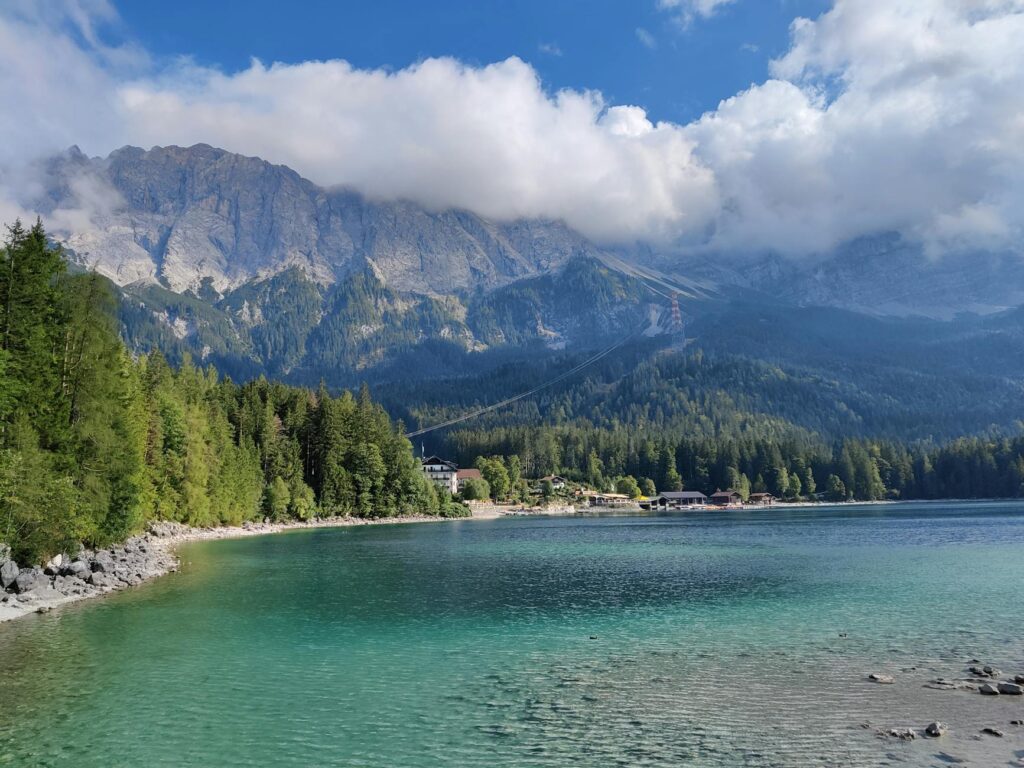
This is the decision the whole trip turns on. Six realistic options, ranked by what they actually deliver rather than by fame.
| Destination | Each way | Door to door | Verdict |
|---|---|---|---|
| Garmisch-Partenkirchen | 1h20, RB6, hourly, direct | ~9 hours | The best all-rounder. Mountains, a gorge, a town, and total flexibility on the day. |
| Salzburg | 1h35–2h | ~10 hours | A second city, a different country, and a Bayern-Ticket covers it. Excellent. |
| Dachau | 35–40 min, S2 + bus 726 | Half a day physically, a whole day emotionally | Free entry. Essential, and not to be squeezed between other things. |
| Neuschwanstein | 2h–2h15 + bus 78 | 10–12 hours | The famous one, and the longest. Entry is timed and books out weeks ahead. |
| Nuremberg | 1h05, ICE | ~8 hours | The best city day trip. Old town, castle, and the rally-grounds documentation centre. |
| The lakes | Starnberger See ~40 min (S6), Ammersee ~50 min (S8) | 4–6 hours | The low-effort option, and lovely in summer. Not a headline. |
If you take one: Garmisch-Partenkirchen
One direct train, eighty minutes, hourly all day, and three completely different days waiting at the far end. That flexibility is the argument: you can decide what to do on the platform, based on the sky.
Clear weather: the Zugspitze, Germany’s highest point at 2,962 m, €78 return for the round trip up the cog railway and down the record-breaking Seilbahn to the Eibsee. Grey weather: the Partnachklamm, roughly 700 metres of rock-cut gallery above a torrent for around €10, which is better in rain than in sun. Either way, the painted houses of Ludwigstraße in Partenkirchen take a quarter of an hour and are worth it.
Insider tip: the MVV Garmischer Sommerticket bundles the return train from Munich with the mountain lifts — €94.50 adult, €12.50 child for the Zugspitze version, against €112 buying a Bayern-Ticket and a Zugspitze return separately. The children’s rate is the real saving. Full detail in our Garmisch-Partenkirchen day trip guide and the Zugspitze from Munich guide.
If the castle is non-negotiable: Neuschwanstein
Be honest with yourself about what this costs. Two to two and a quarter hours by train to Füssen plus bus 78, timed entry that sells out weeks ahead in season, and ten to twelve hours door to door. You will spend most of the day in transit and about thirty-five minutes inside the building.
It is still worth doing once, and on a three-day trip it fits where it would not fit on two. Book the timed entry the moment your dates are fixed. Our Neuschwanstein day trip guide covers the mechanics, and Linderhof and Oberammergau is the less crowded alternative if what you want is a Ludwig II palace rather than that specific silhouette.
If you want the serious one: Dachau
Free entry, 35 to 40 minutes away on the S2 plus bus 726, and physically only half a day. Emotionally it is not. Give it the whole day, do not put a beer garden on the end of it, and do not attempt it and a castle in the same twenty-four hours.
Note that Dachau is outside Zone M, so you need a wider-zone ticket, and that the memorial says some of its content may not be appropriate for children under 13. Our Dachau memorial guide covers the practicalities, and Munich’s WWII history the wider context, including the NS-Dokumentationszentrum in the city.
If you want a second city: Salzburg or Nuremberg
Salzburg is one and a half to two hours away, in another country, and — unusually — a Bayern-Ticket is valid all the way there, which makes an international day trip cost the same as a domestic one. Fortress, old town, Mozart, and a river running through the middle of it.
Nuremberg is closer still at 1 hour 5 minutes on the ICE, and is the more substantial city of the two: a reconstructed medieval old town, the Kaiserburg, the documentation centre at the Nazi party rally grounds and the courtroom where the trials were held. See the Salzburg day trip and the Nuremberg day trip.
Tickets, transport and the €74 trick
| Ticket | Price | Use it for |
|---|---|---|
| Zone M day ticket | €10.10 | Days 1 and 2. Valid until 06:00 the next morning. |
| Group day ticket | Roughly double the single | Up to 5 adults. Two people should never buy two singles. |
| Bayern-Ticket | €34 solo, €74 up to 5 | Day 3. Regional trains across Bavaria — and Salzburg. |
| Airport transfer | Zone M–5 single or Airport–City–Day–Ticket | Munich Airport is Zone 5 — a Zone M ticket does not cover it |
Two rules that catch people out. The Bayern-Ticket is not valid on ICE or EC trains, so the Nuremberg option needs a separate DB ticket — and it is not valid before 09:00 on weekdays, which is why every day-trip itinerary on this site starts at 09:02. At weekends it is valid from midnight, so a Saturday day trip can leave two hours earlier and gain two hours on the ground.
City cards rarely pay for themselves on a three-day trip with three or four paid attractions — run your own numbers with our city card comparison. The mechanics of the network are in our U-Bahn and S-Bahn guide and travel passes; getting in from the airport is covered in Munich airport to city.
Where to stay for three days
With a day trip in the plan, the calculation shifts. On a two-day trip you optimise for Marienplatz; on a three-day trip you optimise for the Hauptbahnhof, because that is where day three starts and ends.
- Ludwigsvorstadt, between the station and the Theresienwiese, is the value answer and a twelve-minute walk into the Altstadt. Scruffy at the station end, fine two streets in.
- Around Marienplatz is the most convenient and the most expensive — see hotels near Marienplatz.
- Haidhausen across the river is the pleasant residential option and ten minutes on the S-Bahn from the Hauptbahnhof.
- Book early for late September. Oktoberfest runs sixteen days from mid-September and roughly triples rates across the whole city.
Our where to stay in Munich guide breaks it down neighbourhood by neighbourhood, and hotel booking tips covers timing and cancellation policy.
The three evenings
Three nights is enough to make each one different, and the most common failure of a Munich trip is spending all three in the same kind of room.
| Night | Where | Why |
|---|---|---|
| One | Beer garden or beer hall — Chinesischer Turm in summer, Augustiner-Keller or the Hofbräukeller otherwise | You came for it, and you will be too tired later in the trip to enjoy it properly |
| Two | A neighbourhood — Glockenbachviertel, Gärtnerplatz or Haidhausen | Small kitchens, wine bars, almost nothing aimed at visitors |
| Three | Close to your hotel, after the day trip | You will be back at 19:00 or later with 20,000 steps behind you. Do not plan an expedition. |
On the beer gardens: the Hirschgarten seats around 8,000 and is reputedly the largest in Europe, though it is a tram ride west of the centre rather than a walk. The Chinesischer Turm in the English Garden is the famous one and the easiest to reach on day 1. The Viktualienmarkt beer garden is the cheapest evening in the Altstadt because bringing your own food is openly encouraged there. Our roundup of the best beer gardens in Munich ranks them, and beer halls for an evening covers the indoor version for winter and rain.
Munich eats early — the good small rooms are full by 20:00 — so book a table for a Friday or Saturday. For a later night, Munich nightlife and wine bars and craft beer cover where the city goes after eleven, which is mostly the Glockenbachviertel and the arches under the Donnersbergerbrücke.
A note on pacing
Three days in a compact city tempts people into building a fourth day out of the gaps. Resist it.
The plan above already involves roughly seven kilometres of walking on day 1, a museum that needs three hours on day 2, and eight to ten hours in transit and on foot on day 3. That is a genuinely full trip, and the single most common piece of feedback from visitors who followed a denser itinerary is that they wish they had sat down more.
Munich rewards sitting down more than most European capitals do, because so much of what makes it pleasant is exactly that: a bench in a beer garden, an hour by the Eisbach watching surfers, a coffee on a square where nothing in particular is happening. If you find yourself with a spare ninety minutes, the correct use of it is the English Garden, which runs roughly five kilometres north from the edge of the city centre and is free. See parks and gardens and free things to do in Munich.
Three variants worth knowing
With children. Cut the Residenz to ninety minutes, take the Deutsches Museum on day 2 for the mining tunnel and the aircraft, and make day 3 Garmisch rather than Neuschwanstein — the Sommerticket child rate is €12.50 and a gorge beats a queue for a castle interior at almost any age. Munich with kids and day trips with kids have the rest.
In winter. The beer gardens are shut and it is dark by about 16:30 in December, which changes the evenings entirely. Swap the English Garden for a beer hall, and consider swapping day 3 for the Therme Erding thermal spa — a four-hour weekday ticket is €37 and it is 45 to 60 minutes out on the S2 and a bus. From late November to 24 December, the Christmas markets rearrange the whole trip; see the Christmas markets guide and the winter guide.
During Oktoberfest. Give the Wiesn a full afternoon and evening rather than an hour, and understand that it will cost you one of your three days. Tents fill by 10:00 at weekends. Read the Oktoberfest guide and first-timer tips before you go, and note that hotel rates make this the most expensive version of a three-day trip by a wide margin.
What to cut
- A second day trip. Three days means one. Two day trips and one city day is a trip to Bavaria that happens to change trains in Munich.
- Neuschwanstein and the Zugspitze in one day. Coach operators sell this. It is four hours on a bus and forty minutes at each.
- A third museum. Two in a day is already pushing it, and three is how people come to believe they dislike museums.
- The Olympiaturm. Closed, with a reopening expected during 2027. The Olympiaberg — a grass hill — gives you the same Alps panorama for nothing.
- Two beer halls. One is a landmark. Spend the other evening in a neighbourhood restaurant.
Frequently Asked Questions
Is 3 days in Munich enough?
Yes — three days is the sweet spot. Two days covers the Altstadt, a major museum or palace and two evenings; the third buys you a day trip, which is where Bavaria rather than Munich starts. Four days lets you add a second day trip or slow the city days down, but the gain is smaller than the jump from two to three.
What is the best day trip from Munich?
Garmisch-Partenkirchen, for most people. It is 1h20 on one direct hourly train, and it holds three different days — the Zugspitze, the Partnachklamm gorge and the two painted towns — so you can decide on the morning based on the weather. Neuschwanstein is more famous and takes ten to twelve hours; Salzburg is the best second-city option and is covered by a Bayern-Ticket.
Can I fit Neuschwanstein and Dachau into three days?
Only by giving up a city day, and I would not. That leaves one day for the Altstadt, the Residenz, the museums and both evenings, which is not enough. If both are genuinely essential, you need four days.
How much does three days in Munich cost?
Excluding accommodation and getting to the city, budget roughly €200–€300 per person for three days: two Zone M day tickets at €10.10, a Bayern-Ticket at €34, three or four attraction tickets, day-trip entry and food. It goes considerably lower with market meals and a €1 Sunday. See Munich trip cost and Munich on a budget.
Which three days of the week are best?
Thursday to Saturday, or Friday to Sunday if you want the €1 Sunday museums. Avoid finishing on a Monday, when most of the art museums close — though the Residenz, Nymphenburg and the Deutsches Museum stay open.
Do I need to book anything in advance?
Only Neuschwanstein, and that as far ahead as your dates allow — entry is timed and sells out weeks in advance in season. The Residenz, the Deutsches Museum, Nymphenburg and every Munich beer garden are walk-ups. Book a restaurant table for a Friday or Saturday evening.
Is Munich walkable?
The Altstadt entirely, and it is flat. Marienplatz to the Residenz is under a kilometre; the Hauptbahnhof to the Isartor is about twenty-five minutes. You need transport for Nymphenburg, the Olympiapark, the airport and day three, and nothing else. See our Munich walking guide.
What if it rains for all three days?
Munich gets around 130 wet days a year, concentrated in June and July. The rain plan: the Deutsches Museum absorbs a whole day, the Kunstareal absorbs another, and for day three take the Partnachklamm — a gorge is better in rain — or the Therme Erding thermal spa. Skip the Zugspitze entirely rather than paying €78 to stand in cloud. Our weather and packing guide has the monthly figures.
Where to go next
The Munich itineraries hub holds every length from one day upwards, and two days in Munich is the version to read if the third day is not certain. For day three itself, start with day trips from Munich and the Bavarian Alps pillar. And if you are still assembling the trip from scratch, planning a Munich trip covers everything upstream of the itinerary.
Related Guides
- Munich Itineraries: How Many Days Do You Need? — the cluster hub
- One Day in Munich: The Perfect 24-Hour Itinerary — High-intent term; SERP is generic listicles with no destination authority
- 2 Days in Munich: The Ideal Weekend Itinerary — Biggest single itinerary term
- 4 and 5 Days in Munich: Extended Itinerary with Day Trips — Long tail with almost no dedicated pages competing
- One Week in Munich and Bavaria: 7-Day Itinerary — Captures the Bavaria trip planner; feeds the onward-travel pillar