Garmisch-Partenkirchen Day Trip from Munich
One direct train, 1h20, hourly. Three routes to choose between — the Zugspitze at €78, the Partnachklamm at €10, or the Alpspitze — plus the combined ticket that saves close to €20.
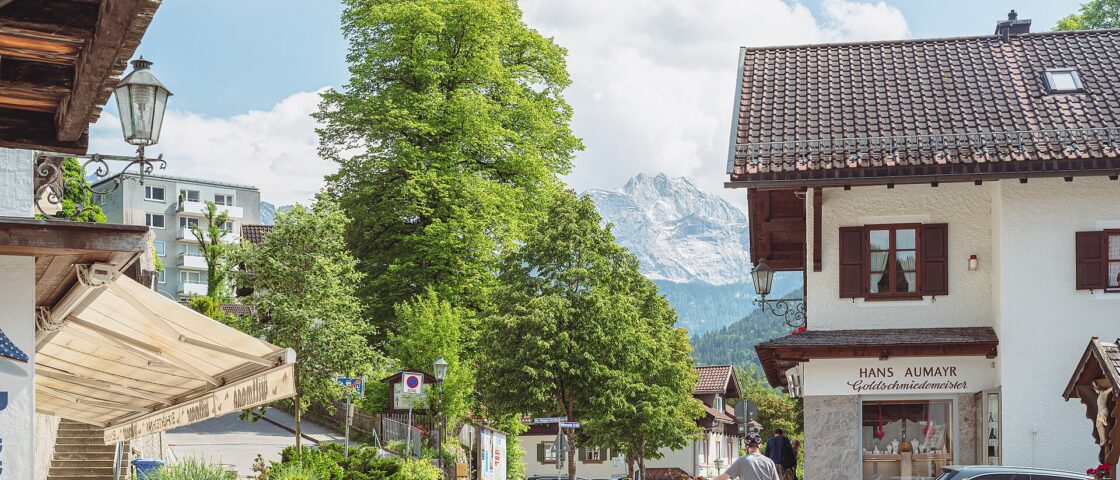
One direct train, 1 hour 20 minutes, no changes, hourly all day. Garmisch-Partenkirchen is the easiest mountain day trip in Germany, and the only genuinely hard part is deciding which of the three big things to do, because you cannot do all three.
Most visitors default to the Zugspitze. It is Germany’s highest peak, it costs €78 return, and it will eat six of your eight useful hours. It is also, on a cloudy day, an extremely expensive trip into fog. The Partnachklamm gorge — around €10, 700 metres of rock-cut walkway with a torrent a metre from your boots — is a better experience per euro than anything on the summit, and almost nobody plans for it.
Here is how to get there, what each route actually costs, the new combined ticket that saves you close to €20, and how to pick between them before you are standing at a valley station making it up.
The day trip at a glance
| Journey | RB6 Werdenfelsbahn, direct, hourly, 1h20–1h26 |
| Leave Munich | 09:02 if using a Bayern-Ticket — it is not valid before 09:00 on weekdays |
| Cheapest ticket | Bayern-Ticket €34 one person, €74 for up to five |
| Best combined ticket | MVV Garmischer Sommerticket — travel plus lifts, from €60.50 |
| Zugspitze return | €78 adult, €39 child 6–15 |
| Partnachklamm | ~€10, roughly 700 m long, open year-round |
| Time on the ground | ~8 hours if you take the 09:02 out and a 19:00-ish train back |
| Do this if the sky is clear | Zugspitze, or the Alpspitze for a third of the price |
| Do this if it is grey | Partnachklamm — the gorge does not care about cloud |
| Wear | Proper shoes. The gorge is wet, and the summit is around 20°C colder than Munich. |
Getting there, and which ticket to buy
The RB6 runs Munich Hauptbahnhof – Tutzing – Weilheim – Murnau – Garmisch-Partenkirchen, hourly, direct, and takes about 1 hour 20 to 1 hour 26. It is a regional train, so there is no reservation and no fuss; turn up, get on, sit on the left after Murnau for the mountains.
The ticket question is where the money is.
| Ticket | Price | Covers |
|---|---|---|
| Bayern-Ticket | €34 solo, €74 up to 5 | Unlimited regional travel across Bavaria for the day. Not valid on ICE/EC, and not before 09:00 on weekdays. |
| MVV Garmischer Sommerticket — Classic | €60.50 adult, €8.00 child (≤14) | Return travel from Munich plus circular rides on the Alpspitzbahn, Hochalmbahn and Kreuzeckbahn |
| MVV Garmischer Sommerticket — Zugspitze | €94.50 adult, €12.50 child | Return travel plus the cog railway, the Gletscherbahn and the Seilbahn Zugspitze |
| Bayern-Ticket + Zugspitze return, bought separately | €112 | The same day, done the expensive way |
Look at the bottom two rows. Buying a Bayern-Ticket and a Zugspitze return separately costs €112; the Sommerticket Zugspitze does the same day for €94.50. That is close to €20 saved for buying the right rectangle of cardboard, and the children’s rate is the real story — €12.50 instead of €39 for the same mountain.
Insider tip: if there are two or three of you and you are not going up a mountain — a gorge-and-town day — the Bayern-Ticket for up to five at €74 is unbeatable, and it also covers Füssen, Nuremberg, the Bavarian lakes and, unusually, Salzburg. It is the single best-value product in Bavarian travel. Our guides to Munich travel passes and day trips from Munich by train work through the arithmetic.
One scheduling consequence of the 09:00 rule: on a weekday with a Bayern-Ticket, your first train is the 09:02, you are on the ground at about 10:25, and a return around 19:00 gives you eight and a half useful hours. At weekends the ticket is valid from midnight, so you can leave at 07:32 and gain two hours — which is exactly what you want if the Zugspitze is the plan.
Pick one: the three routes
Eight hours on the ground sounds generous until you price out the options in time rather than money.
| Route | Time | Cost | Best for |
|---|---|---|---|
| A — Zugspitze | 5–6 hours | €78, or €94.50 with travel | The summit, if the forecast is clear |
| B — Partnachklamm + towns | 4–5 hours | ~€10 plus lunch | Any weather. The best value of the three. |
| C — Garmisch-Classic | 4–5 hours | From €60.50 with travel | Alpine views and walking without the Zugspitze price |
Route A: the Zugspitze
Germany’s highest point, 2,962 m, and the reason most people get on the train.
The classic version is the Round Trip: up one way, down the other. The cog railway (Zahnradbahn) climbs from Garmisch through Grainau, past the Eibsee, and then into a 4.5 km tunnel that brings you out at the Zugspitzplatt at 2,600 m. A short cable car takes you the rest of the way to the summit. Coming down you take the Seilbahn Zugspitze to the Eibsee, which is the better half of the journey and the one to save for last.
That descent cable car holds three records: a 127 m support tower, the tallest of its type; a 2 km vertical rise in a single span; and a 3.2 km unsupported cable section, the longest free span in the world. It is three and a half minutes long and it is worth the fare on its own.
At the top: the golden summit cross, a panorama claimed to take in 400 peaks across four countries, the Panorama 2962 restaurant, and — because this is Germany’s highest mountain — a great many other people. Allow three to four hours for the whole circuit and five to six including getting to and from the valley stations.
The honest warning: check the summit webcam before you buy the ticket. At €78 a head this is the most expensive way in Bavaria to stand inside a cloud, and the mountain makes its own weather — a bright morning in Garmisch tells you very little about what is happening 2,000 metres above it. If the forecast is doubtful, take route B and keep the €78. Our dedicated Zugspitze from Munich guide has the full breakdown of routes, seasons and the Austrian approach from Ehrwald.
Route B: the Partnachklamm, and why it is the best of the three
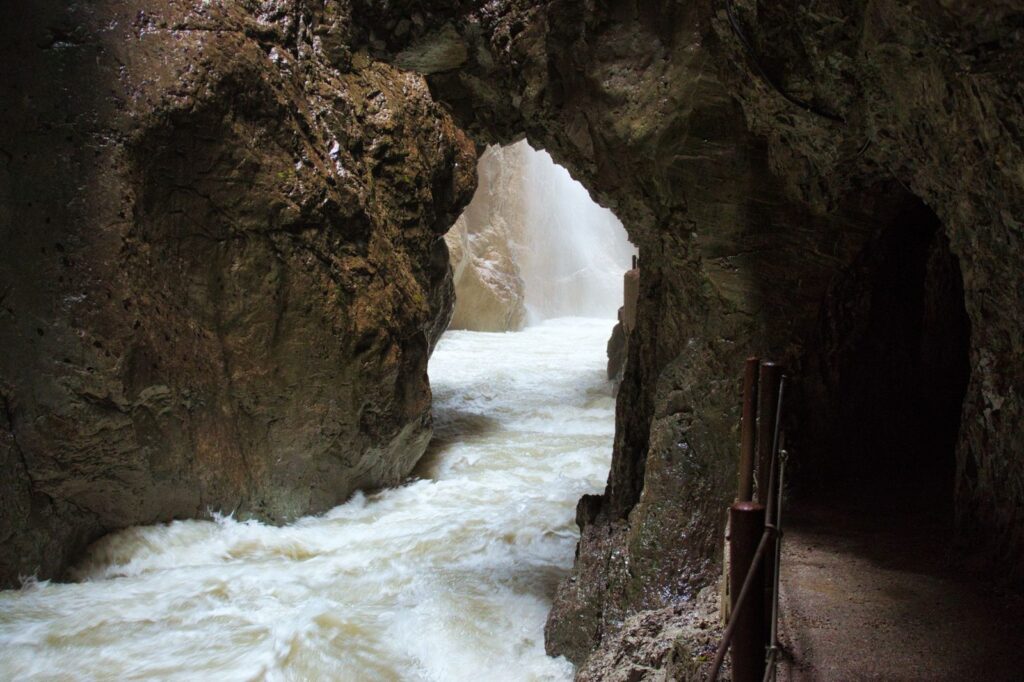
The Partnach has cut a slot through the rock south of Partenkirchen, and in the 1910s a walkway was blasted and tunnelled along the side of it. The result is roughly 700 metres of gallery a metre above a torrent, through tunnels, under overhangs, with water coming at you from every direction. Entry is around €10, or about €9 with a local guest card.
It is genuinely thrilling in a way that a cable car is not, it costs an eighth of the Zugspitze, and it works in rain — arguably it works better in rain, when the river is up and the noise is extraordinary. In deep winter it hangs with ice and is a completely different and equally good walk.
The practicalities:
- Getting there — bus 1 or 2 from Garmisch-Partenkirchen station to the Skistadion, then about 25 minutes’ walk up the valley on a flat gravel track. Or walk the whole way from the station in about 50 minutes.
- The gorge itself takes 20–30 minutes each way. Most people walk in and back out the same way.
- Wear waterproofs and grippy shoes. You will get wet. The path is uneven and often dripping.
- It closes at short notice in bad weather, most often in winter after heavy snow or rockfall. Check on the day before travelling — this is the one real risk in the plan.
- Pushchairs do not work. Carry small children.
On the way you pass the Olympia-Skistadion, built for the 1936 Winter Olympics and still the venue for the New Year’s Day ski jump of the Four Hills Tournament. The jump tower is free to walk up to and the scale of it from below is startling — considerably more so than from television.
Insider tip: if you have legs left, keep going past the gorge exit and climb the path to the Graseck, about 30 minutes up. You come out above the slot you have just walked through, looking down into it, with the Wetterstein wall opposite. There is a mountain inn at the top. This is the best hour of the day and it is free.
Route C: Garmisch-Classic and the Alpspitze
The middle option, and the one that gets least attention. Garmisch-Classic is the lift network on the Alpspitze–Kreuzeck–Hausberg side of the valley: the Alpspitzbahn, the Hochalmbahn and the Kreuzeckbahn, all covered by the €60.50 Sommerticket Classic including your train from Munich.
The Alpspitzbahn takes you to the Osterfelderkopf, where a steel viewing platform called AlpspiX cantilevers two arms out over a thousand-metre drop with an open grid floor. It is a straightforward and effective piece of vertigo and it costs a fraction of what the Zugspitze does.
From the top there is a network of marked walking routes back down through the alpine meadows, some of which take two hours and some of which take five. The Hochalm and Kreuzeck lifts let you shorten the descent when your knees vote against you. For a walker, this is the better mountain day of the two, and the view of the Zugspitze from here is arguably better than the view from the Zugspitze.
Prices for individual summer lift tickets are not published in a way I could verify, so buy the Sommerticket in Munich rather than working it out at the valley station. More on the wider region in our Bavarian Alps from Munich pillar and Bavarian Alps day trips.
Two towns, not one
The hyphen is not decorative. Garmisch and Partenkirchen were separate towns — separate parishes, separate characters, a certain amount of mutual disdain — until they were merged in 1935 so that the place could host the 1936 Winter Olympics as a single municipality. Locals will still tell you which half they are from.
Partenkirchen is the older and much the prettier half. Its Ludwigstraße follows the line of the Roman road from Venice to Augsburg and is lined with painted houses — Lüftlmalerei, the Bavarian tradition of frescoing facades with saints, hunting scenes and trompe-l’œil window frames. Walk it. It takes fifteen minutes and it is the most photogenic street in the Werdenfelser Land.
Garmisch is the newer, larger, more commercial half around the station and the pedestrianised Am Kurpark. It has the shops and most of the hotels and considerably less charm. If you have forty spare minutes, spend them in Partenkirchen.
For a similar painted-village fix without the resort scale, Mittenwald is twenty minutes further down the same railway line and is the more beautiful town by a distance — see our Alps day trips guide. Oberammergau and Linderhof are the other classic pairing in this corner of Bavaria.
The day I would actually take
If somebody gave me one clear day and told me to get it right, this is the plan — route B with the gorge as the spine and the town as the reward, at a total ticket cost of about €44 with a Bayern-Ticket.
| Time | Where |
|---|---|
| 09:02 | Leave München Hbf on the RB6. Left-hand window after Murnau. |
| 10:25 | Arrive Garmisch-Partenkirchen. Bus 1 or 2 to the Skistadion. |
| 10:45 | The Olympia-Skistadion and the ski-jump tower — fifteen minutes, free. |
| 11:10 | Walk up the valley track to the gorge entrance, ~25 min, flat. |
| 11:35 | Partnachklamm, ~€10. Through and back, or through and up. |
| 12:30 | Climb to the Graseck, ~30 min, and eat at the hut looking down into the gorge. |
| 14:15 | Back down and into Partenkirchen. Ludwigstraße and the painted houses. |
| 15:30 | Riessersee — 15 minutes uphill from western Garmisch, and empty. |
| 17:00 | Coffee and cake in Garmisch, or a beer at the Kurpark. |
| 18:06 or 19:06 | RB6 back. In Munich by about half past seven or half past eight. |
1936, and what is still standing
The 1936 Winter Olympics were held here in February, seven months before the Berlin summer Games, and they are the reason the town exists in its current form. The merger of the two villages, the ski stadium, the bob run at the Riessersee, the road and rail improvements — all of it was built for a two-week propaganda exercise by a regime that had been in power for three years.
The Olympia-Skistadion is the most legible survivor and it is still in use every New Year’s Day for the Four Hills ski jump. The stone terracing and the scale of the arena are unmistakably of their period, and the site does now carry explanatory material about what happened here and why. It is worth ten minutes of reading rather than only a photograph — a point our guide to Munich’s WWII history makes about a number of Bavarian sites.
If that thread interests you, Munich’s own Olympic history is the more cheerful sequel: Frei Otto’s tented roof, Günter Behnisch’s park and the 1972 Games are covered in our piece on the 1972 Munich Olympics, with the Olympiapark itself an easy afternoon on the U3.
Eating, and the lake nobody mentions
Resort-town food is resort-town food and Garmisch has its share of mediocre terraces with mountain views and prices to match. Two things worth knowing.
First, the mountain huts beat the town restaurants, comfortably. A Kaiserschmarrn or a bowl of Gulaschsuppe at a hut on the Kreuzeck or the Graseck costs about what a sandwich costs in the pedestrian zone and comes with a view you cannot buy in the valley.
Second, the Riessersee is a fifteen-minute walk uphill from the western edge of Garmisch — a small green lake with the Wetterstein reflected in it and a restaurant terrace on the shore. It is where the 1936 bobsleigh and ice-hockey events were held and it is almost entirely ignored by day-trippers. If your train is not until seven and the gorge is done, go there. Our lakes near Munich guide covers the bigger ones — Eibsee, Starnberger See, Tegernsee, Ammersee.
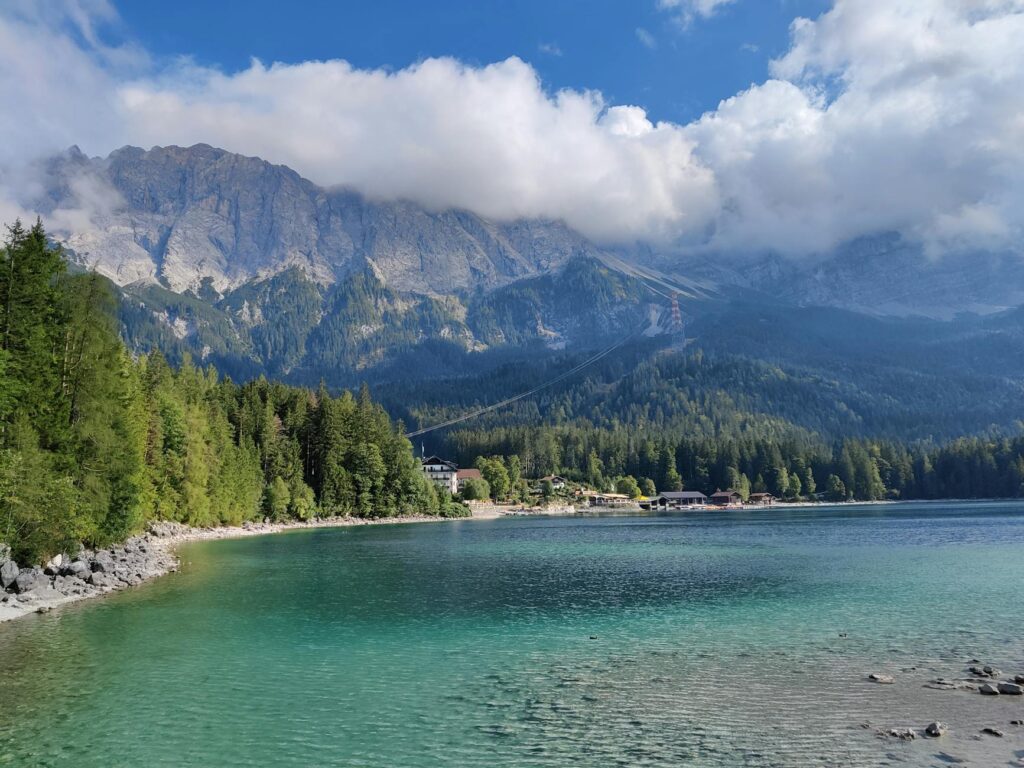
Speaking of the Eibsee: if you come down the Zugspitze by cable car you land on its shore, and the lap of the lake takes about ninety minutes on an easy path. On a clear day the water is a genuinely improbable turquoise with the mountain standing over it. Build it into route A if you have the time.
The winter version
Garmisch is a working ski resort and from December to April the day trip changes shape entirely. Skiers take the Garmisch-Classic area or the Zugspitzplatt glacier; day passes run around €64–€67, which is the ski-pass price and should not be confused with the summer round-trip fares.
For non-skiers, winter is arguably the better season here. The Partnachklamm in ice is remarkable — though it is also when it is most likely to be shut, so check. The Olympia-Skistadion hosts the ski jump on New Year’s Day. And the Zugspitze in winter is a snow plateau rather than a rock summit, which some people prefer and others find featureless. Winter tariffs differ from the summer ones quoted here, so re-check before you buy.
Bring more clothing than you think. The summit sits roughly twenty degrees colder than Munich and the wind at 2,962 m is not theoretical. Our Munich winter guide and weather and packing guide both cover the layering.
What not to do
- Do not try to combine the Zugspitze and Neuschwanstein. Tour operators sell it. It is two full days compressed into one, with four hours on a coach and about forty minutes at each. Take our Neuschwanstein day trip separately.
- Do not buy the Zugspitze ticket before checking the webcam. The single most common regret from this day trip.
- Do not attempt route A and route C in one day. You will do both badly.
- Do not drive. The train is direct, hourly and cheaper than the fuel, and the parking at the valley stations is neither free nor plentiful in season. See driving in and around Munich for when a car does make sense.
- Do not wear trainers into the gorge. The rock is wet, polished and unforgiving.
Frequently Asked Questions
Is a Garmisch-Partenkirchen day trip from Munich worth it?
Yes — it is the best value-for-effort mountain day available from Munich. Eighty minutes on one direct train puts you at the foot of the Wetterstein with a gorge, a 2,962 m summit and a full lift network to choose from. The trip is only a disappointment when people spend €78 on the Zugspitze in poor visibility, which is avoidable.
How long is the train from Munich to Garmisch?
About 1 hour 20 to 1 hour 26 on the RB6, direct and hourly from München Hauptbahnhof. No changes, no reservations. On a Bayern-Ticket the first valid weekday departure is the 09:02.
Can I do the Zugspitze and the Partnachklamm in one day?
Tightly, at a weekend, if you take the 07:32 out. Zugspitze first — five to six hours — then bus down to the Skistadion and walk up to the gorge in the late afternoon. It is a fourteen-hour day and you will enjoy neither as much as you would enjoy one of them. On a weekday with a Bayern-Ticket’s 09:00 start, no.
What does the Partnachklamm cost, and is it open all year?
Around €10 for an adult. It is open year-round in principle, but it closes at short notice in bad weather and does so most often in winter. Always check the day before you travel, and have route C or the towns as your fallback.
Which ticket is cheapest?
If you are not using the lifts: the Bayern-Ticket, at €34 solo or €74 for up to five people. If you are going up a mountain: the MVV Garmischer Sommerticket, which bundles the train with the lifts at €60.50 (Classic) or €94.50 (Zugspitze) and undercuts buying the two separately by close to €20.
Is it suitable for children?
Very. The train is easy, the Sommerticket child rates are startlingly cheap — €8 Classic, €12.50 Zugspitze for under-15s travelling with a parent or grandparent — and the gorge is a genuine adventure for anyone old enough to walk it. Pushchairs do not work in the Partnachklamm; carry babies and toddlers. Our day trips with kids from Munich guide covers the alternatives.
Is the Zugspitze accessible for wheelchair users?
The cog railway and both cable cars are step-free to a large extent and the summit platform is reachable, which makes this one of very few high alpine summits in Europe you can reach without walking. The Partnachklamm is not accessible. Confirm current arrangements with the operator before travelling — our Munich accessibility guide covers the general picture.
What should I do if it rains?
Route B, without hesitation. The Partnachklamm is better in rain, Ludwigstraße’s painted houses look fine wet, and the mountain huts exist for exactly this. Skip the lifts entirely — you are paying for a view that will not be there.
Where to go next
If the mountains are the point of your trip, the Bavarian Alps from Munich pillar is the place to start, with the Zugspitze in detail and Berchtesgaden and the Eagle’s Nest as the other serious contenders. If you are still shaping the trip, day trips from Munich ranks all of them by time and cost, and the itineraries hub shows where a day like this fits — the short answer being day three, not day two.
Related Guides
- The Bavarian Alps from Munich: Complete Mountain Guide — the cluster hub
- Zugspitze from Munich: Germany’s Highest Peak — Major untargeted head term; SERP is tour operators, no authority guide
- Best Day Hikes Near Munich (Reachable by Train) — Strong year-round volume; competitors are hotel-chain blogs
- Skiing Near Munich: Best Resorts for a Day on the Slopes — November to March traffic the site currently captures none of
Photo Credits
Ludwigstrasse in Garmisch-Partenkirchen: 20230608 Ludwigstraße Garmisch-Partenkirchen 01 by Flocci Nivis, CC BY 4.0, via Wikimedia Commons.