Skiing Near Munich: Best Resorts for a Day on the Slopes
Five ski areas within 80 minutes, one ticket that bundles the train, the bus and the lift pass from EUR 64.50, and an honest ranking of which is worth your day.
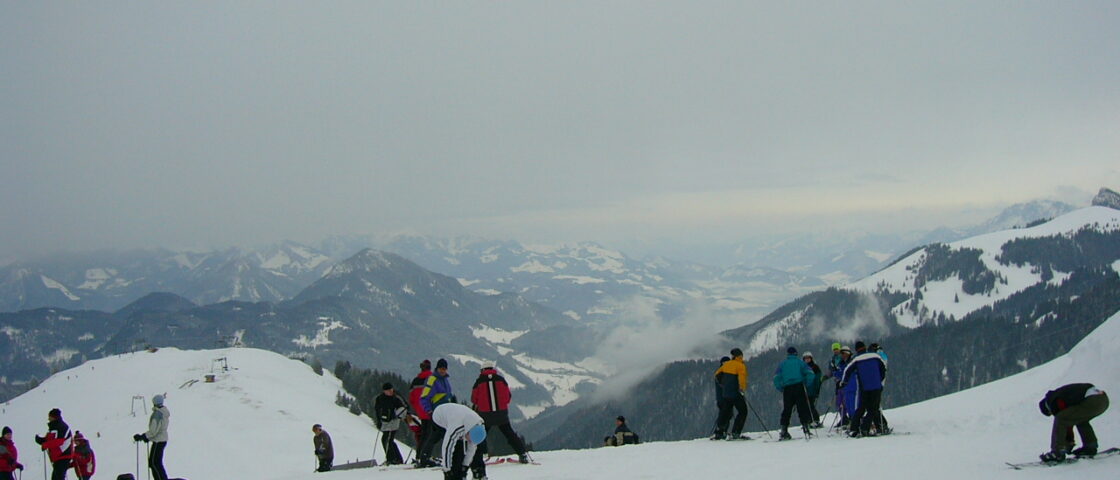
You can ski from Munich for a day without a car, without hiring a driver, and without booking anything in advance — and the ticket that makes it work is the MVV-Skipass, which bundles the return train, the ski bus and the day lift pass into one purchase from about €64.50.
That is the answer most people are looking for. The harder question is which of the five reachable areas to go to, and the honest answer is that none of them are Austria. Munich’s day-trip ski areas are small, low, and — with one exception — dependent on a good winter. Come expecting the Arlberg and you will be disappointed; come expecting a good day on the snow ninety minutes from a city centre and you will not.
Here are the five areas compared properly, what each is actually good for, what the whole day costs, and when in the season it is worth doing at all.
Skiing near Munich at a glance
| Area | Getting there | Piste | Altitude | MVV-Skipass | Best for |
|---|---|---|---|---|---|
| Garmisch-Classic | RB6, 1h20 | 40 km | ~740–2,050 m | €76 adult | The biggest and most varied |
| Zugspitze glacier | RB6 + Zugspitzbahn | 20 km | ~2,000–2,720 m | €79 adult | Snow certainty. Germany’s highest |
| Brauneck, Lenggries | BRB RB56, ~65 min | 34 km, 15 lifts | — | €64.50 adult | The Munich local’s default |
| Sudelfeld, Bayrischzell | BRB RB55, ~80 min | 31 km, 15 lifts | to 1,563 m | €64.50 adult | Families and beginners |
| Spitzingsee-Tegernsee | BRB, ~60 min | 20 km | 980–1,580 m | €64.50 adult | Short days, freestyle |
The MVV-Skipass, which is the whole trick
Buy this and stop thinking about logistics. One ticket covers return travel from the MVV area, the ski bus from the destination station to the lift base, and the day ski pass.
- Garmisch Classic: €76 adult, €53 youth 15–18, €30 child under 15.
- Brauneck, Sudelfeld or Spitzingsee: €64.50 adult, €59.50 youth, €31.80 child.
- Garmisch Zugspitze: €79 adult, €57 youth, €34 child.
- Sold at MVV customer centres, ticket machines, BRB offices, S-Bahn Munich locations and DB travel centres. You can also buy from the conductor with a €2 surcharge, which is the escape hatch if the machine queue at the Hauptbahnhof is twenty deep at seven in the morning.
The one catch is the validity window. The 2026 pass ran from 1 January to 30 March only. Outside those dates you are buying the train and the lift pass separately, which costs more and takes longer. Check the current season’s dates before you plan around it.
To put the value in context: a Brauneck day pass on its own was €53 in the 2025/26 season, so the €64.50 combi buys you the round trip from Munich for about eleven euros. There is no version of driving that competes once you count fuel and parking, and there is certainly no version that lets you have a beer at the bottom.
Insider tip: the ski bus connections are timed to specific trains, not to your convenience. Look up the departure the night before and be on the platform for it. Missing the connection at Lenggries or Bayrischzell can cost an hour, and in January an hour is a meaningful fraction of the skiing daylight.
The five areas, ranked honestly
1. Garmisch-Classic — the one to pick if you can only go once
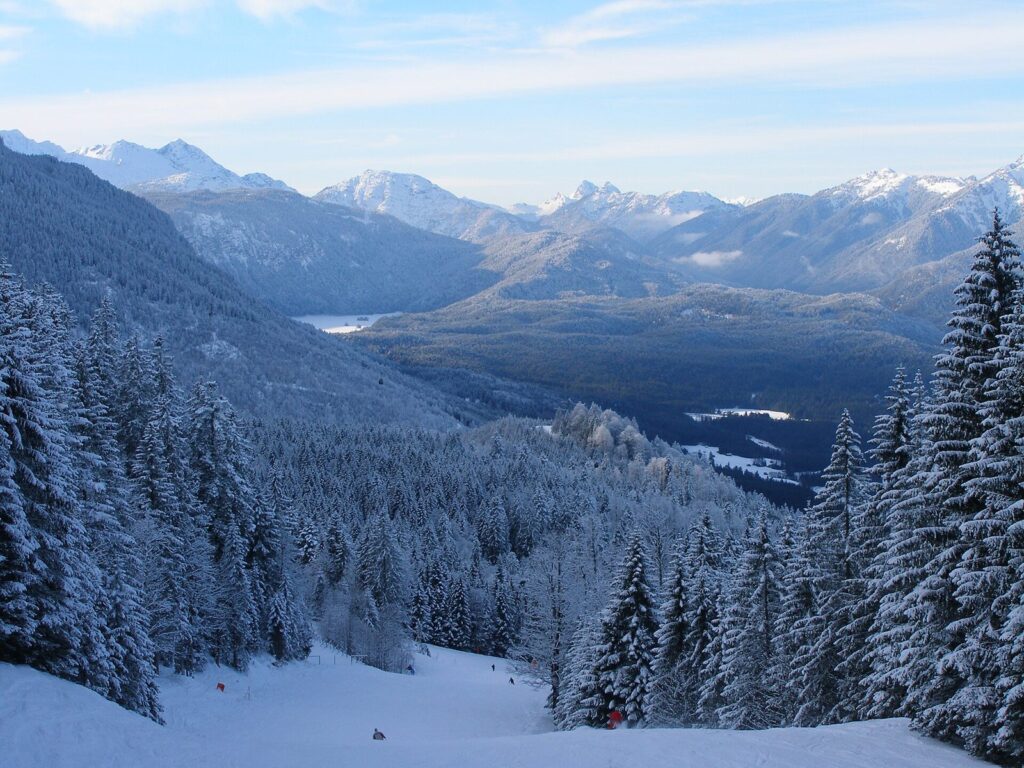
40 kilometres of piste, several lifts and cable cars, from around 740 to 2,050 metres. This is one of the largest and most varied areas within day-trip reach, spread across the Hausberg, Kreuzeck and Alpspitze, and the likeliest of the five to keep a strong skier interested for a full day.
It also has the Kandahar, the World Cup downhill course, which is a genuinely serious piece of terrain and one of the steepest race pistes in the world. You can ski it when it is open to the public. The 1936 Winter Olympics were held here, which is why Garmisch and Partenkirchen — separate towns until they were merged in 1935 for exactly that purpose — have the infrastructure they do.
The honest downside: the bottom station sits at around 740 metres. In a warm winter the lower runs are slush or closed, and getting down at the end of the day means riding the lift rather than skiing it. Garmisch has extensive snowmaking, but there is a limit to what a cannon can do in February rain.
Getting there is the easiest of the lot: RB6 Werdenfelsbahn, direct, hourly, 1h20 to 1h26. See our Garmisch day trip guide for the town and the summer version.
2. The Zugspitze glacier — the one that always has snow
20 kilometres of piste between roughly 2,000 and 2,720 metres — Germany’s highest ski area, on the Zugspitzplatt beside the Schneeferner glacier.
The trade is straightforward. You get snow certainty: the Zugspitzplatt is skiable when everything below it is grass, the season runs from roughly November into May, and on a clear day the views over four countries are extraordinary. What you do not get is variety. Twenty kilometres of mostly wide, gentle glacier terrain is a morning’s worth for a competent skier, the runs are exposed to weather, and there is no tree line to give you anything to look at when the cloud comes in.
Go here in early December, or in late April, or when the snow report everywhere else is bad. In mid-February with a good base, Garmisch-Classic is the better ski. The MVV-Skipass Zugspitze variant is €79 adult, and our Zugspitze from Munich guide covers the mountain in full — including the summer round trip at €78, which is a different product entirely.
3. Brauneck, Lenggries — where Munich actually goes
The BRB RB56 runs straight from Munich to Lenggries — one of the shortest realistic journeys to real skiing from the city.
This is the local mountain in the way that Herzogstand is the local hiking mountain. It is busy on a sunny Saturday, it has a proper spread of red runs, and the descent back to Lenggries is long and satisfying. The apres is unpretentious. If you want to understand how Munich actually uses the Alps rather than how brochures say it does, come here on a January Sunday.
The downside is the crowd. Proximity is a double-edged thing: on a good weekend the lift queues can be long. Coming by train is a genuine advantage rather than a compromise.
4. Sudelfeld — the family choice
31 kilometres, 15 lifts, up to 1,563 metres, reached by the BRB RB55 to Bayrischzell in about 80 minutes.
Sudelfeld is wide, sunny and mostly gentle, which makes it the best of these areas for children, beginners and anyone whose legs are out of practice. It has a good snowpark and a substantial investment in snowmaking, and the whole area feels less pressured than Brauneck. Strong skiers will find it undemanding.
Watch the train. The BRB leaves Munich as one three-part set — front to Bayrischzell, middle to Lenggries, rear to Tegernsee — and it uncouples the Bayrischzell portion at Holzkirchen and splits the other two at Schaftlach. Sit in the wrong carriage with your skis and you will arrive in a different valley. This catches people out every single season.
5. Spitzingsee-Tegernsee — the short day
20 kilometres between 980 and 1,580 metres, about an hour from Munich. Level with the Zugspitze glacier as the smallest of the five, and the one that most rewards a half day rather than a full one. It has a strong freestyle scene and a genuinely lovely setting above the Spitzingsee, and it is the right choice if you are combining skiing with something else — a Tegernsee lunch, or an afternoon at a spa.
The Tegernsee valley is expensive and entirely aware of it, so eat before you arrive or accept the pricing.
The Austrian question
Anyone who has skied properly will look at those piste figures and ask why they would not simply go to Austria. It is a fair question and the answer is time, not quality.
- Innsbruck is about two hours by train, with up to ten direct services a day and the fastest taking 1h54, and it is surrounded by ski areas of a completely different order — the Nordkette rises straight out of the city, and the Stubai glacier and Axamer Lizum are short bus rides away. As a day trip it is doable but tight; as a two or three-night base it is far better than anything on the German side. See travel from Munich for the routes south.
- Kitzbühel, the Wilder Kaiser and the Zillertal are all within about two to two and a half hours and all comfortably larger than Garmisch. They are weekend destinations rather than day trips from Munich.
- Salzburg at 1h35 to 2h puts you within reach of the Ski amadé network, which is enormous. Again: a base, not a day trip.
The honest verdict: if you have one day, ski in Bavaria — the MVV-Skipass makes it frictionless and you will be back in a Munich beer hall by seven. If you have three days and skiing is the point of the trip, go to Austria and stay there. Using Munich as a base for repeated Austrian day trips is the worst of both, because you spend five hours a day on trains.
Getting there: the morning in detail
A Bavarian ski day is won or lost between seven and eleven in the morning, so it is worth being specific about it.
- Leave from München Hauptbahnhof, not from an outlying station. The trains originate there, which means you get a seat and — more importantly with skis — a place to stand them. By the second stop the vestibules are full of other people’s equipment.
- The 09:02 rule does not apply to the MVV-Skipass. That restriction belongs to the Bayern-Ticket, which is invalid before 09:00 on weekdays. The Skipass is a different product, so you can take an earlier train — and on a short January day you should.
- Boots on or boots in a bag? On the train, in a bag, and change at the base. Walking through the Hauptbahnhof in ski boots is a specific kind of misery and the changing rooms at every one of these areas are adequate.
- The ski bus meets the train. It is included in the pass, it goes from the station forecourt, and it is timed to specific arrivals rather than running continuously. This is the part where an unfamiliar visitor loses forty minutes.
- Coming home, the late-afternoon trains back from Lenggries, Bayrischzell and Garmisch are the busiest of the day. Either catch the one before the rush or accept standing for the first twenty minutes.
Insider tip: the beer at the bottom is the genuine argument for the train, and Bavarians treat it as the point rather than a bonus. Germany’s drink-drive limit is strict and enforced, and the one thing a car cannot give you is a Hefeweizen at four in the afternoon at the lift base followed by a nap on the way home.
What Bavarian skiing is actually like
Worth setting expectations, because the gap between what these areas are and what an international skier imagines is where the disappointment lives.
- The scale is regional, not alpine-resort. Forty kilometres of piste at Garmisch is a good Bavarian area and a small Austrian one. There is no lift-linked network here of the kind you get in the Tyrol or the Trois Vallées — each area is self-contained.
- The altitude is the constraint. Base stations at roughly 700 to 1,000 metres are simply low for a modern winter, and snowmaking carries these areas through more of the season than the marketing admits. This is why the glacier exists as an option at all.
- The huts are excellent and cheaper than Austria. A Kaiserschmarrn, a Germknödel or a plate of Kasspatzn on a sun terrace at 1,400 metres is a large part of the experience, and Bavarian mountain catering is unpretentious in a way the Austrian equivalent often is not.
- The apres is understated. No Ischgl-style operation here. A beer, a band on a good Saturday, and everyone on the 17:12 home.
- Weekends are genuinely crowded. Two and a half million people live within ninety minutes of these five areas. If you can ski midweek, do; the difference in lift queues at Brauneck between a Wednesday and a Saturday is dramatic.
None of that is a reason not to go. It is a reason to go with the right expectation: this is a very good day out from a major city, not a ski holiday, and judged as the former it is close to unbeatable in Europe. Vienna, Zurich and Milan are the only comparable cases, and only Zurich does it better.
When to go
| Period | Conditions | Verdict |
|---|---|---|
| November–December | Only the Zugspitze glacier reliable | Go high or don’t go |
| Late December–early January | Usually good, extremely busy | Christmas markets are the better use of the week |
| Mid-January–February | The best window. Cold, settled base, short days | Go now. The 2026 MVV-Skipass started on 1 January; check MVV for this winter’s dates |
| March | Warm afternoons, good snow up high, spring skiing | Very good, and quieter. Pass ran to 30 March in 2026 |
| April–May | Zugspitze glacier only | Novelty rather than skiing |
Two things about the daylight. Sunset is around 16:45 in January, and the lifts stop well before that — a 09:02 departure from Munich gets you skiing around 10:45 and gives you five hours, which is a full day on legs that have not skied since last year. And Bavarian winters have become noticeably less reliable at low altitude, so check the snow report the day before rather than the week before. A closed lower mountain changes the day completely.
What the day actually costs
- MVV-Skipass: €64.50 to €79 depending on the area, covering the train, the ski bus and the lift pass.
- Ski and boot hire: check the hire shop’s current price list for a standard set at the resort. Book online the day before where you can — the shops at the lift base are busiest between 08:30 and 09:30, precisely when you arrive.
- Mountain lunch: €15 to €25. Bavarian mountain huts are cheaper than Austrian or Swiss ones but not cheap, and many are cash only. Carry notes.
- A lesson: from about €50 for a group session, considerably more one to one. Book ahead; walk-up availability on a weekend is poor.
All in, expect €110 to €150 per person for a day with hire and lunch, or €70 to €90 if you have your own equipment and carry a sandwich. That is not cheap, and it is roughly what a Zugspitze summer round trip plus a Bayern-Ticket costs, so treat it as a real line in the budget rather than an afterthought. Our Munich trip cost guide puts it in context and Munich on a budget covers the cheaper winter alternatives.
If you do not ski
Every one of these areas has a non-skiing day attached to it, which matters if your party is split.
- Tobogganing. The Wallberg above the Tegernsee has one of the longest natural toboggan runs in Bavaria and is part of the Alpen Plus alliance. The Blomberg above Bad Tölz has a summer and winter run at the base station.
- Winter walking. The valley paths at Lenggries, Bayrischzell and Garmisch are cleared and signposted, and the Partnachklamm in full ice is arguably better than in summer — around €10, and it closes at short notice after ice fall, so check.
- The Zugspitze as a sightseeing trip. You do not need skis to ride up. €78 return for the summer round trip; winter rates are quoted separately.
- A spa afterwards. This is the correct end to a ski day and Munich is well set up for it — the Müller’sches Volksbad at €23 for four hours including the pool, or Therme Erding out on the S2. Read German sauna etiquette first; the rules are stricter than you expect.
And if the snow has failed entirely, our Munich winter guide covers what the season offers in the city itself.
Frequently Asked Questions
Can you ski near Munich as a day trip?
Yes, easily, and without a car. Five areas — Garmisch-Classic, the Zugspitze glacier, Brauneck, Sudelfeld and Spitzingsee — are all between about an hour and 1h20 from Munich by regional train, and the MVV-Skipass bundles the return journey, the ski bus and the day lift pass into a single ticket from €64.50. A 09:02 departure has you on the snow by about 10:45.
Which is the best ski resort near Munich?
Garmisch-Classic, on size and variety — 40 kilometres of piste, including the Kandahar World Cup downhill. The Zugspitze glacier beats it on snow certainty but has only 20 kilometres of fairly gentle terrain. Brauneck at Lenggries is the closest and the one Munich locals actually use, and Sudelfeld is the best for families and beginners.
How much does the MVV-Skipass cost?
For the 1 January to 30 March 2026 season: Garmisch Classic €76 adult, €53 youth 15–18, €30 child; Brauneck, Sudelfeld or Spitzingsee €64.50 adult, €59.50 youth, €31.80 child; Garmisch Zugspitze €79 adult, €57 youth, €34 child. It includes return travel, the ski bus and the day pass. Buy it at MVV centres, ticket machines, DB travel centres or from the conductor with a €2 surcharge — and check the current season’s validity window before planning around it.
Is skiing near Munich good for beginners?
Sudelfeld is the best of the five — wide, sunny, mostly gentle, with 31 kilometres of largely undemanding terrain and a relaxed atmosphere. Spitzingsee is also manageable and shorter to reach. Garmisch-Classic has beginner areas but the mountain as a whole is more serious, and the Zugspitze glacier, while gentle, is exposed and can be intimidating in weather. Book lessons ahead rather than turning up.
When is the ski season near Munich?
Realistically mid-January to mid-March for the lower areas, which is also roughly when the MVV-Skipass is sold. The Zugspitze glacier runs much longer, from early December to early May depending on snow, because it sits between 2,000 and 2,720 metres. Low-altitude Bavarian winters have become less reliable, so check the snow report the day before rather than assuming.
Should I ski in Bavaria or go to Austria instead?
For one day, ski in Bavaria — the logistics are frictionless and you are back in Munich for dinner. For three days or more with skiing as the point of the trip, go to Austria and stay there: Innsbruck is about two hours away by train (1h54 on the fastest) with far larger areas around it, and Salzburg opens up the Ski amadé network. What does not work is basing yourself in Munich and commuting to Austria daily.
Can I hire skis at the resorts?
Yes, all five have hire shops at the lift base, and each posts its own price list for skis, boots and poles. Book online the evening before if you can — the shops are at their busiest between 08:30 and 09:30, which is exactly when the trains from Munich arrive. Carry cash as well as a card; mountain huts in particular are frequently cash only.
What if I don’t ski but my group does?
Tobogganing on the Wallberg or the Blomberg, cleared winter walking paths in every valley, the Partnachklamm in ice at around €10, or simply riding a cable car up for the view. The Zugspitze does not require skis. And the best non-skier’s plan is to take the same train, spend the day in Garmisch or on the Tegernsee, and meet everyone at the bottom.
Where to go next
The mountains are the reason Munich is worth more than a weekend — the Bavarian Alps from Munich is the hub, with the Zugspitze and Garmisch-Partenkirchen for the specifics and day hikes near Munich for the summer version of the same trains. For the rest of the cold season, the Munich winter guide and the Christmas markets cover December, and weather and packing tells you what to bring.
Related Guides
- The Bavarian Alps from Munich: Complete Mountain Guide — the cluster hub
- Zugspitze from Munich: Germany’s Highest Peak — Major untargeted head term; SERP is tour operators, no authority guide
- Garmisch-Partenkirchen Day Trip from Munich — Top-five Munich day trip with no page on the site
- Best Day Hikes Near Munich (Reachable by Train) — Strong year-round volume; competitors are hotel-chain blogs
Photo Credits
Kandahar run: Snowy mountains in Kandahar by Bernd Brägelmann from Cologne, Germany, CC BY-SA 2.0, via Wikimedia Commons.
Skiers at Sudelfeld: Skifahrer bei Vorbereitungen by Mattes, Public domain, via Wikimedia Commons.