Zugspitze from Munich: Germany’s Highest Peak
A full day, EUR 78, and one rule that matters more than any other: do not book in advance. Timings, the round trip, the record-breaking cable car, and what to do when the summit is in cloud.
The Zugspitze from Munich is a full day, costs €78 on top of your rail fare, and should not be booked in advance. That last point is the one that matters, and it is the reason this guide exists: the summit makes its own weather, it is frequently in cloud when Garmisch below is in sunshine, and there is no refund for a white-out.
Get it right and you stand at 2,962 m on the highest ground in Germany, looking across four countries and something like four hundred peaks. Get it wrong and you have paid €78 to stand inside a cloud, on a crowded terrace, next to a restaurant.
Here is how to do it: the timings from Munich, what the ticket covers, which order to ride the lifts in, and what to do instead when the mountain is shut in.
The Zugspitze from Munich at a glance
| Detail | Figure |
|---|---|
| Summit altitude | 2,962 m — the highest point in Germany |
| Munich to Garmisch-Partenkirchen | 1h20 by regional train |
| Garmisch to summit and back | 3–4 hours of lifts and time at the top |
| Total door to door | 9–10 hours |
| Adult return ticket | €78 (summer season, from 23 May 2026) |
| Child 6–15 | €39 |
| What the ticket covers | One ascent and one descent, across the cog railway, Gletscherbahn and Zugspitze cable car |
| Rail fare from Munich | Covered by a Bayern-Ticket (regional trains only, not before 09:00 on weekdays) |
Getting to the mountain
Munich Hauptbahnhof to Garmisch-Partenkirchen is 1h20 on a regional service, running roughly hourly. The Zugspitzbahn — the cog railway — leaves from its own station immediately beside the main one, so the change is a two-minute walk rather than a transfer.
A Bayern-Ticket covers the Munich–Garmisch leg and, for two or more people, is by a wide margin the cheapest way to do it. Two caveats that shape the whole day: it is not valid on ICE or EC services, and it is not valid before 09:00 on weekdays. On a weekday, that means the 09:02 rather than the 08:02, and it costs you the first hour of the mountain.
Insider tip: at weekends the Bayern-Ticket is valid from midnight, so a Saturday or Sunday early train gets you to Garmisch by about 09:00 and onto the mountain before the crowd. This is the one context in which the weekend beats the weekday for a Bavarian day trip, and it is worth knowing.
Driving takes roughly the same time and gains you nothing except the ability to leave when you like. Parking at the valley stations fills at weekends. Our Bavarian Alps from Munich guide covers the wider transport picture.
What €78 actually buys
The summer return ticket is €78 for an adult and €39 for a child aged 6 to 15, with the summer season having opened on 23 May in 2026. It covers one ascent and one descent and is valid across all three of the mountain’s lift systems, which is what makes the round trip possible.
That is a lot of money, and it is worth being clear about the value proposition rather than pretending otherwise. What you are paying for is a genuinely extraordinary piece of infrastructure and a view that, on the right day, is among the great panoramas of Europe. What you are not paying for is a guarantee, and the operator does not offer one.
The round trip, and which way round
The ticket allows what the operator calls the Zugspitze Round Trip — up one way, down the other. Use it. Riding the same lift twice wastes half of what you have paid for.
The circuit has three legs:
- The Zahnradbahn, a cog railway roughly ninety years old, which runs from Garmisch through Grainau, past the Eibsee, and then into a 4.5 km tunnel bored inside the mountain, emerging on the glacier plateau at Zugspitzplatt, 2,600 m.
- The Gletscherbahn, a short cable car from the plateau up to the summit itself.
- The Seilbahn Zugspitze, a single enormous cable-car span dropping from the 2,962 m summit down to the Eibsee.
Go up on the cog railway and down on the cable car. The tunnel section is slow and dark and it is better endured at the start of the day than at the end; the cable-car descent is the spectacular leg and it should be the thing you finish on rather than the thing you queue for at 09:30.
Budget three to four hours for the whole circuit including time at the top.
The cable car is the point
The Seilbahn Zugspitze holds three world records and they are worth knowing before you get in, because otherwise you will simply experience it as a long ride with a view:
- Its support tower is 127 m tall — the highest of its kind anywhere.
- The altitude difference between the valley and summit stations is two kilometres, in a single span, which no other cable car matches.
- The final unsupported section of cable runs 3.2 km — the longest freely suspended rope span in the world.
The practical effect is that for several minutes there is nothing at all between you and the Eibsee two kilometres below. If anyone in your group is uneasy about heights, this is the leg to warn them about, and it is a reason some people prefer to ride the cog railway both ways.
At the top
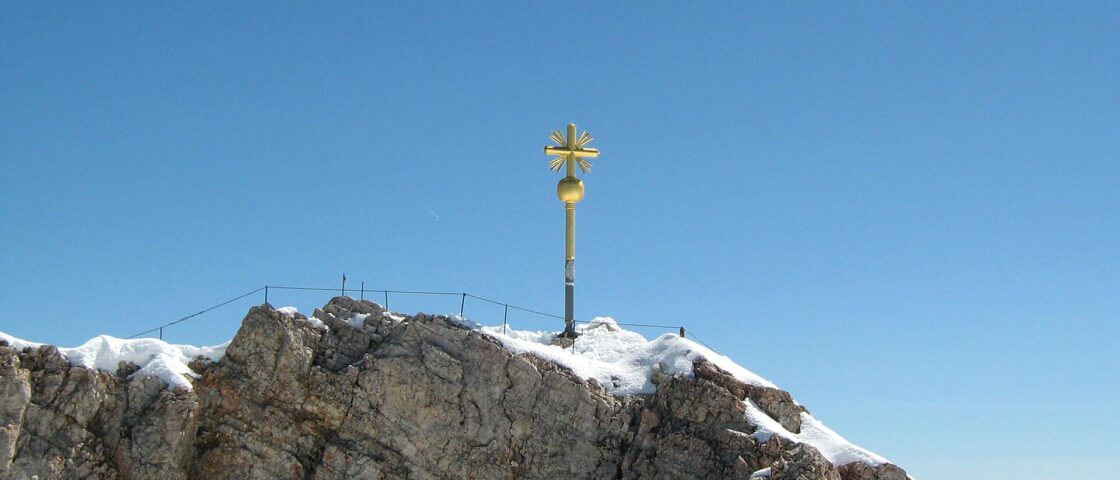
The summit is a compact platform of glass and steel with terraces on both sides of the German–Austrian border, which runs directly across it. There is the Panorama 2962 restaurant, an exhibition on the cog railway’s history, and the golden summit cross on the rock spire above the terrace.
The view, on a clear day, takes in something like 400 peaks across four countries — Germany, Austria, Switzerland and Italy. It is a genuinely rare thing and it justifies the price when it is there.
Three honest observations about the summit:
- It is small and it gets crowded. Several hundred people arrive on each lift, and the terrace is not large. Mid-morning on a fine weekend is a scrum.
- It is cold. Well below the valley temperature, windy, and capable of being below freezing in July. People arrive in shorts and last ten minutes.
- The golden cross involves a short scramble on a secured route from the terrace, and it is not for everyone. The view from the terrace is the same view.
Do not eat at the top unless you want to. The restaurant is fine and priced as you would expect from a business that carries everything up a mountain, and the Zugspitzplatt one stop below is cheaper.
Check the weather. Then check it again.
This is the single most important section in this guide.
The Zugspitze is high enough to generate its own cloud, and it does so routinely on days that look perfectly clear from Garmisch. A valley forecast tells you almost nothing about summit conditions. What tells you is the operator’s own summit webcams, which are live and which show you exactly what you would be looking at if you went up now.
The workflow that works:
- Do not pre-book. Buy the ticket on the day, at the valley station.
- Check the webcam the night before to decide whether to head for Garmisch at all.
- Check it again from Garmisch station before you buy. You are already there; the gorge and the Eibsee are both good alternatives and cost a fraction of the money.
- If it is marginal, go up anyway but go early. Cloud tends to build through the day rather than clear.
- Keep the Zugspitze as a flexible day in a longer trip rather than fixing it to a date.
Treating the summit as a weather-dependent option rather than a fixed plan is the best decision available to anyone doing this trip, and it is why booking a tour with a fixed date is a worse product than it appears.
What to do instead when the summit is clouded
You are in Garmisch-Partenkirchen with a whole day and no summit. This is not a wasted trip — the two best alternatives are arguably better value than the mountain.
The Eibsee circuit
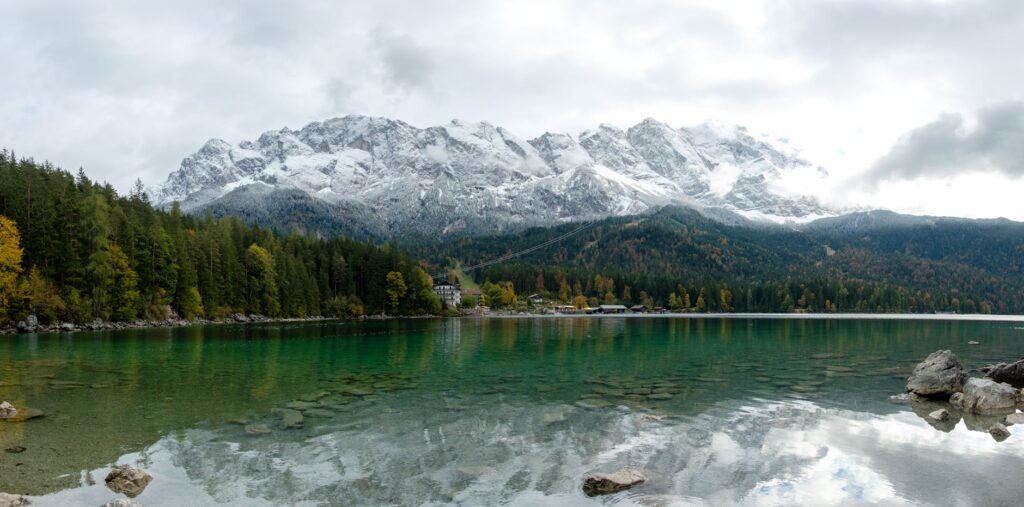
Take the cog railway one stop past Garmisch to Eibsee and walk the lake. It is about 7 km, mostly flat, on a good path, and the water is a startling green over pale gravel with the Zugspitze massif standing directly behind it. It costs nothing beyond the short rail leg. Photographers frequently prefer it to the summit, and even on a cloudy day the lake works.
The Partnachklamm
A gorge roughly 700 m long where the Partnach has cut a slot through limestone deep enough that the sky becomes a strip. Entry is around €10. You walk it on a gallery cut into the rock, through short tunnels, with the water going past fast and loud a few metres below. It is genuinely wet, and a jacket is not optional.
From the station it is about 25 minutes’ walk to the Olympic ski stadium and another 20 up the valley, or take a bus to the stadium. Do not turn round at the far end: continue up and come back over the Eckbauer, on foot in about two hours or by the small cable car. The gorge closes at short notice in bad weather, most often in winter — check the same morning.
Cloud on the summit frequently means a fine day in the valley. Both of these work in exactly those conditions.
The day, hour by hour
Assuming a weekday and a Bayern-Ticket, which is the most common way visitors do this.
| Time | What |
|---|---|
| 09:02 | Leave München Hbf. The first train a weekday Bayern-Ticket permits. |
| 10:25 | Arrive Garmisch-Partenkirchen. Check the summit webcam before you buy anything. |
| 10:45 | Cog railway from the Zugspitzbahn station, through Grainau and the 4.5 km tunnel. |
| 11:55 | Zugspitzplatt, 2,600 m. Change for the Gletscherbahn. |
| 12:15 | Summit. Both terraces, the golden cross, the four-country view. |
| 13:45 | Seilbahn Zugspitze down to the Eibsee — the record-breaking span. |
| 14:15 | Half an hour at the Eibsee shore before the connection. |
| 15:30 | Back in Garmisch. Coffee in Partenkirchen, across the river. |
| 16:30 | Train to Munich. |
| 17:50 | München Hbf. |
Two things this plan deliberately does not do. It does not try to add the Partnachklamm — the gorge is a separate day, not an add-on. And it does not rush the summit; ninety minutes up there is right, because the view changes as cloud moves and the first ten minutes are spent finding your bearings.
If you have a car or a weekend Bayern-Ticket and can leave an hour earlier, do — the mountain is at its clearest and emptiest in the morning. Our Munich itineraries guide covers where a day like this fits in a longer trip.
The Austrian side
The Zugspitze straddles the border, and there is a second, entirely separate way up from the Austrian village of Ehrwald in the Tiroler Zugspitzarena — the Tiroler Zugspitzbahn, a single cable car to the same summit.
It is worth knowing about for two reasons. The Austrian ascent is generally quieter than the German one, and it is a different experience — one long cable car rather than a tunnel and a plateau. But it is a poor choice from Munich: getting to Ehrwald by public transport takes considerably longer than getting to Garmisch, the ticketing is separate from the German operator’s, and you lose the round trip that makes the German ticket good value.
Use the Austrian side if you are already in the Tirol or heading on towards Innsbruck. From Munich, go via Garmisch. Our travelling on from Munich guide covers the routes south if the Tirol is part of a longer trip.
A short history of getting up there
The Zugspitze was first climbed in 1820 by a survey party, which is late for a European mountain and says something about how little interest anyone had in summits before the nineteenth century invented the idea.
The cog railway is roughly ninety years old, and the tunnel it runs through — 4.5 km bored inside the mountain — was an extraordinary undertaking for its era, driven through rock by men working in conditions that would not now be permitted. The line still uses the same route. When you are grinding uphill in the dark wondering why this leg takes so long, that is the reason: you are inside a mountain, on a railway built before anyone had a machine equal to the job.
The Seilbahn Zugspitze is the modern counterpoint, opened in 2017 to replace a much older cable car, and its three world records were a deliberate piece of engineering ambition rather than an accident of geography. The contrast between the two — a ninety-year-old rack railway and a record-breaking single-span cable car, on the same ticket, on the same mountain — is the most interesting thing about the round trip and the reason to do both legs rather than one twice.
The summit also carries a working weather station and a research facility, which is why there is more built on top of a mountain than the tourism alone would explain.
Winter on the Zugspitze
The Zugspitzplatt is a glacier ski area and the most snow-reliable terrain within reach of Munich, which is its main argument. Winter ticketing differs from the summer round-trip price above and is published separately; do not assume the €78 figure applies.
Two honest notes. Non-skiers can still ride up in winter, and the summit in snow is spectacular — but the days are short, the cold at 2,962 m is serious, and cloud is at least as common as in summer. And for skiers, the Zugspitze glacier is expensive to access relative to what you get; Garmisch-Classic below it, or Brauneck at Lenggries, are better value days on snow. See our Munich winter guide.
Keeping the cost down
The mountain ticket is fixed at €78 and there is no meaningful discount on it. Everything else about the day is negotiable, and for a group the savings are substantial.
- The Bayern-Ticket is the big one. It covers the Munich–Garmisch return on regional trains at €34 for one person, with each additional traveller adding just €10. For a family of four the rail leg becomes almost incidental. It is not valid on ICE or EC services, or before 09:00 on weekdays.
- Take food. Summit and plateau catering is priced as mountain catering always is. A bag of lunch from a Munich supermarket before you leave saves €20 a head and there is nowhere that objects to you eating it on the terrace.
- Skip the summit and do the Eibsee instead if the budget is the binding constraint. The lake circuit is free, the view of the massif is superb, and you have spent the price of a regional train ticket rather than €78.
- Children under six travel free on the mountain, and 6–15s are half price at €39 — but four people at full and half fares is still well over €200 before you have eaten. This is not a cheap family day.
For the wider arithmetic of Bavarian rail travel, see our budget transport in Munich guide, and getting around Munich for the city network you will use to reach the Hauptbahnhof.
What to take
- A windproof layer, always, including in August. The summit can be below freezing in midsummer and the wind does the rest.
- Sunglasses and sunscreen. At 2,962 m, with snow on the plateau reflecting upward, the UV is far stronger than the temperature suggests.
- Proper shoes if you plan to walk at the Eibsee or in the gorge — wet limestone and smooth soles are a poor combination.
- Cash, for the gorge entry and mountain huts.
- Water. Altitude dehydrates you faster than you notice.
- A charged phone, because the webcam check is the whole strategy.
Our Munich weather and packing guide covers the seasonal detail for the wider region.
Walking on the mountain
Most visitors ride up and ride down, which is the right call on a day trip from Munich. It is worth knowing what the alternatives involve, if only to be clear about what you are not doing.
Walking up the Zugspitze is a serious mountain day, not a long hike. The routes from the Eibsee or through the Höllental gain around two kilometres of height, take eight to ten hours, and the Höllental route includes a via ferrata with fixed cables and a glacier crossing. It requires equipment, experience and settled weather, and people get into trouble on it every summer. If that is what you want, arrange it properly with a guide; do not attempt it because the cable car queue looked long.
The realistic middle option is walking on the Zugspitzplatt, the glacier plateau at 2,600 m. Marked paths cross it in summer, the ground is gentle, and it gives you an hour of actual mountain underfoot rather than viewing platform. Come down from the summit to the plateau, walk, then take the cog railway back through the tunnel. It costs nothing extra and it is the single best improvement most people could make to this day.
Down in the valley, the Eibsee circuit at about 7 km and the walk up to the Eckbauer above the Partnachklamm are both straightforward on good paths. For the wider range of walking in the range, see our outdoor activities guide and the lakes near Munich.
Is it worth it?
A straight answer, because the price deserves one.
| If you are… | Verdict |
|---|---|
| In Munich for a week with a clear forecast | Yes. Go on the clearest morning you get. |
| In Munich for three days | Probably not. The Walchensee and the Herzogstand cost far less and clouds out far less often. |
| Travelling with young children | Mixed. The lifts are exciting; the summit is cold, crowded and small, and €39 each adds up. |
| Uneasy with heights | Ride the cog railway both ways and skip the cable car. The tunnel does not expose you to anything. |
| Facing a cloudy forecast | No. Eibsee and the Partnachklamm, and come back another time. |
| Collecting high points | Yes, obviously. It is the highest ground in Germany and there is no substitute. |
Frequently Asked Questions
How do I get to the Zugspitze from Munich?
Take a regional train from München Hauptbahnhof to Garmisch-Partenkirchen, about 1h20, then the Zugspitzbahn cog railway from its own station beside the main one. A Bayern-Ticket covers the rail leg but not the mountain. Allow nine to ten hours door to door.
How much does the Zugspitze cost?
€78 for an adult return and €39 for a child aged 6–15 in the 2026 summer season, which opened on 23 May. That covers one ascent and one descent across the cog railway, the Gletscherbahn and the Zugspitze cable car, and is on top of your rail fare from Munich. Winter rates are published separately.
Should I book Zugspitze tickets in advance?
No. This is the main recommendation of this guide. The summit is often in cloud when the valley is clear, there is no refund for poor visibility, and buying on the day lets you check the live webcams first and go somewhere else if the mountain is shut in. Booking ahead removes the only real protection you have.
Can you do the Zugspitze as a day trip from Munich?
Yes, comfortably. Munich to Garmisch is 1h20, the round trip up and down takes three to four hours including time at the top, and the return leg is another 1h20. It fills a day and leaves no room for anything else, so do not plan a gorge walk on the same day.
How high is the Zugspitze?
2,962 metres, the highest point in Germany. The German–Austrian border runs across the summit, and the Zugspitzplatt glacier plateau below it sits at 2,600 m. On a clear day the view is claimed to take in about 400 peaks across four countries.
What is the Zugspitze Round Trip?
Going up by one route and down by the other on the same ticket: the cog railway through a 4.5 km tunnel to the Zugspitzplatt and a short cable car to the summit, then the Seilbahn Zugspitze down to the Eibsee. Do it in that order — the tunnel is the dull leg and the cable-car descent is the spectacular one.
Is the Zugspitze cable car frightening?
It can be. It holds three world records — a 127 m support tower, a two-kilometre rise between valley and summit stations, and a 3.2 km unsupported cable span — which means several minutes with nothing beneath you but the Eibsee, a long way down. Anyone uncomfortable with heights should take the cog railway in both directions instead.
What should I do if the Zugspitze is cloudy?
Walk the Eibsee, a flat 7 km lake circuit directly beneath the massif that costs nothing, or do the Partnachklamm gorge at around €10 and come back over the Eckbauer. Both work well on exactly the days the summit does not, and both are in Garmisch-Partenkirchen where you already are.
Where to go next
The Zugspitze is one option among many in the mountains south of the city — our Bavarian Alps from Munich guide sets it against the Oberland lakes, the Herzogstand and the Königssee, several of which give you a better view for less money. For the wider list of days out, see day trips from Munich and Bavarian Alps day trips.
Related Guides
- The Bavarian Alps from Munich: Complete Mountain Guide — the cluster hub
- Garmisch-Partenkirchen Day Trip from Munich — Top-five Munich day trip with no page on the site
- Best Day Hikes Near Munich (Reachable by Train) — Strong year-round volume; competitors are hotel-chain blogs
- Skiing Near Munich: Best Resorts for a Day on the Slopes — November to March traffic the site currently captures none of
Photo Credits
Zugspitze summit cross: 250610 Gipfelkreuz Zugspitze 02 by BKP, CC BY-SA 3.0, via Wikimedia Commons.