Weisswurst and the Bavarian Breakfast Explained
Two sausages, sweet mustard, a pretzel and a wheat beer, before noon. What is in a Weisswurst, why the noon rule exists, how to eat one without being watched, and where to find a good one.
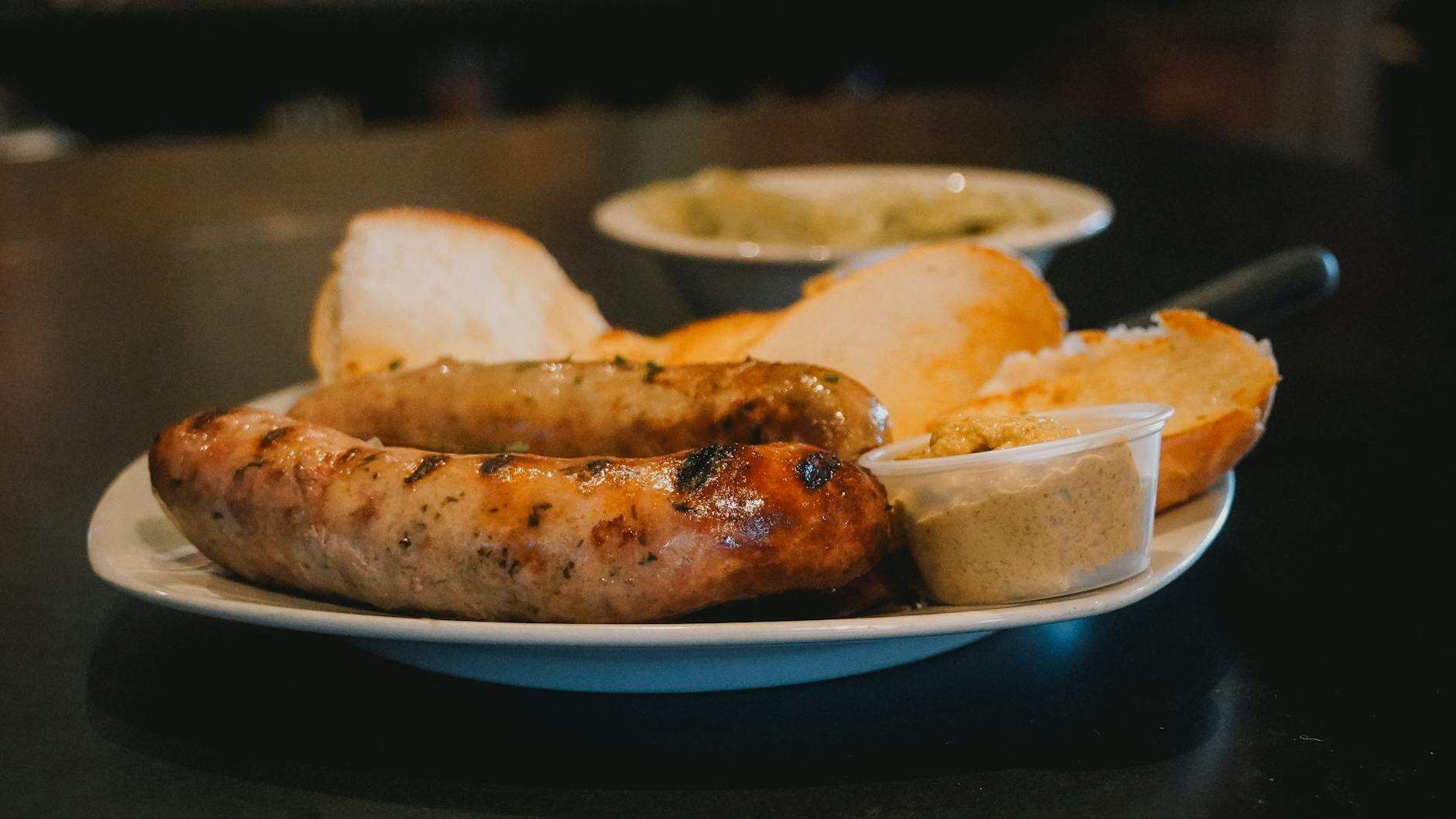
Before noon, two sausages, sweet mustard, a pretzel and a wheat beer. That is a Bavarian breakfast, and every part of it is governed by rules that Münchners follow without thinking and visitors break within thirty seconds of the plate arriving.
The famous one — the Weisswurst must not hear the twelve o’clock bell — is not folklore invented for tourists. It is a food-safety rule from a city without refrigeration, fossilised into etiquette. The sausage was made at dawn, sold raw, carried home and put straight into hot water. By afternoon it was no longer safe, so it was no longer eaten, and a hundred and seventy years later Munich kitchens still stop serving it at midday.
Here is what is in it, how to eat it without being watched, where to get a good one, and the rest of the Bavarian breakfast that nobody writes about.
Weisswurst at a glance
TOKEN_HERO| What it is | A pale, soft veal-and-pork sausage, poached not fried |
| Meat | At least 51% veal, plus pork belly and cooked veal head meat |
| Seasoning | Parsley, onion, mace, lemon, pepper, salt |
| Size | About 12 cm long, 28–32 mm across |
| Cooked | 25 minutes at 70°C — poached, never boiled |
| Served | Two at a time, in their hot water, in a lidded tureen |
| With | Süßer Senf (sweet mustard), a Brezn, a Weissbier |
| When | Before noon. The rule is real and still observed. |
| The skin | You do not eat it. Cut it open or zuzeln. |
| Price | Roughly €6–€10 for two with a pretzel, depending on the room |
| Invented | Legend says 22 February 1857 on Marienplatz. Historians are not so sure. |
What is actually in it
People are often nervous about the colour, which is a pale greyish white rather than the pink of a supermarket sausage. The colour is the point: there is no curing salt and no smoking, which is exactly why it does not keep.
| Component | Detail |
|---|---|
| Veal | At least 51% of the muscle meat. This is the defining requirement. |
| Pork belly | The fat, and most of the texture |
| Cooked veal head meat | Traditional; contributes the gelatinous softness |
| Egg white | Binder |
| Parsley | The green flecks. Fresh, and generously used. |
| Mace | The spice that makes it taste like itself. Nutmeg’s outer husk. |
| Onion, lemon, pepper, salt | The rest of the seasoning |
| Casing | Pig casing — thicker than the sheep casing used for bratwurst |
The texture is the surprise. It is soft, almost custardy, nothing like a coarse bratwurst — closer to a very fine mousse in a skin. The flavour is mild, herbal and slightly lemony, and it wants the sweet mustard to give it any sharpness at all.
You will read that Münchner Weisswurst carries an EU protected-origin designation. I could not confirm that against the Bavarian heritage-food register, which sets out the recipe and the tradition without stating a protection status, so this guide does not claim it.
22 February 1857, allegedly
The story Munich tells about itself goes like this.
On the morning of 22 February 1857, at an inn called Zum Ewigen Licht on Marienplatz, the innkeeper Joseph Moser — Moser Sepp — got up early to make the veal bratwurst his customers expected and discovered he had run out of sheep casings. What he had instead were pig casings, which are thicker and tougher. Knowing they would burst in the pan, he poached the sausages in hot water rather than frying them.
The accident worked. The sausage that came out was pale, soft and delicate, and Munich has been eating it ever since.
It is a very good story and it may not be true. Munich’s own city archivist, Richard Bauer, has argued that the Weisswurst is more plausibly a development of the older Maibock-Wurst and that something very like it existed by 1814 — four decades before Moser’s morning. A precise date and a single inventor make a better plaque than a slow evolution, which is generally how these things go.
Either way, the site is on Marienplatz and the tradition is Munich’s rather than Bavaria’s generally. Our guide to the history of Munich covers the nineteenth-century city that produced it.
The noon rule, and why it survives
Die Weißwurst darf das Mittagsläuten nicht hören — the white sausage must not hear the noon bell. It is the most quoted rule in Bavarian food and it is genuinely observed: kitchens across Munich, including the Hofbräuhaus, stop serving Weisswurst at midday.
The reason was never ceremonial. Weisswurst contains no curing salt, no nitrite, no smoke and no preservative of any kind. It was made in the small hours, sold raw over a butcher’s counter in the morning, carried home and dropped into hot water immediately. In a city with no domestic refrigeration, a raw uncured veal sausage sitting about in the afternoon was a genuine hazard.
Refrigeration solved the problem — a modern Weisswurst keeps for a few days in a fridge — and the rule survived anyway, which is the interesting part. It survived because it had become a marker of belonging. Ordering Weisswurst at two in the afternoon is not dangerous; it simply announces that you are not from here.
Insider tip: the practical consequence is that a Bavarian breakfast is a genuinely good use of a morning you would otherwise waste. Eat at 10:00 or 10:30, not 08:00 — this is a late breakfast, traditionally a second one, eaten between the early shift and lunch. It also pairs neatly with the Viktualienmarkt at its liveliest and gets you to Marienplatz for the Glockenspiel at 11:00.
How to eat one
TOKEN_PLATEThe sausages arrive in a lidded tureen, floating in the water they were poached in. Take them out with a fork; the water is there to keep them hot and is not eaten.
The skin is not eaten. This is the one thing that matters, and there are two accepted ways of dealing with it.
- The polite method. Lay the sausage on the plate, cut it lengthways down the middle with a knife, fold the skin back like a jacket, and lift the meat out in halves with your fork. Dip in mustard. This is what you do in a restaurant and it is what most Münchners do.
- The proper method — zuzeln. Pick the sausage up with your fingers, bite off one end, and suck the meat out of the skin. It is loud, undignified and completely traditional, and it is how the older generation still does it. Nobody will object; some will approve.
A third method exists and is wrong: cutting the sausage into rounds and eating skin and all. It is not dangerous, but it is the culinary equivalent of eating a banana without peeling it.
The mustard is not optional. Süßer Senf — sweet mustard, coarse, brown, sugary and a little tangy — is a different product from any mustard sold outside Germany, and Weisswurst without it tastes underseasoned because it is. The standard brand on almost every Munich table is Händlmaier, and a jar of it is a considerably better souvenir than a printed T-shirt. See our Munich souvenirs guide.
The other two thirds: pretzel and wheat beer
A Weisswurst on its own is a snack. The breakfast is three things.
The Brezn. A Bavarian pretzel is not the crisp American snack — it is a soft, chewy bread pretzel with a dark lye crust and a thick belly, coarse salt on top, best eaten within about four hours of baking. Split it, butter it if you like, and use it to mop mustard. A good one costs about a euro and a bad one is still fine.
The Weissbier. Wheat beer, half a litre, cloudy, banana-and-clove in the aroma, and yes, at half past ten in the morning. This is entirely normal in Munich and nobody will look at you twice. If you would rather not, the accepted alternative is an alkoholfreies Weissbier, which Bavaria takes seriously and does very well, or a coffee, which is tolerated.
Order a Halbe — a half litre — rather than a Maß. Wheat beer is served in half-litre vase glasses by convention and asking for a litre of it marks you out more than the noon rule ever will. Our Munich food and beer guide covers the styles.
Where to eat it in Munich
TOKEN_MARKET| Where | Why |
|---|---|
| Weisses Bräuhaus, Tal | The city-centre benchmark. Small, old, busy, and it takes the sausage seriously. Two minutes from the Hofbräuhaus and a much better room. |
| Viktualienmarkt | Butchers’ stalls and small counters. Cheapest, quickest, and you eat standing up like everybody else. |
| A neighbourhood Wirtshaus | Haidhausen, Schwabing, the Au — anywhere with a handwritten Brotzeit board. This is where it is best and least performed. |
| Hofbräuhaus | Serviceable, and the room is the draw rather than the food. Go at 11:15 and see our Hofbräuhaus guide first. |
| A Metzgerei (butcher) | The purist option. Buy two, ask for them warm, eat them off paper. |
The one to avoid is any restaurant on a main tourist street advertising Weisswurst in four languages on a photograph menu. It will be reheated, it will be served at three in the afternoon, and it will be the version that gives the dish a bad name. Our guides to the best restaurants in Munich and cheap eats both steer around them, and a food tour is a decent shortcut if you would rather be shown.
The rest of the Bavarian breakfast
Weisswurst is one option on a broader spread of morning and mid-morning food that Bavaria calls Brotzeit — literally bread time, meaning a cold or light meal eaten outside proper mealtimes.
- Leberkässemmel. A slab of hot Leberkäs — a fine-textured baked meatloaf that contains no liver and no cheese despite the name — in a bread roll with mustard. About €4, sold everywhere, and the single best cheap breakfast in Munich.
- Obatzda. Ripe Camembert mashed with butter, paprika, onion and a splash of beer, eaten with bread or a pretzel. Around €9 as a plate. Also the standard beer-garden order.
- Wurstsalat. Sliced sausage, onion, vinegar and oil. Sharper than it sounds and very good on a hot morning.
- Radi. A white radish spiralled on a special cutter, salted until it weeps, eaten with beer.
- Semmeln and cold cuts. The ordinary German breakfast, and what most Münchners actually eat on a Tuesday.
The full picture is in our traditional Bavarian food guide, and Munich street food covers the stand-up end of it. Vegetarians should note that a Bavarian breakfast is not naturally accommodating — Obatzda and pretzels are the honest answer, and vegetarian and vegan Munich has the better addresses.
Making it at home
You will not make Weisswurst at home unless you own a bowl chopper, but you can cook one properly, and cooking one badly is how most people outside Bavaria form a poor opinion of the dish.
- Never boil it. This is the whole rule. Bring water to the boil, take the pan off the heat, then put the sausages in and leave them for about ten minutes.
- The target is roughly 70°C, held for around 25 minutes in commercial production. Boiling water splits the casing and turns the filling rubbery.
- Do not prick them. Ever.
- Serve them in the water, in a covered dish, and take them out one at a time so the second stays hot.
- Sweet mustard is not substitutable. Dijon, English mustard and wholegrain are all wrong in different directions. If you cannot get süßer Senf, honey stirred into a mild mustard is a rough approximation.
The other half of the Bavarian breakfast is far more portable. A good bakery pretzel and a bottle of Weissbier will get you most of the way, and both are widely available outside Germany now.
Five ways visitors get it wrong
| The mistake | What to do instead |
|---|---|
| Eating the skin | Cut it lengthways and fold it back, or zuzeln |
| Ordering it at 15:00 | Eat before noon. Kitchens stop serving anyway. |
| Asking for ketchup | Süßer Senf. It is on the table already. |
| Ordering a Maß of wheat beer | A Halbe. Wheat beer comes in half-litre glasses. |
| Eating the poaching water | It is there to keep the sausages hot. Leave it. |
| Choosing a photo-menu restaurant | A neighbourhood Wirtshaus, a market counter or the Weisses Bräuhaus |
One more that is worth its own line: do not order a Weisswurst as a starter before a main course. It is not an appetiser, it is a meal, and it belongs at half past ten in the morning rather than at the front of a dinner. Ordering two of them at 19:00 in a beer hall is the clearest possible signal that you have read about the dish rather than eaten it. Our Munich travel tips guide collects the other conventions worth knowing before you arrive.
The Weisswurst equator
Germans joke about the Weißwurstäquator: an imaginary line north of which the sausage, the sweet mustard, the wheat beer and a certain cast of mind all cease to exist. Some place it at the Main, some at the Danube, some — with false precision — at the 49th parallel. Several towns have erected markers claiming to sit on it.
It is a joke that carries a real point. Bavaria is a distinct place with its own dialect, its own Catholic calendar, its own political party and its own food, and it spent most of its history as a separate kingdom rather than a German province. Visitors who arrive expecting generic Germany are frequently thrown by how specifically Bavarian Munich is — see our guide to Bavarian traditions, and German phrases for Munich for the dialect you will actually hear.
The Weisswurst sits right at the centre of that. It is a Munich dish with a Munich rule, eaten to a Munich clock, and taking part in it properly for twenty minutes on a weekday morning tells you more about the city than an afternoon in most of its museums.
Frequently Asked Questions
What is Weisswurst made of?
At least 51% veal of the muscle meat, plus pork belly, cooked veal head meat and egg white, seasoned with parsley, onion, pepper, mace, lemon and salt. No curing salt, no nitrite and no smoke, which is why it is pale and why it does not keep.
Why can’t you eat Weisswurst after noon?
Originally for safety: it was made at dawn, sold raw, and had no preservatives, so an afternoon sausage was a genuine risk in a city without refrigeration. Modern production removed the danger and the rule stayed as a custom. Munich kitchens still stop serving it at midday.
Do you eat the skin?
No. Either cut the sausage lengthways and fold the skin back, or pick it up and suck the meat out — a technique called zuzeln. Slicing it into rounds and eating the casing is the mistake visitors make most often.
What do you drink with it?
A half-litre of Weissbier, wheat beer, at whatever hour of the morning you are eating. An alcohol-free Weissbier is a completely respectable substitute and Bavaria makes very good ones. Coffee is tolerated but is not the tradition.
How much does a Weisswurst breakfast cost?
Roughly €6 to €10 for two sausages with a pretzel, plus about €5 for the beer, depending on where you sit. At a Viktualienmarkt counter or a butcher it is cheaper; in a famous beer hall it is more. It remains one of the cheapest good meals in the city centre.
Where was Weisswurst invented?
By tradition, at the inn Zum Ewigen Licht on Marienplatz on 22 February 1857, when the innkeeper Joseph Moser ran out of sheep casings. Munich’s city archivist has questioned the story, suggesting the sausage evolved from the older Maibock-Wurst and existed by around 1814. The 1857 version is the one on the plaques.
Will children eat it?
Often, yes — it is mild, soft and not spicy, and the sweet mustard helps. The pretzel is a guaranteed win. Cut the skin off for them rather than teaching a five-year-old to zuzeln in a restaurant. Our Munich with kids guide has more on eating out with children.
Can I take Weisswurst home?
Fresh Weisswurst keeps only a few days refrigerated, so it is not a realistic souvenir unless you are driving. Vacuum-packed and tinned versions exist and are a shadow of the fresh article. Take a jar of Händlmaier sweet mustard instead — it travels, it lasts, and it is the part you cannot buy at home. See Munich food shopping.
Where to go next
Start with the Munich food and beer guide for the wider picture, then traditional Bavarian food for the dishes and the beer halls and breweries for where to eat them. If you are fitting breakfast into a short trip, one day in Munich and two days in Munich both start at the Viktualienmarkt at half past eight, which is exactly the right place to be.