Viktualienmarkt Munich: Complete Guide to the Famous Food Market
Tour Viktualienmarkt Munich. What to eat, must-try stalls, beer garden, opening times, tips for first visit.
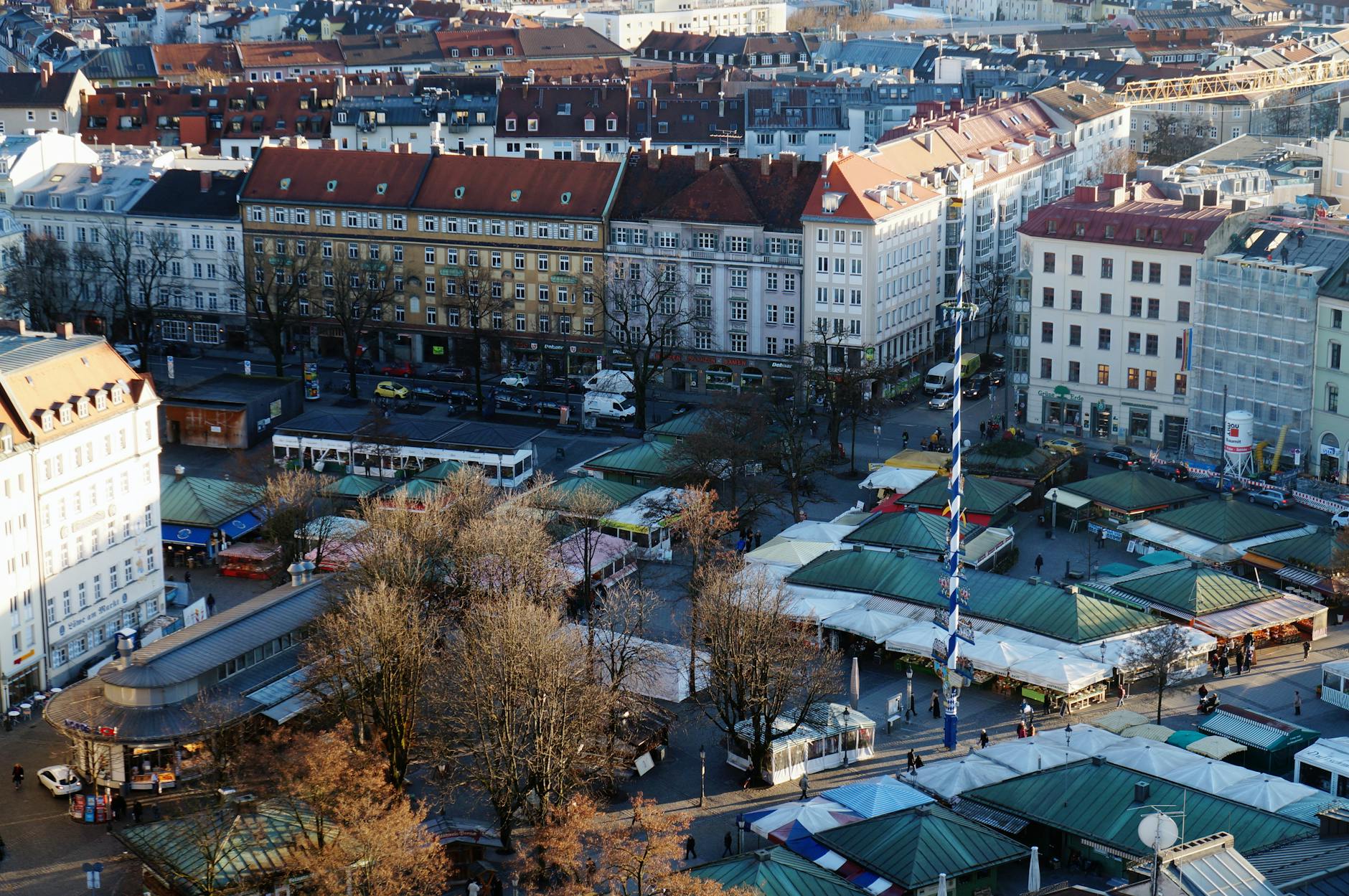
Viktualienmarkt Munich is the city’s central daily food market and the closest thing the Altstadt has to a living room. Tucked between Marienplatz and the Isar, it has been Munich’s open-air pantry since 1807 — more than 200 years of cheese stacks, flower buckets, sausage smoke, and the unmistakable chatter of Müncheners shopping for dinner. More than 100 stalls cover 18,591 square metres around a blue-and-white Maibaum and a beer garden where six city breweries take turns pouring. This 2026 guide walks you through the must-try stalls, what to order standing up, how the rotating beer garden works, opening times, history, etiquette, and a 45-minute tasting loop you can do hungry and leave very full.
Viktualienmarkt Munich Quick Facts
| Detail | What to Know |
|---|---|
| Address | Viktualienmarkt 6, 80331 München (Altstadt) |
| Nearest U/S-Bahn | Marienplatz (S1–S8 and U3/U6) — 3 minutes on foot |
| Size | ~22,000 m² of permanent open-air market |
| Number of stalls | Around 110 permanent traders |
| Opening hours | Mon–Sat ~7:00–20:00, individual stalls vary; many close around 18:00 |
| Sundays | Closed (you can still walk through; nothing is trading) |
| Beer garden | ~600 seats, six rotating breweries, open daily Apr–Oct + warm winter days |
| Toilets | Public WC at the market (small fee, ~€0.50–€1) |
| ATM | Yes, several around the perimeter and on Tal/Marienplatz |
| Family-friendly | Yes — kid-friendly food, fountains, Maibaum, open space |
| Accessibility | Mostly step-free but heavily cobbled; manageable with care |
| Typical lunch spend | €15–€25 per person for full snacks and a drink |
A 200-Year-Old Market: The History of Viktualienmarkt Munich
The market was born from overcrowding. By the early 1800s, Munich’s farmers’ market on Marienplatz had outgrown its own square — produce carts, livestock, and flower wagons jammed the cobbles right under the Town Hall. On 2 May 1807, King Maximilian I Joseph issued a royal decree relocating the trade to a larger site between the Heiliggeistkirche and Frauenstraße. That decree is why the Viktualienmarkt Munich still trades in the same spot today.
The name came later. “Viktualien” derives from the Late Latin victualia — provisions, the old word for food. The market survived Munich’s 19th-century industrial overhaul, weathered the 1944 Allied bombing that flattened much of the Altstadt, and was rebuilt stall by stall in the post-war years. Today its character is legally protected: the city of Munich classifies the Viktualienmarkt as a cultural monument and runs it through a dedicated market authority. A 2018 city council resolution approved a long-term renovation plan specifically designed to keep the small artisan traders in place — a quiet local victory against the gentrification that has emptied so many European city-centre markets.
The Layout: How to Read the Market
Viktualienmarkt Munich isn’t laid out on a grid; it sprawls in clusters. Pin the Maibaum in your mental map — everything radiates from there.
- Maibaum and beer garden: dead centre. This is your landmark and your sit-down anchor.
- Fruit and vegetable stands: ring the beer garden, busiest from the morning. Look for the brown wooden booths with stacked produce.
- Cheese row: the south-eastern stretch — Käse Bauer, Frische Paradies, and several Alpine specialists in a tight cluster.
- Butcher and sausage row: along the eastern edge — Schlemmermeyer, Bauernsalami, Geflügel-Knoll, and the Bratwurstherzl lunch counter.
- Fish stand: by the Pfistermühle side — Nordsee and a small group of fishmongers under refrigerated counters.
- Flower stalls: framing the western side and along Frauenstraße — Munich’s florists shop here.
- Spice merchants and delicatessens: tucked between produce stands — Tom Riedel Gewürze and the olive booths are the showstoppers.
- Fountains: seven of them, each topped with a bronze of a beloved Munich folk performer — Karl Valentin, Liesl Karlstadt, Weiss Ferdl, Ida Schumacher, Elise Aulinger, Roider Jackl. They double as the easiest meeting points.
The Maibaum: Munich’s Most Famous Maypole
The Maibaum at the centre of the Viktualienmarkt Munich is one of the city’s most photographed objects. Painted in the white-and-blue diagonal stripes of the Bavarian flag, it stands roughly 30 metres tall and is hung with carved figural panels showing scenes from Munich life: a horse-drawn beer cart, the Schäfflertanz (coopers’ dance), Oktoberfest carousels, musicians, the Münchner Kindl, and the brewers’ patron saints Boniface and Florian.
The first Maibaum here was donated by Munich’s breweries in May 1962 and has been replaced several times since. The maypole erection on or before 1 May is a ceremony with music, beer, and brass bands. The other half of the tradition is mischief: in the weeks before May Day, neighbouring districts try to steal each other’s Maibäume. If a rival group succeeds before the pole is raised, the owners must “buy it back” with beer and food. The Viktualienmarkt pole is sometimes guarded overnight.
The Viktualienmarkt Beer Garden: Six Breweries, One Tap
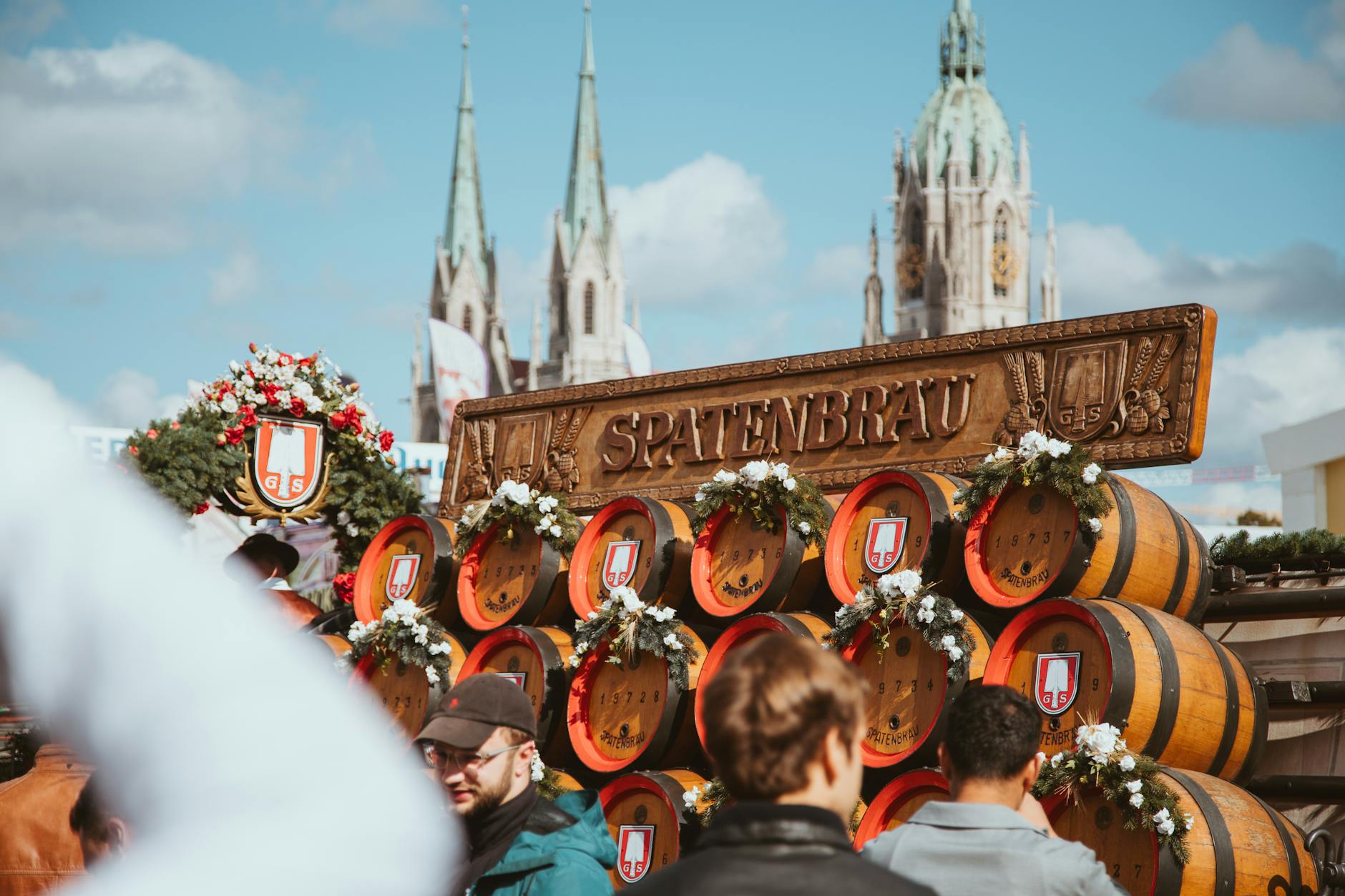
The Viktualienmarkt beer garden sits right under the Maibaum, sheltered by old chestnut trees. It has roughly 600 covered seats (some sources put the wider capacity around 1,100 with the outer fringes), and its defining feature is the rotating brewery system. All six Munich city breweries — Augustiner, Hacker-Pschorr, Hofbräu, Löwenbräu, Paulaner, and Spaten — take turns supplying the beer. The tap changes every six weeks or so, the brewery sign over the bar flips, and the regulars adjust their orders accordingly. There’s no other beer garden in Munich where you can taste every city brewery from the same bench across a single summer.
Opening hours are roughly 9:00–22:00, closed Sundays, weather-dependent. Full season runs April through October. As at every classic Munich beer garden, the rule is bring your own food, buy drinks at the bar — and that rule is the secret to the Viktualienmarkt beer garden experience. Pick up a Wurstsemmel from Schlemmermeyer, a Vesper board from Vesperkönig, cheese from Käse Bauer, and a fresh Brez’n, then carry the lot to a free table and buy a Maß. See our guide to Munich’s best beer gardens for more.
Must-Visit Stalls at the Viktualienmarkt Food Market
You won’t visit every stall. With 110 traders you’d run out of stomach before pavement. Here are the twenty that most reward a first-time visitor — what they’re famous for, what to order, and roughly what to pay.
1. Münchner Suppenküche (Schmankerl-Markt) — Soups
A market institution for hot, hearty soups, served standing at a small counter. The signature is Bavarian Leberknödelsuppe (a fat liver dumpling in clear beef broth), but the rotating menu runs from Pfannkuchensuppe (sliced pancake in broth) to Gulaschsuppe and a vegetarian seasonal option. €6–€9. Best on a cold day.
2. Caspar Plautz — Potatoes
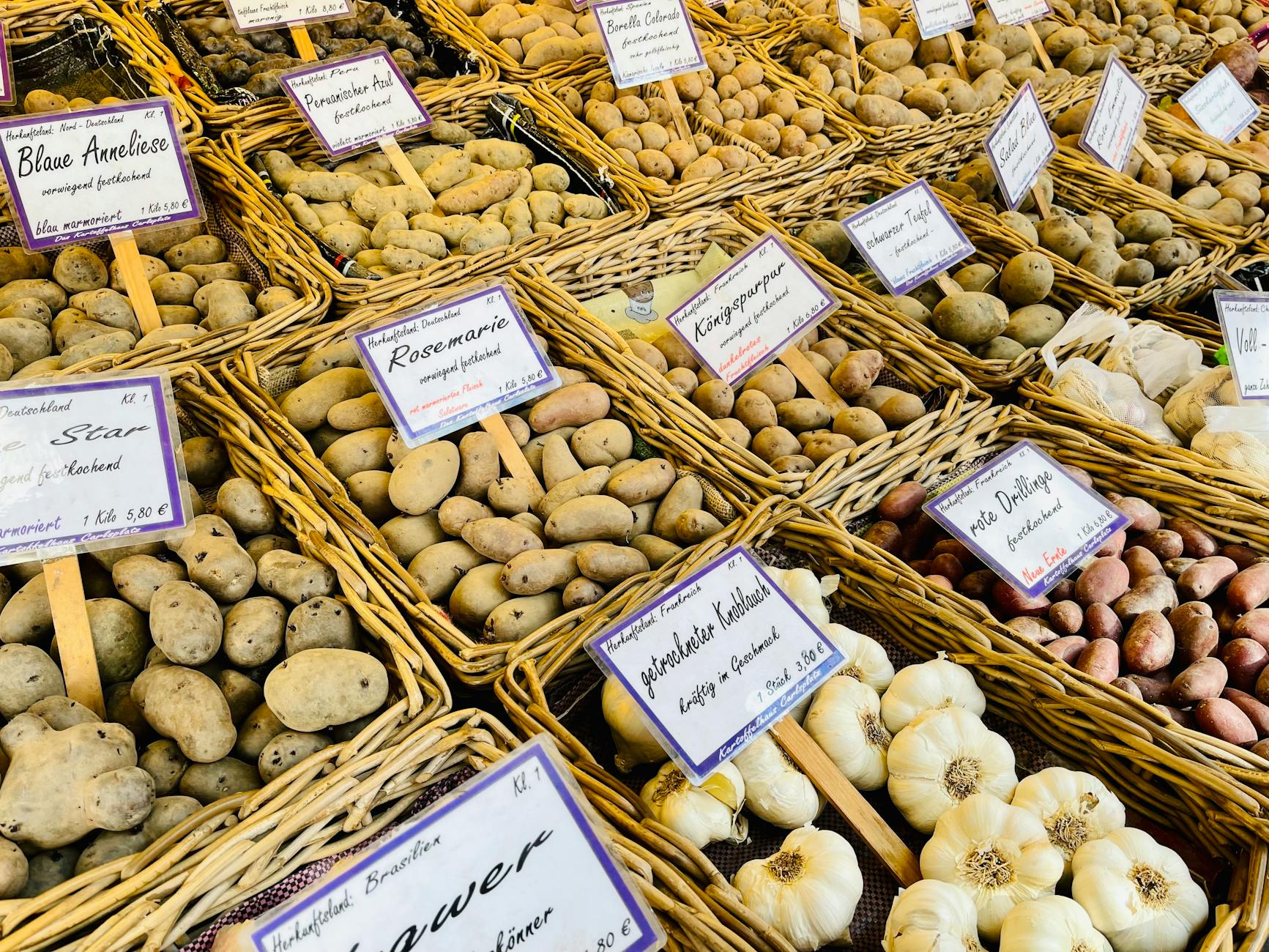
Yes, a whole stall for potatoes — and one of Munich’s most beloved lunch counters. Theo Lindinger and Dominik Klier build composed lunches around a hot heirloom potato, a topping (the shakshuka is the cult favourite), and a fresh salad. Kitchen opens at noon; best items run out by 13:30. Cash only. €8–€12.
3. Münchner Kindl Senf — Mustards
A family business making regional organic mustards for 35+ years, heir to a Viktualienmarkt mustard-making lineage from around 1920. The süßer Senf is mandatory; horseradish, fig, garlic, and Weißbier variants make great gifts. €4–€7 a jar.
4. Geflügel-Knoll — Roast Chicken
A century-old poultry stall whose rotisserie chickens (Hendl) are the lunchtime equal of any Oktoberfest tent. Half a roast chicken with potato salad runs about €11; whole birds, ducks, and game birds available to take home. The crackling is the giveaway — listen for the spit and look for the queue.
5. Frische Paradies — Cheese and Delicacies
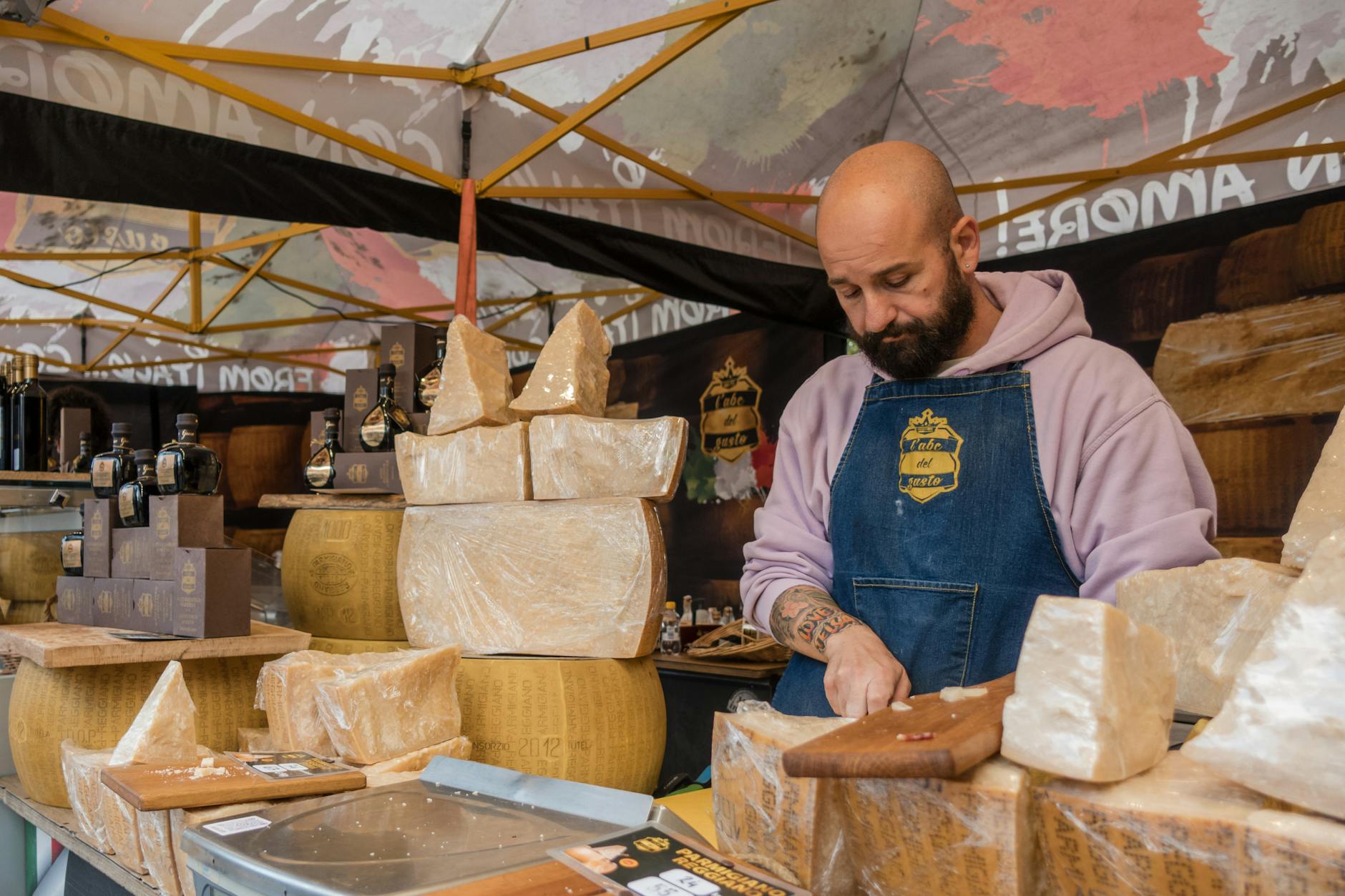
A serious cheese counter with Alpine wheels, fresh ricotta, ash-coated chèvre, and aged Comté. They’ll cut to order — ask for a small piece (“ein kleines Stück, bitte”) and they’ll happily wedge off as little as 50 g for a beer-garden picnic. €4–€10 a portion.
6. Käse Bauer — French and Swiss Cheese
The francophile of the Viktualienmarkt cheese row, with rotating French specialties: Brie de Meaux, Reblochon, Roquefort, Munster, raw-milk Comté. Switzerland is well represented too — proper raw-milk Gruyère, aged Sbrinz. Knowledgeable staff, generous tastes. €5–€15 a portion.
7. Honig-Häusl — Honey
Bavarian honey from small apiaries — chestnut, Alpine flower, lime blossom, forest honey, and a famous strong dark honey. Jars €6–€14. They also stock beeswax candles, mead, and propolis.
8. Schlemmermeyer — Sausages
The classic Wurst stall. Grilled Bratwurst in a fresh Semmel with sweet mustard for €3.50–€4.50 — Munich’s best-value lunch. Hundreds of cold sausages, Salami, and Bavarian charcuterie behind the glass; they vacuum-pack for travel.
9. Bratwurstherzl am Viktualienmarkt — Bratwurst Counter
The sit-down option — a tiny wood-panelled counter spilling into the market, grilling Nürnberger Bratwurst over beechwood. Order “sechs Nürnberger mit Kraut” and a Helles. €11–€16. One of Munich’s most authentic short lunches.
10. Eis Sarcletti — Italian Gelato
Munich’s most famous gelateria has a satellite at the Viktualienmarkt. Pistachio, stracciatella, Amarena, and seasonal sorbets — a single scoop around €2, two-scoop cone around €4. Long queues in summer; they move fast.
11. Schubeck’s Delicatessen Annex
Star Munich chef Alfons Schubeck’s spice and deli outpost. Pre-blended mixes, gourmet condiments, tinned specialities. Pricey, gift-shoppy. €5–€25.
12. Heimeranbäck — Bread
The market’s standout bakery: dark rye, sourdough, sunflower-seed loaves, plus the obligatory rack of warm Brez’n. The walnut bread (Walnussbrot) is the local picnic standard. €2–€7 per loaf, Brez’n €1.20.
13. The Olive Market
A multi-stall corner of Greek, Italian, and Provençal olives, tapenades, stuffed peppers, sundried tomatoes, and antipasti by weight. Free tastes are normal; ask. €3–€8 per portion.
14. Vesperkönig — Vesper Boards
The Vesper specialist — wooden boards of regional cheeses, hams, sausages, pickles, and bread to take to the beer garden. Pre-built boards from €12; bespoke from €15. The smartest single purchase if you want a quick Viktualienmarkt picnic without curating it yourself.
15. The Fish Market (around Pfistermühle)
Fresh fish, oysters, smoked salmon, and Bavarian river fish (Renken from the lakes, Forelle). The fried-fish-sandwich (Backfischsemmel) and smoked-salmon Brötchen are the walk-and-eat picks at €5–€8. Closed earlier than the rest of the market — visit before 17:00.
16. Tom Riedel Gewürze — Spices
Open glass jars of saffron, sumac, vanilla pods, peppercorns from twelve origins, mole-mix, Bavarian “Brez’nsalz” (pretzel salt). The aroma alone is worth the stop. Spices €3–€15 per packet; saffron pricier.
17. Münchner Stadtbier
The city-bottled craft beer stand — Munich-brewed Helles, Pils, dark beers, and rotating seasonal kegs from smaller producers outside the big six. Bottles €3–€5, growler refills available. A useful counterweight to the rotating-brewery beer garden if you want something experimental.
18. Bauernsalami
A specialist farm-sausage and dry-cured-salami counter — Bavarian wild boar, venison, beef-and-pork classics, and chilli, herb, and nut-studded varieties. They slice paper-thin to order. €4–€10 per portion. Great souvenirs.
19. Glühwein Stand (Winter)
From the first cold weeks of November through Christmas, a Glühwein stand and a Punsch counter take over a small corner of the market. €4–€5 a mug plus the refundable cup deposit. A more local alternative to the Marienplatz crush.
20. The Lieferhof and Fruit Specialists
Fruit and exotic-produce specialists at the market’s edge stock Bavarian strawberries in early summer, dragon fruit, fresh figs in autumn, and three varieties of mango. A peach costs more than a supermarket bag but tastes like the platonic ideal of a peach. €1–€4 each.
What to Eat: A Walking Snack Menu
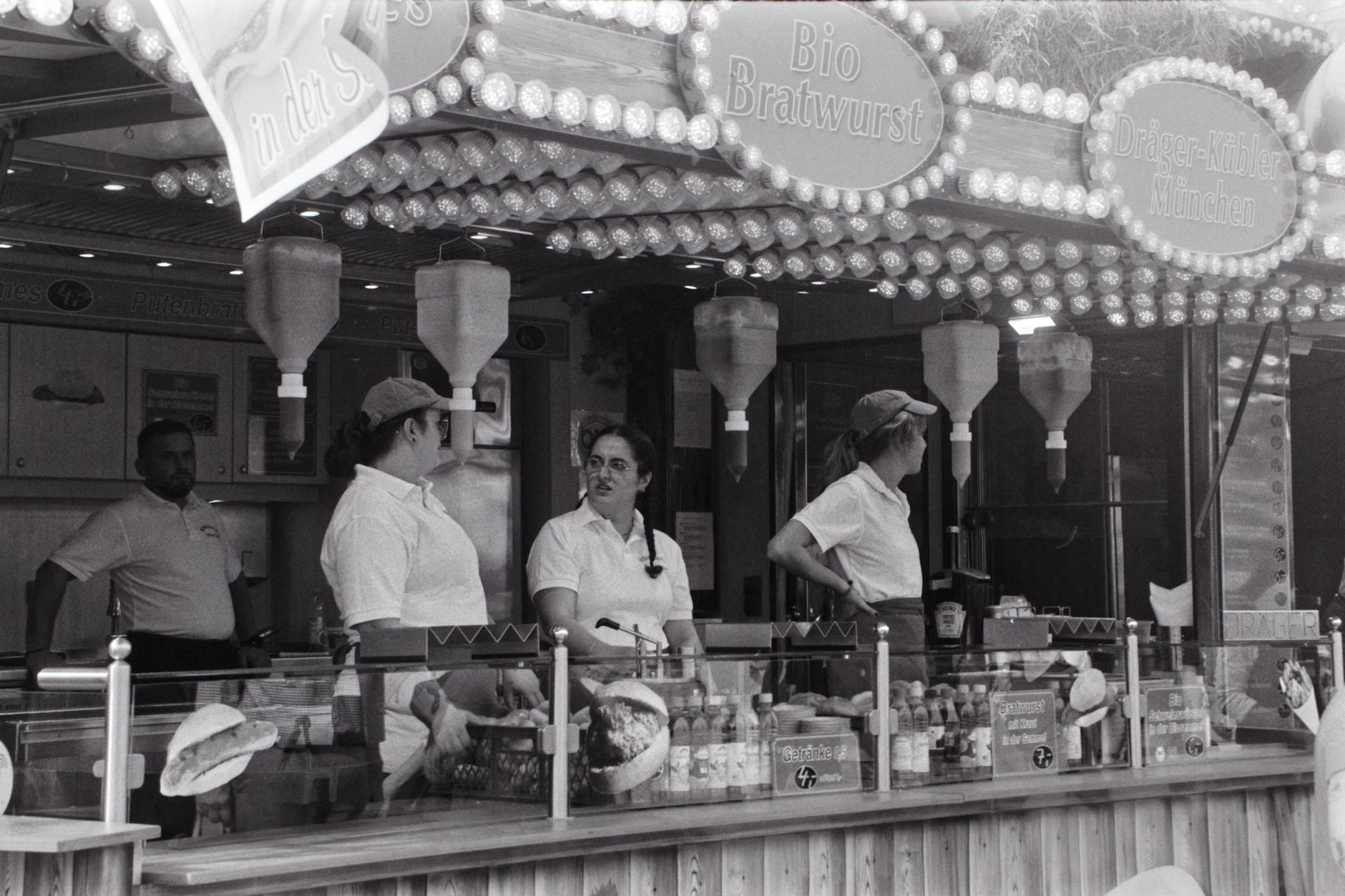
The point of the Viktualienmarkt is to graze. Resist the urge to sit down with a proper meal — eat in small, mobile bites instead, and you’ll cover more flavours in an hour than a single restaurant lunch will give you in two.
- Wurstsemmel: a grilled Bratwurst or Leberkäse in a fresh roll with sweet mustard. From Schlemmermeyer or one of the butcher stalls. €3.50–€5.
- Brez’n: a warm Bavarian pretzel from Heimeranbäck — plain, with butter (Butterbrez’n), or split with ham and cheese. €1.20–€4.
- Käsesemmel: a fresh roll built around a cut of Bergkäse or Camembert — order at any cheese counter or build your own with bread from Heimeranbäck.
- Suppe: Leberknödelsuppe or Gulaschsuppe at Münchner Suppenküche. €6–€9, especially on a cold day.
- Reiberdatschi: potato pancakes with apple sauce, available seasonally — €4–€6 for two.
- Schmalznudel: the Bavarian hand-stretched doughnut at Café Frischhut, just around the corner on Prälat-Zistl-Straße — Munich’s most famous market-edge snack. €2.50.
- Gelato: two scoops at Eis Sarcletti. €4.
What to Buy: Edible Souvenirs from the Food Market in Munich
The Viktualienmarkt food market is the single best place in Munich to buy edible souvenirs that aren’t tacky. A few highlights worth a suitcase corner:
- Münchner Kindl Senf — a jar of sweet Bavarian mustard, around €5
- Bavarian honey from Honig-Häusl — chestnut or Alpine flower, €8–€12
- Vacuum-packed Bauernsalami — wild-boar or venison, travel-safe, €8–€15
- A whole wheel of aged Alpine cheese — vacuum-sealed for travel at Käse Bauer or Frische Paradies, €15–€40
- Schnaps — Bavarian Williamsbirne (pear), Zwetschge (plum), or Obstler from a specialist spirits stall, €15–€35
- Spice blends — Bavarian Brez’nsalz, the Viktualienmarkt house mix at Tom Riedel, €4–€8
- Lebkuchen and chocolate — especially in autumn and Advent
Best Time to Visit Viktualienmarkt Munich
The market has three different personalities depending on when you arrive.
- Saturday morning (9:00–13:00): electric. Locals do the weekly shop, the beer garden warms up by 11:00, brass bands play, and every stall is fully stocked. The best photographs and the densest atmosphere — also the busiest.
- Weekday lunchtime (11:30–14:00): office workers fill the standing counters, Caspar Plautz queues form, and the beer garden hums. Easier than Saturday but still full of life.
- Tuesday or Wednesday early morning (7:00–10:00): the quietest version of the market. Traders have time to chat, you can ask questions, and the produce is freshest. Best for shopping rather than atmosphere.
- Late afternoon (16:00–19:00): winding down. Many stalls start packing up by 18:00, but the beer garden runs into the evening and the Maibaum lights catch the sunset. Romantic if you go for drinks, not for shopping.
- Friday: Munich’s traditional fish day — the fish stalls are at their best, and the market often hosts small special events such as wine tastings, regional producer days, and the August Fountain Festival.
A Suggested 45-Minute Market Tour
A tested Munich market tour you can do hungry and leave full — eight stalls, ending with a beer. Bring €30 in cash.
- 0–5 min — Heimeranbäck: warm Brez’n in hand (€1.20). Eat as you walk.
- 5–10 min — Schlemmermeyer: grilled Wurstsemmel with sweet mustard (€4).
- 10–15 min — Frische Paradies or Käse Bauer: 50 g aged Alpine cheese (€3–€4) — eat or save.
- 15–20 min — Tom Riedel Gewürze: sniff your way through the spice jars, buy a small packet (€4).
- 20–25 min — Honig-Häusl: taste two honeys, buy a small Alpine flower jar (€6–€8).
- 25–30 min — Caspar Plautz (if before 13:30): grab the loaded-potato lunch of the day to share (€10).
- 30–35 min — Münchner Kindl Senf: taste and buy a jar of sweet mustard (€5).
- 35–45 min — Beer garden: buy a Maß or Helles (€5–€9) and sit under the Maibaum with everything you’ve collected. Finish with a scoop of Sarcletti gelato (€2) on the way out.
Prefer a guide? Several of the tasting walks in our Munich food tours guide start at or pass through the Viktualienmarkt.
Shopping Etiquette and German Phrases
The Viktualienmarkt rewards a little German and a little patience. The traders are mostly second- or third-generation locals who appreciate visitors who play by the rules.
- Queue properly: Munich queues without forming visible lines. Make eye contact with the trader, mark your place, and wait your turn.
- Don’t touch the produce: Point and let the seller pick. Touching is for supermarkets, not for markets.
- Bring small bills and coins: Most food stalls are cash-only or strongly prefer cash; the beer garden bar takes card.
- Weights: “ein Pfund” (a pound) = 500 g. “ein Kilo” = 1 kg. “hundert Gramm” = 100 g. “ein Achtel” = 125 g — the cheese-counter standard.
- Tastes are free: Ask politely (“Darf ich probieren?”) and you’ll usually be offered a sliver of cheese, sausage, olive, or honey.
Useful Market German
- Grüß Gott! — the Bavarian greeting. Use it on arrival.
- Ein Pfund Kartoffeln, bitte. — A pound of potatoes, please.
- Ein kleines Stück, bitte. — A small piece, please.
- Darf ich probieren? — May I try?
- Was kostet das? — How much is that?
- Das war’s, danke. — That’s all, thanks.
- Pfiat di! / Servus! — Bavarian goodbyes.
Combining the Market with Nearby Sights
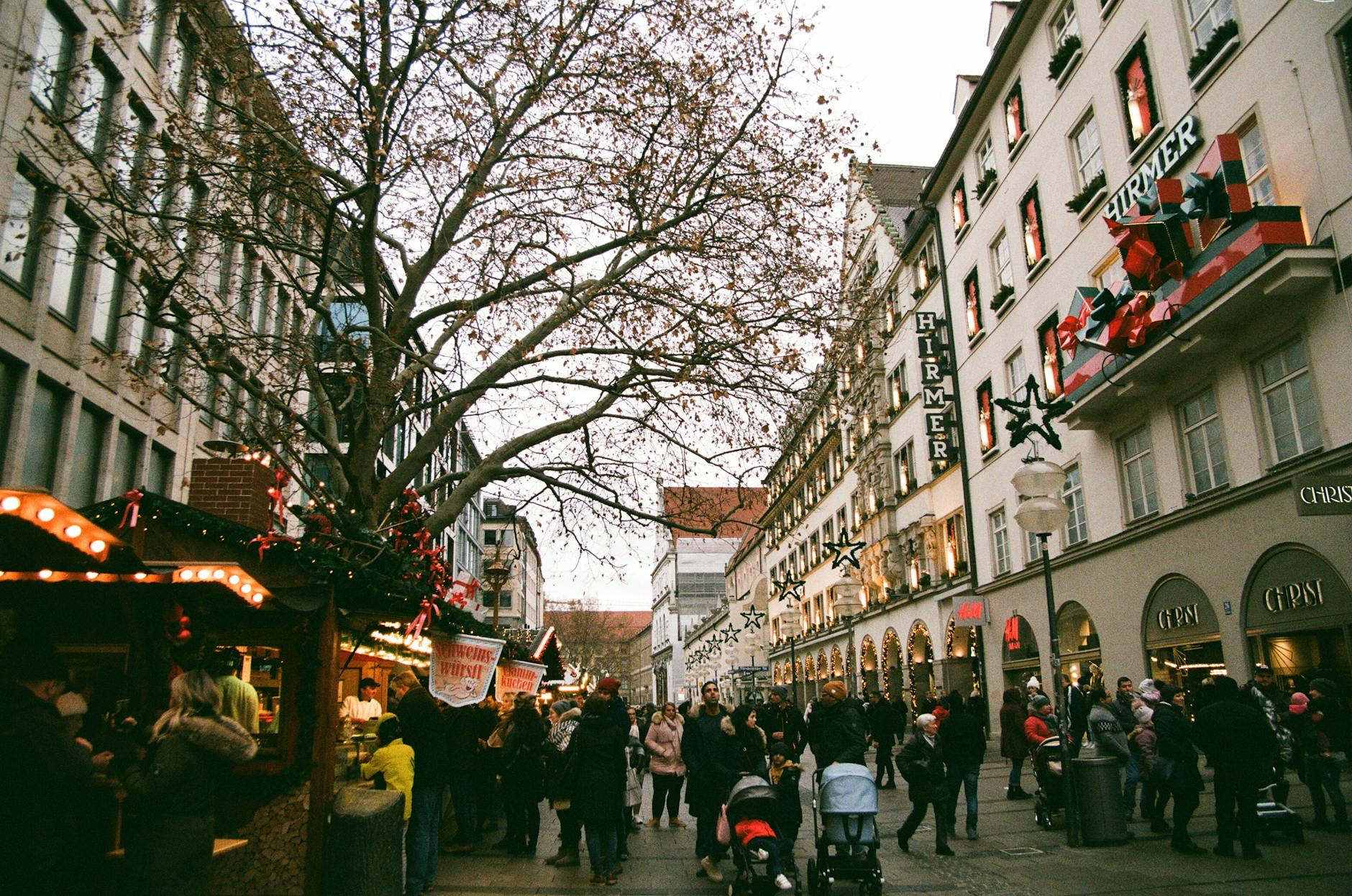
Viktualienmarkt Munich sits in the densest tourist quarter of the city. Five sights are within five minutes’ walk:
- Marienplatz (2 minutes): the Town Hall, the Glockenspiel, and the heart of Munich. Time your visit for 11:00 or 12:00 to catch the carillon, then walk to the market for lunch. See our Munich landmarks guide.
- Alter Peter (St Peter’s Church) — right next door: climb the 306 steps of the tower for the best ground-level view in Munich — including a bird’s-eye over the Viktualienmarkt itself, with the Maibaum dead centre and the beer garden a green smudge of chestnut trees. €5 entry, open daily.
- Heiliggeistkirche: the Holy Spirit Church on the market’s northern edge, the original anchor of the 1807 decree. Free entry; ten minutes is enough.
- Frauenkirche (8 minutes): the twin-domed cathedral that is Munich’s silhouette. Free entry; climb the south tower for a different angle on the city.
- Altstadt-Lehel district: the wider neighbourhood is a half-day in itself — see our Altstadt-Lehel guide.
With Kids at the Viktualienmarkt
Viktualienmarkt Munich is genuinely kid-friendly. Children love the open space, the fountains, the Maibaum, and a parade of approachable snacks: sweet pretzels, small Knödel, chocolate-dipped fruit, child-sized cones at Eis Sarcletti. The beer garden welcomes children at all hours and wide tables suit strollers. Public toilets include baby-changing space. The climb up Alter Peter next door makes a good energy-burner after lunch.
Accessibility
Viktualienmarkt Munich is largely step-free at the main access points, and the central plaza around the Maibaum is broadly flat. Much of the surface is uneven historic cobblestone, however — hard work for wheelchairs and strollers, so plan a slower pace. The beer garden has fixed bench seating with limited gaps for wheelchairs but staff help if asked. Marienplatz U-Bahn has lifts; the walk to the market is short and flat.
Winter vs Summer Experience
The Viktualienmarkt is open year-round, but the two seasons feel like different markets.
Summer (May–September) is the peak: chestnut trees in full leaf, the beer garden in constant use, strawberries and Spargel (white asparagus) piled high in May, sunflowers and dahlias overflowing the flower stalls, gelato queues at Sarcletti, and brass bands at weekends. Eat outside; linger.
Winter (November–February) is quieter and more Bavarian. The Glühwein stand opens, the beer garden often closes (re-opens on warm days), lights string up during December’s “Winterzauber,” and hot soup at Münchner Suppenküche becomes the point of a visit. Game, mushrooms, and roast chestnuts make winter the under-rated foodie season.
Cash vs Card, Toilets, and Other Practicalities
- Cash vs card: Most food stalls are cash-only or strongly prefer cash. The beer garden bar takes card. Bring €30–€60 in small notes and coins.
- Toilets: Central public WC at the market (€0.50–€1), plus toilets in nearby cafés and the Schrannenhalle next door.
- ATMs: Several on Tal, Sendlinger Straße, and at Marienplatz — under five minutes’ walk.
- Budget: Full grazing visit €15–€25 per person; sit-down lunch at Bratwurstherzl plus a beer €18–€25.
- Bags: Bring a tote. Plastic bags cost money.
- Dogs: Welcome around the market and in the beer garden on a lead.
Frequently Asked Questions
Is the Viktualienmarkt open on Sundays?
No. The market follows the German Sunday-closure tradition — all stalls are closed and the beer garden does not trade. You can still walk through the empty square, but for any actual shopping or eating, visit Monday through Saturday.
Cash or card at the Viktualienmarkt?
Cash is strongly preferred. Most food stalls don’t take cards; some larger ones now accept contactless. The beer garden bar takes card. Bring €30–€60 in small notes and coins for a comfortable visit.
What’s the best food to eat at the Viktualienmarkt?
If you only eat three things: a grilled Wurstsemmel from Schlemmermeyer, a loaded potato from Caspar Plautz (before 13:30), and a Schmalznudel from Café Frischhut right around the corner. Add a fresh Brez’n, a slice of aged Alpine cheese, and a Maß in the beer garden for the complete picture.
When does the Viktualienmarkt beer garden close?
The beer garden generally serves until around 22:00 Monday through Saturday, with last orders shortly before. It runs full season April through October and on warm winter days. Sundays it does not open. Exact hours flex with weather.
Can I sit at the Viktualienmarkt beer garden with food from elsewhere?
Yes — and this is the whole point. Like every traditional Munich beer garden, the rule is simple: drinks must be bought from the bar, but you’re free to bring your own food. Most regulars assemble a picnic from the Viktualienmarkt stalls (cheese, sausage, bread, fruit) and carry it to a free table. Cutlery is rarely provided, so bring a folding knife or buy what you can eat with your hands.
How long does a Viktualienmarkt visit take?
A quick walk-through with one snack: 30 minutes. The 45-minute grazing tour above is the sweet spot. A proper sit-down lunch in the beer garden: two hours. Foodies easily spend a half-day, especially on Saturday mornings.
Is the Viktualienmarkt food market touristy?
It’s both. The Viktualienmarkt Munich sits two minutes from Marienplatz, but it’s also a genuine local food market where Munich residents do their weekly shopping. The mix — tourists eating gelato next to chefs from nearby restaurants buying cheese by the kilo — is the point. Shop early on a weekday for local feel; visit Saturday for atmosphere.
A Final Word on Viktualienmarkt Munich
Viktualienmarkt Munich isn’t a museum — it’s the food market Munich has used for two centuries, and the way to enjoy it is to use it. Buy something to eat now, something to take home tomorrow, and a beer to drink under the chestnut trees. Go hungry, bring cash, learn three German phrases, and you’ll leave understanding more about Munich than most museums teach.
For more on what to eat and drink in the city, see our complete Munich food and beer guide, the traditional Bavarian food guide, our best beer gardens in Munich roundup, the Munich landmarks guide, and our Altstadt-Lehel neighbourhood walk.