Haidhausen: Munich’s Charming Village Neighborhood
Explore Haidhausen, Munich's charming French Quarter. Cafes, Wiener Platz, Kulturzentrum Gasteig, things to do.
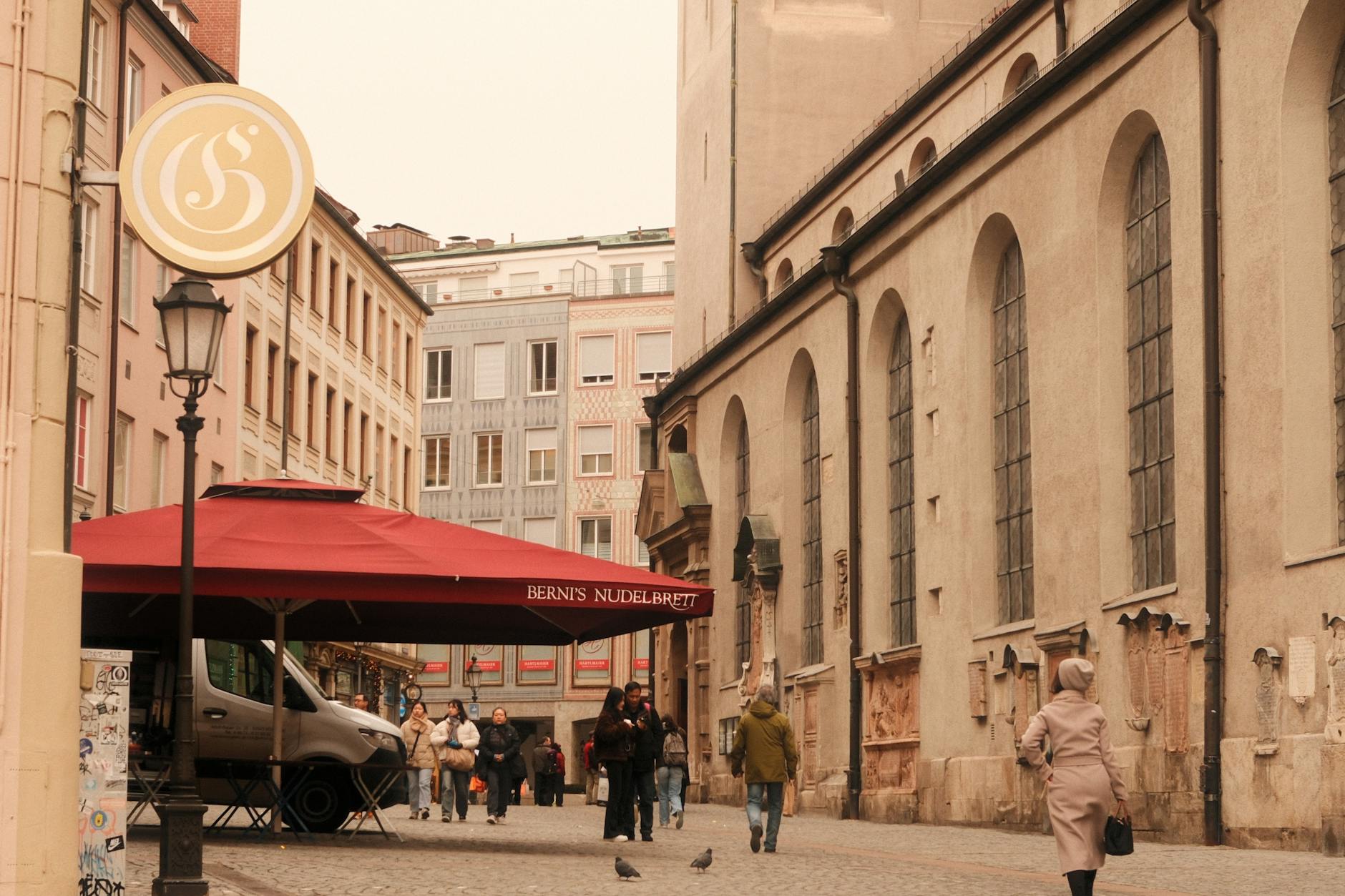
Cross the Isar from Marienplatz, walk five minutes uphill, and Munich quietly changes. The trams slow. The buildings stop being grand and start being friendly — three- and four-story painted houses in butter-yellow, dusty pink, and chalk-blue, with shutters and window boxes and old shop signs that haven’t been replaced since 1955. Welcome to Haidhausen Munich, the neighborhood every local will tell you is the prettiest in the city, often described as a “village in the middle of the city.” East of the Isar, anchored by Wiener Platz and the famous French Quarter (Franzosenviertel) with its streets named after Paris, Bordeaux, and the Battle of Sedan, Haidhausen is where authentic Bavarian charm survived both the war and the 21st century. This insider’s guide covers everything: history, what to see, where to eat, the walking route, and why your trip to Munich needs an afternoon here.
Haidhausen at a Glance
| Detail | Information |
|---|---|
| Location | East bank of the Isar, directly across from Altstadt |
| Borough | Officially Au-Haidhausen (Bezirk 5) |
| Nearest U-Bahn | Max-Weber-Platz (U4/U5) |
| Nearest S-Bahn | Ostbahnhof or Rosenheimer Platz (all S-Bahn lines) |
| Walk to Marienplatz | 15 minutes across the Isar bridge |
| Vibe / Ambiance | Village-in-the-city, leafy, residential, gently bohemian |
| Best for | Walking, cafe culture, beer gardens, escaping tourist crowds |
| Must-see | Wiener Platz, Pariser Platz, Muellersches Volksbad, Friedensengel |
| Where to eat | Hofbraeukeller, Wirtshaus in der Au, Showroom, Wiener Markt food stalls |
| Adjacent neighborhoods | Au (south), Bogenhausen (north), Lehel (across the river) |
A Brief History: From Broken Glass to Beloved Quarter
Haidhausen is older than Munich itself. It was first mentioned as haidhusir (“heath houses”) in 808 — almost 400 years before Munich was founded. For most of its history it was a separate village outside the gates, growing along the old salt road from the Isar valley to Vienna. In 1854 it was incorporated into Munich along with Au and Giesing.
The 19th century turned Haidhausen into a working-class quarter. The boom that followed the Franco-Prussian War of 1870/71 — the so-called Gruenderzeit — packed the area with day-laborers, brickmakers, and railway workers who arrived to build the booming city across the river. Conditions were rough. Locals nicknamed it the Glasscherbenviertel — the “broken-glass quarter” — for the bottles and brawls that piled up on its cobblestones.
And here is the gift of history: Haidhausen was barely bombed in WWII. About two-thirds of its residential buildings still date from before 1914. When Munich tore itself down and rebuilt in concrete in the 1950s and 60s, Haidhausen quietly kept its Gruenderzeit facades, its cobbles, and its proportions. By the 1970s the city began renovating rather than demolishing. Artists moved in. Then young professionals. Today the broken-glass quarter is one of Munich’s most desirable addresses — and walking through it feels closer to 1890 than 2026.
One more historical anchor worth knowing: the famous Auer Dult — Munich’s beloved triannual folk fair with antiques, crockery, and Ferris wheels — happens just south of here in the neighborhood of Au at Mariahilfplatz, three times a year (spring, summer, autumn). It’s a 10-minute walk from central Haidhausen and a perfect pairing with a stroll through the French Quarter.
Why Visit Haidhausen?
The short answer: because it’s the prettiest piece of pre-war Munich left standing, and because almost no tourists come here. Altstadt is gorgeous but it’s also rebuilt and crowded. Schwabing is famous but increasingly chain-shopped. Haidhausen, five minutes from the city center across the river, is leafy, low-rise, unhurried, and unmistakably a real place where Muenchners actually live, work, drink coffee, and walk dogs.
You come to Haidhausen for:
- Pastel-painted Gruenderzeit facades on quiet, cobbled streets
- The dense web of cafes, wine bars, and neighborhood restaurants
- One of Munich’s best beer gardens — Hofbraeukeller — without the Hofbraeuhaus crowds
- An Art Nouveau swimming pool you can actually swim in
- The riverside parks and the gilded Angel of Peace
- Independent shops — no chains to speak of
- The sense, rare in any city center, that you’ve gone somewhere quieter
The French Quarter (Franzoesisches Viertel)
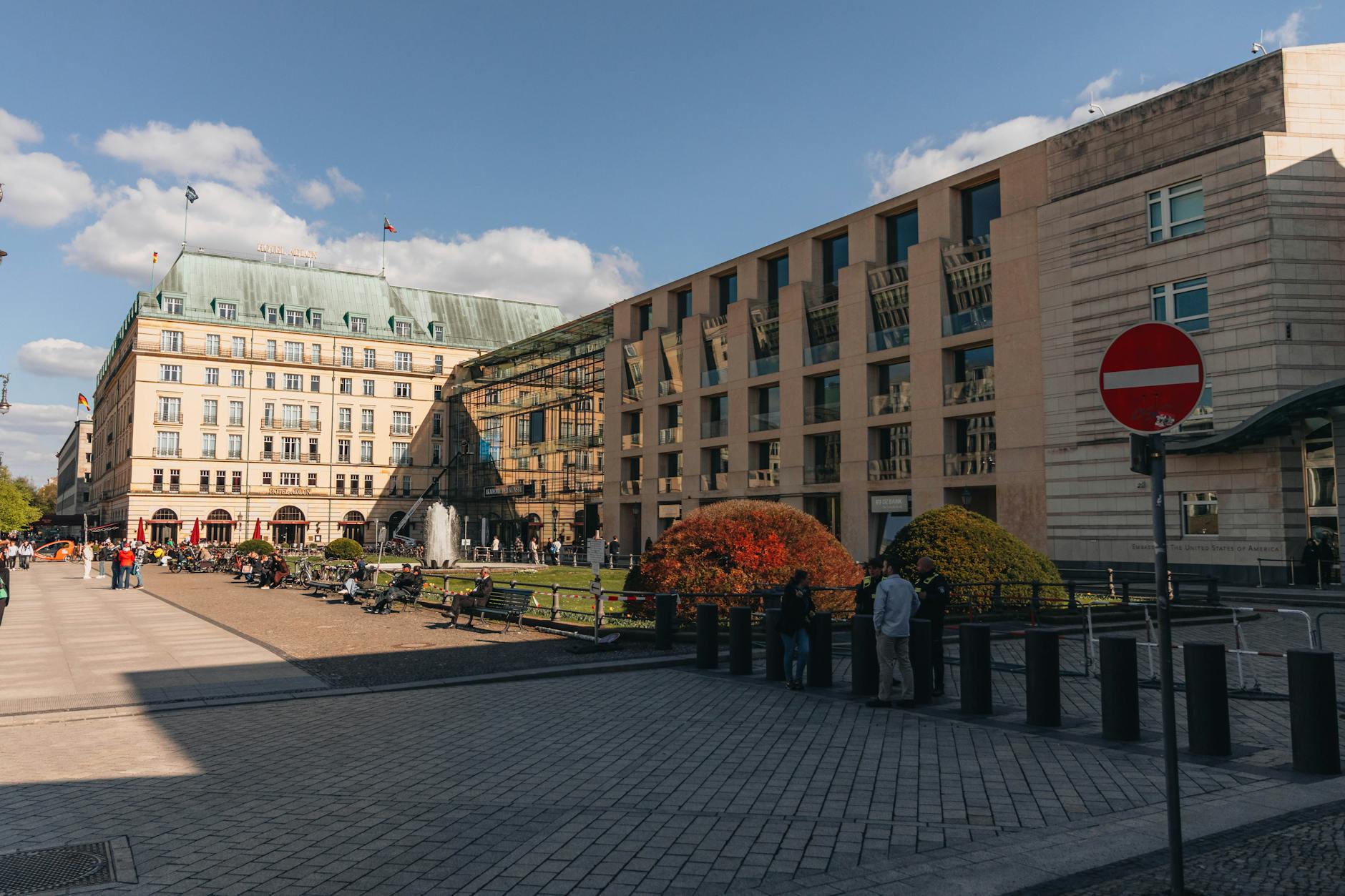
The French Quarter Munich — Franzosenviertel — is the heart of Haidhausen and its most famous feature. Walk a few minutes south of Max-Weber-Platz and you’ll find streets called Pariser Strasse, Sedanstrasse, Woerthstrasse, and squares named Pariser Platz, Bordeauxplatz, and Orleansplatz. The whole grid was laid out between 1871 and 1905 on French urban-planning principles: broad radial streets converging on geometric squares, like a miniature Haussmann Paris.
The irony? The streets are named for places Bavaria fought against in the Franco-Prussian War of 1870/71. Sedan, Orleans, Woerth — these were battle sites. Bavaria won and decided to commemorate its victory by naming a brand-new district after the cities of the loser, then designing it in the loser’s architectural style. It’s a wonderfully Bavarian gesture, half triumph and half affection.
Today the French Quarter is purely residential — there’s nothing to “see” in the museum sense — but it’s the walking that matters. The streets are leafy. Many buildings have painted facades, original cast-iron balconies, and shutters in green or burgundy. Pariser Platz itself, with its central fountain ringed by chestnut trees and surrounded by cafes, is one of the most photographable squares in Munich. Bordeauxplatz, a long rectangle of green flanked by symmetrical apartment blocks, is the quarter’s wider stage. Walk slowly. Look up.
Top Sights and Squares
1. Wiener Platz
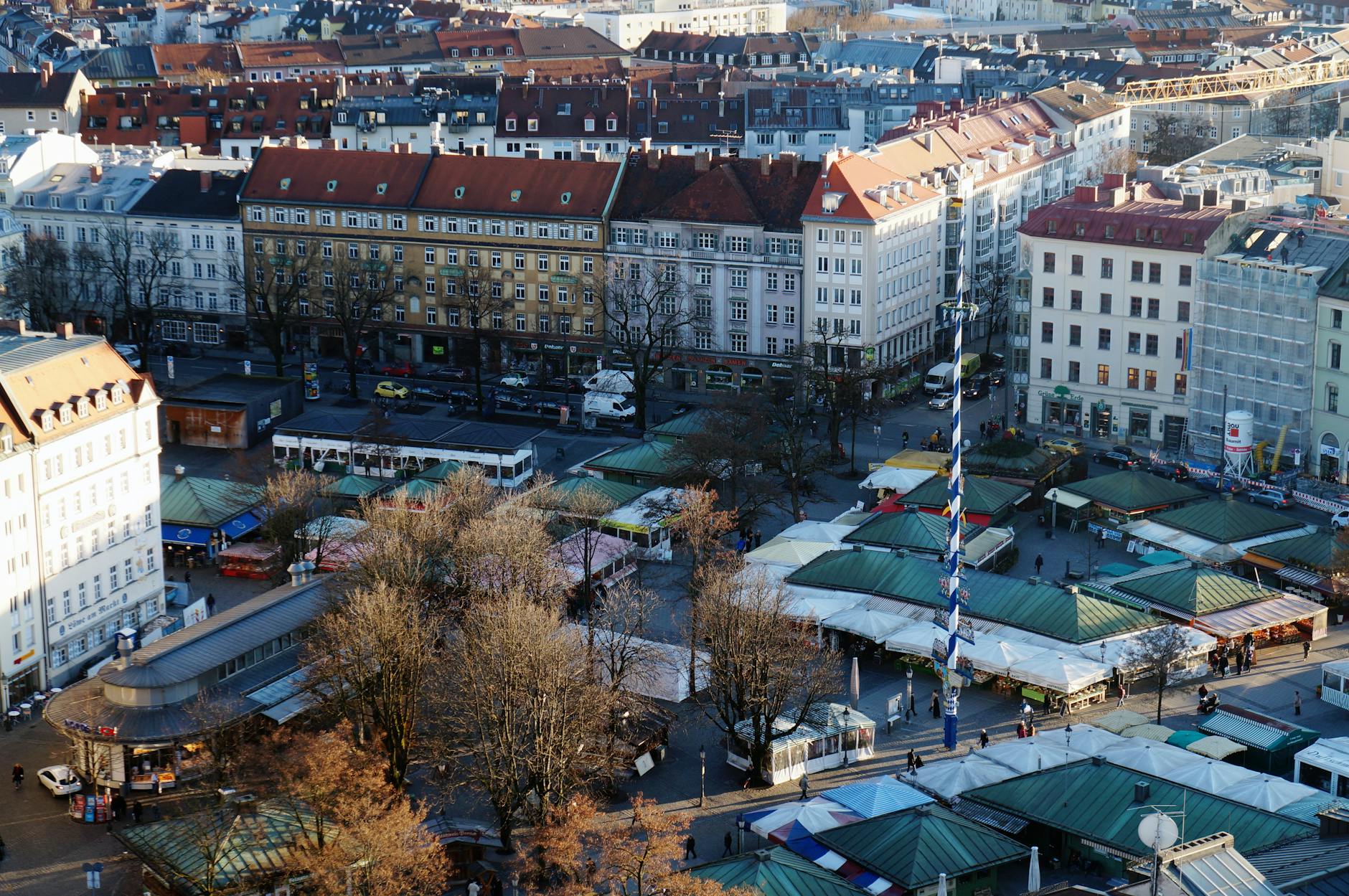
Wiener Platz is the village heart of Haidhausen and the postcard square locals defend fiercely. A traditional Maibaum (blue-and-white striped maypole) stands in the middle. A small daily market — the Wiener Markt — runs Monday to Saturday roughly 8am to 6pm, with around a dozen permanent stalls selling flowers, fish, cheese, fruit, bread, sausage, honey, and a tiny coffee bar that locals swear by. It’s a smaller, more village-y version of the Viktualienmarkt across the river. On the western edge of the square sits the Hofbraeukeller (see below). On the eastern edge, a cluster of cafes spills onto the cobbles. This is the square you sit in for an hour.
2. Kulturzentrum Gasteig (and the HP8 Temporary Venue)
The Gasteig is Munich’s largest cultural center — a brick complex from 1985 perched above Rosenheimer Platz. In normal times it houses the Munich Philharmonic, the Munich City Library, the adult-education center, and the University of Music. Right now (2026) it’s empty: the building is closed for a major renovation expected to run into the late 2020s (and some elements into the 2030s). The Munich Philharmonic and the rest of the program have temporarily relocated south of the river to Gasteig HP8 in Sendling, where the spectacular Isarphilharmonie concert hall opened in 2021. So: come to Haidhausen to walk past the Gasteig’s striking exterior; book your concert tickets for HP8 across the river. The Gasteig’s terrace above Rosenheimer Platz still offers one of the best free skyline views in Munich.
3. Maximilianeum (Bavarian Parliament)
The honey-yellow palace crowning the hill at the east end of the Maximiliansbruecke is the Maximilianeum, home of the Bavarian State Parliament (Landtag). Built 1857–1874, it was originally a foundation school for gifted students (it still is — they live in the wings). From the bridge it’s one of Munich’s most cinematic views, the Maximilianstrasse telescoping back across the Isar to Max-Joseph-Platz. Free guided tours of the Parliament are offered when the Landtag is in session — book through the official Bavarian Landtag website. Otherwise, admire it from the outside, ideally at golden hour.
4. Muellersches Volksbad
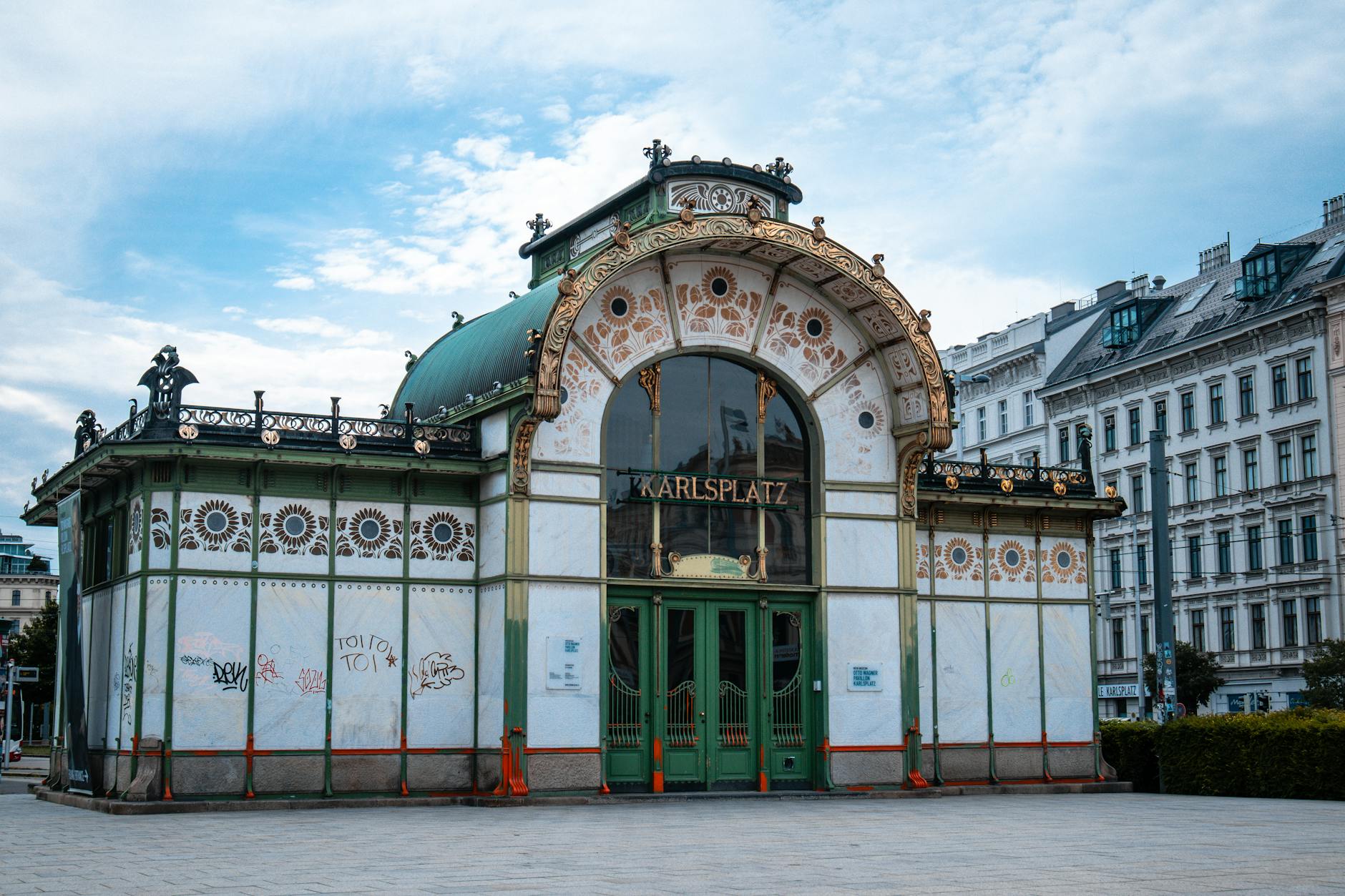
Munich’s first public indoor swimming pool, opened in 1901 — and at the time the largest and most expensive in the world. Designed by Carl Hocheder in Neo-Baroque Jugendstil (German Art Nouveau), it was inspired by Oriental hammams and Roman thermal baths. The wide marble staircase, the stucco frescoes, the bronze figures and the vaulted swim halls feel more like a cathedral than a public bath. And the magic is: you can actually swim here. Entry is around €5.50; lockers are coin-operated. The smaller former women’s pool is warmer and great for relaxing; the larger former men’s pool is cool and perfect for laps. There’s also a Roman-Irish steam bath with rooms at 40°, 60°, and 80°C. Bring a swimsuit and a towel. It’s on the riverfront just south of the Ludwigsbruecke.
5. Maximiliansanlagen (Isar Park East Bank)
The long, narrow ribbon of park running along the east bank of the Isar from the Maximilianeum north to the Bogenhausen border. Planned in the 19th century by Carl von Effner, the Maximiliansanlagen is a classic English-style landscape park with winding paths, mature trees, lawns, and constant river views. In summer it fills with cyclists, joggers, dog-walkers, and locals reading on the grass. The Friedensengel column anchors the northern end.
6. Friedensengel (Angel of Peace)
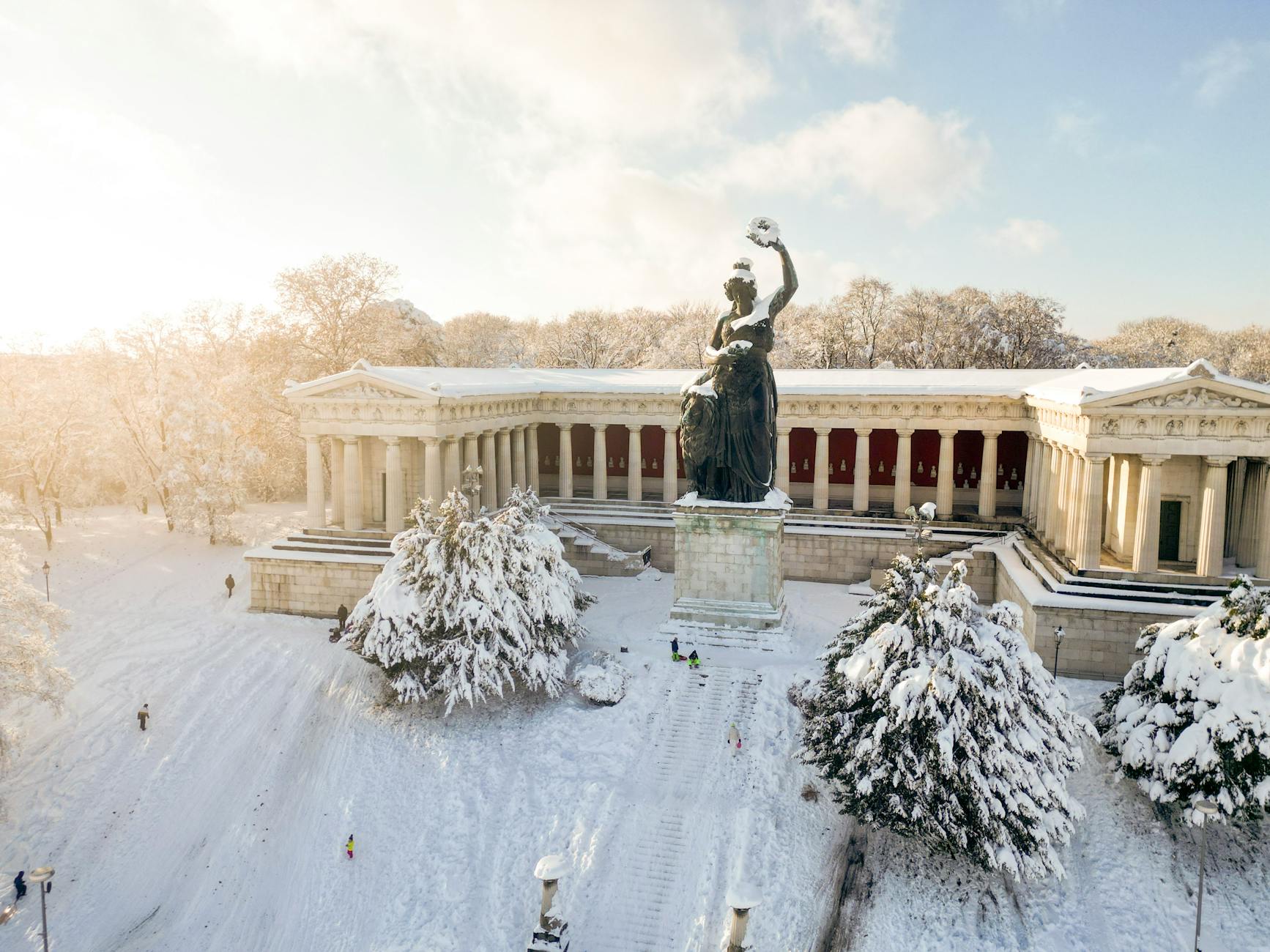
A 38-meter Corinthian column topped with a gilded bronze Nike — the Greek goddess of victory — inaugurated in 1899 to celebrate 25 years of peace after the Franco-Prussian War. The temple beneath features four gold mosaics depicting war, victory, peace, and cultural blessings. Climb the terrace beneath (the Prinzregent-Luitpold-Terrasse) for panoramic views back across the river to the Altstadt skyline and the Bavarian Alps on clear days. Free, always open, magnificent at sunset. It marks the boundary between Haidhausen and Bogenhausen at the eastern end of Prinzregentenstrasse.
7. Herbergerlweg and Kriechbaumhof
Walk Preysingstrasse south and look for the narrow cobbled lane of Herbergerlweg — a 200-meter passage of tiny former workers’ cottages (“Herbergen”) that survived from the 18th and 19th centuries. The nearby Kriechbaumhof, a relocated half-timbered farmhouse from 1577, anchors this pocket of pre-industrial Haidhausen. It’s the most unexpected three minutes in the neighborhood — pure Bavarian village hiding behind a Gruenderzeit street.
8. St. Johann Baptist Church
The neo-Gothic parish church rising over Johannisplatz with its 97-meter spire — built 1852–1874 to serve the booming working-class district. The interior is unexpectedly grand: ribbed vaulting, stained glass, and a peaceful nave that’s always open. A useful landmark when navigating: if you can see the spire, you’re in central Haidhausen.
9. Muffatwerk
Right beside the Muellersches Volksbad, the old municipal heating plant now houses the Muffathalle and Muffatwerk — one of Munich’s best mid-size concert venues plus a club, summer beer garden (Ampere) and cafe. Indie and electronic concerts almost nightly. Worth checking the program if you’ll be in Munich for more than a few days.
Best Cafes in Haidhausen
Cafe culture is Haidhausen’s love language. Six standouts:
- Wiener Cafe Kreutzkamm — the Munich branch of the legendary Dresden patisserie. Old-world coffee house, perfect Stollen, Sachertorte, and the best Baumkuchen east of the Isar.
- Cafe Lotti / Lotti Eck — in a converted corner Kramerladen on Preysingstrasse. All-day breakfast, Bircher muesli, fresh croissants, a sunny terrace. Pet-friendly.
- Little Rabbit’s Room — directly on Wiener Platz, vegan-leaning, sun-drenched, beloved by the brunch crowd.
- Cafe im Vorhoelzer Forum — technically on TUM campus a short walk away, but worth the detour for the rooftop terrace and one of the best panoramic city views in Munich; affordable lunches.
- Johannis Cafe — neighborhood corner cafe opposite St. Johann Baptist, with a quiet street terrace and good cakes.
- Cafe Mucca — third-wave specialty coffee, brunch plates, design-conscious interior; the go-to for serious coffee drinkers.
Best Restaurants in Haidhausen
Haidhausen punches well above its weight on dining — from old-school Bavarian to refined modern to excellent Vietnamese and Italian. Our picks:
- Hofbraeukeller am Wiener Platz — the local Bavarian heavyweight. Traditional Schweinshaxe, Schnitzel, dumplings; 1,400 seats in the chestnut-shaded beer garden; €15–€28 mains. The locals’ Hofbraeuhaus, minus the tour buses.
- Wirtshaus in der Au — just south in neighboring Au, famous for its dumplings (Knoedel) of every imaginable variety. Iconic. €18–€28.
- Showroom — refined modern German, Michelin-recognized; tasting menus €90–€140; intimate dining room. Book 2–3 weeks ahead.
- Koenigsquelle — Haidhausen institution; classic continental cooking — Wiener Schnitzel, Tafelspitz, seasonal game; €25–€45.
- Mangostin Asia — pan-Asian fusion in a leafy garden setting south of the Friedensengel; €25–€40.
- Co Chu — neighborhood Vietnamese on Sedanstrasse; fresh pho and bun cha; €11–€16.
- Pizzeria Da Mimmo / Mimi’s — wood-fired Neapolitan; tiny dining room; €10–€15 pizzas.
- Tantris (just north in Schwabing, a 10-minute taxi) — 2-Michelin-star legend; €240+ tasting; book 6 weeks ahead.
Best Bars in Haidhausen
The drinking scene clusters around Wiener Platz, Pariser Strasse, and the streets radiating from Bordeauxplatz. It’s lower-key than Glockenbachviertel — no thumping speakeasies — but excellent for wine bars, cocktails on cobbled corners, and neighborhood Kneipen.
- Negroni — small Italian-influenced cocktail bar on Sedanstrasse; the namesake is a must-order.
- Barroom — modern craft cocktails just off Wiener Platz; intimate, low-lit.
- Vivo — wine and tapas, terrace seating in summer.
- Tab House — craft-beer pub with rotating European taps.
- Molly Malone’s — Irish pub, lively on match nights, friendly any night.
- Cafe Hueller — long-running Haidhausen wine-and-late-night spot, classic and unpretentious.
- Hofbraeukeller beer garden — open until 23:00 in summer; one of Munich’s loveliest summer-evening drinks.
Wiener Markt: The Daily Market
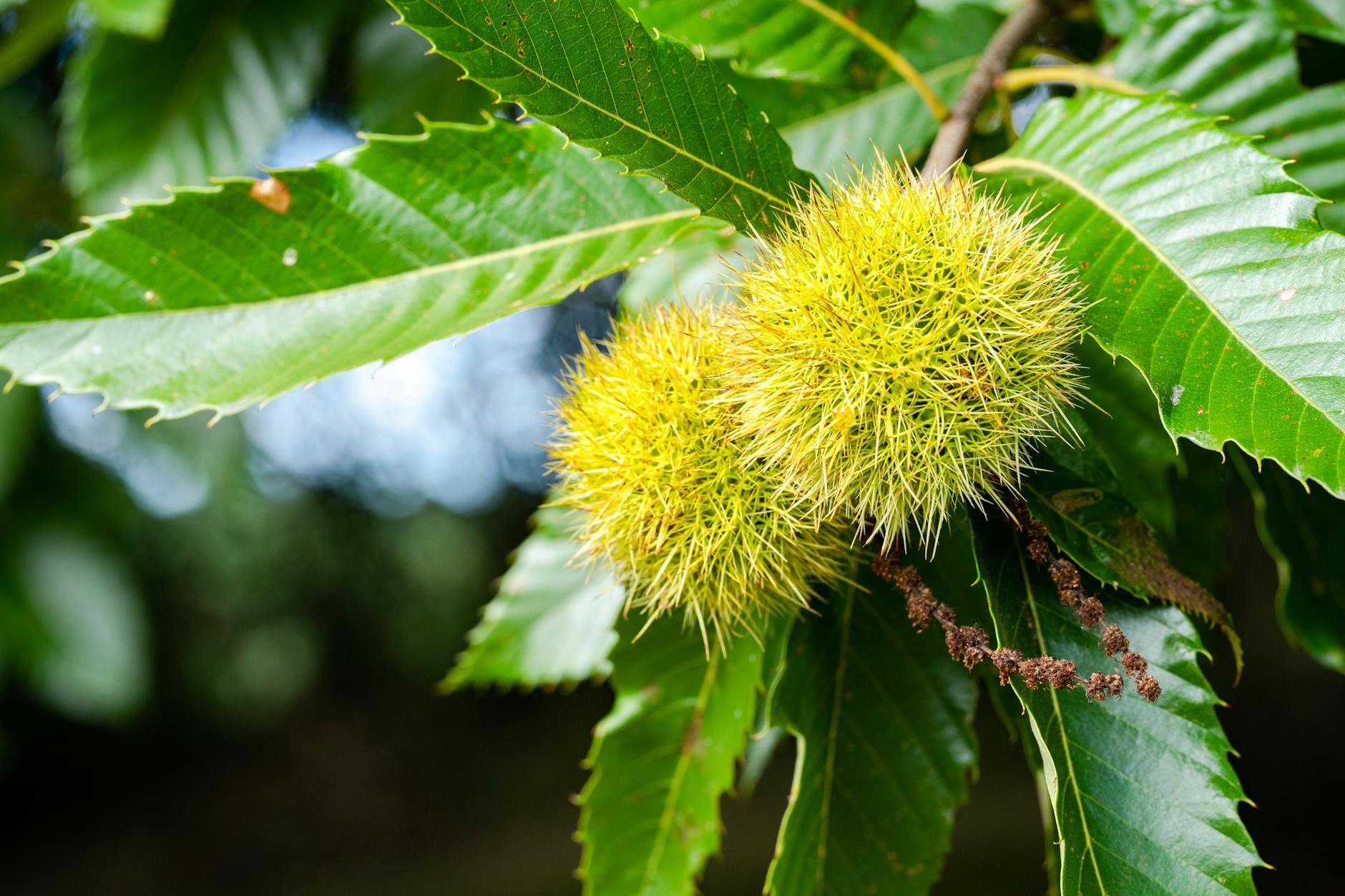
The Wiener Markt has been running on Wiener Platz since 1889 and is Munich’s smallest permanent daily market — about a dozen stalls compared to Viktualienmarkt’s 100+. That intimacy is the point. Locals do their daily shopping here: fresh fish from Fischerei Pommer, flowers, organic vegetables, regional cheese, sausage from a long-running Metzgerei, and one tiny coffee stand that turns out the neighborhood’s best espresso at €1.80 a cup. Hours roughly Monday to Friday 8:00–18:00, Saturday 8:00–14:00; closed Sundays and on official Bavarian holidays. Combine with a Hofbraeukeller lunch.
Where to Stay in Haidhausen
Haidhausen is wonderfully quiet at night and 10–15 minutes from the Altstadt by U-Bahn or foot — a smart choice for repeat visitors who want a local base.
- Hotel Opera — small four-star boutique on St.-Anna-Strasse (technically Lehel, two minutes across the bridge); antique-furnished rooms; €170–€260.
- Hotel Admiral — family-run boutique near Muellersches Volksbad; €130–€200.
- Holiday Inn Munich City Centre — reliable mid-range chain at Rosenheimer Platz; €120–€180.
- Hotel Neumayr — small family-run option in central Haidhausen; €90–€130.
- Apartments and Airbnbs — plentiful around Bordeauxplatz and Pariser Strasse; expect €120–€200/night.
Shopping: Small Boutiques and Antique Finds
You will not find an H&M in Haidhausen and that is the point. Shopping here is a treasure-hunt of one-room boutiques, hand-printed paper and stationery, ceramics, second-hand designer fashion, and antique shops. The cluster runs along Preysingstrasse, Innere Wiener Strasse, and around Wiener Platz. Highlights:
- Lotti and Friends — interiors, ceramics, gifts
- Kunsthandwerk shops on Preysingstrasse — handmade crafts and small-batch design
- Antiquariate — several second-hand book and antique shops near Bordeauxplatz
- Vintage and second-hand fashion — a handful of curated shops along Innere Wiener Strasse
- Auer Dult (three times a year at Mariahilfplatz, 10 min south) — Munich’s beloved folk-fair-and-antiques market; spring (May), summer (late July/early August), autumn (October). One of the best antique-hunting events in Bavaria.
The 90-Minute Haidhausen Walking Loop
This is the route we’d give a friend with one afternoon to spare. About 4 km, mostly flat, easily extended with coffee stops.
- 0:00 — Start at Max-Weber-Platz (U4/U5). Walk south on Innere Wiener Strasse.
- 0:10 — Wiener Platz. Wander the market; admire the maypole; a quick coffee at the market kiosk or Wiener Cafe Kreutzkamm.
- 0:25 — Into the French Quarter. Walk south on Pariser Strasse toward Pariser Platz. Cross diagonally to Bordeauxplatz. Detour through Sedanstrasse and Woerthstrasse.
- 0:45 — Preysingstrasse and Herbergerlweg. Look for the hidden cobbled lane of workers’ cottages and the half-timbered Kriechbaumhof.
- 0:55 — St. Johann Baptist. Step inside the neo-Gothic nave for five quiet minutes.
- 1:05 — Maximiliansanlagen. Drop down to the riverside park. Walk north along the Isar.
- 1:20 — Friedensengel. Climb the terrace stairs; soak in the panoramic view of the Altstadt and (on clear days) the Alps.
- 1:30 — Back via Maximilianeum. Walk south along Prinzregentenstrasse and Maximiliansbruecke; admire the Parliament from the bridge.
- 1:40 — Finish at Hofbraeukeller for a Mass in the beer garden, or back to Max-Weber-Platz for the U-Bahn.
Haidhausen vs. Other Munich Neighborhoods
| Neighborhood | Vibe | Best For |
|---|---|---|
| Haidhausen | Village-in-the-city, leafy, residential | Walking, cafes, beer gardens, escaping crowds |
| Glockenbachviertel | Trendy, creative, LGBTQ+ epicenter | Nightlife, design dining, cocktail bars |
| Schwabing | Bohemian-turned-upmarket, English Garden | Cafe culture, parks, classic literary Munich |
| Altstadt-Lehel | Historic tourist core | First-time sightseeing, big landmarks |
| Maxvorstadt | University, museums, students | Art-focused trips, museum-hopping |
Short version: Altstadt-Lehel if it’s your first day in Munich. Glockenbachviertel if you’re hunting nightlife and design. Schwabing if you want classic Munich cafe-and-park culture. Haidhausen if you want a slower, prettier, more local afternoon — and arguably the most photogenic streets of all.
Across the river to the south-west, Sendling and Westpark offers a similar residential feel with more green space and lower prices.
How to Get to Haidhausen from Marienplatz
- By U-Bahn: from Marienplatz take U3 or U6 one stop to Odeonsplatz, change to U4 or U5 east — two stops to Max-Weber-Platz. About 8 minutes door-to-door.
- By S-Bahn: any S-Bahn line east one stop from Marienplatz to Rosenheimer Platz (3 minutes), then a short uphill walk into Haidhausen.
- By tram: tram 19 from Karlsplatz/Stachus stops directly at Max-Weber-Platz.
- On foot: 15–20 minutes via the Maximilianstrasse and Maximiliansbruecke — one of the best urban walks in Munich, with the Maximilianeum framed at the end.
- By bike: 8–10 minutes via the riverside path; bike racks plentiful around Wiener Platz.
Best Time to Visit Haidhausen
May to early October is the sweet spot. The beer garden at Hofbraeukeller is open, the cafe terraces on Wiener Platz are in full bloom, the Maximiliansanlagen is at its leafy best, and you can swim outdoors in the Isar nearby. Late May, June, and early September are peak — long evenings, mild temperatures.
December has its own charm: a small, very local Christmas market on Weissenburger Platz with handmade crafts, no crowds, and Gluehwein under fairy lights. Worth a half-hour detour from the bigger Marienplatz market.
Time of day: Saturday mornings (Wiener Markt at peak) and weekday late afternoons (light slanting down the cobbles) are the prettiest. Sundays are sleepy — most shops shut by German law, but cafes and the beer garden carry on.
Hidden Tips and Local Knowledge
- The Gasteig rooftop terrace is currently fenced off during renovation, but Rosenheimer Platz itself still offers a free elevated city view.
- Visit the Hofbraeukeller beer garden on a Tuesday or Wednesday afternoon — locals only, no waits, and you’ll get the chestnut trees almost to yourself.
- Bring your swimsuit for Muellersches Volksbad. Towels can be rented (€3) but bring your own if you can.
- The best Friedensengel photo is from the Luitpoldbruecke bridge looking east — the gilded angel against the late-afternoon sky.
- Don’t leave without coffee from the Wiener Markt kiosk — a Muenchner ritual. Stand at the counter; the espresso is €1.80; the locals are friendly.
- Time your Auer Dult: spring (Maidult, early May), summer (late July to early August — Jakobidult), autumn (mid-October — Kirchweihdult). One of Munich’s most authentic local events.
- Skip Kultfabrik / Werksviertel for daytime — the giant nightlife complex east of Ostbahnhof is great after midnight but lifeless before then.
Frequently Asked Questions
Where is Haidhausen in Munich?
Haidhausen is directly east of the Isar river, opposite the Altstadt. Officially it forms half of Au-Haidhausen (Bezirk 5). The nearest U-Bahn is Max-Weber-Platz (U4/U5); the nearest S-Bahn stations are Rosenheimer Platz and Ostbahnhof. From Marienplatz it’s a 15-minute walk across the Maximiliansbruecke.
Why is Haidhausen called the French Quarter?
The southern part of the neighborhood — the Franzosenviertel — was built between 1871 and 1905 to French urban-planning principles, with broad radial streets converging on geometric squares. The streets are named after the battle sites and cities of the Franco-Prussian War: Pariser Strasse, Sedanstrasse, Woerthstrasse, Bordeauxplatz, Orleansplatz. Bavaria won the war and somewhat ironically built a piece of Paris on the east bank of the Isar to commemorate it.
Is Haidhausen worth visiting as a tourist?
Absolutely — especially if you’ve already done the main Altstadt sights. Haidhausen offers a side of Munich most tourists miss: village atmosphere, pre-war architecture, a daily market, one of the city’s best beer gardens, and the gilded Angel of Peace. Plan a half-day; you can easily combine it with a swim at Muellersches Volksbad or a lunch at Hofbraeukeller.
Is Haidhausen safe?
Very safe — one of the calmest residential districts in Munich, day or night. Ostbahnhof (the eastern S-Bahn hub) can feel busier and slightly less polished after midnight but is still well-lit and well-policed. Central Haidhausen around Wiener Platz and the French Quarter is peaceful.
Can I swim at Muellersches Volksbad?
Yes — it’s a fully functioning public pool. Entry is about €5.50, lockers are coin-operated, and you’ll need a swimsuit and a towel (towels rentable). The Roman-Irish steam bath is a separate, higher-priced ticket. Photography is restricted in the pool halls but allowed in the entrance lobby and staircases.
Is the Gasteig open in 2026?
No — the main Gasteig building in Haidhausen is closed for a multi-year renovation. The Munich Philharmonic and other resident institutions are temporarily based at Gasteig HP8 (with the Isarphilharmonie concert hall) in Sendling, south of the river. The Haidhausen Gasteig is expected to reopen in stages into the late 2020s and 2030s.
Where should I eat in Haidhausen?
For traditional Bavarian: Hofbraeukeller (Wiener Platz beer garden) or Wirtshaus in der Au (legendary dumplings). For refined: Showroom or Koenigsquelle. For casual: Co Chu (Vietnamese) or Mimi’s (Neapolitan pizza). For cafes: Wiener Cafe Kreutzkamm, Cafe Lotti, or Little Rabbit’s Room on Wiener Platz.
Continue Exploring Munich
Haidhausen is one of Munich’s most rewarding neighborhoods, but it’s not the only one worth a wander. For a complete tour of the city by district, see our Munich neighborhoods overview and our pick of the best neighborhoods in Munich. If you loved the village charm of Haidhausen, you’ll want to compare it with the trendier Glockenbachviertel, the bohemian-turned-elegant Schwabing, and the refined historic core of Altstadt-Lehel. Each tells a different chapter of the same beautiful city — and Haidhausen is the chapter that whispers.