One Week in Munich and Bavaria: 7-Day Itinerary
Seven days from one Munich hotel: four days in the city and three day trips to Neuschwanstein, the Zugspitze and Salzburg, with the tickets, journey times and prices, and how to adjust for winter and summer.

A week in Munich is the right amount of time to see the city properly and the best of Bavaria with it: four days in Munich and three day trips — Neuschwanstein, the Alps at Garmisch and the Zugspitze, and Salzburg — all by train from one hotel. You never need to change rooms, and you never need a car.
That is the short answer. The longer one is that a week also lets you do Munich at the right speed. Shorter trips force you to cram the Residenz, the Pinakotheks and the English Garden into one breathless loop; seven days gives each its own morning, leaves room for a long lunch at the Viktualienmarkt, and still gets you to a castle, a glacier and Mozart’s birthplace. Here is the plan, day by day, with the tickets, journey times and prices you need, and the swaps that work better in winter or summer. If you have less time, our Munich itineraries hub has plans from one to five days.
A week in Munich and Bavaria at a glance
| Day | Where | Highlights | Getting there |
|---|---|---|---|
| 1 | Munich old town | Marienplatz, Glockenspiel, Frauenkirche tower, Viktualienmarkt, Residenz, Hofbräuhaus | On foot |
| 2 | Museums and the English Garden | Alte Pinakothek, Pinakothek der Moderne, Eisbach surfers, Chinesischer Turm | U-Bahn, tram, on foot |
| 3 | Neuschwanstein | Neuschwanstein and Hohenschwangau castles, the Marienbrücke | Train to Füssen, about 2h–2h15, then bus 78 |
| 4 | Nymphenburg and the Olympiapark | Nymphenburg Palace, Olympiaberg, BMW Welt | Tram 17, U-Bahn |
| 5 | Garmisch-Partenkirchen and the Zugspitze | Germany’s highest mountain, 2,962 m; the Eibsee | Train, about 1h20 |
| 6 | Salzburg | Old town, Hohensalzburg fortress, Mozart | Regional train, 1h35–2h, Bayern-Ticket valid |
| 7 | Munich’s last day | Deutsches Museum or the Dachau memorial; farewell beer garden or beer hall | S-Bahn, tram |
Before you go: base, timing and tickets
Stay in one place
Base yourself in Munich for all seven nights. Every day trip in this plan starts at the Hauptbahnhof, and the time you would lose checking in and out of a second hotel is time you would rather spend on a mountain. The best areas for a week are the Altstadt, if you want to walk everywhere, or the Maxvorstadt, Glockenbachviertel or Isarvorstadt for better value and better evenings, all within a short ride of the station. Staying near the Hauptbahnhof itself saves ten minutes each day-trip morning but is not where you want to spend your evenings. Our guide to where to stay in Munich compares the neighbourhoods.
The one exception: if you swap Salzburg for Berchtesgaden and the Königssee in summer, one night down there turns a very long day into a pleasant one.
Which day to arrive
Arrive on a Thursday or Friday if you can. Two things shape the Munich week. On Sundays the shops close across Germany, Viktualienmarkt stalls included, but the Bavarian state museums — the Alte Pinakothek, the Pinakothek der Moderne, Museum Brandhorst and others — charge just €1. On Mondays most of those museums close, while the Residenz, Nymphenburg and the Deutsches Museum stay open. The plan below is written for a Friday arrival: Day 2 lands on a €1 Sunday and Day 3, the castle day, on a Monday, when the museums you would otherwise want are shut.
Tickets for the week
You need two kinds of ticket: one for Munich’s U-Bahn, S-Bahn, trams and buses, and one for the regional trains on the day trips.
| Ticket | Price | Covers | Best for |
|---|---|---|---|
| MVV Wochenkarte, Zone M | €23.80 in 2026; €25.80 from 1 January 2027 | All public transport in Munich’s Zone M for 7 days, plus until 12:00 the next day | Your Munich days. Note that the airport is outside Zone M |
| Single day ticket, Zone M | €10.10 in 2026; €10.80 from 2027 | A day of unlimited city travel | A short stay; three of these cost more than the week ticket |
| Bayern-Ticket | €34 for one, €44 for two, €74 for five (2nd class) | A day of regional trains across Bavaria, to Salzburg Hbf and Kufstein; not ICE/IC | The three day trips. Valid weekdays from 09:00, weekends from midnight |
| Deutschlandticket | €63 a month in 2026; check the 2027 price on the official Deutschlandticket site | Local transport and regional trains across Germany; a monthly subscription | Solo travellers doing several day trips — but read the terms |
Do the sums for your group. A solo traveller on this plan would pay €23.80 for the Munich week ticket plus three Bayern-Tickets at €34, or €125.80 in total. A couple pays €47.60 for two week tickets and €132 for three two-person Bayern-Tickets: €179.60, or about €90 each. The Deutschlandticket undercuts the solo total, but it is a subscription that has to be cancelled, it runs by calendar month, and its validity across the Austrian border to Salzburg is not the same as the Bayern-Ticket’s, so check before you rely on it for Day 6.
Insider tip: the Bayern-Ticket is not valid before 09:00 on weekdays. For Neuschwanstein, where an early start matters, either travel at the weekend or buy a regular ticket for the early train. The Bayern-Ticket also does not cover the airport transfer; for that see our airport to city guide.
Day 1: the old town
Start where the city started. The Marienplatz has been Munich’s main square since the Middle Ages, and the neo-Gothic New Town Hall on its north side is where the Glockenspiel plays at 11:00 and 12:00 every day, plus 17:00 from March to October. It lasts about 15 minutes. It is a mechanical curiosity rather than a spectacle — figures jousting and dancing high up on the tower façade — and you should watch it once, from the far side of the square, with a coffee, and then get on with the day.
Then climb something. The Frauenkirche south tower, reopened in 2022 after restoration, is a spiral stair followed by a lift; it costs €7.50, opens 10:00–17:00 Monday to Saturday and 11:30–17:00 on Sundays and holidays, with last ascent at 16:30. St. Peter’s, the Alter Peter, is the harder climb — 306 steps, no lift, €5 — and the better view, because it looks straight down on the Marienplatz and the New Town Hall, and on clear days to the Alps.
Lunch at the Viktualienmarkt, the open-air food market a minute south of the Marienplatz: a Leberkässemmel from a butcher’s stall, cheese, bread and a beer in the market’s beer garden, with the stalls all around you. Our Viktualienmarkt guide has the stalls worth finding.
Spend the afternoon in the Residenz, the palace of the Wittelsbach rulers of Bavaria. It is enormous — ten courtyards and room after room on show — and the Residenzmuseum alone costs €10, or €15 with the Treasury. The set piece is the Antiquarium, a vaulted Renaissance hall almost 66 metres long built in 1568–1571. Allow two to three hours and do not try to see every room. Afterwards, walk through the Hofgarten next door.
In the evening, do the Hofbräuhaus once. It is touristy, loud and overpriced for what it is, and it is still worth an hour for the scale of the hall, the brass band and the sheer Bavarian theatre of it. It is open daily 11:00–24:00; seating on the ground floor is free, so you can just walk in and find a space. Our Hofbräuhaus guide explains how to make the most of it, and the beer halls and breweries guide lists the quieter alternatives.
Day 2: museums and the English Garden
On a Sunday, this is the €1 day. The Kunstareal in the Maxvorstadt holds three of Germany’s great art collections side by side. The Alte Pinakothek (€9 on other days) has one of the world’s leading collections of old masters — Dürer, Rubens, Rembrandt — and is the one to prioritise. The Pinakothek der Moderne (€10) covers twentieth-century art, design and architecture, and Museum Brandhorst (€7) contemporary art in a building clad in coloured ceramic rods. The Neue Pinakothek is closed for renovation for several years; some of its highlights hang in the Alte Pinakothek in the meantime. Under-18s go free, and all three close on Mondays.
Pick two museums at most. Three hours of old masters is plenty for anyone who is not an art historian, and the afternoon belongs outdoors.
Walk east to the English Garden, which runs about 5 km north from the edge of the city centre and is bigger than New York’s Central Park. Start at its southern tip, where the Eisbach standing wave produces the sight Munich is famous for: surfers riding a river in the middle of a city. Surfing was allowed again from May 2026 under new safety rules after a fatal accident in 2025; our Eisbach surfing guide has the detail. Then walk north through the park to the Chinesischer Turm, a pagoda-shaped wooden tower in the middle of one of the city’s biggest beer gardens, or further on to the Seehaus on the Kleinhesseloher See.
Dinner in Schwabing, at the park’s western edge.
Day 3: Neuschwanstein
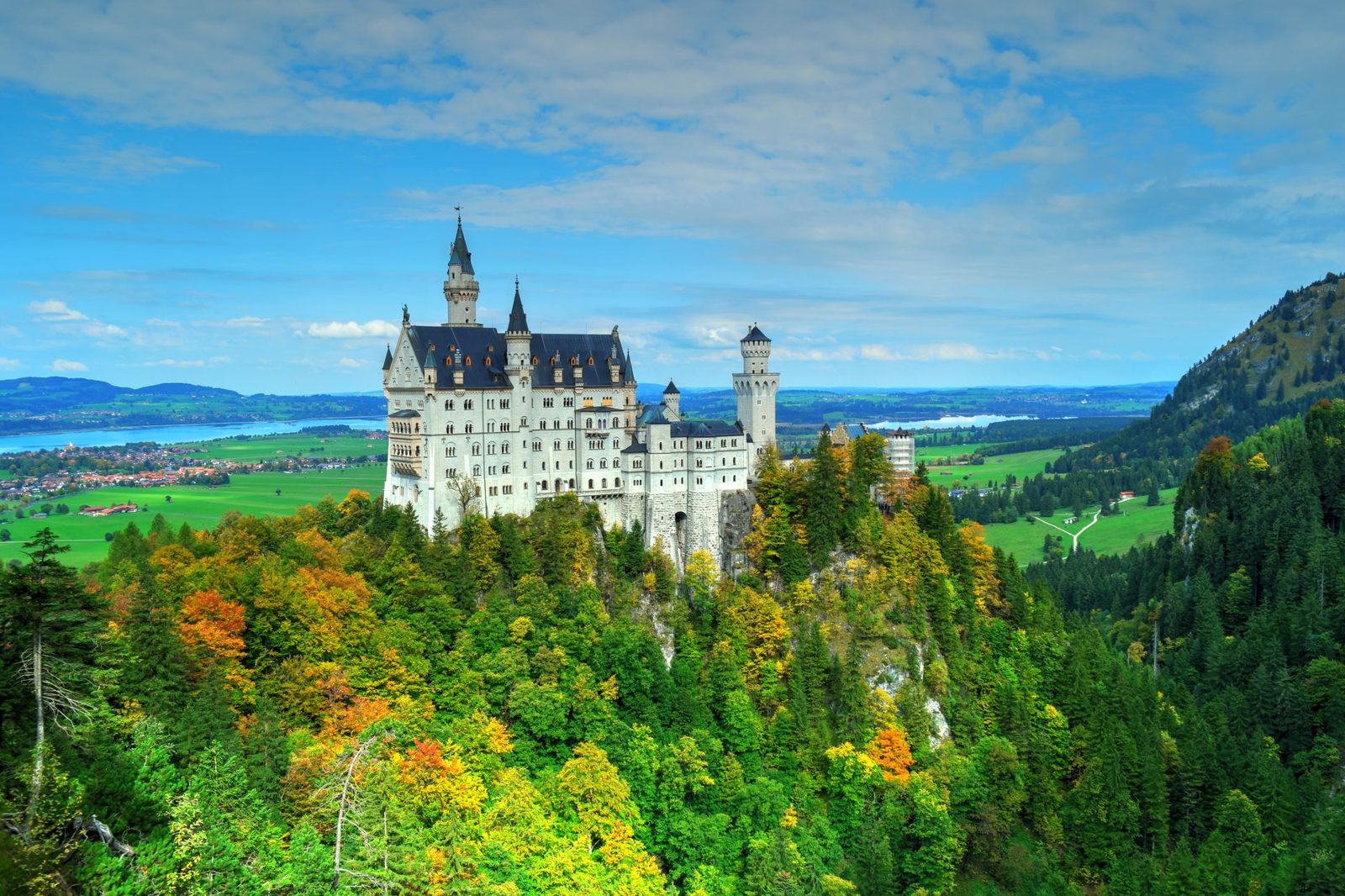
The castle you have seen on a thousand postcards, and the day trip that most needs planning. Neuschwanstein was begun in 1869 for Ludwig II, the king who poured his fortune into fantasy palaces; only about 15 rooms were ever finished. It stands above the village of Hohenschwangau near Füssen, about two hours from Munich.
- Getting there: regional train from München Hauptbahnhof to Füssen, then bus 78 to Hohenschwangau. Allow 2h–2h15 each way and 10–12 hours door to door. From 1 January 2027 the MVV tariff extends to the Ostallgäu, and a group day ticket for zones M–13, covering up to five people, costs €43.90.
- Tickets: entry is by timed guided tour only, about 30 minutes. An adult ticket is €21 plus a €2.50 online fee, and under-18s go free but still need a ticket. Book online well ahead in summer; the ticket centre in the village sells only same-day tickets for whatever is left.
- Hours: 09:00–18:00 from late March to mid-October, 10:00–16:00 from mid-October to late March. Closed on 1 January and 24, 25 and 31 December.
- The climb: it is a steep walk of about 40 minutes up from the Ticket Center, or a shuttle bus at €3.50 uphill or a horse-drawn carriage at €8.
- Add Hohenschwangau: the yellow castle below, where Ludwig grew up, is €23.50; a combined Königsticket for both castles is sold by the Ticket Center, so check its price in the official shop.
Be clear about what you are getting. The tour is short and brisk, the interiors are unfinished in places, and the best thing about Neuschwanstein is its outline from the Marienbrücke, the iron bridge over the Pöllat gorge behind it, which can close in snow and ice. The day works because of the whole package — the train through the Allgäu, the lakes, the mountains and the castle — not because of 30 minutes inside. Our Neuschwanstein day trip guide has the full timetable and tactics.
Day 4: Nymphenburg and the Olympiapark
A slower city day after the long trip. Take tram 17 from the Hauptbahnhof to Nymphenburg Palace, about 20 minutes, the Wittelsbachs’ summer residence begun in 1664. The combined ticket for the palace, the Marstallmuseum with its state coaches and porcelain, and the park pavilions costs €20 from April to mid-October and €16 in winter, when the park pavilions are closed; the palace alone is €10. The 229-hectare park is free and is the best part: long canals, avenues of trees and pavilions scattered through the woods. Allow half a day.
In the afternoon, head to the Olympiapark, built for the 1972 Games. Know what is shut before you go: the Olympiaturm has been closed since June 2024 and is expected to reopen during 2027, and the Olympiastadion is closed for renovation. The park itself is free and the Olympiaberg, a grass hill made of wartime rubble, gives the same Alpine panorama the tower used to. Across the road, BMW Welt is free to walk through, and the BMW Museum is ticketed. Our Olympiapark guide and BMW Museum and BMW Welt guide cover both.
Day 5: Garmisch-Partenkirchen and the Zugspitze
The Alps, properly. The train from the Hauptbahnhof reaches Garmisch-Partenkirchen in about 1h20, and from there the Zugspitze, at 2,962 metres Germany’s highest mountain, is a round trip of three to four hours: up by cog railway through the mountain to the glacier plateau at 2,600 metres, a short cable car to the summit and its golden cross, and down by the cable car to the Eibsee.
The round-trip ticket is €78 for adults at summer rates, which run to 22 November 2026. Winter 2026/27 rates start on 27 November: €70.50 online or €78 at the ticket office. Check the operator’s site for any closure between seasons, and check the summit webcam before you buy: if the top is in cloud you will pay €78 to stand in fog, and that is the moment to swap days. Our Zugspitze from Munich guide covers the routes, and the Garmisch-Partenkirchen day trip guide what to do in the valley if the weather says no — the Partnach Gorge, the painted houses of Partenkirchen, the walk round the Eibsee.
Day 6: Salzburg
A different country for the price of a Bayern-Ticket. The regional train reaches Salzburg in 1h35 to 2 hours, and the Bayern-Ticket is valid all the way to Salzburg Hauptbahnhof. The city is compact, baroque and beautiful: the old town on the left bank of the Salzach, the cathedral, the Getreidegasse with Mozart’s birthplace, and the Hohensalzburg fortress above it all, reached by funicular. In Advent its Christmas markets are among the prettiest in the region.

Salzburg is the right Day 6 for most people because it works in any season. Our Salzburg day trip guide has a walking route. The alternatives, if you have seen Salzburg before:
- Berchtesgaden and the Königssee (about 2h30 each way): a fjord-like lake with electric boats and the chapel of St. Bartholomä, best from late spring to autumn. The Eagle’s Nest is closed in winter. One night down there is the better plan; see Berchtesgaden and the Eagle’s Nest.
- Nuremberg: just over an hour by ICE, about 1h45 by regional express. The Bayern-Ticket is not valid on the ICE, so book an early saver fare or take the slower train. Medieval walls, the Kaiserburg and the Nazi rally grounds; see our Nuremberg day trip guide.
- A lake and a spa town: the Tegernsee is about an hour from Munich on the BRB, with the iodine-sulphur baths of Bad Wiessee on its western shore. Our guide to Bavarian spa towns and lakes near Munich have the detail.
Day 7: the Deutsches Museum or Dachau, and a farewell
The last day is a choice between two very different mornings.
The Deutsches Museum, on its island in the Isar, is one of the world’s great science and technology museums: around 25,000 square metres of aircraft, ships, mines, instruments and machines. It is open daily 09:00–17:00 (last entry 16:30), closed on a handful of public holidays, and costs €16 for adults. Three hours is the realistic minimum, and you will still miss most of it. Our Deutsches Museum guide picks the sections worth your time.
The Dachau Concentration Camp Memorial Site, about 16 km north-west of the city, is the other choice, and for many visitors the most important thing they do in Bavaria. Dachau opened in March 1933 and was one of the first Nazi concentration camps. Entry is free, it is open daily 09:00–17:00 (closed only on 24 December), and English-language tours at 11:00 and 13:00 cost €4 and last about two and a half hours. Take the S2 and bus 726, about 35–40 minutes; Dachau is outside Zone M, so you need a wider-zone ticket. The memorial says some content may not suit children under 13. Plan nothing heavy for the afternoon. See our Dachau memorial guide.
End the week somewhere that says Munich: a beer garden under chestnut trees if the weather allows, a quieter beer hall if it does not, and a last walk across the Marienplatz after dark, when the New Town Hall is lit and the day-trippers have gone home.
What the week’s sights cost
Munich is not a cheap city, but its sightseeing is more reasonable than its hotels. Here is what one adult pays for the main tickets in this plan, at the prices published in October 2026, following the Friday-arrival version with the €1 Sunday on Day 2.
| Day | Tickets | Cost |
|---|---|---|
| 1 | Frauenkirche tower €7.50, St. Peter’s tower €5, Residenz with Treasury €15 | €27.50 |
| 2 | Alte Pinakothek and Pinakothek der Moderne on a Sunday, €1 each | €2 |
| 3 | Neuschwanstein €21 plus €2.50 online fee, shuttle bus €5 return | €28.50 |
| 4 | Nymphenburg combined ticket (€20 in summer, €16 in winter) | €16–20 |
| 5 | Zugspitze round trip (summer rate) | €78 |
| 6 | Salzburg: the old town is free to walk; the fortress and museums are extra | — |
| 7 | Deutsches Museum €16, or the Dachau memorial free (€4 for a guided tour) | €0–16 |
| Total, main sights | €152–172 | |
The Zugspitze is the single biggest line, and it is the one to drop if the weather or the budget says no; the walk round the Eibsee below it costs nothing. Under-18s go free at Neuschwanstein, the state museums and Nymphenburg, which makes this a far cheaper week for families than the adult total suggests.
Eating your way through the week
Seven days is long enough to eat Bavarian food properly rather than just once. Have a Weisswurst breakfast with sweet mustard and a pretzel one morning, before noon as tradition demands. Have roast pork with crackling and a dumpling in a Wirtshaus, Obatzda and radishes in a beer garden, and a Leberkässemmel standing up at the Viktualienmarkt. Most day-trip towns have a good inn near the station, so lunch out of town is easy. Our guide to traditional Bavarian food explains the menu, and Munich’s best beer gardens tells you where to eat it outdoors.
How to adjust the week for the season
Winter (November to March)
Days are short — in December it is dark from about 16:30 — so start day trips early and keep evenings for the city. From late November the week changes character entirely: the Christkindlmarkt on the Marienplatz runs from 20 November to 24 December 2026 with most other markets opening from late November. Salzburg’s markets make Day 6 even better. Neuschwanstein and Linderhof keep shorter hours, the Zugspitze becomes a ski area, and the Eagle’s Nest closes. See our Munich Christmas markets guide.
Summer (June to August)
Light until about 21:30 in June means long evenings in beer gardens, which are the point of a Munich summer. It is also the wettest stretch of the year, with sudden thunderstorms, so keep the Zugspitze day flexible. Swap Salzburg for Berchtesgaden and the Königssee, or for a swim in one of the lakes. Book Neuschwanstein tickets well in advance.
During the Oktoberfest
The Oktoberfest runs for 16 days from mid-September to the first Sunday in October: from 18 September to 3 October in 2027. Hotel rates rise sharply, and the beer tents fill by mid-morning at weekends. If your week overlaps it, replace Day 4 with a weekday at the Wiesn, book your hotel very early, and do the day trips on the weekends, when the city is at its most crowded. Our Oktoberfest guide covers the rest.
Is a week in Munich too long?
Not if you use it the way this plan does. Munich on its own fills four good days; much more than that and you will start repeating beer halls. The reason a week works is that Munich is one of the best-connected bases in southern Germany: the Alps are under 90 minutes away, a royal castle two hours, and another country less than two. Seven days gives you both halves of Bavaria — the city of museums, palaces and beer gardens, and the mountains, lakes and castles around it — without the cost or hassle of a road trip.
If you have only five days, drop Day 4 and Day 6; our 5 days in Munich itinerary shows how. If you have three, keep Days 1, 2 and one day trip, as in 3 days in Munich. And if you have more than a week, use the extra days for an overnight in Berchtesgaden, a lake, or a longer journey on to Vienna, Innsbruck or Zurich; our guide to travel from Munich covers onward routes.
Frequently Asked Questions
Is a week in Munich enough to see Bavaria?
It is enough to see the highlights: Munich itself in four days, plus Neuschwanstein, the Zugspitze and Salzburg as day trips. Bavaria is large, so a week will not cover Franconia or the Romantic Road as well.
Should I stay in Munich for the whole week?
Yes, for this plan. Every day trip leaves from the Hauptbahnhof, so one Munich hotel saves time and money. The only trip that benefits from an overnight is Berchtesgaden and the Königssee.
Do I need a car for a week in Bavaria?
No. Neuschwanstein, Garmisch, Salzburg, Berchtesgaden, Nuremberg and the lakes are all reachable by train, and a car is a liability in central Munich. A car only makes sense for the Romantic Road or remote Alpine valleys.
What is the best transport ticket for a week in Munich?
The MVV Wochenkarte for Zone M (€23.80 in 2026, €25.80 from January 2027) for city travel, plus a Bayern-Ticket (€34 for one, €44 for two) on each day-trip day. Solo travellers can compare the €63 monthly Deutschlandticket.
Can you visit Neuschwanstein and the Zugspitze on the same day?
Not sensibly by public transport. They are in different valleys and each takes a full day from Munich. Give each its own day.
What day of the week should I arrive in Munich?
Thursday or Friday. That gives you a full Saturday for the shops and markets, a €1 Sunday at the state museums, and lets you spend Monday, when most museums close, on a day trip.
Is a week in Munich good in winter?
Very, especially from late November, when the Christmas markets open in Munich and Salzburg. Plan for short days, check the castles’ winter hours and expect the Zugspitze to be a ski area.
More Munich itineraries and day trips
The Munich itineraries hub has every plan from one day in Munich to two days and beyond. For the trips out of the city, start with day trips from Munich by train and the Bavarian Alps from Munich.
Prices, hours and fares checked in October 2026 against the operators’ own sites, MVV and Deutsche Bahn.
Related Guides
- Munich Itineraries: How Many Days Do You Need? — the cluster hub
- One Day in Munich: The Perfect 24-Hour Itinerary — High-intent term; SERP is generic listicles with no destination authority
- 2 Days in Munich: The Ideal Weekend Itinerary — Biggest single itinerary term
- 3 Days in Munich: Complete Day-by-Day Itinerary — Second-biggest; the third day is a day trip, so it links hard into that pillar
- 4 and 5 Days in Munich: Extended Itinerary with Day Trips — Long tail with almost no dedicated pages competing