Olympiapark Munich: Complete Visitor Guide
The tower, the stadium and the zip wire are all closed for renovation. What is still open, why the tent roof matters, and the free hill that replaces the tower.
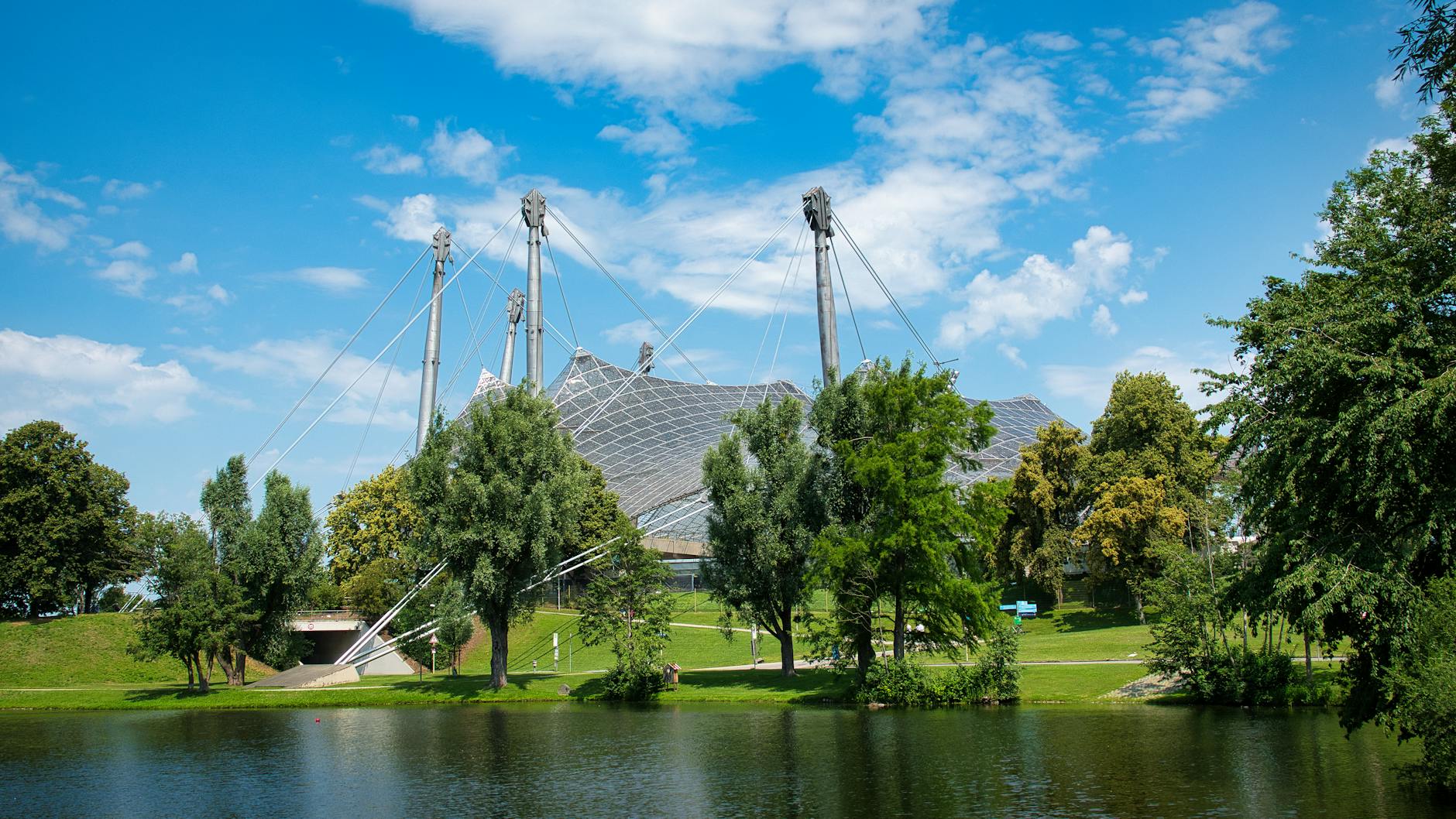
Go, but know what is shut before you do. In 2026 the Olympiapark has no tower, no stadium and no zip wire — the Olympiaturm has been closed since June 2024, the Olympiastadion building has been fully closed since October 2025 for a renovation running to 2029, and the Flying Fox stopped with it in September 2025.
That sounds like a reason to skip it. It is not. The park itself is free, permanently open, and one of the two or three best pieces of public space in Germany — 85 hectares of artificial landscape built on wartime rubble, under a tent roof that changed how buildings are engineered. The Olympiaberg gives you the Alps panorama the tower used to, for nothing. And the newest building in the park, the SAP Garden, opened in September 2024.
Here is what is open, what is closed and until when, what the architecture is actually doing, and how to spend two hours or a full day here.
Olympiapark Munich at a glance
| Getting there | U3 to Olympiazentrum, about 15 min from Marienplatz. Zone M day ticket €10.10 |
| Cost | The park is free. Individual venues and tours are ticketed |
| Open | The park itself, always. No gates, no closing time |
| Olympiastadion | CLOSED since October 2025. Renovation to 2029 |
| Olympiaturm | CLOSED since 1 June 2024. Expected to reopen during 2027 |
| Flying Fox | Unavailable since 8 September 2025, with the stadium |
| Tent roof | Renovation mid-2026 to end 2029, €298.4m. Phased; the park stays open |
| Still open | Olympiaberg (free) · SAP Garden · Olympiahalle · Sea Life · the lake · the memorial · Waldi and Architek tours |
| Next door | BMW Welt and the BMW Museum, across the road |
| Best free view in Munich | The Olympiaberg at sunset, looking south to the Alps |
What is closed, and until when
Let us get the bad news out of the way properly, because almost every guide to this park is describing a version of it that has not existed for two years.
The Olympiastadion
Completely closed since October 2025, with work running to 2029. The renovation covers the VIP lounges, changing rooms, sanitary and technical areas, the building fabric, fire protection and building services, and it will restore the original 1972 colour scheme. The stadium held 63,118 and was Bayern Munich’s home until the Allianz Arena opened in 2005.
You cannot go inside. You can walk right up to the outside of it, and the roof — which is the interesting part anyway — is visible from everywhere in the park and from directly above on the Olympiaberg.
The tent roof
Munich city council released €298.4 million on 1 October 2025 for a full renovation of the tent roof, starting mid-2026 and finishing at the end of 2029. The acrylic glass panels have a limited service life and have to be replaced entirely on safety grounds.
It is phased — the roof over the stadium first, then the link section, then the Olympiahalle, then the swimming hall — and the operator’s position is that park operations are otherwise largely unaffected, precisely because the stadium is shut anyway. Expect scaffolding and hoardings in parts of the ensemble for the next three years. It does not stop the park working.
The Olympiaturm and the Flying Fox
The Olympiaturm — 291 metres tall with an observation platform at about 190 metres, and around €13 to go up — has been shut since 1 June 2024 for fire-protection work and lift replacement, with reopening expected during 2027. Check before you plan a viewpoint around it, and be sceptical of any article that recommends it as open today.
The Flying Fox, the zip wire that ran from 35 metres above the pitch down to the east stand, has been unavailable since 8 September 2025 because of the stadium closure. When it runs it costs €46 adult and €41 for children, pupils and students. The Waldi and Architek guided tours continue through the renovation.
Insider tip: if a rooftop experience is what you came for, the substitute is not another attraction in this park — it is the Frauenkirche south tower in the Altstadt, which reopened in 2022 at €7.50, is 86 steps and then a lift, and is open Mon–Sat 10:00–17:00 and Sun 11:30–17:00 with last ascent at 16:30. See Munich’s viewpoints and photo spots.
The Olympiaberg: the best free thing in Munich
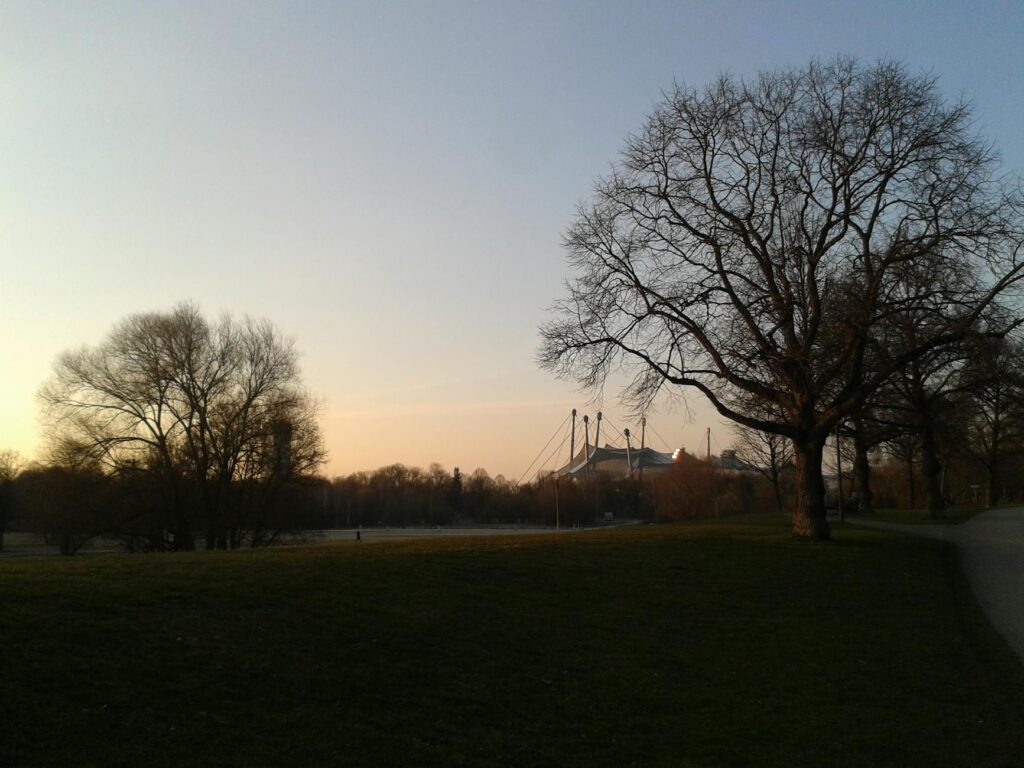
A grass hill in the middle of the park, 565 metres above sea level and about 60 metres above the surrounding plain, built out of the rubble of bombed Munich. It takes ten minutes to walk up. There is no ticket, no barrier and no closing time.
From the top you get the Alps to the south on a clear day, the whole tent-roof ensemble laid out below with the stadium bowl open to view, the BMW four-cylinder tower and museum to the east, and the city skyline beyond. It is, straightforwardly, the best free viewpoint in Munich, and it delivers most of what the closed Olympiaturm used to for nothing.
Come for sunset. The hill faces west and south, half of Munich comes up here with a bottle on a summer evening, and there is an established habit of open-air concerts and impromptu gatherings on the slope. In winter it is a sledging hill. This is where the park is most obviously a piece of everyday city infrastructure rather than a monument.
The one honest caveat: on a hazy day the Alps are not there, and the view is a good urban panorama rather than a spectacular one. Check the visibility before you make a special trip; the rest of the park does not depend on it.
The architecture, and why it mattered
Most visitors photograph the roof and move on. It is worth ten minutes of understanding, because this is one of the genuinely important buildings of the twentieth century and the reason is not aesthetic.
Germany in 1972 had a specific problem: it was hosting its first Olympics since Berlin in 1936, and everything about the 1936 Games — the monumental axes, the stone, the scale, the ideology of it — had to be visibly repudiated. The answer was the opposite of monumental. Günter Behnisch and Fritz Auer designed a landscape rather than a complex: buildings sunk into artificial hills, a lake, no formal axis, and a translucent roof that appears to have been draped over the whole thing.
- The roof concept came from Frei Otto, developed out of his tent roof for the German pavilion at Expo 67 in Montreal — the first time anyone had built a lightweight cable-net structure at that scale.
- Total roof area: 74,800 m², of which the section over the stadium is 34,550 m², sheltering about 43,000 seats. It links the stadium, the Olympiahalle and the swimming hall into one continuous ensemble.
- The engineering was the hard part. Fritz Leonhardt and Jörg Schlaich solved the structural problem, and the computational methods developed for it — form-finding for cable nets — went on to underpin a whole generation of tensile architecture worldwide.
- It was named a “Historic Landmark of Engineering in Germany” in 2023, which is the profession’s own assessment of its importance.
Stand under the acrylic panels and look up at the cable net and it is immediately obvious why it took a supercomputer’s worth of hand calculation. It is also obvious why the panels now need replacing: fifty years of Bavarian weather on a plastic that was experimental when it went up. See Munich architecture for how it sits in the city’s wider story, and the 1972 Olympics for the Games themselves.
The memorial
The 1972 Games are remembered for one thing above all others, and the park does not hide from it.
The Erinnerungsort Olympia-Attentat 1972 is a memorial pavilion set into a depression in the ground in the northern part of the park, opened on 6 September 2017 in the presence of Israeli President Reuven Rivlin and the German President Frank-Walter Steinmeier. It commemorates the twelve people killed — eleven members of the Israeli Olympic team and one Bavarian police officer.
It is a serious, restrained piece of design, cut into the landscape rather than placed on it, and it took forty-five years to build — a delay that is itself part of the story. Go. It takes twenty minutes and it is the reason the park is not simply a nice piece of 1970s landscaping. Our guide to Munich’s difficult history and the history of Munich covers the wider context.
What is open: the rest of the park
SAP Garden
The newest thing here and the reason the park has a future rather than only a past. Opened on 27 September 2024, with 10,796 seats for ice hockey and 11,500 for basketball, it is the shared home of EHC Red Bull München in the DEL and FC Bayern Basketball. It replaced the old Olympia-Eishalle, where EHC played until 2024, and it holds three separate ice rinks open to clubs and the public.
Tickets for a DEL night are far easier to get and far cheaper than anything involving FC Bayern’s football team, and German ice hockey is a genuinely good live product. If you are in Munich between September and March and want to watch professional sport without the ordeal described in our FC Bayern tickets guide, this is the answer.
Olympiahalle and the concert calendar
The Olympiahalle, capacity around 12,500 seated and up to 15,500 with an unseated floor, is Munich’s main indoor arena for touring acts and remains in use through the renovation, though its section of roof is scheduled for work later in the phasing. If a band you like is playing Munich, it is probably playing here. Check the calendar before you travel — it is a fifteen-minute U-Bahn ride and a better evening than most.
Sea Life, the lake and the park itself
- Sea Life Munich sits at the foot of the tower and is a competent chain aquarium. Honestly: it is expensive for what it is, and it is the right choice only if you have children and it is raining. See rainy-day options with kids for the alternatives, several of which are better.
- The Olympiasee is an artificial lake with a path round it, ducks, and benches. It takes twenty minutes to circuit and it is where the park works best as a park.
- The grounds themselves are used continuously by Munich — running, cycling, skating, football on the open pitches, and the whole thing is free and never closes. Our parks and gardens guide places it against the English Garden and the Westpark.
BMW Welt and the BMW Museum
Directly across the road, connected by a footbridge, and the obvious pairing for a half day. BMW Welt is free — it is a showroom with architecture — and the BMW Museum next to it, in the “salad bowl” building, is ticketed. The four-cylinder tower behind them is the company headquarters and is not open to the public. See our BMW Museum and BMW Welt guide.
The park as a piece of city planning
Something worth noticing while you are walking around: none of this is on flat ground, and none of the ground is natural.
Before 1972 the site was the Oberwiesenfeld — a parade ground, then Munich’s first airfield, then, after the war, the place the city dumped the rubble of its bombed centre. The Olympiaberg is that rubble. The landscape architects then modelled the whole site into a sequence of artificial hills and hollows so that the buildings sit in the ground rather than on it, and so that no single structure dominates from any angle. Stand anywhere in the park and you will find you cannot see all of it at once. That is deliberate.
The Olympic Village to the north, built to house the athletes, was handed over to ordinary residents afterwards and has been lived in continuously ever since — a pedestrianised deck-access scheme with traffic below and people above, which was radical at the time and has aged far better than the equivalent British and French experiments of the same decade. It is not a museum piece; people put their bins out there. Walking through it is one of the more interesting free things you can do in Munich, and almost no visitor does.
The overall ambition — “Die heiteren Spiele”, the cheerful Games — was to present a democratic, open, unmonumental Germany. Everything from the pastel colour scheme to Otl Aicher’s pictogram system, which is the direct ancestor of every airport sign you have ever followed, was designed to say so. The events of 5 September 1972 destroyed that framing, and the park has carried both stories ever since. Our guide to Munich’s history and architecture goes further into this.
Practicalities
- Distances are larger than the map suggests. From the U-Bahn exit to the memorial in the north of the park is a good twenty minutes on foot, and a full circuit including BMW Welt is around five kilometres. Wear something you can walk in.
- There is very little shelter. The park is open ground and the tent roof does not cover the walking routes. In rain there is nowhere to duck into except the venues, most of which are ticketed or closed.
- Food is thin. Kiosks and a handful of cafés, plus whatever a festival has brought in. It is better to eat in the city and come here afterwards, or to bring something and use the lawns — which is what Munich does.
- Cycling is allowed and pleasant. The park connects to the wider network and the paths are wide. See cycling in Munich.
- Accessibility is good by the standards of a 1972 site — the main routes are paved and graded, though the Olympiaberg is a grass slope with a steady climb. Our accessibility guide has more.
- Combine it with Nymphenburg. Tram 17 from the Hauptbahnhof reaches the palace in about twenty minutes, and the two sit on the same north-western side of the city — a palace morning and an Olympiapark afternoon is a coherent day. See the Nymphenburg guide.
Events worth timing a visit around
- Tollwood Summer, from June. The festival takes over a large part of the park — music, theatre, a market and a great deal of food — and it is free to enter with ticketed headline shows. The winter edition moves to the Theresienwiese. See our Tollwood guide.
- The Munich Marathon, 11 October 2026. One of Germany’s five largest, and the course finishes in the Olympiastadion — which, given the closure, is worth checking against the 2026 arrangements before you plan around the finish.
- Ice hockey at the SAP Garden, September to March. The DEL regular season plus playoffs.
- Summer open-air concerts on the Olympiaberg and in the park, most of them informal.
The full year is in our Munich events calendar and festivals and events.
How to spend the time
| You have | Do this |
|---|---|
| 90 minutes | U3 to Olympiazentrum · walk under the tent roof · up the Olympiaberg · back |
| Half a day | Add the memorial, a circuit of the Olympiasee, and BMW Welt across the footbridge |
| A full day | All of the above plus the BMW Museum, and an evening at the SAP Garden or the Olympiahalle |
| With children | The lake, the open lawns, Sea Life if it rains, and the Olympiaberg as a hill to run down |
| In winter | Sledging on the Olympiaberg, then indoors — the SAP Garden’s public ice rinks |
The park sits in the Olympic quarter north-west of the centre, alongside the 1972 Olympic Village, which is now ordinary housing and one of the more interesting pieces of residential planning in Germany. Our Olympic quarter guide covers the neighbourhood, and the best neighbourhoods in Munich puts it in order against the rest.
Is it worth it, honestly?
Depends entirely on what you want from it, and the answer has changed since 2024.
- If you came for a viewpoint: the Olympiaberg, yes, and it is free. The tower, no — it is shut, with reopening expected during 2027.
- If you came for the stadium: no. It is closed until 2029 and there is no interior access of any kind. If you want to be inside a stadium in Munich, the Allianz Arena tour is running, at €25 adult for the combi ticket with the FC Bayern Museum, and it takes 120 to 150 minutes.
- If you came for the architecture: emphatically yes, and the closures barely matter. The roof is best appreciated from outside and above, which is exactly where you can still go.
- If you came for the history: yes. The memorial is open and it is the most substantial thing in the park.
- If you have three days in Munich and are choosing: the Olympiapark is a good half day and it is competing against the Residenz, the Deutsches Museum, the Kunstareal and a day in the Alps. In a three-day trip it probably loses. In five days it earns its place. See three days in Munich and the five-day itinerary.
The strongest single argument for going is the one that has nothing to do with sightseeing: this is where Munich actually spends its free time. On a Sunday in June the park holds runners, sunbathers, a slackline strung between two trees, an amateur football match, a group with a barbecue and a hundred people on the hill waiting for the light to go. That is worth an afternoon in any city, and it costs nothing.
Frequently Asked Questions
Is Olympiapark Munich worth visiting in 2026?
Yes, with adjusted expectations. The stadium is closed until 2029, the Olympiaturm until it reopens, expected during 2027, and the Flying Fox with them — so three of the headline attractions are gone for now. What remains is free and genuinely good: the tent-roof ensemble seen from outside, the Olympiaberg viewpoint, the 1972 memorial, the lake, the SAP Garden and BMW Welt across the road. Budget ninety minutes rather than a day.
How much does Olympiapark cost?
The park is free and always open — no gates, no ticket, no closing time. The Olympiaberg costs nothing. BMW Welt is free. What is ticketed: the BMW Museum, Sea Life, guided tours, and events at the Olympiahalle and SAP Garden. Getting there costs a Zone M day ticket at €10.10, or nothing extra if you already have one.
Can you go up the Olympiaturm?
No. It has been closed since 1 June 2024 for fire-protection work and lift replacement, and reopening is expected during 2027. It is 291 metres tall with a platform at about 190 metres and cost around €13 when open. Use the Olympiaberg instead, which is free and delivers a similar southward view, or the Frauenkirche south tower in the Altstadt at €7.50.
Can you visit the Olympiastadion?
Not inside. The stadium building has been completely closed since October 2025 for a renovation running to 2029, covering the lounges, changing rooms, technical areas, fire protection and the restoration of the original colour scheme. You can walk around the outside and look down into the bowl from the Olympiaberg, which is arguably the better view of the roof anyway.
How do you get to Olympiapark from Marienplatz?
U3 to Olympiazentrum, about fifteen minutes, and the park entrance is at the station exit. A Zone M day ticket at €10.10 covers it, and a group day ticket covers up to five adults for roughly double the single price — which is why two people should almost never buy two singles. See our U-Bahn and S-Bahn guide.
What is the tent roof made of?
Acrylic glass panels suspended on a steel cable net, covering 74,800 m² in total with 34,550 m² over the stadium alone. Frei Otto developed the concept from his tent roof for the German pavilion at Expo 67; Günter Behnisch and Fritz Auer designed the ensemble, and Fritz Leonhardt and Jörg Schlaich engineered it. The panels have a limited service life, which is why the whole roof is being replaced between mid-2026 and the end of 2029 at a cost of €298.4 million.
Is there a memorial to the 1972 attack?
Yes. The Erinnerungsort Olympia-Attentat 1972 is a pavilion cut into a depression in the northern part of the park, opened on 6 September 2017 with the Israeli and German presidents present. It commemorates the twelve people killed — eleven members of the Israeli Olympic team and one Bavarian police officer. It takes about twenty minutes and it is free.
Can you watch sport at Olympiapark?
Yes, at the SAP Garden, which opened on 27 September 2024 with 10,796 seats for ice hockey and 11,500 for basketball. It is home to EHC Red Bull München and FC Bayern Basketball, and it has three public ice rinks. Tickets are far easier to obtain and much cheaper than Bundesliga football at the Allianz Arena, which holds 75,024 on the other side of the city.
Is Olympiapark good for children?
Very. It is a large open landscape with a lake, hills to run down, open lawns and no traffic, and it costs nothing. Sea Life at the foot of the tower is the wet-weather option, though it is expensive for what it is. In winter the Olympiaberg is a sledging hill and the SAP Garden’s public rinks are open. See Munich with kids and Munich playgrounds.
Where to go next
The park is one part of a city that takes sport unusually seriously — the Munich sports guide covers the rest, from the Allianz Arena to the surfers on the Eisbach. For the history behind the buildings, the 1972 Olympics and Munich architecture; for the neighbourhood, the Olympic quarter and BMW Welt across the footbridge. And if you are fitting it into a wider plan, things to do in Munich ranks it against everything else.
Related Guides
- Sport in Munich: Stadiums, Surfing and Getting Active — the cluster hub
- Allianz Arena and the FC Bayern Museum: Visitor Guide — One of Munich’s biggest attraction terms and the site has nothing on it
- How to Get FC Bayern Tickets and See a Match — High volume and a genuinely confusing process, so there is room to beat resellers
- Eisbach Surfing: Munich’s River Wave Explained — Iconic, heavily searched, zero coverage on site