Munich History & Architecture Guide
Munich's nearly 900-year history — from medieval salt traders and Wittelsbach kings to Nazi-era darkness, postwar reconstruction, and modern landmarks — explained through the buildings that still tell the story.
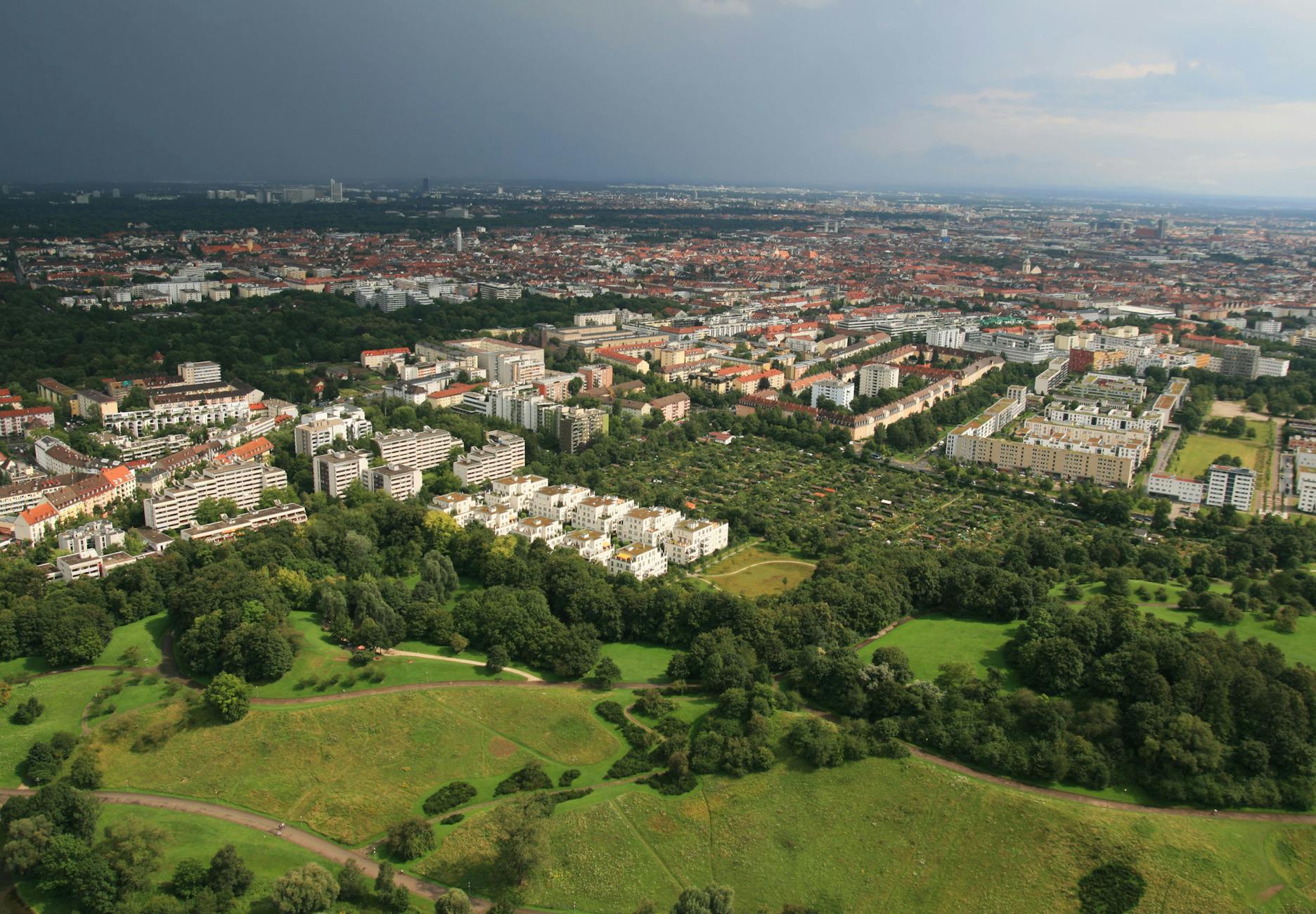
Munich’s history stretches back nearly nine centuries — from a humble 12th-century salt-trading post founded by monks, to the glittering capital of the Wittelsbach kings, to a 20th-century city that birthed and was bombed for its role in Nazism, and finally to the prosperous, design-conscious Bavarian capital of today. This complete Munich history guide walks you through every era and the buildings that still tell the story — Gothic cathedrals, Renaissance courtyards, Baroque palaces, Neoclassical temples, postwar reconstructions, and Olympic-era modernism. By the end you’ll be able to look at any street in central Munich and read it like a chapter in the city’s biography.
Origins: Monks, Salt, and a Bridge (8th–12th Century)
The story of Munich begins not in 1158, the official founding date, but earlier — with monks. As far back as the 8th century, Benedictine monks from the Tegernsee Abbey settled on the elevated ground where today’s Old Peter (Alter Peter / Peterskirche) stands. The German name München derives from the Old High German Munichen, meaning roughly “by the monks,” and the city’s coat of arms still features a hooded monk to this day.
The town’s official birthday came in 1158. Henry the Lion, Duke of Saxony and Bavaria, destroyed a rival toll bridge upstream at Föhring (which had belonged to the Bishop of Freising) and forced the lucrative salt trade from Reichenhall to Augsburg to cross his own new bridge over the Isar. The settlement that grew around it was granted market, mint, and toll rights in the so-called Augsburg Arbitration. Salt — the white gold of the medieval economy — funded everything that came next.
By 1175 Munich had received city status and was ringed by a fortified wall. Three of its old gates still survive in modified form — the Isartor (1337), the Sendlinger Tor (14th century), and the Karlstor (originally the Neuhauser Tor, 14th century) — and they remain useful navigational anchors when you’re orienting yourself in the Altstadt today. The compact circle of the medieval city wall is still legible in the ring road formed by Sonnenstraße, Karlsplatz, Lenbachplatz, Maximiliansplatz, Odeonsplatz, Marienhof, and Frauenstraße.
Want to see the medieval bones of the city in person? Start at Marienplatz, walk south to the Viktualienmarkt, then loop east toward the Isartor and back north along the river — most of what you pass was, in some form, present by the year 1300.
The Wittelsbachs Arrive: Munich Becomes a Capital (1240–1500)
In 1240 Munich passed into the hands of the House of Wittelsbach, a dynasty that would rule Bavaria for an extraordinary 678 years — until 1918. From 1255 the Wittelsbachs made Munich their residence, and the city’s fate was inseparable from theirs ever after. Every great palace, royal church, opera house, and museum you’ll see in central Munich exists because some Wittelsbach duke, elector, or king commissioned it.
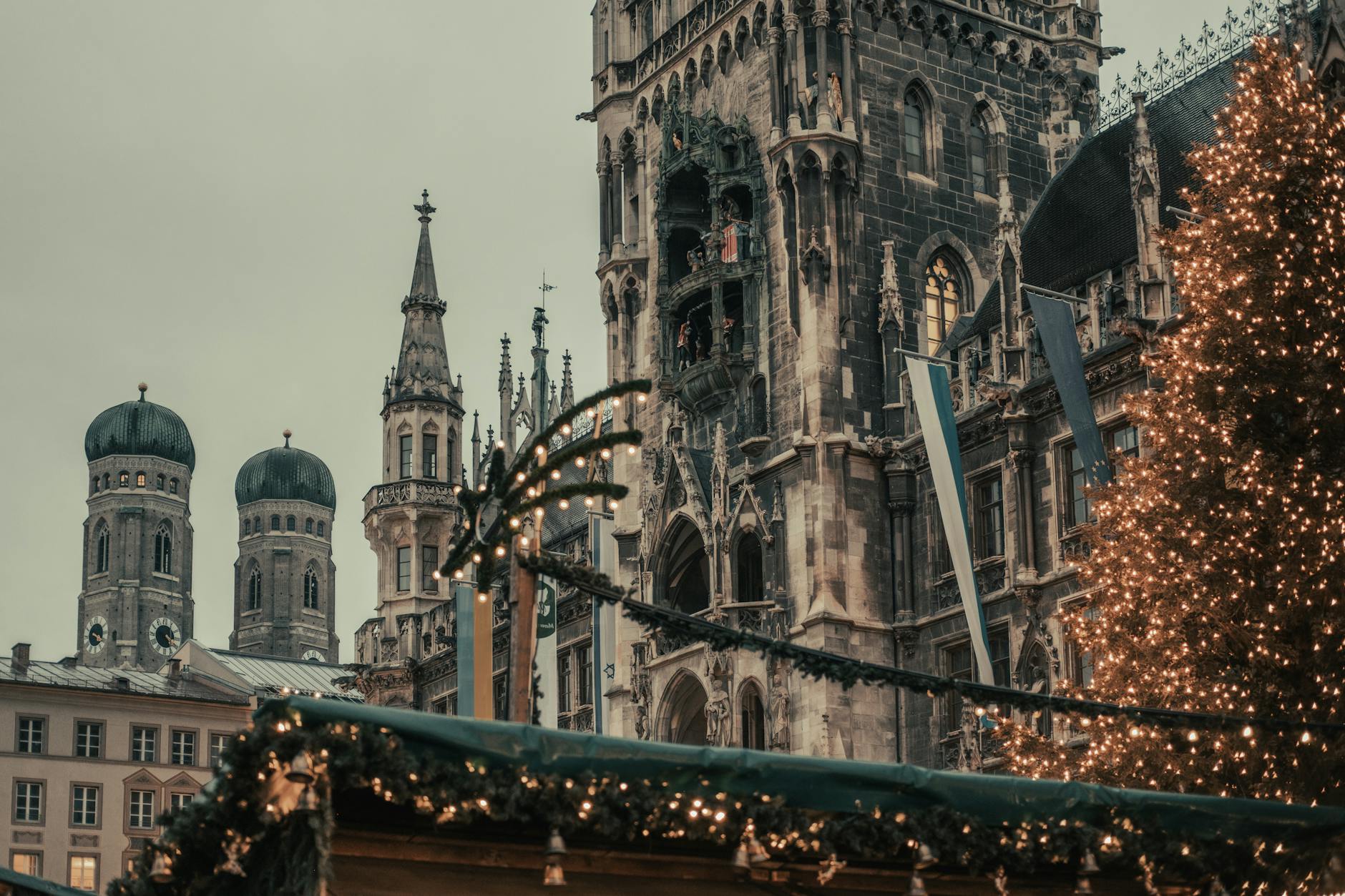
When Bavaria was reunited under Albrecht IV in 1506 (after a brief war with the Duchy of Landshut), Munich was confirmed as its capital. By then the late Gothic period was already in full swing in the city. The Old Town Hall (Altes Rathaus) was enlarged. The medieval church of Our Lady — the famous Frauenkirche — was being constructed in red brick at remarkable speed: just twenty years from groundbreaking in 1468 to completion of the main structure in 1488. Its twin onion-domed towers, completed in 1525, became and remain the unmistakable symbol of Munich. Since a 2004 referendum, city policy has kept new buildings in the centre to about 100 meters, roughly the height of the towers — a policy that protects Munich’s low, generously-spaced skyline.
Late Gothic Highlights to See
- Frauenkirche (1468–1488) — the Cathedral of Our Lady; climb the south tower for the best skyline view
- Altes Rathaus (Old Town Hall, c. 1470) — the late Gothic council hall on Marienplatz, rebuilt after WWII
- Heiliggeistkirche (Holy Spirit Church, 14th c.) — Munich’s hospital church, later Baroque-ified inside
- Salvatorkirche (1494) — a small late Gothic gem near Salvatorplatz
- Isartor and Sendlinger Tor — the surviving medieval city gates
Renaissance and Counter-Reformation Munich (1500–1650)
The 16th and early 17th centuries transformed Munich from a Gothic merchant city into a Renaissance capital and a stronghold of the Catholic Counter-Reformation. The Wittelsbachs were enthusiastic patrons of Italian style, and they imported architects, sculptors, and painters from Florence, Venice, and Rome.
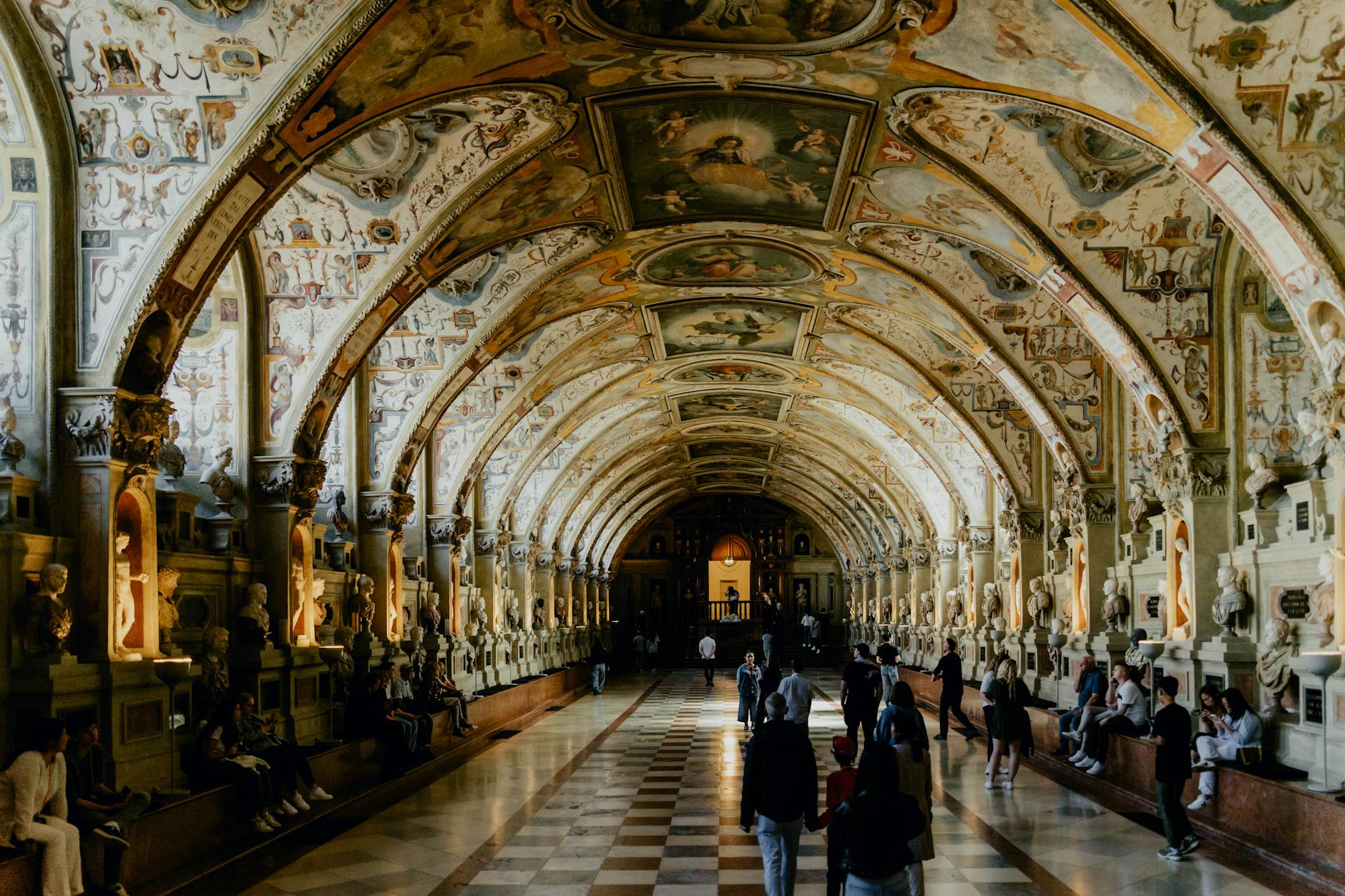
In 1568 Duke Albrecht V built the Antiquarium inside the Residenz — a 66-meter-long barrel-vaulted hall designed to display the Wittelsbach collection of Greek and Roman antiquities. It is one of the largest and most magnificent Renaissance halls north of the Alps and remains one of the most spectacular interiors in Germany. The Munich Residenz, which began as a modest castle in 1385, was expanded over four centuries into a sprawling royal palace of ten courtyards and 130 rooms.
The defining building of Munich’s Counter-Reformation is the Michaelskirche (St. Michael’s Church) on Neuhauser Straße. Built between 1583 and 1597 by Duke William V as a spiritual flagship for the Jesuits, it was — and still is — the largest Renaissance church north of the Alps. Its barrel vault, the second largest in the world after St. Peter’s Basilica, was a structural marvel. The crypt beneath holds the tomb of King Ludwig II, the famous “fairy-tale king” who built Neuschwanstein.
In 1623, during the Thirty Years’ War, Munich became an Electoral Residence when Duke Maximilian I was elevated to Prince-Elector. But the war’s brutality reached the city: in 1632 King Gustavus Adolphus of Sweden occupied Munich and only an enormous ransom prevented its destruction. Plague and starvation in the following years killed roughly a third of the population. Munich would not fully recover until the late 17th century.
The Baroque Boom: Italian Splendor in Bavaria (1650–1780)
The late 17th and 18th centuries brought one of Munich’s most beloved architectural eras: high Bavarian Baroque and, later, Rococo. Wealth poured back in after the Thirty Years’ War, the Wittelsbachs intermarried with the Habsburgs, and Italian masters once again dominated the building scene.
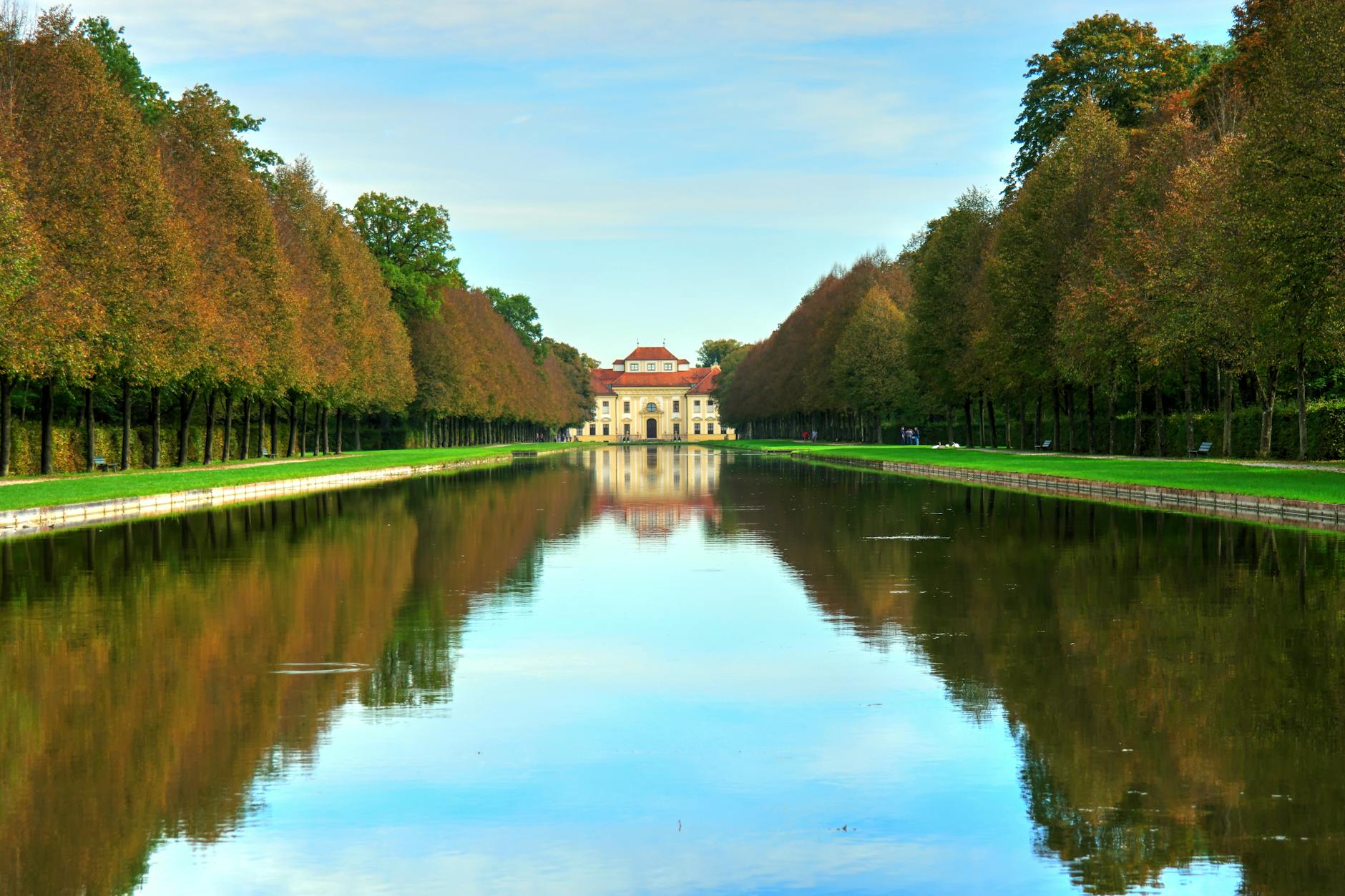
Construction of Nymphenburg Palace began in 1664 as a summer retreat for Electress Henriette Adelaide of Savoy, a gift to celebrate the long-awaited birth of an heir, Maximilian II Emanuel. Over the following century it grew into one of the largest royal residences in Europe — a 632-meter-wide Baroque palace with formal gardens, canals, and four exquisite garden pavilions (the Amalienburg, Badenburg, Pagodenburg, and Magdalenenklause). The Amalienburg, designed by François Cuvilliés in 1734–39, is one of the supreme masterpieces of European Rococo.
Inside the city walls, the Theatinerkirche (1663–1690) introduced full-blown Italian high Baroque to Munich. Modeled on Sant’Andrea della Valle in Rome and crowned with a bright yellow facade and a 71-meter dome, it became the prototype for southern German Baroque churches. Don’t miss the Asamkirche (1733–1746) on Sendlinger Straße — the private church of the Asam brothers, just 22 meters long but jaw-droppingly intense, with every centimeter of wall and ceiling encrusted in gold, marble, frescoes, and writhing stucco saints. It is widely considered the densest Rococo interior in the world.
Munich Baroque Must-Sees
- Nymphenburg Palace and gardens (1664 onwards) — and the Amalienburg in the park
- Theatinerkirche (1663–1690) — bright yellow Italianate church on Odeonsplatz
- Asamkirche (1733–1746) — late Rococo at its most overwhelming
- Cuvilliés Theatre inside the Residenz (1751–1755) — Mozart conducted here
- Schloss Schleißheim (1701–1726) — the “Bavarian Versailles” 14 km north of the city
Ludwig I and the Neoclassical Capital (1806–1864)
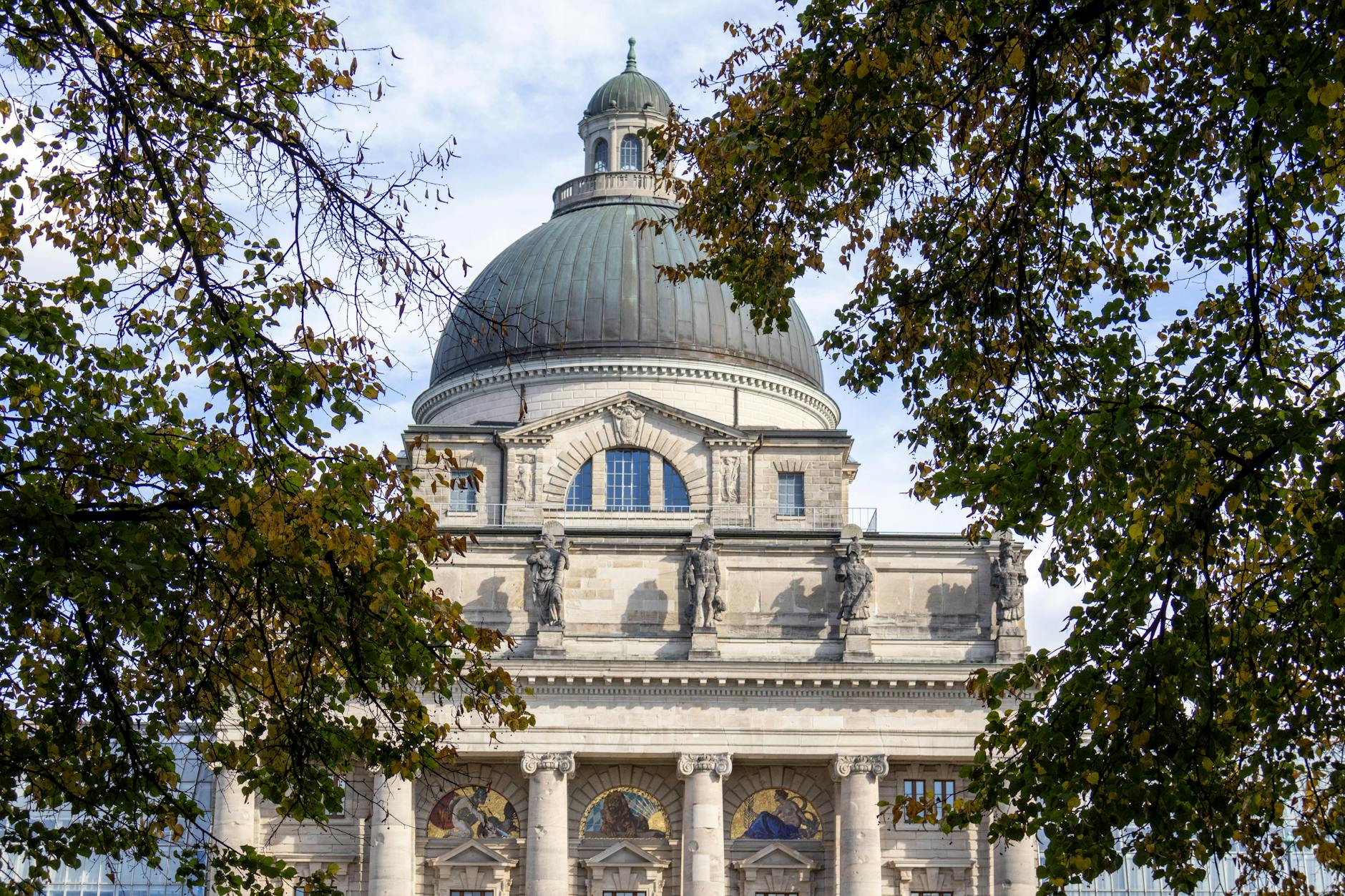
When Bavaria was elevated from an Electorate to a Kingdom in 1806 (a gift from Napoleon to Maximilian I Joseph for switching sides), Munich became a royal capital — and Maximilian’s son, the future King Ludwig I, decided it should look the part. From his ascent in 1825 until his abdication in 1848, Ludwig I and his court architect Leo von Klenze remade central Munich into what they called a “New Athens on the Isar.”
The pair created entirely new ceremonial squares and avenues. Königsplatz was conceived as a Greek temple precinct, framed by the Doric Propyläen (1862), the Ionic Glyptothek (1830) housing classical sculpture, and the Corinthian State Collection of Antiquities (1848) — three buildings, three Greek orders, one square. Ludwigstraße, a kilometer-long ceremonial boulevard, was punched north from Odeonsplatz to a new triumphal arch, the Siegestor. The avenue is lined with monumental Italianate and Romanesque-Revival institutions: the State Library, the University, the Ludwigskirche.
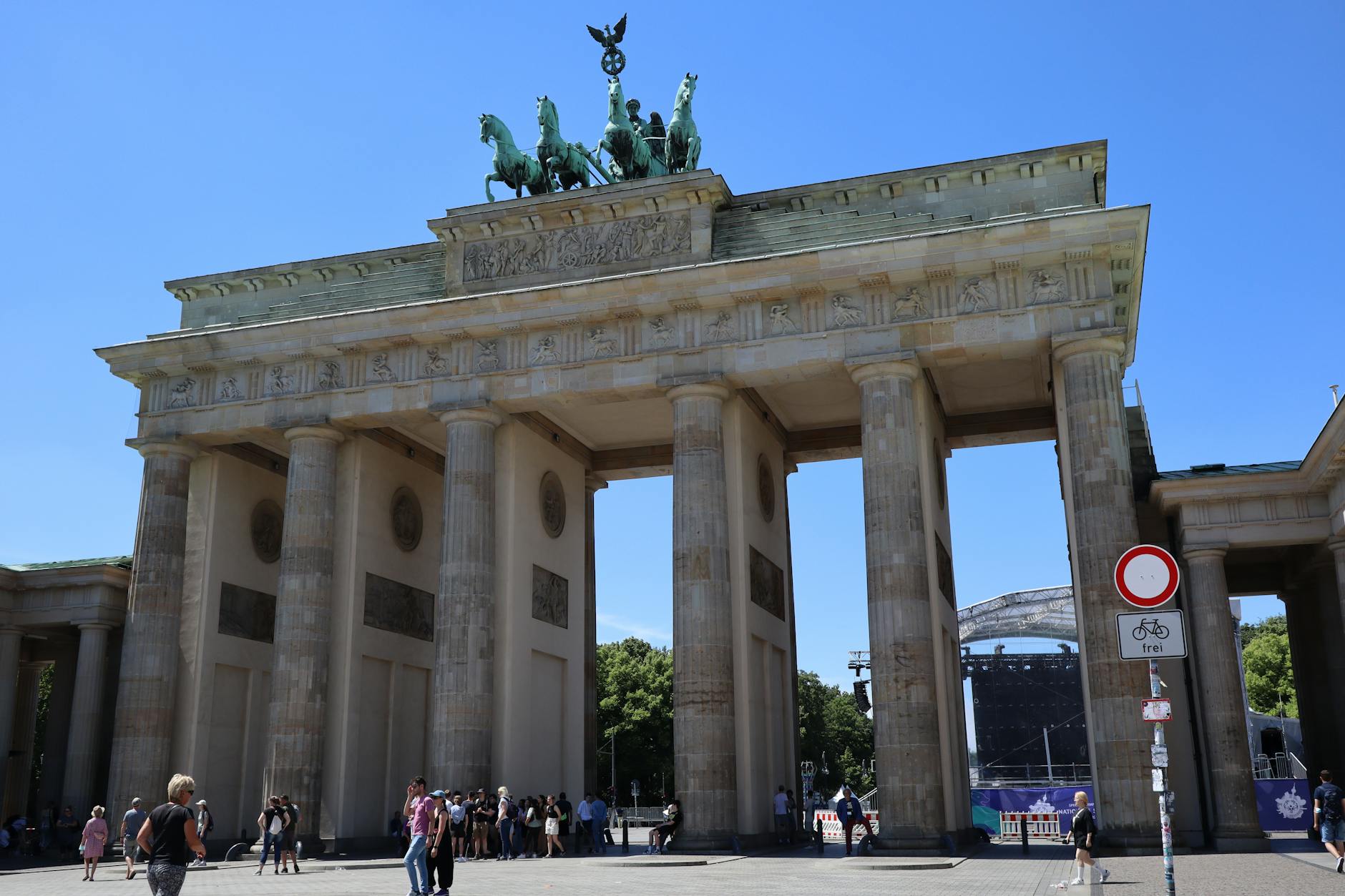
Klenze also expanded the Residenz with the Königsbau (1826–1835) — an eastern wing modeled directly on the Palazzo Pitti in Florence — and built the Alte Pinakothek (1826–1836), one of the world’s first purpose-built public art museums. It set the template for art museums in Berlin, St. Petersburg, Brussels, Rome, and beyond.
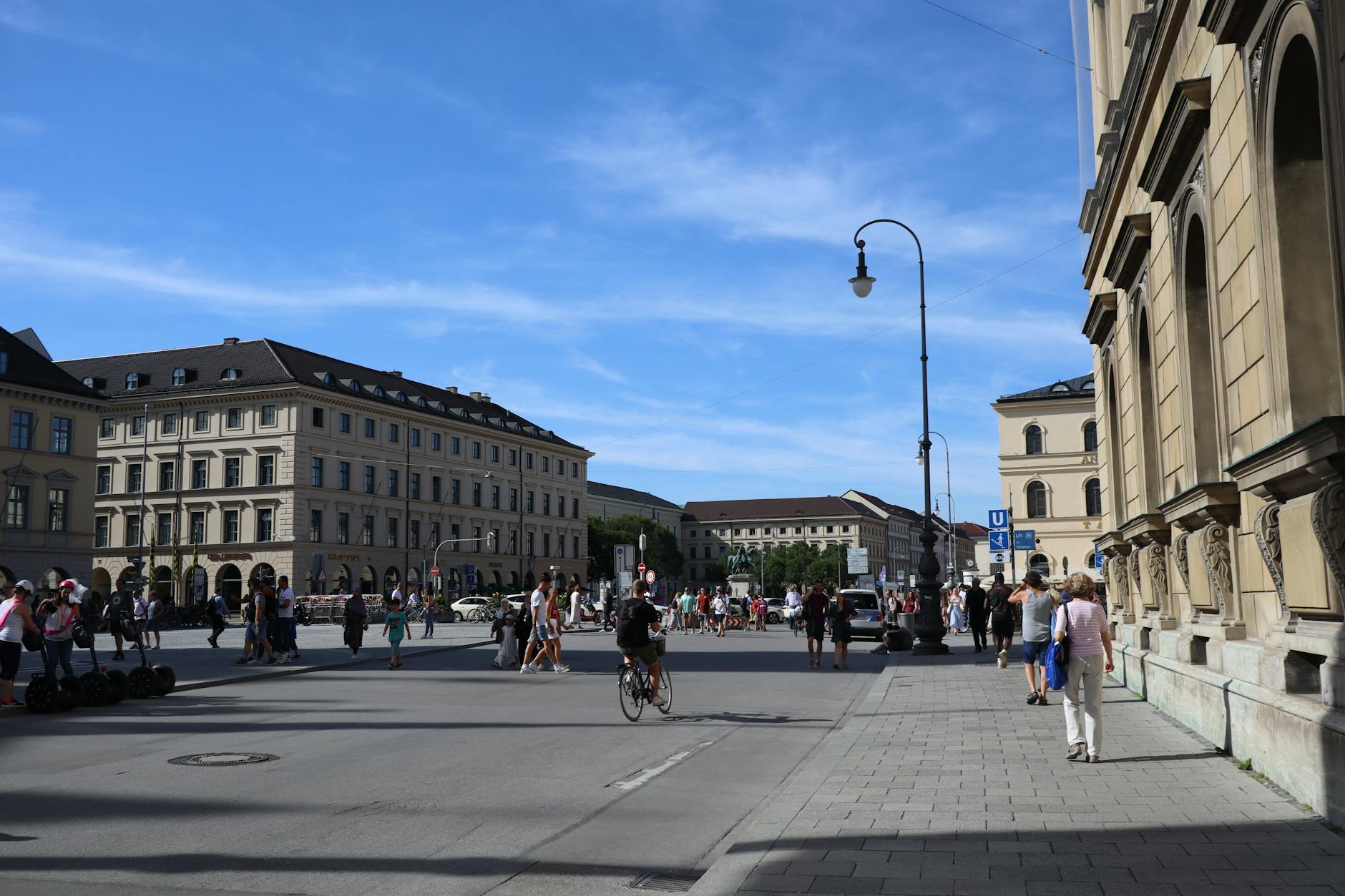
Across town, Friedrich von Gärtner gave Ludwigstraße its Romanesque Revival character, while the Feldherrnhalle (1844) — a loggia modeled on the Loggia dei Lanzi in Florence — closed the southern end of the boulevard at Odeonsplatz. Beyond Munich’s borders, Ludwig I built the colossal Walhalla hall of fame near Regensburg (1842), a full-scale Doric temple set high above the Danube.
Whoever does not know Munich, does not know Germany.
King Ludwig I of Bavaria (attributed)
Industrialization, Art Nouveau, and the Prince-Regent Years (1864–1914)
Munich’s neoclassical golden age ended dramatically. In 1846 Ludwig I scandalized Europe with his open affair with the Irish-born dancer Lola Montez, and the political fallout (combined with the wider 1848 revolutions) forced him to abdicate in favor of his son, Maximilian II. Maximilian’s own architectural legacy is the Maximilianstraße, a wide boulevard of Gothic-Tudor-revival hybrid buildings that runs east from the Residenz to the Maximilianeum (today the seat of the Bavarian State Parliament) on the far bank of the Isar.
Then came the Prinzregentenzeit — the long, peaceful Prince-Regent era of Luitpold (1886–1912), uncle of the famously eccentric King Ludwig II and the mentally ill King Otto. Although Luitpold never officially took the crown, this period was the belle époque of Munich. The city’s population doubled to 600,000. The university expanded. Schwabing exploded as a bohemian artists’ quarter — Wassily Kandinsky, Paul Klee, Franz Marc, Thomas Mann, and Rainer Maria Rilke all lived and worked there. The Prinzregentenstraße, a third grand axis, was driven east of the Residenz, ending at the Friedensengel (Angel of Peace) and crossing the Isar to the Bavarian National Museum and the Haus der Kunst (built later, in the Nazi era).
It was also the great age of Munich Jugendstil — the German cousin of Art Nouveau. The 1896 magazine Jugend, founded in Munich, gave the entire movement its name. Walk through Schwabing today (Ainmillerstraße, Wilhelmstraße, the area around Münchner Freiheit) and you’ll see exuberantly decorated apartment buildings with ironwork, sgraffito, and floral stucco from this era — a remarkable amount of it survived the war.
The Dark 20th Century: Revolution, Nazism, and War (1914–1945)
The 20th century brought catastrophe. Defeat in World War I ended the Wittelsbach monarchy in November 1918 — King Ludwig III simply released his subjects from their oaths of loyalty and slipped away. A short-lived Bavarian Soviet Republic was declared in 1919, then violently crushed by Freikorps paramilitaries. In the bitter postwar years Munich became a hothouse of right-wing extremism.
It was here, in Munich, that Adolf Hitler joined the tiny German Workers’ Party in 1919, transformed it into the NSDAP, and on November 8–9, 1923 launched the failed Beer Hall Putsch from the Bürgerbräukeller. The march on the city the next morning was stopped by Bavarian police gunfire at the Feldherrnhalle on Odeonsplatz. Hitler was jailed at Landsberg, where he wrote Mein Kampf. After taking power in 1933, the Nazis declared Munich the “Capital of the Movement” (Hauptstadt der Bewegung) and built monumental party buildings around Königsplatz: the Führerbau (where the 1938 Munich Agreement was signed), the Verwaltungsbau, and the two open-air “Temples of Honor” for the dead of the 1923 putsch.
The first Nazi concentration camp, Dachau, opened in March 1933 just 16 km northwest of central Munich. It is now a sobering memorial that should be on any serious history visitor’s itinerary. The NS-Dokumentationszentrum on Brienner Straße, opened in 2015 on the former site of the Brown House (Nazi party headquarters), is the city’s primary museum of confrontation with this period.
Allied bombing between 1940 and 1945 hit Munich 71 times. By the war’s end roughly 50% of the city — and 90% of the medieval Old Town — lay in ruins. American troops entered Munich on April 30, 1945.
Rebuilding: Munich’s Postwar Choice (1945–1972)
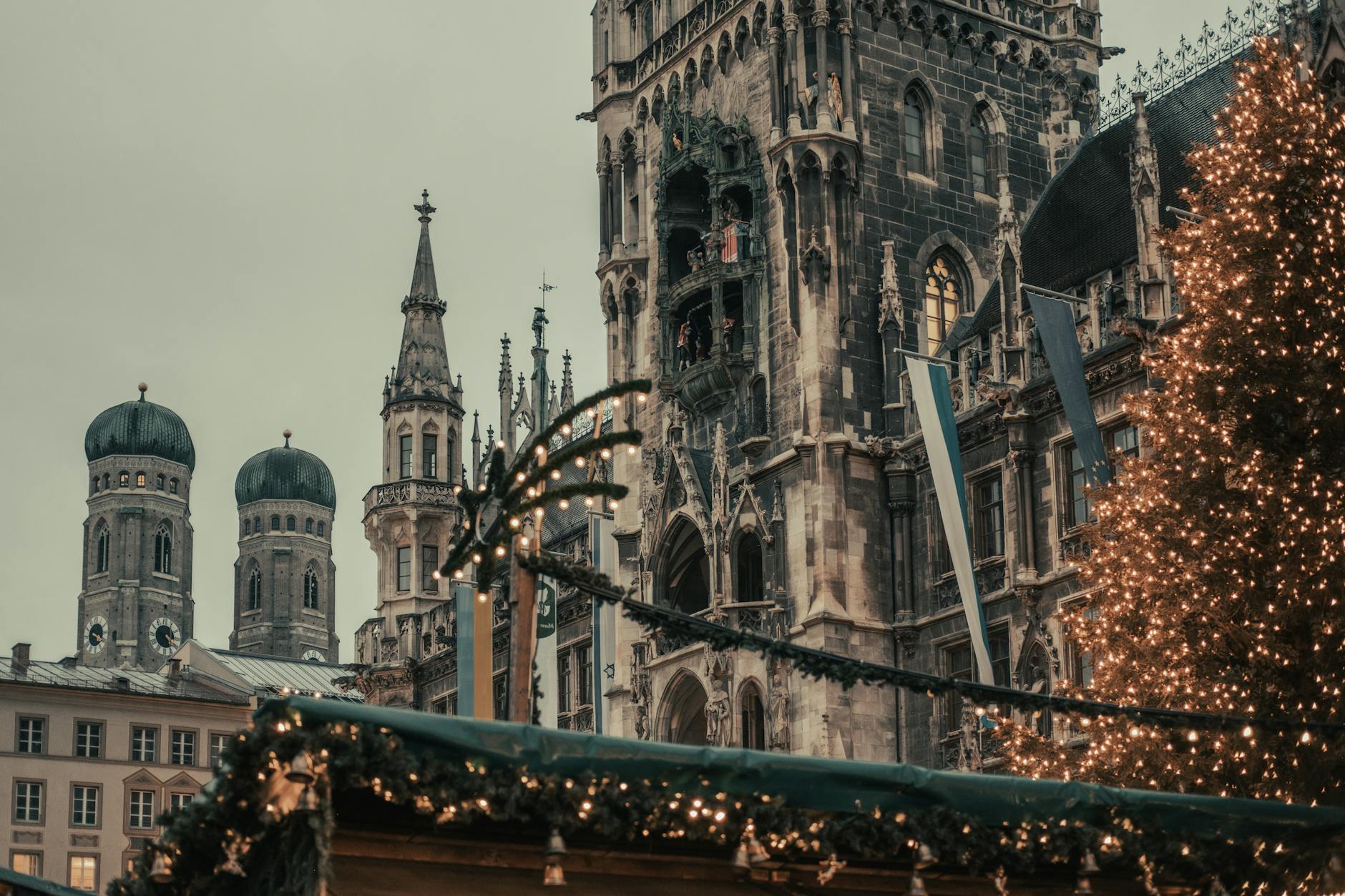
Many bombed German cities chose to modernize: Frankfurt and Hannover replaced their ruined centers with grids of modernist towers and wide car-friendly avenues. Munich, almost uniquely, chose the opposite path. After fierce public debate in the late 1940s, the city decided to rebuild its historic center largely as it had been. Streets kept their medieval widths and curves. The Frauenkirche, the Old and New Town Halls, the Residenz, the Theatinerkirche, the major churches — all were painstakingly reconstructed using surviving photographs, plans, and salvaged stones.
The result is one of Europe’s most successful postwar reconstructions. To a casual visitor today, the central Altstadt looks centuries old. Look closer, though, and you’ll see the seams: a slightly too-clean stone here, a 1950s-era door fitting there, a faint line where original masonry meets reconstruction. The Alte Pinakothek by Hans Döllgast (reopened 1957) is a particularly admired “creative reconstruction” — Döllgast left the bombed central section deliberately stripped down in plain brick, so the wound is still visible alongside the rebuild. It’s a minor masterpiece of how to repair a damaged building honestly.
By the late 1950s the West German Wirtschaftswunder (economic miracle) was in full swing, BMW was thriving on Munich’s northern edge, and the city had a new self-image as a wealthy, livable, design-conscious capital.
The 1972 Olympics and Modern Munich (1972–2000)
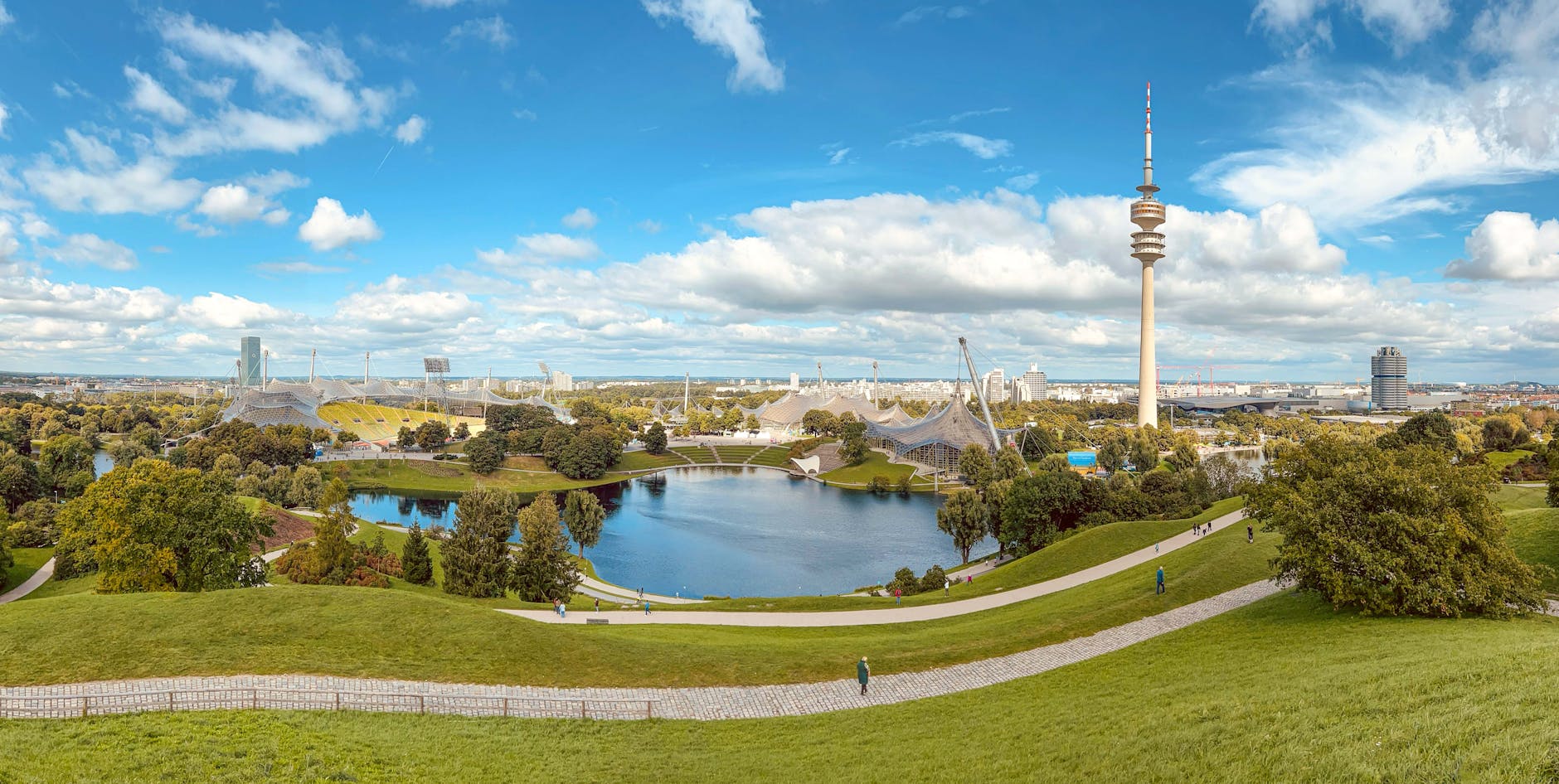
If 1945–1970 was about restoring the past, the 1972 Munich Olympic Games were about asserting a confident, optimistic, transparently democratic future. Architect Günter Behnisch and engineer Frei Otto designed the Olympiapark with a revolutionary lightweight tensile-cable canopy that floats above the stadium, swimming hall, and arena like a great translucent web — an architectural metaphor for the new “Heitere Spiele” (“Cheerful Games”) that postwar Germany wanted to present to the world.
The Games were tragically scarred by the September 5, 1972 terrorist attack at the Israeli athletes’ quarters in the Olympic Village, in which 11 Israeli team members and a German police officer were killed. A memorial site at Connollystraße 31 commemorates them. But the architecture remains — and is still in heavy daily use, hosting concerts, swimming, and the BMW Welt complex next door (opened 2007), with Coop Himmelb(l)au’s deconstructivist BMW Museum addition (2008) and the cylindrical 1972 BMW HQ tower (the “four-cylinder”).
From the 1970s onward Munich also extended its U-Bahn and S-Bahn, pedestrianized the central streets between Karlsplatz and Marienplatz (one of the first big pedestrian zones in Germany), and built the dramatic Allianz Arena (Herzog & de Meuron, 2005) in the northern suburb of Fröttmaning — a glowing white, red, or blue inflated cushion of ETFE foil that has become one of the most photographed pieces of contemporary German architecture.
The Games left both a park and a scar. Our full account of the 1972 Munich Olympics covers the architecture, the massacre and what stands on the site today.
21st-Century Munich: Layered, Wealthy, Carefully Modern
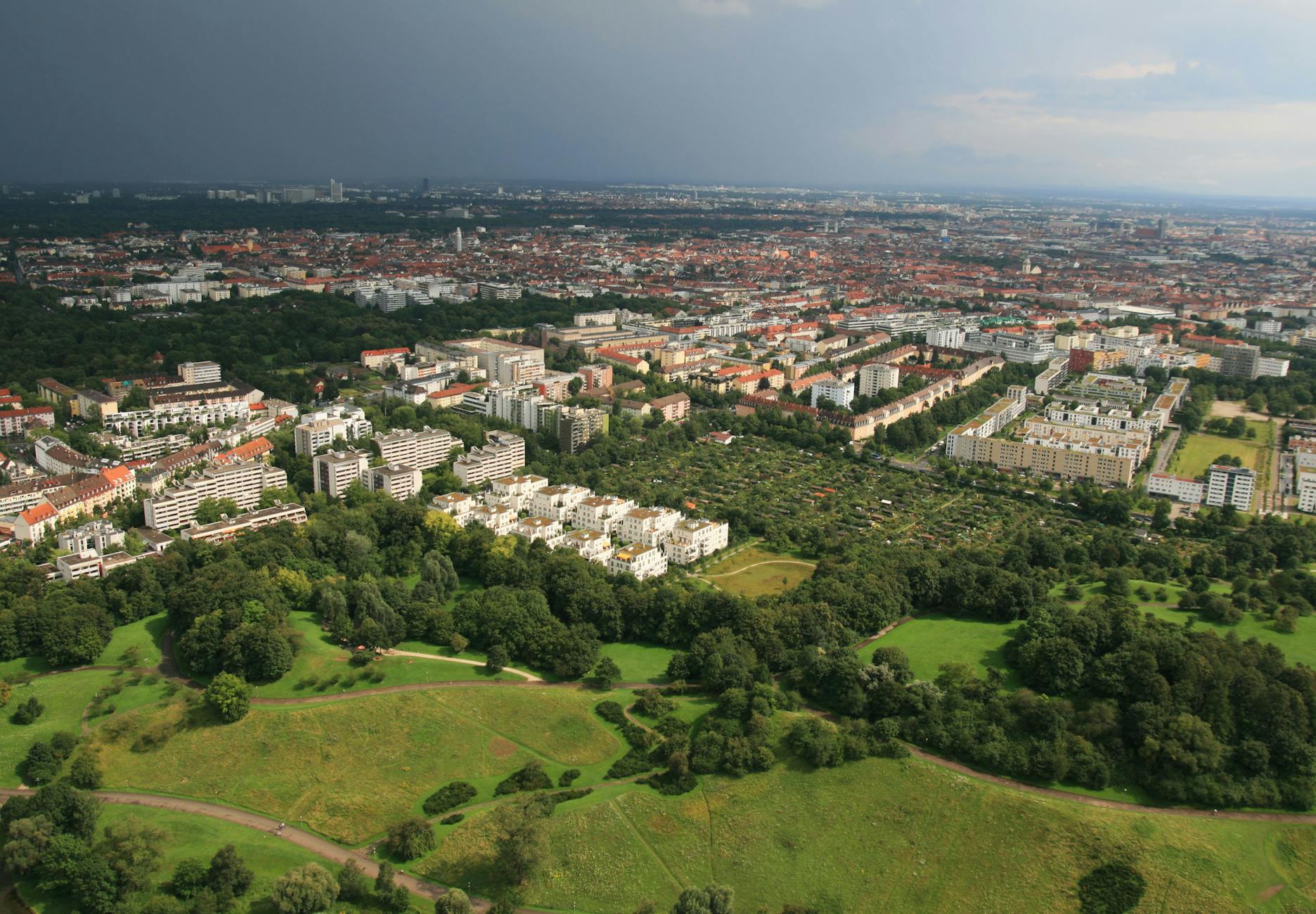
Modern Munich is one of the wealthiest and most expensive cities in Europe, headquarters to BMW, Siemens, Allianz, and dozens of other global firms. Its building culture is conservative by international standards — there is no Frankfurt-style cluster of glass skyscrapers in central Munich, and the 99-meter Frauenkirche-height rule has held off the worst of skyline-shredding development. New construction tends to be careful, contextual, and quietly high-quality.
Highlights of recent decades include the Pinakothek der Moderne (Stephan Braunfels, 2002) on the Kunstareal museum row; the Museum Brandhorst (Sauerbruch Hutton, 2009) with its 36,000 ceramic-rod facade; the NS-Dokumentationszentrum (Georg Scheel Wetzel, 2015) — a deliberately stark white cube next to the Nazis’ former Brown House site; the new Munich Volkstheater (Lederer Ragnarsdóttir Oei, 2021); and major rebuilds of historical interiors like the State Opera and the Bayerische Staatsbibliothek.
If you want to read modern Munich’s architectural priorities at a glance: subtlety over spectacle, durability over fashion, public space over private icon. The result is a city that visitors often describe as feeling “unhurried” and “complete” — a 900-year sequence of buildings that all somehow share the same DNA.
The buildings are only half the story. The maypoles, Tracht and brass bands that visitors read as “Bavarian” are covered in our guide to Bavarian customs and traditions, including where each one comes from.
Architectural Styles Decoded: A Field Guide
You don’t need an art-history degree to read Munich’s buildings — you need about eight visual cues and one named example of each you can walk to. The city is unusually good as a teaching collection because almost every major European style is represented by at least one first-rank survivor, often within a ten-minute walk of the next. Learn the tells below and the Altstadt stops being a pretty backdrop and starts being a legible timeline. Pair this with our guide to Munich’s landmarks and you’ll know not just what you’re looking at but why it looks that way.
Romanesque and Gothic (12th–early 16th century)
What to look for: Romanesque is heavy, round-arched, and rare in Munich — the city was founded too late to build much of it, so what survives is fragmentary, like the older core walls of Peterskirche. Gothic is the real medieval signature here, and Munich’s version is distinctly Bavarian: not the lacy French stone tracery you get at Reims, but tall, plain, red-brick hall churches with pointed arches, ribbed vaults, and very little exterior ornament. Brick was cheap and local; stone had to be hauled in. The result is a stripped, almost austere Gothic that relies on sheer height and interior space rather than carved decoration.
Go see: the Frauenkirche (1468–1488) is the textbook example — a vast brick hall under a single soaring roof, its famous twin towers capped not with Gothic spires but with green copper “Welsh domes” added in 1525. Inside, the columns seem to merge into a forest of vaulting. For the smaller-scale version, step into the Old Town Hall’s reconstructed Gothic council chamber on Marienplatz.
Renaissance (1550–1620)
What to look for: calm, balanced, classical. Round arches return, facades go symmetrical, and you start seeing Italian ideas — pilasters, pediments, harmonious proportion — imported by Wittelsbach dukes who had been to Italy and wanted some of that prestige. Munich’s Renaissance is largely a court-and-church affair driven by the Counter-Reformation, so it can feel monumental and slightly stern rather than playful.
Go see: St. Michael’s Church (Michaelskirche) on Neuhauser Straße (1583–1597), the largest Renaissance church north of the Alps, with a barrel-vaulted nave that directly influenced later Baroque interiors. For the secular version, the Antiquarium inside the Residenz — a 66-metre barrel-vaulted Renaissance hall built to display the dukes’ antique sculpture — is the single most spectacular Renaissance room in the city.
Baroque and Rococo (1650–1780)
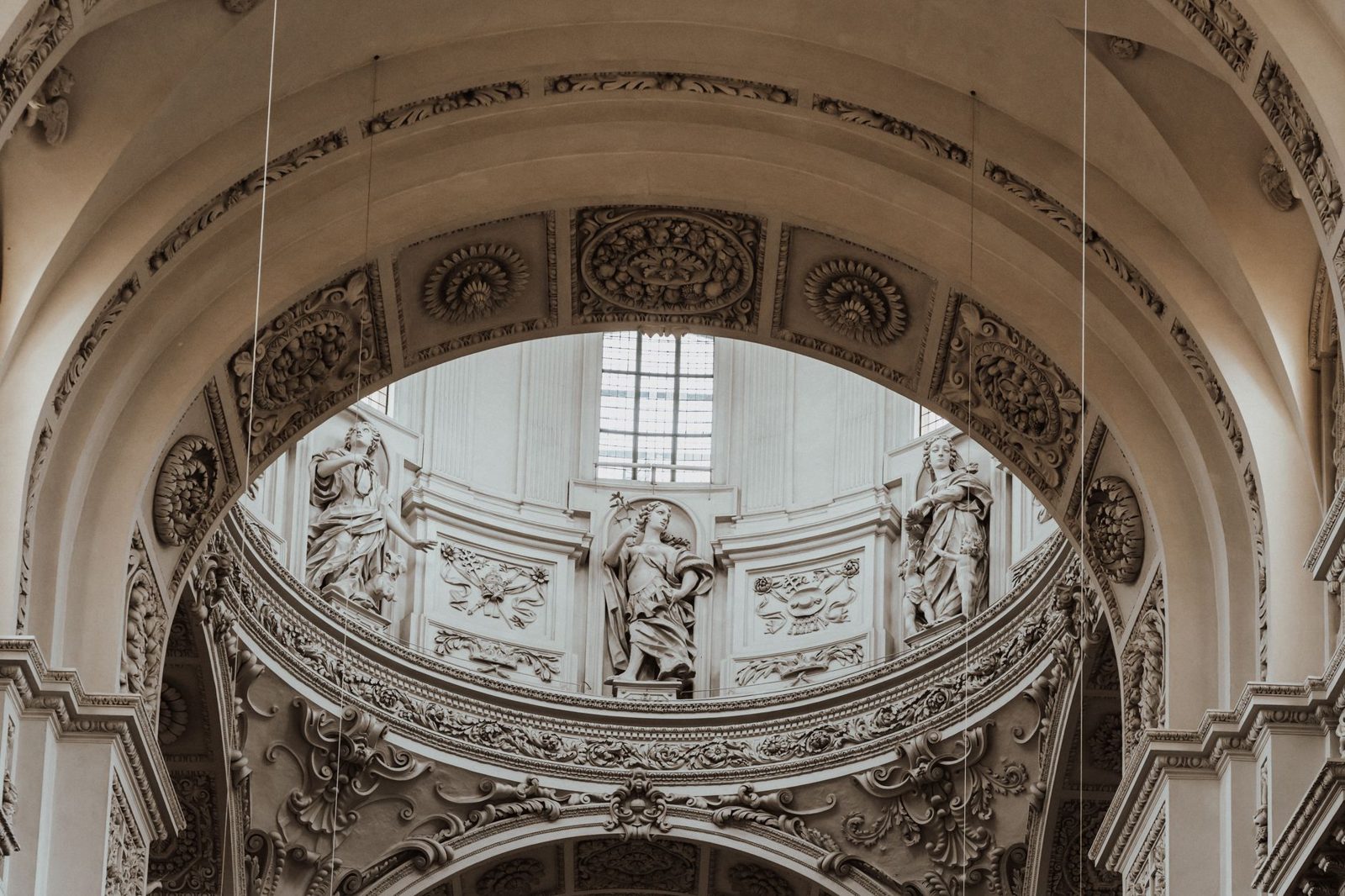
What to look for: drama, motion, and gold. Baroque facades curve and swell; interiors disappear under stucco, gilding, and ceiling frescoes painted to look like the heavens have opened overhead. Rococo, the lighter phase that follows, swaps Baroque’s heaviness for sugar-spun delicacy — pastel colours, asymmetric shell-and-scroll ornament (the very word comes from rocaille), and a feeling that the walls themselves are dissolving. This is Munich at its most theatrical, and two names dominate: the Asam brothers, Cosmas Damian and Egid Quirin, who built their own private church as a total work of art, and the Walloon court architect François de Cuvilliés, who brought French Rococo to Bavaria.
Go see: the Asamkirche (1733–1746) on Sendlinger Straße — tiny, dark, and absolutely encrusted with gold and drama, the most intense Baroque interior in Germany. For Rococo at its most refined, the Cuvilliés Theatre inside the Residenz and the Amalienburg hunting lodge in the Nymphenburg park, whose mirrored Hall of Mirrors in silver and pale blue is the high-water mark of the entire style. The Theatinerkirche‘s yellow Italian-Baroque facade on Odeonsplatz is the easiest example to spot from the street.
Neoclassical (1800–1870)
What to look for: Greece and Rome, rebuilt in Bavaria. Columns, porticos, pediments, and severe geometric clarity replace Baroque curves. This is the look King Ludwig I commissioned wholesale to turn Munich into “Athens on the Isar,” and its master was the architect Leo von Klenze, who gave the city a temple district, triumphal arches, and the long ceremonial boulevards still at the heart of the modern map. If a Munich building looks like a Greek temple or a Renaissance Florentine palazzo dropped onto a wide straight street, you’re looking at the Klenze era.
Go see: Königsplatz, where Klenze’s Glyptothek (1816–1830, Ionic) faces the Corinthian Propylaea gateway across a square modelled on the Acropolis — the most concentrated Neoclassical ensemble in Germany. The Alte Pinakothek nearby pioneered the templated art-museum facade copied across Europe; plan a visit with our guide to the Pinakothek museums. Walk the Ludwigstraße north to the Siegestor arch to see the boulevard Klenze and Friedrich von Gärtner laid out as a single composition.
Jugendstil / Art Nouveau (1895–1914)
What to look for: curves, flowers, and faces. Jugendstil — Germany’s Art Nouveau, literally “youth style,” named after the Munich magazine Jugend — breaks out across apartment buildings of the boom years with sinuous wrought ironwork, floral stucco reliefs, sculpted female heads above windows, and stained glass. It’s an apartment-house and shopfront style more than a monument style, so you find it by looking up at residential facades rather than visiting a single landmark.
Go see: the residential streets of Schwabing — Ainmillerstraße and Römerstraße in particular — where intact Jugendstil facades run for whole blocks. The Müllersches Volksbad on the Isar (1901), a public swimming hall of extravagant Art Nouveau and neo-Baroque splendour, is the one interior you can actually use: buy a ticket and swim under its barrel-vaulted ceiling. For more neighbourhood-by-neighbourhood context, see our Munich neighbourhoods guide.
Nazi-Era Monumentalism (1933–1945)
What to look for: stripped classicism scaled up to intimidate. The regime that called Munich the “Capital of the Movement” built in a cold, simplified neoclassicism — long colonnades of square pillars, bare limestone, oppressive symmetry, no ornament, deliberately superhuman proportions. The intent was to dwarf the individual, and that chill is still legible in the surviving structures, which the city has chosen to leave standing and contextualise rather than demolish.
Go see: the Haus der Kunst (1937) on Prinzregentenstraße, with its endless flat-pillared portico, now repurposed as a contemporary art gallery — a pointed reversal of its origins. Around Königsplatz, the two surviving Nazi administrative buildings now house a music academy and the NS-Dokumentationszentrum, which stands on the site of the demolished “Brown House” party headquarters. To understand the period properly, read it alongside our Munich and World War II history guide.
Postwar Reconstruction (1945–1970)
What to look for: old shapes, new fabric. After up to 90% of the Altstadt was flattened, Munich made a deliberate civic choice — unlike Frankfurt or Hannover — to rebuild its historic core to its old footprint and silhouette rather than modernise it. So most “medieval” and “Baroque” facades in the centre are sympathetic reconstructions from the late 1940s and 1950s. The tells are subtle: stone that’s slightly too uniform, a plainer interior behind a historic shell, a date plaque reading 1952 on a “Gothic” building, or a simplified version of a lost facade where full restoration was impossible.
Go see: the Altes Rathaus on Marienplatz (rebuilt after the war), the reconstructed nave of the Frauenkirche, and the National Theatre on Max-Joseph-Platz, rebuilt brick by brick from old plans and reopened in 1963. Look for the line where surviving original masonry meets cleaner postwar stone — the city makes no secret of the seam.
Contemporary (1972–today)
What to look for: two distinct moods. First, the optimistic high-tech moment of 1972 — sweeping, transparent, lightweight engineering meant to project a new, democratic, open Germany. Second, the quieter contemporary work of recent decades, which in conservative Munich tends toward crafted facades, restrained massing, and clever surfaces rather than flashy towers. The 99-metre Frauenkirche height limit in the centre keeps everything low, so contemporary statement pieces cluster on the edges of the old core.
Go see: the Olympiapark tent roofs (Frei Otto and Günter Behnisch, 1972), whose acrylic-and-cable canopies still look like they landed from the future; the BMW Welt and the four-cylinder BMW Tower in the north, covered in our BMW Museum and Welt guide; and the rainbow-ceramic-clad Museum Brandhorst (2009) in the Kunstareal museum quarter, best paired with the rest of the city’s museums and culture.
If you want to go deeper on the buildings themselves, our guide to Munich architecture walks through the landmark structures style by style.
Ten Buildings That Tell Munich’s Story
If you want the whole nine centuries compressed into a walkable highlight reel, these ten buildings do it. Visit them roughly in this order and you’ll trace the city’s biography from its medieval bones to its glass-and-steel present — each one is the clearest surviving witness to its era. Several sit within the same square kilometre of the Altstadt; the last few pull you out to the museum quarter and the northern edge of the city.
1. Peterskirche — the oldest spot in the city (12th century)
“Old Peter” is Munich’s oldest parish church and stands on the rise where the founding monks first settled, predating the official 1158 founding. Its current shape is a layered palimpsest — Romanesque core, Gothic choir, Baroque interior — which makes it a one-building summary of medieval Munich. Climb the 306 steps of the tower for the best close-range view of Marienplatz and the Frauenkirche; on clear Föhn-wind days the Alps appear on the horizon.
2. Frauenkirche — the symbol of Munich (1468–1488)
The red-brick Cathedral of Our Lady and its twin domed towers are the city’s defining silhouette, protected by a height rule that still keeps the modern skyline below 99 metres. Built in a single generation, it’s the supreme example of austere Bavarian brick Gothic. Find the “Devil’s Footprint” in the entrance — a black mark in the floor tied to a builders’ legend — and notice how, from that exact spot, the side windows seem to vanish behind the pillars.
3. The Residenz — 600 years of royal ambition in one complex (1385–1850s)
No single building tells more of the story. The former seat of the Wittelsbach dukes, electors, and kings grew over six centuries into a sprawling palace stitching together a Renaissance Antiquarium, a Baroque chapel, the Rococo Cuvilliés Theatre, neoclassical galleries by Klenze, and a Treasury of crown jewels. It is effectively this entire article rendered in three dimensions. Give it a half-day minimum — our dedicated Munich Residenz guide maps a route through the highlights so you don’t get lost in its 130 rooms.
4. Michaelskirche — the Counter-Reformation in stone (1597)
The largest Renaissance church north of the Alps was built by Duke Wilhelm V as a Jesuit statement of Catholic confidence, and its enormous barrel-vaulted nave became a template for the Baroque churches that followed. Its crypt holds the tomb of the most famous Wittelsbach of all, the fairy-tale “mad king” Ludwig II — making it a quiet pilgrimage site for anyone who’s seen Neuschwanstein.
5. Asamkirche — the Baroque turned up to eleven (1746)
Squeezed between townhouses on Sendlinger Straße, this tiny church was built by the Asam brothers as their private chapel, with no patron to please but themselves — so they went all in. Every surface drips gilt, marble, and theatrical fresco; the light is deliberately dim and golden. It is the most concentrated Baroque interior in the country and a vivid demonstration of how Munich’s church builders treated architecture as immersive theatre rather than mere structure.
6. Nymphenburg Palace — the summer of the dynasty (1664–18th c.)
The Wittelsbachs’ Baroque summer residence sprawls across a vast park west of the centre, its central pavilion flanked by wings and fronted by a long canal. Inside is the Hall of Mirrors where the future Ludwig II was born and the “Gallery of Beauties” commissioned by Ludwig I; out in the gardens, Cuvilliés’ Amalienburg hunting lodge is Rococo at its most exquisite. It’s the counterweight to the urban Residenz — the same family at play rather than at work. The surrounding gardens feature in our Munich parks and gardens guide.
7. The Glyptothek and Königsplatz — Athens on the Isar (1830)
Leo von Klenze’s Ionic temple of ancient sculpture, facing the Propylaea gateway across Königsplatz, is the purest expression of Ludwig I’s dream of remaking Munich as a new Athens. The square is the most complete Neoclassical ensemble in Germany — and a place where history doubled back on itself, since the Nazis later paved it for rallies before the city restored its lawns. Stand in the middle and you’re standing on two very different versions of German ambition.
8. Neues Rathaus — Victorian Munich playing medieval (1867–1909)
The New Town Hall that dominates Marienplatz looks five centuries old but is barely a century older than the cars parked beside it — a neo-Gothic fantasy in stone, built when the booming industrial city wanted a civic showpiece grander than its real medieval hall next door. Its Glockenspiel carillon clatters to life daily with jousting knights and dancing coopers. It’s the perfect lesson in how Munich’s “old” centre is often a deliberate, confident imitation of older styles.
9. The Olympiapark tents — Germany reintroduced to the world (1972)
The sweeping acrylic canopies Frei Otto and Günter Behnisch strung over the 1972 Olympic stadiums were engineered to feel weightless, democratic, and transparent — the architectural opposite of the heavy Nazi monumentalism a generation earlier. That symbolism was the whole point of the “cheerful Games.” Today the park is where Münchners jog, swim, and picnic, and the roofs remain one of the most influential structures of postwar architecture anywhere.
10. BMW Welt and the BMW Tower — the confident present (1973 / 2007)
Across the ring road from the Olympiapark, the four-cylinder BMW Tower of 1973 and the swooping double-cone glass pavilion of BMW Welt (2007) bookend Munich’s modern self-image as a wealthy engineering capital. It’s corporate architecture as civic spectacle — and free to walk into. Together with the adjacent BMW Museum it’s the cleanest snapshot of 21st-century Munich; plan it with our BMW Museum and Welt guide.
Want this list as a guided narrative rather than a self-led crawl? A good Munich walking tour ties several of these stops together with the stories between them, and our deeper history of Munich fills in the centuries that connect one building to the next. To understand the family whose ambition built most of this list, read up on the Wittelsbach dynasty before you go.
How to See Munich’s History in One Day, Two Days, or a Week
One Day: The Historic Walking Loop (4 hours)
Start at Karlsplatz (Stachus) and the Karlstor city gate. Walk east along the pedestrian Neuhauser Straße past the Bürgersaalkirche, the Renaissance Michaelskirche, and the Augustinerkeller. Detour two minutes south to the dazzling Asamkirche on Sendlinger Straße. Continue to Marienplatz for the New Town Hall and the 11 a.m. or 12 p.m. Glockenspiel. Climb the tower of St. Peter’s (Alter Peter) for the best 360° view of the Old Town. Walk north past the Frauenkirche to Odeonsplatz (Theatinerkirche, Feldherrnhalle, Residenz). End at the southern entrance of the English Garden for a beer at the Chinese Tower.
Two Days: Add Royal Munich
On day two, head out to Nymphenburg Palace (tram 17 from the central station, ~20 min). Tour the main palace and at least the Amalienburg pavilion, then walk through the canal-laced gardens. Back in town, spend the afternoon at the Residenz — the Antiquarium, the Cuvilliés Theatre, and the Treasury are unmissable. Finish on Königsplatz with one of the three museums there.
A Week: Go Deep
With a full week, add: a half-day at Dachau Memorial, a morning at the NS-Dokumentationszentrum, a serious afternoon in the Alte Pinakothek, a tour of the BMW Museum and Welt, a stroll around Olympia-Park beneath the Olympic Tower (closed since June 2024, with reopening expected during 2027), an Art Nouveau walk through Schwabing, and a day trip to Schleißheim Palace or Neuschwanstein. For more context, see our museums guide.
Practical Tips for History-Focused Visitors
- Buy a Munich Card or City Pass for combined transport + museum discounts — see our budget guide
- Most state museums are €1 on Sundays — Alte Pinakothek, Glyptothek, and the State Antiquities Collections all participate
- The Residenz, Nymphenburg, and Schleißheim share a 14-day combo ticket if you’ll visit more than two
- Dachau is closed Mondays, as are most major museums; plan accordingly
- English-language tours run several times daily at the Residenz, Nymphenburg, BMW Welt, and the NS-Dokumentationszentrum
- Wear comfortable shoes — central Munich is largely cobblestoned and very walkable
- Dress modestly in active churches like the Frauenkirche, St. Michael’s, and the Asamkirche
- Photography is allowed without flash in most museums; check signage in temporary exhibits
The best history museums in Munich ranks the collections that tell this story indoors, from medieval Munich through the Nazi era to the postwar rebuild.
Munich History at a Glance: Timeline
| Year | Event |
|---|---|
| c. 750 | Tegernsee Benedictine monks settle on the Petersbergl |
| 1158 | Henry the Lion forces the salt road through Munich; official founding |
| 1240 | Wittelsbach dynasty inherits Munich |
| 1255 | Munich becomes Wittelsbach residence |
| 1468 | Construction of the Frauenkirche begins |
| 1506 | Bavaria reunified; Munich confirmed as capital |
| 1583 | Construction of the Renaissance Michaelskirche begins |
| 1632 | Swedish occupation during the Thirty Years’ War |
| 1664 | Construction of Nymphenburg Palace begins |
| 1806 | Bavaria becomes a kingdom; Munich a royal capital |
| 1810 | First Oktoberfest held |
| 1825–1848 | Reign of Ludwig I: Königsplatz, Ludwigstraße, the Pinakotheken |
| 1918 | End of the Wittelsbach monarchy |
| 1923 | Failed Beer Hall Putsch |
| 1933 | Nazis declare Munich “Capital of the Movement”; Dachau opens |
| 1945 | Munich liberated, ~50% of the city in ruins |
| 1957 | Reopening of the rebuilt Alte Pinakothek |
| 1972 | Munich Summer Olympics; Olympiapark opens |
| 2005 | Allianz Arena opens |
| 2015 | NS-Dokumentationszentrum opens |
Frequently Asked Questions
How old is Munich?
Munich’s official founding is 1158, making the city 868 years old in 2026. There were earlier monastic settlements on the same hill from the 8th century onward, and the name itself — derived from Munichen, “by the monks” — recalls them.
What architectural styles will I see in Munich?
Almost the full European canon: surviving fragments of Romanesque (Peterskirche), late Gothic (Frauenkirche, Altes Rathaus), Renaissance (Michaelskirche, Antiquarium), Baroque and Rococo (Theatinerkirche, Asamkirche, Nymphenburg, Amalienburg), Neoclassical (Königsplatz, Glyptothek, Pinakotheken), Romanesque Revival and Italianate (Ludwigstraße), Neo-Gothic (the New Town Hall on Marienplatz, despite looking medieval, is actually 1867–1909), Jugendstil/Art Nouveau (Schwabing apartment houses), Nazi monumentalism (Haus der Kunst, parts of Königsplatz), postwar reconstruction, 1970s tensile structures (Olympiapark), and contemporary work (Allianz Arena, Museum Brandhorst, NS-Dokumentationszentrum).
Is the Munich Old Town original?
Mostly no — but it looks like it is. Up to 90% of the medieval Altstadt was destroyed in WWII bombing. Almost everything you see at street level was rebuilt, often from rubble and original plans, between 1946 and the early 1970s. The reconstruction is generally considered one of the most successful in Europe.
What’s the most historically important building in Munich?
The Munich Residenz is the most historically dense — it accumulated 600 years of Wittelsbach building campaigns in one place and contains royal apartments, a Renaissance hall, a Rococo theatre, a Baroque chapel, neoclassical galleries, and a treasury all in a single complex. The Frauenkirche is the most visually iconic. For 20th-century history, Dachau and the NS-Dokumentationszentrum are the most consequential.
How long do I need for Munich’s main historical sites?
A focused minimum is 2 full days for central Munich plus Nymphenburg. Add a third day for Dachau and a fourth if you want to do the Residenz justice. A week lets you cover everything above plus serious time in the major art museums and a day trip to Neuschwanstein or Regensburg.
Are guided history tours worth it?
Generally yes, especially for first-time visitors. Free walking tours leave several times daily from Marienplatz. Specialist tours focused on Third Reich history, Bavarian royalty, or beer-and-brewing history are widely available and tend to be excellent. Audio guides are particularly good at the Residenz, the Pinakotheken, and Dachau.
Read Munich Like a Book
What makes Munich’s history so rewarding to visit is that it’s still legible. The salt road is now a tram route. The medieval city wall is still a ring road. The Wittelsbach palaces are still palaces. The pedestrian Neuhauser Straße is still the route into town through the old Karlstor gate. The 1972 Olympic Park is still where Münchners go for a Sunday picnic. Few European capitals have managed to keep so many layers visible and useful — and that, more than any single monument, is what gives the city its remarkable sense of continuity.
Wherever you start your trip, take a moment to look at the year over the doorway, the brick course halfway up a wall, or the slightly-too-clean stone in an otherwise weathered facade. Munich rewards that kind of attention. Once you start reading the city, it’s hard to stop.
Plan the rest of your visit with our complete Munich trip planner, browse our things to do guide, choose accommodation in our where to stay guide, or work out logistics in our transport guide.