Munich Architecture: From Gothic to Modern — A Visitor’s Guide
Tour Munich's architecture from Gothic Frauenkirche to BMW Welt. Styles, must-see buildings, self-guided walks.
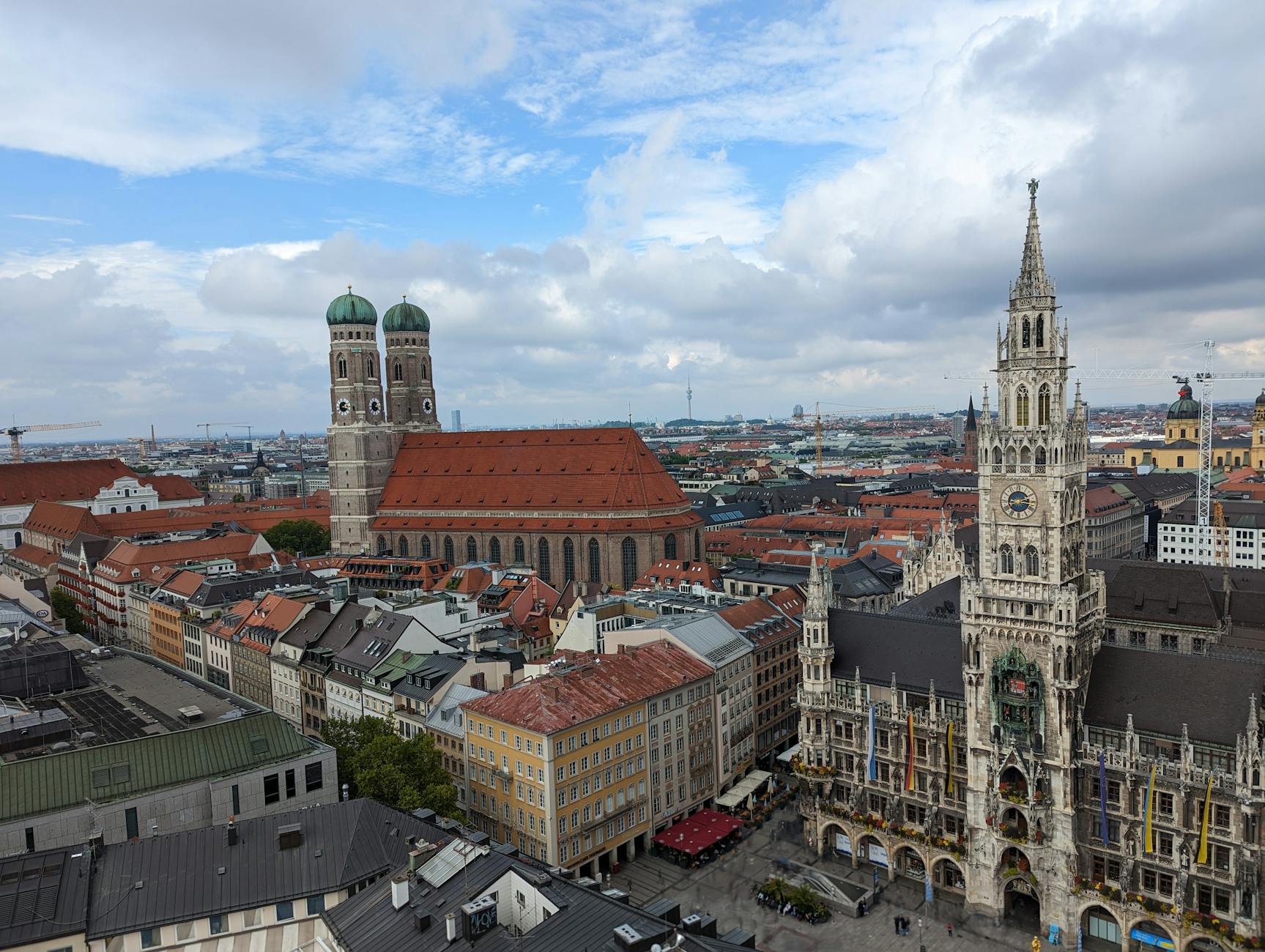
Munich architecture is a layered eight-hundred-year manuscript written in brick, sandstone, stucco, and — more recently — ETFE foil and tensile steel. You can stand on a single square here and see late Gothic brick towers, an Italian Baroque dome, a Florentine loggia, and a Neo-Gothic town hall in one panoramic sweep, then walk fifteen minutes to a glass cloud designed by Coop Himmelb(l)au. This visitor’s guide to Munich architecture walks you through every style on display in the Bavarian capital — Gothic, Renaissance, Baroque, Rococo, Neoclassical, Historicist, Jugendstil, Nazi-era monumental, postwar conservative reconstruction, Olympic-era tensile modernism, postmodern, and twenty-first-century contemporary — and ends with a self-guided walk that links the highlights in under three hours.
Munich Architecture at a Glance: Quick Facts
| Category | Pick |
|---|---|
| Best neighbourhood for architecture | Altstadt (medieval core, all styles in 1 km²) |
| Iconic landmark | Frauenkirche — twin onion-cupola towers, 1488 |
| Modern icon | BMW Welt (Coop Himmelb(l)au, 2007) |
| Free architecture walk start | Marienplatz |
| Architecturally significant churches (3) | Frauenkirche, Theatinerkirche, Asamkirche |
| Industrial-modern building | BMW Vierzylinder Tower (Karl Schwanzer, 1972) |
| Best-preserved Baroque/Rococo | Asamkirche (Sendlinger Straße, 1733–1746) |
| Best skyline viewpoint | St Peter’s tower (“Alter Peter”) |
| Architecture museum | Architekturmuseum der TUM (in Pinakothek der Moderne) |
| Height limit since 2004 | ~99 m (Frauenkirche tower height) |
A Short History of Munich Architecture (1158 to Today)
Munich was founded in 1158 as Munichen — “by the monks” — a Benedictine settlement on a salt-trade ford of the Isar. Almost nothing survives from those first medieval centuries above ground; what you see today began under the Wittelsbach dukes who moved their seat here in 1255 and never left. The dynasty’s eight-century building boom is essentially the story of Munich architecture itself: late-Gothic brick churches in the 14th–15th centuries, an Italianate Renaissance import under Albrecht V, an Italian-Baroque flourish under Henriette Adelaide of Savoy, a homegrown Rococo masterpiece in the Asam brothers, then Ludwig I’s neoclassical Königsplatz project, and finally his grandson’s neo-everything Maximilianstil avenue. Each Munich architecture chapter sits visibly beside the last.
That long continuity was nearly erased in three years of Allied bombing between 1942 and 1945. By the war’s end roughly half of central Munich’s building stock was destroyed and only about 2.5 percent of the city’s buildings were undamaged. The city had a choice: build a modernist replacement on the rubble or rebuild the historic shell. Munich chose preservation — partly through a deliberate planning philosophy that prioritised the prewar street grid and silhouette (later formalised in the city’s Altstadtsatzung old-town statute). Hans Döllgast’s poetic reconstruction of the Alte Pinakothek became the era’s emblematic gesture: visibly modern brickwork stitched into the surviving 19th-century fabric.
The 1972 Olympics gave Munich permission to be radically modern again — Frei Otto and Günter Behnisch’s translucent tent roofs and Karl Schwanzer’s BMW “four-cylinder” tower were rebellions against the heaviness of Nazi-era stone monumentalism. Since 2000 a third wave of contemporary architecture has arrived: BMW Welt’s glass cloud, the colour-changing Allianz Arena, Sauerbruch Hutton’s polychrome Brandhorst Museum. And in 2004 Munich’s voters drew a literal line in the sky — a referendum capped new high-rises at the height of the Frauenkirche’s towers (about 99 m), keeping the silhouette the medieval bricklayers set down in 1488.
Munich Architecture by Style: Gothic to Contemporary
Every major European style is represented inside the inner ring of Munich architecture, often within shouting distance. The clearest way to read the city is chronologically — here is each style with its best three to five examples and what to look for when you visit.
1. Gothic (14th–15th centuries)
Late medieval Munich was a brick-Gothic city, and the earliest layer of Munich architecture is the one most visitors notice first. Bavaria sits in a quarry-poor flatland, so master builders worked in fired red brick rather than the cut stone you find in the Rhineland — a Hanseatic-tinged North German Gothic language transplanted south. Pointed arches, tall lancet windows, ribbed star-vaults, and that characteristic warm-red colour are the markers.
- Frauenkirche (Frauenplatz 12) — Munich’s cathedral, built 1468–1488 by Jörg von Halsbach in red brick. The twin towers were finished in 1488; the famous green copper Welsh cupolas on top, modelled (according to long tradition) on the Dome of the Rock in Jerusalem, were added in 1525 — technically a Renaissance hat on a Gothic body. Both towers reach about 99 m and now define the city’s legal height ceiling. Free to enter; south tower climb extra.
- Alter Hof (Burgstraße 8) — the original 13th-century residence of the Wittelsbach dukes before they moved north to the Residenz. The Affenturm watchtower and the medieval bay window are the surviving Gothic fragments. Free courtyard.
- Heiliggeistkirche (Tal 77) — a hall church next to Viktualienmarkt with a Gothic core under a Baroque skin: look up at the ribbed vaults to read the underlying medieval geometry. Free.
- St Peter’s Church (“Alter Peter”) (Rindermarkt 1) — Munich’s oldest parish church, founded in the 12th century, rebuilt in Gothic form in the 14th. Climb the 306-step tower for the best architectural panorama in the city. Tower €5 adult.
Photo tip: the Frauenkirche reads best from the Peterskirche tower (south-east, golden hour) or from the pedestrian Liebfrauenstraße angle where the towers line up tight above the brick nave.
2. Renaissance (16th century)
Duke Albrecht V (r. 1550–1579) brought Italian humanism — and with it the Renaissance chapter of Munich architecture. The style arrived as a courtly import rather than a citywide movement — limited mostly to the Residenz and to the Jesuit church around the corner — but what survives is exceptional.
- Antiquarium of the Residenz (Residenzstraße 1) — built 1568–1571 to display Albrecht V’s antique sculpture collection, this nearly 70-metre barrel-vaulted hall is the largest Renaissance interior north of the Alps. The vaulting and window reveals are painted with over 100 views of 16th-century Bavarian towns. €10 (Residenz Museum ticket).
- St Michael’s Church (Michaelskirche) (Neuhauser Straße 6) — the largest Renaissance church north of the Alps, built 1583–1597 in a late-Mannerist mode for the Jesuits and Duke Wilhelm V as a Counter-Reformation flagship. The barrel-vaulted nave is the second-widest of its kind after St Peter’s in Rome. Free entry; crypt (Wittelsbach family vault, including King Ludwig II) €3, €2 reduced.
3. Baroque (17th–early 18th century)
The Italian-leaning court of Elector Ferdinand Maria and his Savoyard wife Henriette Adelaide imported the Roman Baroque whole — the most operatic chapter in Munich architecture. Theatre-set facades, swelling domes, sweeping pilasters, and white-and-gold stucco interiors arrive in Munich in the late 17th century; the mood is operatic.
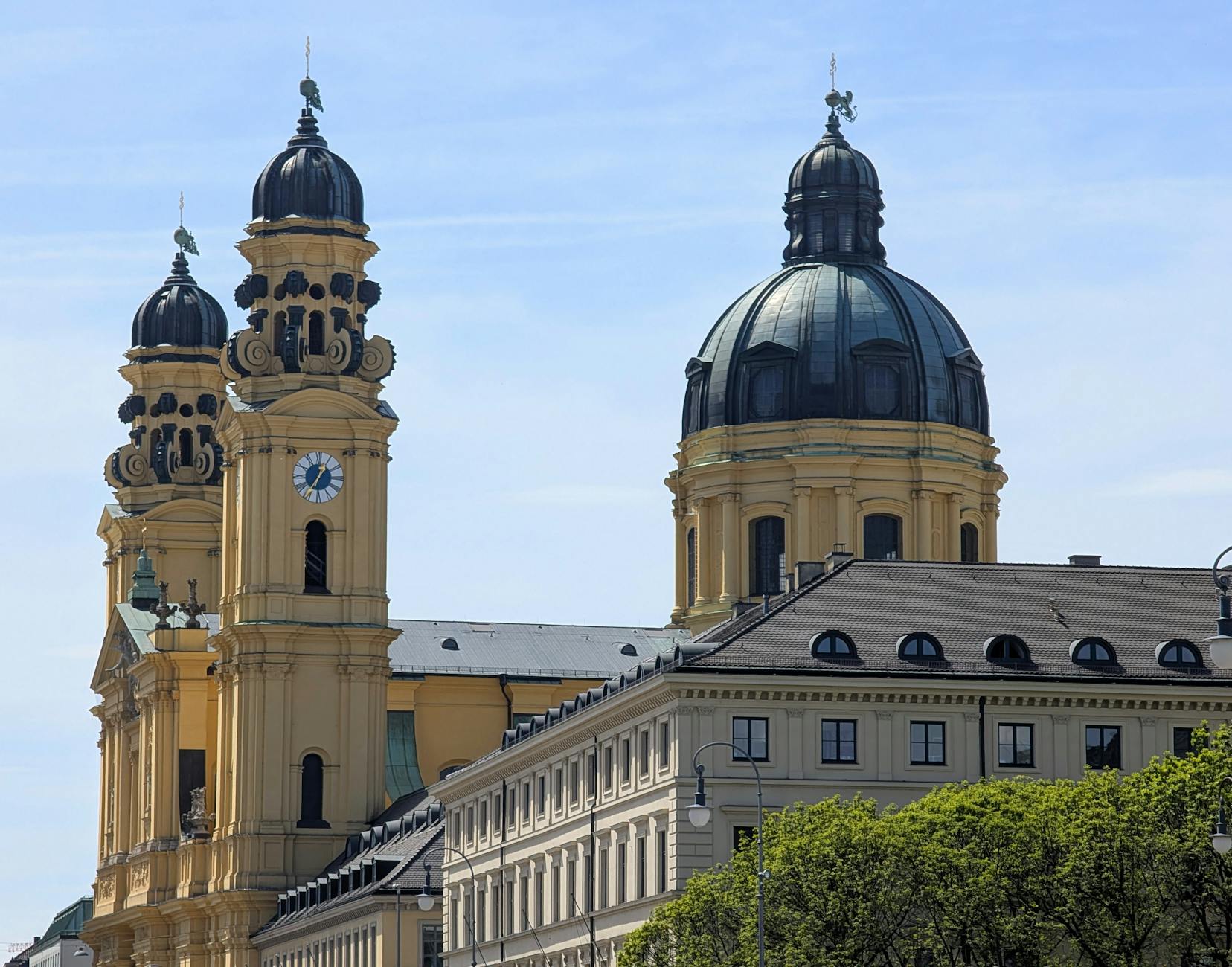
- Theatinerkirche (St Kajetan) (Theatinerstraße 22) — built 1663–1690 by Agostino Barelli and Enrico Zuccalli, modelled on Sant’Andrea della Valle in Rome. The 71 m dome and twin towers anchor Odeonsplatz; the mustard-yellow Rococo façade was added by François de Cuvilliés in the 1760s. Wittelsbach crypt below. Free.
- Bürgersaalkirche (Neuhauser Straße 14) — a small early-18th-century church on the pedestrian zone; the upper church is a Baroque jewel-box, the lower contains the tomb of the Jesuit “Rupert Mayer” beatified by Pope John Paul II. Free.
- Karmeliterkirche (Karmeliterstraße 1) — the first Baroque church in Munich (1657–1660), today the Bavarian State Archives library. Exterior viewing only most days.
- Nymphenburg Palace central pavilion (Schloß Nymphenburg 1) — the original 1664 summer retreat for Henriette Adelaide, expanded into the wide Baroque palace front you see today. €8 palace ticket.
4. Rococo (mid 18th century)
Munich architecture did Rococo better than almost any city north of the Alps. The Wittelsbach court architect François de Cuvilliés the Elder and the Asam brothers produced interiors whose energy and asymmetric flourish are world-class.
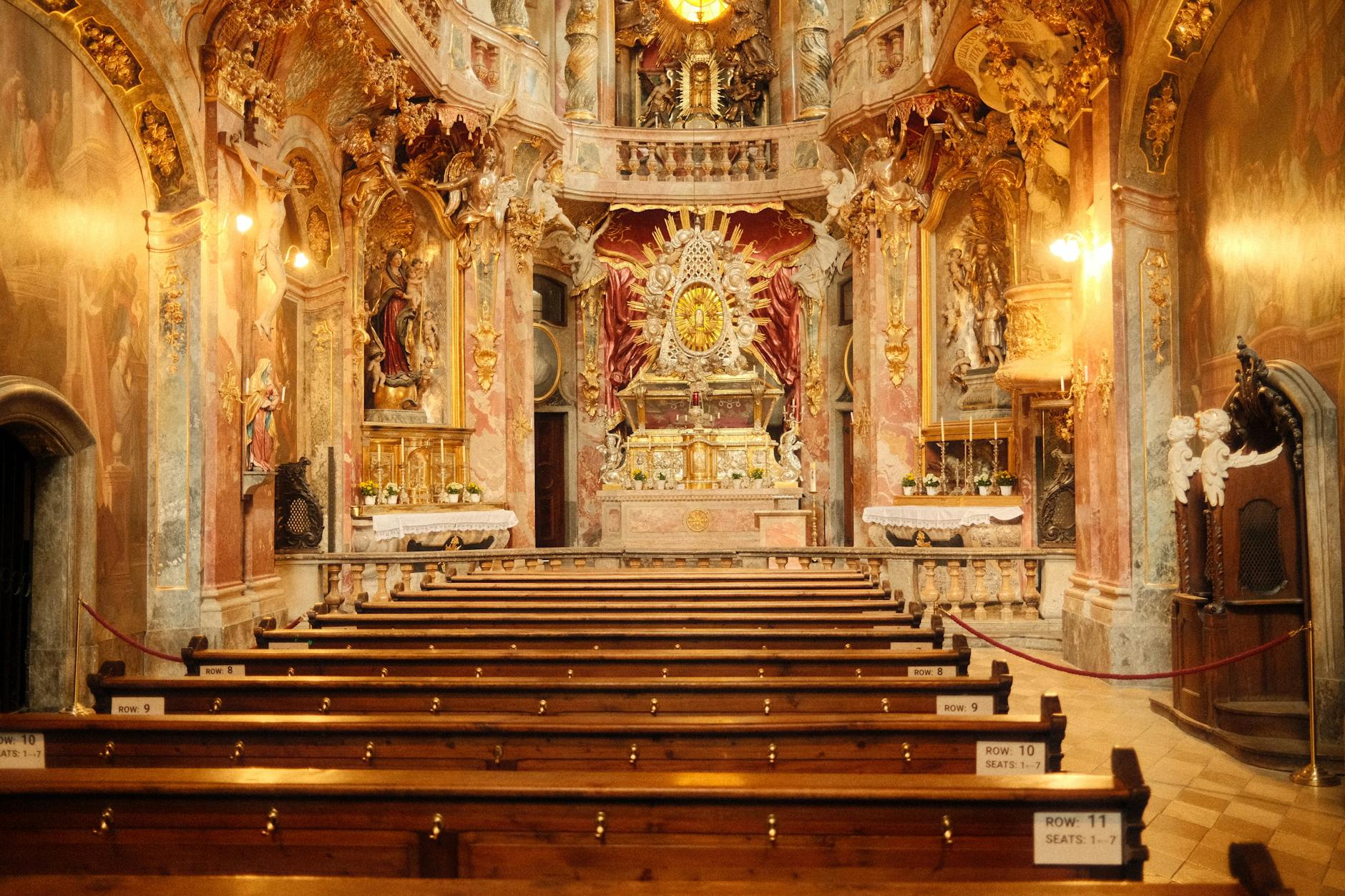
- Asamkirche (St Johann Nepomuk) (Sendlinger Straße 32) — built 1733–1746 by brothers Cosmas Damian and Egid Quirin Asam as a private chapel attached to their own home. Floor only 22 × 8 m; every centimetre crammed with painted ceiling, gilded carving, twisted columns, and trompe-l’oeil. One of the great Late-Baroque/Rococo interiors anywhere. Free.
- Cuvilliés Theatre (Residenzstraße 1, in the Residenz) — Cuvilliés the Elder’s intimate horseshoe court theatre (1751–1755) where Mozart’s Idomeneo premiered in 1781. Carved wooden interior survived WWII because it had been dismantled and stored in 1943. €5.
- Amalienburg in Nymphenburg Park — Cuvilliés’ 1734–1739 hunting lodge for Electress Maria Amalia, with a circular Mirror Hall that is the single most photographed Rococo interior in Germany. €5 park-buildings ticket.
5. Neoclassical / Classicism (early 19th century)
King Ludwig I (r. 1825–1848) wanted to turn Munich into “an Athens on the Isar,” and he reset Munich architecture toward antiquity. He hired Leo von Klenze and Friedrich von Gärtner and they delivered — sober Greek temple-fronts and Italian palazzo facades that look nothing like the Rococo their fathers built.
- Königsplatz ensemble (U-Bahn Königsplatz) — Munich’s most coherent neoclassical set piece. Three buildings face a vast rectangular plaza: the Doric Propyläen gateway (von Klenze, completed 1862), the Ionic Glyptothek sculpture museum (von Klenze, 1816–1830, the first public sculpture museum in Germany), and the Corinthian Staatliche Antikensammlungen (Georg Friedrich Ziebland, 1838–1848). Glyptothek €6.
- Feldherrnhalle (Odeonsplatz) — von Gärtner’s 1841–1844 Florentine open loggia modelled on the Loggia dei Lanzi in Florence, commissioned to honour Bavarian generals. Free; also significant as the site of the 1923 Beer Hall Putsch.
- Ruhmeshalle and Bavaria statue (Theresienhöhe) — von Klenze’s 1843–1853 Doric hall of fame, fronted by the colossal 18 m bronze Bavaria figure by Ludwig Schwanthaler. Hall free; Bavaria interior climb €4.
- Hofgarten arcades (between the Residenz and Galeriestraße) — Italianate arcade frescoes of Wittelsbach history commissioned by Ludwig I. Free.
6. Neo-Gothic and Historicism (later 19th century)
The mid-to-late 19th century brought a wave of stylistic historicism to Munich architecture: city halls revived medieval flamboyance, churches were given new medieval skins, and “national style” became a question of identity.
- Neues Rathaus (New Town Hall) (Marienplatz 8) — Georg von Hauberrisser’s Neo-Gothic masterwork, built in three phases 1867–1908. 9,159 m², 400 rooms, an 85 m main tower with a 43-bell Glockenspiel (daily at 11:00 and 12:00 year-round, plus 17:00 March–October). Tower lift from €7 (timed online slot). Façade free to admire any hour.
- Mariahilfkirche (Mariahilfplatz, Au) — Joseph Daniel Ohlmüller’s 1831–1839 brick Neo-Gothic church, an early German example of the revival style. Free.
7. Neo-Renaissance, Neo-Baroque, and the “Maximilianstil”
Ludwig I’s son, King Maximilian II, was not satisfied with Greek revival and commissioned a self-consciously new “national” style — a mixture of English Perpendicular Gothic, Italian Renaissance, and free invention. The result is the Maximilianstil avenue.
- Maximilianstraße (Max-Joseph-Platz to Maximilianeum) — Friedrich Bürklein’s grand boulevard (1852–1875) lined with pointed-window Maximilianstil buildings: the Government of Upper Bavaria, the former Mint, the Völkerkundemuseum (now Museum Fünf Kontinente), all crowned by the Neo-Renaissance Maximilianeum on the bluff across the Isar.
- Bayerisches Nationalmuseum (Prinzregentenstraße 3) — Gabriel von Seidl’s monumental 1894–1900 Neo-Renaissance/Neo-Baroque pile, designed so its successive wings each match the style of the collections inside.
- Justizpalast (Karlsplatz) — Friedrich von Thiersch’s 1891–1897 Neo-Baroque courthouse with a glass-and-iron dome that nods to industrial-era engineering. Exterior viewing only.
8. Jugendstil (Art Nouveau, 1890s–1900s)
Munich was one of the two great German centres of Jugendstil (the other was Darmstadt), and this Art Nouveau moment is the most overlooked layer in Munich architecture. Schwabing is its surviving heartland. The famous early icon — Hofatelier Elvira by August Endell, with its astonishing dragon-relief façade — was destroyed by the Nazis and then by bombs. But plenty remains.
- Müllersches Volksbad (Rosenheimer Straße 1) — Carl Hocheder’s 1901 municipal bathhouse on the Isar bank, an Art Nouveau-meets-Neo-Baroque interior of stucco vaulting, mosaics, and original tilework. Still operating as a public swimming pool — €4.50 swim ticket buys you a tour of the architecture from the inside.
- Schwabing villas and apartment buildings — walk Ainmillerstraße, Römerstraße, and the streets around Wedekindplatz to find painted floral façades, wrought-iron balconies, and the curved oriel windows of the Munich Jugendstil. Free.
- Borstei (Dachauer Straße, west of the centre) — Bernhard Borst’s 1924–1929 model garden housing estate; not strictly Jugendstil but its transitional Reform-era courtyards and ornamented façades read as the style’s logical heir.
9. Nazi-Era Architecture (1933–1945)
Munich was the “Hauptstadt der Bewegung” — Capital of the Nazi Movement — and the Third Reich left a permanent footprint on Munich architecture. The buildings have been repurposed, never demolished, and stand today as part of an honest national-memory exercise.
- Haus der Kunst (Prinzregentenstraße 1) — Paul Ludwig Troost’s 1933–1937 colonnaded Nazi-classical exhibition hall, opened by Hitler in 1937 to house the “Great German Art Exhibition.” Today a leading contemporary art museum. €15.
- Führerbau and former Verwaltungsbau (Arcisstraße 12 / Brienner Straße 45, Königsplatz) — twin 1937 Nazi-classical administrative buildings flanking Königsplatz. The Führerbau (now Hochschule für Musik und Theater) is where Chamberlain signed the Munich Agreement in 1938; the Verwaltungsbau is now the home of central Munich’s art-history institutes. Free exterior viewing; interiors limited.
- NS-Dokumentationszentrum (Brienner Straße 34) — Georg Scheel Wetzel’s 2015 stark white cube, built on the site of the demolished Brown House (former Nazi Party HQ). The contrast between the new building and its surroundings is the entire architectural argument. €5; free Sundays.
- Königsplatz pavement — the granite slabs laid in 1935 to convert the neoclassical square into a Nazi parade ground were torn up in 1988 and replaced with the present lawn-and-gravel surface; you can still read the outline of the era from the surviving Troost buildings facing each other across the green.
10. Postwar Reconstruction (1945–1960s)
Munich architecture took an unusually conservative postwar path for West Germany: rebuild the prewar silhouette, keep the street grid, do not erect modernist replacements in the old town. The result is the inner ring you see today — historic shells with often modern interiors. The signature interventions came from Hans Döllgast, whose patched-brick reconstruction of the Alte Pinakothek (1952–1957, Barer Straße 27) deliberately left the bomb damage legible while filling in with raw new brick. Stand at the south façade and you can read the line where 1836 von Klenze meets 1950s Döllgast — modesty and honesty as a design strategy. The Pinakothek is open Tuesday–Sunday; €7 main ticket, €1 on Sundays. The same philosophy guided the Frauenkirche, Residenz, Hofbräuhaus, and Peterskirche rebuilds — interior fabric is largely 1950s but the elevations are what Munich looked like before 1939.
11. Modernism — the Olympic Era (around 1972)
The 1972 Summer Olympics were Munich’s chance to prove that postwar West Germany was open, light, and democratic — “die heiteren Spiele,” the cheerful Games. Two buildings carried the message and changed engineering globally.
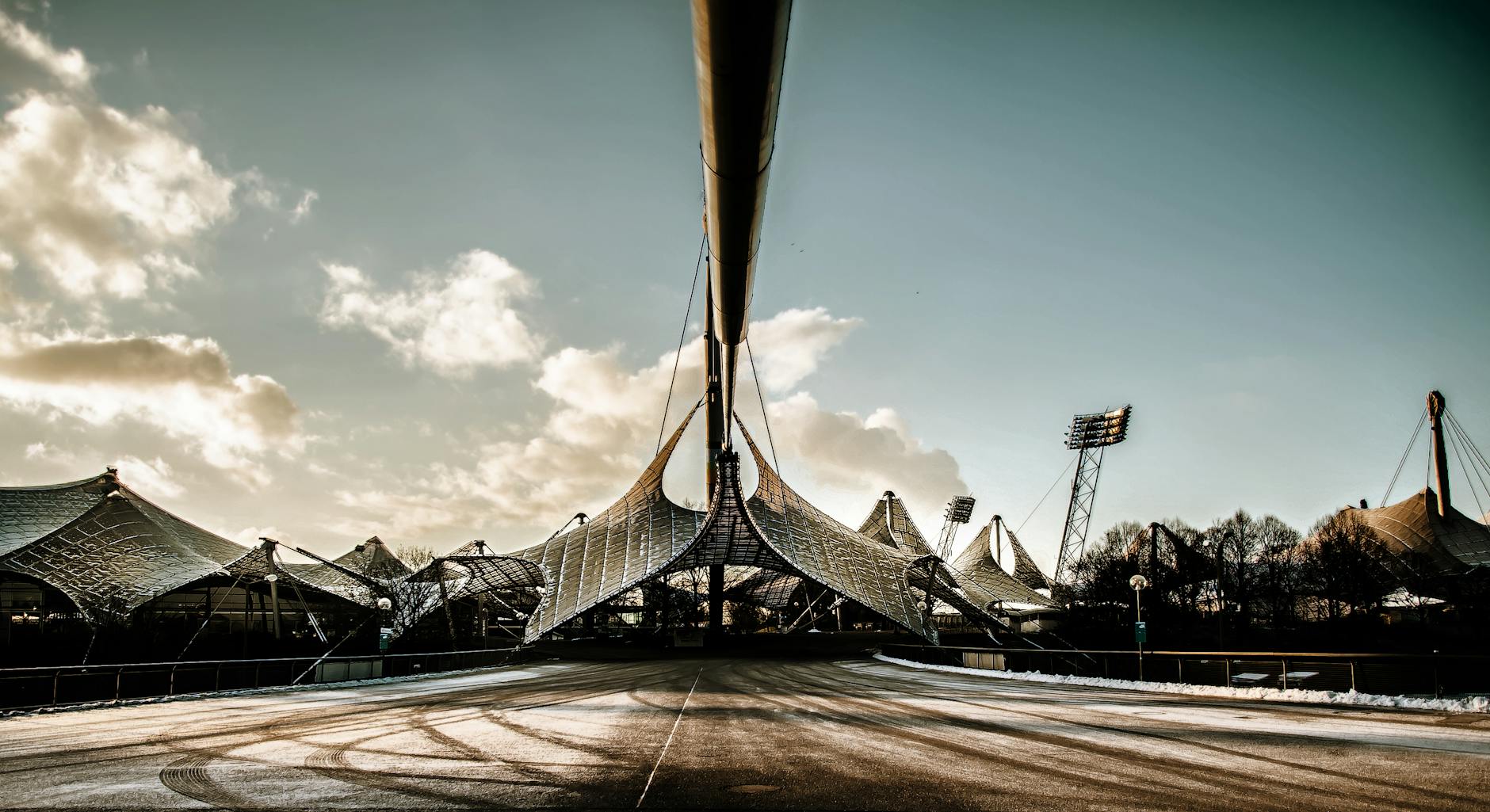
- Olympiastadion and Olympiapark tent roofs (Spiridon-Louis-Ring 21) — Behnisch & Partner with engineer Frei Otto and structural engineers Leonhardt and Schlaich produced a 74,800 m² translucent acrylic-glass canopy on steel-cable nets, sweeping from stadium to swimming hall to gym. The first large-scale tensile-cable roof, and a direct ancestor of every fabric stadium roof since. Park free; stadium entry €3.50. The 190 m Olympiaturm observation tower has been closed since June 2024 and is expected to reopen during 2027; until then the Frauenkirche south-tower climb is the best high panorama in the city.
- BMW Vierzylinder Tower and BMW Museum (Petuelring 130) — Karl Schwanzer’s 1972 four-cylinder headquarters tower (the “Vierzylinder”), with its four interlocked cylinder volumes suspended from a central mast, plus the adjacent silver-bowl museum. Headquarters not open to the public; museum €17 (€9 reduced).
12. Postmodern (1980s)
Munich’s postmodern moment was short and corporate. The defining example is the Hypo-Haus (Arabellastraße 12, Bogenhausen), Bea Betz and Walther + Bea Betz’s 1981 high-rise headquarters with its four counter-rotated cylindrical volumes wrapped in horizontal aluminium bands — a deliberately unconventional shape that became a Munich late-century landmark. Worth a detour for any 1980s-architecture devotee.
13. Contemporary (post-2000)
The 21st century has been Munich architecture’s most adventurous run since 1972. A handful of single-building statements anchor the new era, mostly clustered on the northern Olympiapark edge.
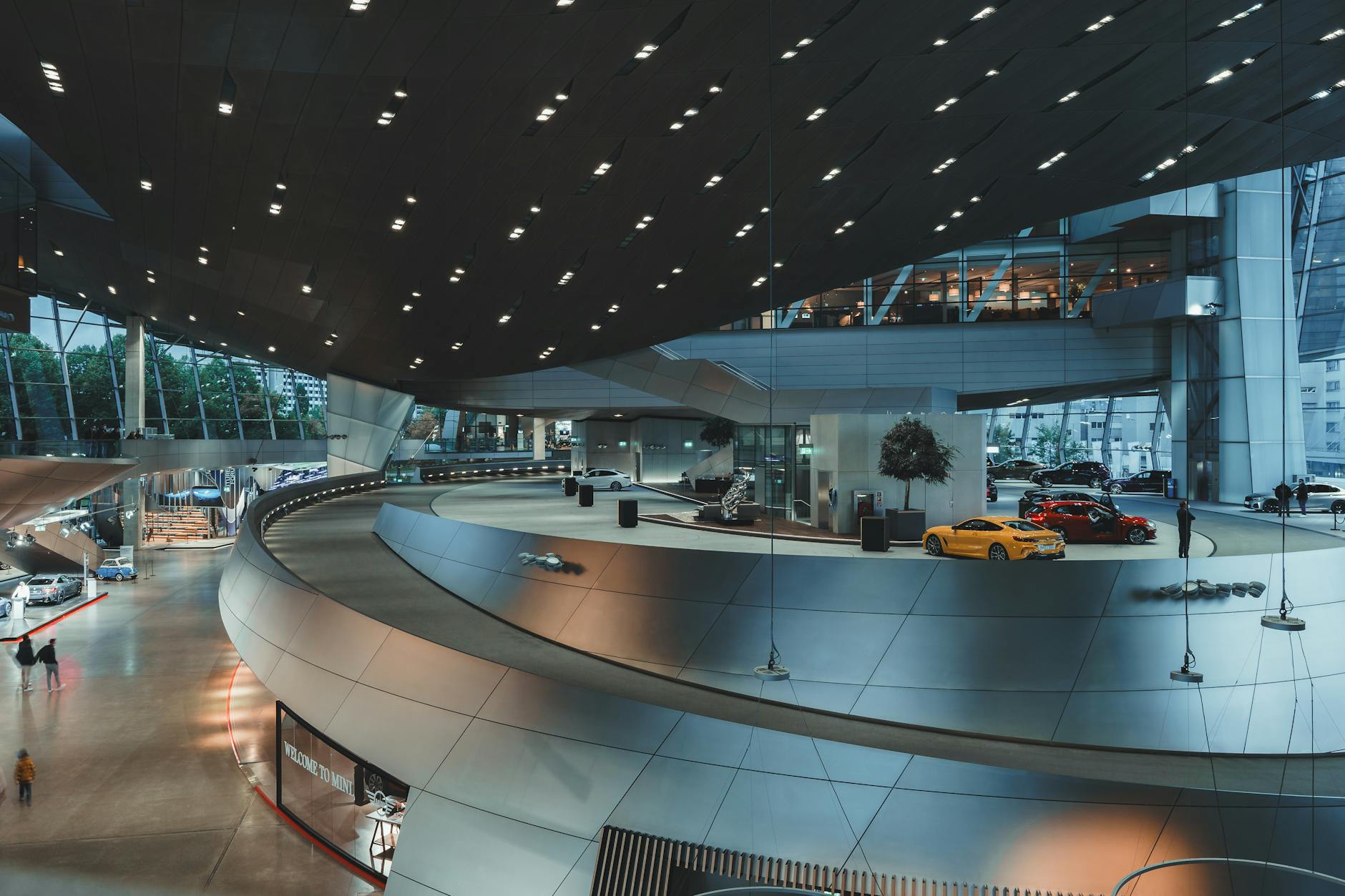
- BMW Welt (Am Olympiapark 1) — Coop Himmelb(l)au’s 2003–2007 brand experience and car-delivery centre, a 16,000 m² “cloud” roof floating on twelve columns and tied down by a sculpted double-cone glass vortex that doubles as the entrance hall. The most consequential piece of contemporary architecture in Munich. Free to enter.
- Allianz Arena (Werner-Heisenberg-Allee 25, Fröttmaning) — Herzog & de Meuron’s 2002–2005 football stadium clad in 2,874 diamond-shaped ETFE foil cushions that can be lit red (Bayern), blue (formerly 1860 Munich), or white (Germany internationals). The first colour-changing exterior of any stadium in the world. €15 tour.
- Museum Brandhorst (Theresienstraße 35a) — Sauerbruch Hutton’s 2005–2009 contemporary art museum clad in 36,000 vertical ceramic rods in 23 polychrome glazes; the façade visibly shifts colour with viewing angle. €7; €1 Sunday.
- Pinakothek der Moderne (Barer Straße 40) — Stephan Braunfels’ 2002 white concrete-and-glass volume housing four collections under one roof, including the architecture museum of the TU Munich. €10; €1 Sunday.
- NS-Dokumentationszentrum (Brienner Straße 34) — Georg Scheel Wetzel’s 2011–2015 stark white cube on the site of the former Brown House; see Nazi-era section above.
- Werksviertel-Mitte (Atelierstraße, east of Ostbahnhof) — an in-progress neighbourhood of converted industrial warehouses, the rotating Hi-Sky Ferris wheel, and the under-construction Konzerthaus München by Cukrowicz Nachbaur. The most interesting current development zone in Munich.
Self-Guided Munich Architecture Walk (2–3 Hours)
This compact Munich architecture walk through Altstadt covers seven centuries in roughly 3.5 km of mostly flat walking. Reckon on 2 hours brisk, 3 hours if you go inside the churches. Start any morning when the churches are open (most welcome visitors from about 7:30 or 8:00).
- Marienplatz (start) — Stand with your back to the Old Town Hall. In front of you: the Neues Rathaus (Neo-Gothic, 1867–1908). To your left: Peterskirche tower (Gothic). Behind you: the late-Gothic Altes Rathaus tower (reconstructed). One square, three eras. 5 minutes.
- St Peter’s Church and tower (optional 306-step climb, €5) — best architectural panorama in the city. 20 minutes with climb, 5 without.
- Frauenkirche — north from Marienplatz via Liebfrauenstraße. The 1488 brick nave, the 1525 Welsh cupolas, and the famous “Devil’s Footprint” stone slab inside the entry. 15 minutes.
- Michaelskirche — west on Kaufingerstraße, then left onto Neuhauser Straße. The largest Renaissance church north of the Alps; pop in to see the barrel vault. 10 minutes.
- Karlsplatz / Stachus — continue west; circle the 1791 Karlstor gate and the Justizpalast dome on the north side. 10 minutes.
- Asamkirche — south on Herzog-Wilhelm-Straße, then east on Sendlinger Straße. The Asam brothers’ Rococo masterpiece. Slip inside and let your eyes adjust. 15 minutes.
- Sendlinger Tor — the surviving south gate of the medieval city wall, two minutes south. 5 minutes.
- Back via Marienplatz to Theatinerkirche — head north up Theatinerstraße. The yellow Baroque façade and twin 65 m towers anchor the south end of Odeonsplatz. 20 minutes including walk.
- Feldherrnhalle and Odeonsplatz — the Florentine loggia and the broad neoclassical square. 10 minutes.
- Residenz façades — walk along Residenzstraße. The west façade by Leo von Klenze (Königsbau, 1826–1835) mimics Florence’s Palazzo Pitti. 10 minutes.
- Hofgarten (finish) — the 1613–1617 Italianate court garden, with the Diana Temple and Café Tambosi (since 1775). Sit, order a coffee, look back at the Theatinerkirche dome. 20 minutes.
Total walking distance: ~3.5 km. Approximate elevation: flat. Time: 2 hours brisk, 3 hours with interiors. Cost: €0 if you skip the Peterskirche tower; €5 with it. To extend, add a 15-minute U-Bahn hop from Odeonsplatz (U3/U6) to Olympiazentrum for the BMW Welt + Olympiapark tent-roof leg — budget another 90 minutes for that loop.
Guided Munich Architecture Tours and Walks
- Munich Tourism architecture walks — the official tourist office runs themed group walks on Friday and Saturday mornings April through October, focused on the Altstadt; ~€20 per person, 2 hours, English available. Book at the tourist office on Marienplatz or via munich.travel.
- Greeter Munich — a free volunteer-led service pairing visitors with Munich locals. Many of the Greeters offer architecture-themed walks. Book 7 days ahead at muenchen.de/greeter.
- Private architecture-focused tours — providers including Context Travel and Munich Walk Tours offer 2–4 hour private walks led by art historians or working architects, typically €150–€300 for up to six. Best for groups wanting to dig into a single era (Baroque, Jugendstil, postwar reconstruction).
- BMW Welt and BMW Museum architectural tour — €15 combined, 90 minutes, daily; book at bmw-welt.com.
- Allianz Arena architecture tour — €15 adult, ~1 hour, daily except match days; book at allianz-arena.com.
For broader sightseeing context, see our Munich walking tours guide.
Best Neighbourhoods for Munich Architecture Lovers
- Altstadt — 1 km² containing every major style from Gothic to contemporary. If you have one day, spend it here.
- Schwabing — north of Siegestor; the best concentration of Jugendstil apartment houses and villas in the city. Walk Ainmillerstraße, Römerstraße, Franz-Joseph-Straße.
- Maxvorstadt / Kunstareal — the museum quarter around Königsplatz: neoclassical Glyptothek and Propyläen, postwar Döllgast Pinakothek, contemporary Brandhorst and Pinakothek der Moderne, all walkable in 15 minutes.
- Olympiapark and BMW — the 1972 tensile-roof legacy plus the 2007 BMW Welt and the 1972 Vierzylinder. One U-Bahn stop (U3 Olympiazentrum) puts you in the middle of it.
- Werksviertel-Mitte — east of Ostbahnhof; converted industrial warehouses, the Hi-Sky wheel, and the new concert hall under construction. Munich’s most current development zone.
- Haidhausen and Au — late-19th-century working-class brick rowhouses and the Neo-Gothic Mariahilfkirche; an underrated walk along Wiener Straße and Mariahilfplatz.
Munich Architecture Museums and Collections
- Architekturmuseum der TUM (inside the Pinakothek der Moderne, Barer Straße 40) — the largest architecture collection in Germany: over 500,000 drawings, models, and photographs, with rotating exhibitions. Included in the Pinakothek der Moderne ticket (€10, €1 on Sundays).
- Die Neue Sammlung (same building) — the design and applied-art collection, the largest of its kind in the world; useful counterpart to the architecture displays.
- Stadtmuseum (Munich City Museum, currently closed for renovation through ~2030) — when it reopens it will hold the city’s permanent urban-architecture display. In the meantime smaller exhibits rotate in the foyer.
Best Viewpoints to Read the Skyline
- St Peter’s tower (“Alter Peter”) — 306 steps, €5. The single best view of the Altstadt skyline: Frauenkirche, Neues Rathaus, Heiliggeistkirche all in one frame. Open daily 9:00–19:30 summer; shorter winter hours.
- Frauenkirche south tower — lift access, currently re-opening in stages after long restoration; check muenchen.de/sights before going. Higher view than Peterskirche but with the Frauenkirche silhouette itself out of frame.
- Olympiaturm (Olympiapark) — 190 m, closed since 1 June 2024 and expected to reopen during 2027. Once it does, it is the one place high enough to see Munich and the Alps in one view on a clear föhn day.
- Neues Rathaus tower — lift, from €7, 85 m. Mid-height view straight down Marienplatz toward the Frauenkirche.
Photography Tips for Munich Architecture by Style
- Gothic Munich — shoot brick exteriors in late-afternoon side light to bring out the texture; for the Frauenkirche silhouette, try the Liebfrauenstraße angle at golden hour.
- Baroque Munich — yellow façades (Theatinerkirche) photograph best under blue-sky midday light; interiors need a stabilised camera and ISO 1600+.
- Rococo — Asamkirche interior is tight and dark; a wide lens (16–24 mm full-frame equivalent), a fast aperture, and no flash. Stand against the back wall.
- Neoclassical — Königsplatz works best with a long lens that compresses the three temple façades together; shoot from the Propyläen looking east.
- Olympic tensile roofs — best from the hill north of the Olympiasee, late afternoon, with the roofs catching warm light and the Alps in the haze beyond.
- Allianz Arena — shoot from the U-Bahn footbridge at Fröttmaning at blue hour on match nights; the lit ETFE cushions over the dusk sky is the canonical image.
- BMW Welt — the double cone reads best from the bridge over the Mittlerer Ring at twilight, with the interior light pouring out through the glass.
Frequently Asked Questions
What is the oldest building in Munich?
St Peter’s Church (“Alter Peter”) on Rindermarkt is the oldest parish church in Munich, with foundations dating back to the 12th century — predating the city’s official 1158 founding. The current Gothic structure is mostly 14th-century. The Alter Hof, the original Wittelsbach residence near Marienplatz, contains 13th-century fabric and is the oldest secular building.
Why does Munich look so low-rise compared to other German cities?
Two reasons. First, the conservative postwar reconstruction policy rebuilt the historic prewar street grid and silhouette rather than replacing it with modernist blocks. Second, in a November 2004 city referendum Munich voters narrowly approved a building-height limit pegged to the Frauenkirche towers — roughly 99 metres — across the entire city limits. New towers can no longer exceed it without exceptional permission.
Are any buildings taller than the Frauenkirche allowed in Munich?
A small number predate or were grandfathered around the 2004 referendum — most notably the 146 m Highlight Towers and the 146 m Hochhaus Uptown München, both built in the early 2000s on the city’s northwestern fringe. Within the inner ring the Frauenkirche (98.57 m) remains the tallest structure. Periodic political debates re-open the question, but no new exception has been granted inside the protected zone.
What is the best free architecture walk in Munich?
The Altstadt loop from Marienplatz to Frauenkirche to Michaelskirche to Asamkirche to Theatinerkirche to Odeonsplatz, finishing in the Hofgarten — about 3.5 km, 2–3 hours, no admission required (most churches are free, though donations are welcomed). Full step-by-step route in the self-guided walk section above.
Where is Munich’s tallest building?
The tallest buildings in Munich are the twin Highlight Towers (146 m each) and the Hochhaus Uptown München (146 m), all in the Schwabing-Freimann and Moosach districts on the city’s northern edge. Inside the historic core, the Frauenkirche’s north tower (98.57 m) is still the highest point — and by city law that will not change.
Who is the most famous architect associated with Munich?
Leo von Klenze (1784–1864), King Ludwig I’s court architect, gave Munich its neoclassical face — the Königsplatz, the Glyptothek, the Königsbau wing of the Residenz, the Alte Pinakothek, and the Ruhmeshalle. For 20th-century work, the partnership of Frei Otto and Günter Behnisch on the 1972 Olympic roofs is the city’s signature modernist contribution; Karl Schwanzer’s BMW Vierzylinder dates from the same year. Among living architects, Coop Himmelb(l)au and Herzog & de Meuron defined Munich’s post-2000 contemporary moment.
Which church is the best example of Rococo in Munich?
The Asamkirche (St Johann Nepomuk) on Sendlinger Straße, built 1733–1746 by brothers Cosmas Damian and Egid Quirin Asam as their private chapel. The interior is one of the finest small Late-Baroque/Rococo spaces in Europe. Free to enter.
Plan Your Munich Architecture Trip
Munich architecture rewards slow walking more than fast checklist-ticking. You can read eight centuries of Munich architecture on a single morning loop through the Altstadt, then jump on the U-Bahn for ninety minutes of 1972 modernism and 2007 contemporary on the Olympiapark side — and finish a day’s worth of sightseeing having seen more architectural variety than most European capitals can muster across an entire week. For deeper background on the city that built it, see our Munich history and architecture pillar and our history of Munich overview. For the single richest building on the route, dig into our Munich Residenz guide. If you would rather have a local lead the way, see our Munich walking tours guide. And if your interest in the contemporary leg has been sparked, our dedicated BMW Museum and BMW Welt piece covers the architecture, exhibits, and ticketing in full.