Munich to Vienna: Complete Travel Guide
The Railjet does it in four hours from EUR 19, centre to centre. Fares, the Salzburg stopover that improves the journey, and an honest comparison of the two cities.
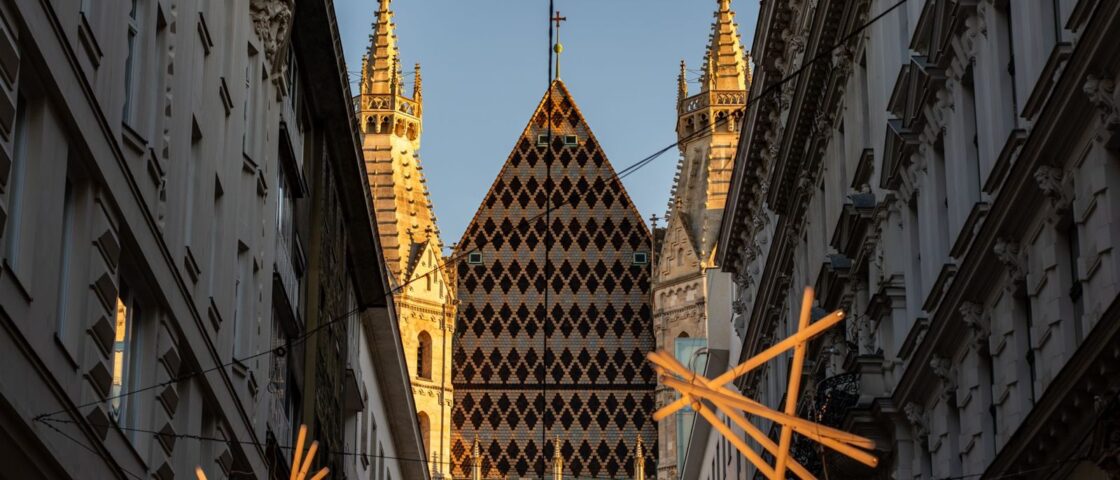
Take the train. Four hours, city centre to city centre, roughly hourly, and from about €19 if you book ahead — there is no serious argument for flying between Munich and Vienna, and the bus saves you nothing worth having.
That is the whole answer to the transport question, and it takes one paragraph. The more interesting question is the one people are actually asking when they search this: whether to break the journey at Salzburg, how long Vienna deserves, and whether the two cities are similar enough that doing both is a repetition. They are not, and the differences are sharper than the guidebooks suggest.
Here is the route in detail, the fares that are actually available, the stopover that turns a transfer into a trip, and an honest comparison of the two cities.
Munich to Vienna at a glance
| Option | Time | Cost | Frequency | Verdict |
|---|---|---|---|---|
| Railjet (direct train) | ~4 h | From €19 booked ahead | 12–14 direct daily, roughly hourly | The answer. Centre to centre |
| Train with a Salzburg stopover | 1h50 + 2h10 | Same or slightly more | Both legs hourly | The best version of the journey |
| FlixBus | From 5h30 | ~€20–€35 | 16 a day | Only if the cheap train fares have gone |
| Flying | ~1 h in the air, 4–5 h door to door | Varies wildly | Frequent | Slower in practice. Don’t |
| Driving | ~4 h | Fuel + Austrian vignette + Vienna parking | — | Pointless unless you’re touring |
The Railjet, in detail
The Railjet is a joint ÖBB and Deutsche Bahn product, run with Austrian rolling stock, and it is one of the better long-distance trains in Europe — quiet, punctual by the standards of German long-distance rail, with a proper restaurant car rather than a trolley.
- Journey time: about four hours, München Hauptbahnhof to Wien Hauptbahnhof, direct with no change.
- Frequency: 12 to 14 direct services a day depending on the day of the week, working out at roughly hourly through the middle of the day with gaps early and late.
- Principal stops: Rosenheim, Salzburg at about 1h50, Linz at about three hours, then St. Pölten before Vienna.
- Distance: 355 kilometres.
- Seat reservation is not required on an ordinary ticket. Interrail and Eurail pass holders must reserve, at €3 to €5.
The scenery is better than the average European trunk route without ever being spectacular. The first hour out of Munich crosses the Bavarian plain with the Alps standing off to the right; the approach to Salzburg is genuinely lovely; and then the line follows the Danube valley through Upper Austria before flattening out into the run-in to Vienna. Sit on the right-hand side leaving Munich for the mountains and the river.
Getting the €19 fare
Advance fares on this route are the ÖBB Sparschiene, which starts at around €19 in second class. Like every European advance fare it is a limited contingent, it is tied to a specific train, and it disappears as the train fills.
- Book on oebb.at rather than bahn.de. Both sell the journey, but ÖBB is the operator of record for the Austrian side and the Sparschiene contingent is theirs. DB’s Sparpreis for the same train is often, though not always, higher.
- Three to six weeks ahead is the sweet spot. Booking opens roughly six months out; the cheapest tickets do not usually appear on day one.
- Midday and mid-week departures are cheapest. Friday afternoons and Sunday evenings are the expensive slots on every route in central Europe and this one is no exception.
- The Sparschiene is train-specific and non-flexible. Miss it and you buy again. If your plans are soft, the flexible fare is a lot more money but it is genuinely flexible — decide honestly which you are.
Insider tip: if you are travelling as a pair or a family, check the ÖBB’s own family and group pricing before assuming two singles is the answer. Austria prices groups better than Germany does, and the cross-border ticket is issued under Austrian rules.
Note what does not work here: the Bayern-Ticket, at €34 solo or €74 for up to five, is excellent value inside Bavaria and even reaches Salzburg — but it is not valid on the Railjet, which is an EC-class service. You cannot use it to shortcut this journey. Our guide to Munich travel passes sets out where it does and does not apply.
Break the journey at Salzburg
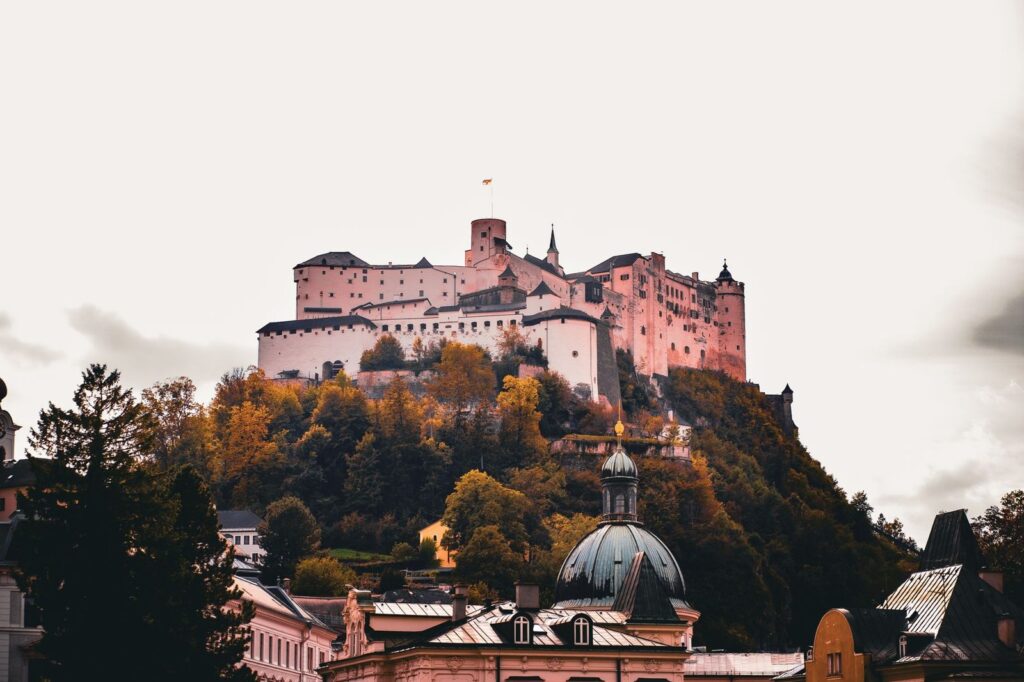
This is the single best decision available on this route, and most people miss it because they book a through ticket and never think about it again.
Salzburg is 1h50 from Munich and 2h10 from Vienna — almost exactly halfway, on the same hourly service. Getting off there costs you a day and buys you a small, dense, extraordinarily good-looking baroque city that you can see properly in one. The Altstadt is compact enough to walk end to end in twenty minutes; the Hohensalzburg fortress on its rock above the town is one of the best-preserved in Europe; and the Mozart industry, while relentless, is easy to sidestep.
Two ways to do it. Either break the journey with a night in Salzburg, buying two separate advance tickets rather than one through fare — which is usually no more expensive and sometimes cheaper. Or treat Salzburg as a day trip from Munich on a different day entirely, in which case the Bayern-Ticket is valid to Salzburg on regional trains, which is one of the great quirks of the Bavarian ticket system — €34 for one person or €74 for five, to another country.
The unflattering part: Salzburg in July and August is close to unbearable, and the Getreidegasse in high season is a slow-moving column of people. Come in May, or in late September, or accept that you are queueing.
The alternatives, and why they lose
The bus
FlixBus runs 16 departures a day, the fastest taking about 5h30, with fares from roughly €20 to €35. The first leaves around 03:00 and the last just before midnight.
The honest verdict: it is ninety minutes slower and often not much cheaper than an advance train fare, which makes it a fallback rather than a choice. Where it earns its place is late booking — when the €19 Sparschiene has gone and the flexible train fare has climbed past €90, the bus at €30 becomes the sensible option. It also runs at hours the train does not, which matters if you are connecting to an early flight.
This is worth contrasting with the Munich to Prague route, where the bus genuinely beats the train — five hours against five and a half, with no fast rail link. Vienna is the opposite case.
Flying
About an hour in the air, and a worse journey in every other respect. Munich Airport is in Zone 5, which means 40 to 45 minutes on the S1 or S8 before you have even checked in, and Vienna Airport is a further transfer at the other end. Add two hours for check-in and security and you are at four to five hours door to door, for more money, more hassle and considerably more carbon.
The exception is a through connection — if Vienna is a change of plane rather than a destination, fly. Otherwise this is one of the clearest train-beats-plane routes in Europe. Our Munich airport to city guide covers the transfer end of it if you do need the airport.
Driving
Roughly four hours on the A8 and A1, so no faster than the train, and you arrive with a car in a city where you do not want one. Vienna’s parking regime is strict and expensive, and Austria requires a motorway vignette which you must buy before crossing the border — the fines for not having one are substantial and the checks are real. See driving in Munich for the wider case against a car in this part of the world.
On board: what four hours actually feels like
Four hours is long enough that the train matters, and the Railjet is a better one than most people expect.
- Second class is spacious, air-conditioned, with power at every seat and reliable wi-fi across most of the route. It is comfortably better than a standard ICE second class and considerably better than anything on the German regional network.
- First class buys you wider seats, more space and at-seat service, and on advance fares the gap is sometimes only €15 or €20. On a four-hour run that is one of the better upgrades in European rail.
- Business class is a third tier above first — a small cabin at the front with a handful of seats. It is a genuine luxury and priced like one; skip it unless the difference is trivial.
- The restaurant car is a proper Henry-am-Zug operation with cooked food rather than a microwave. It is not cheap, and the Austrian standard here is decent rather than remarkable, but you can get a hot meal and a glass of Grüner Veltliner at a table.
- Luggage goes on overhead racks and in end-of-carriage stacks. There is no check-in, no weight limit and no fee, which is a large part of why the train beats the plane on this route even before you count the time.
Insider tip: board at München Hauptbahnhof rather than München Ost. The Hauptbahnhof is the origin, so the train arrives empty and you choose your seat; by München Ost, seven minutes later, the unreserved seats in the good carriages have gone. The Hauptbahnhof is three U-Bahn stops from Marienplatz and a twelve-minute walk from the Theresienwiese — see the Munich U-Bahn and S-Bahn guide for getting there.
How long to give Vienna
Three days is the floor and four is better, which is more than Munich needs and is the single most common planning mistake on this route — people allocate two nights to Vienna because they gave two nights to Munich, and then spend the second afternoon realising they have not left the first district.
- Day one — the Ringstraße and the first district. Stephansdom, then the loop of nineteenth-century state architecture that replaced the city walls: the Staatsoper, the Rathaus, the Parliament, the two great museums facing each other across Maria-Theresien-Platz. Walk it rather than taking the tram; it is about five kilometres and the whole point is the scale.
- Day two — one enormous museum. The Kunsthistorisches Museum holds the largest collection of Bruegels in the world and a Habsburg treasury that has no equivalent anywhere. Give it a full morning, minimum. The alternative is the Belvedere for Klimt, including The Kiss, which is smaller and busier.
- Day three — Schönbrunn, and something modern. The palace and its gardens take half a day; the MuseumsQuartier and the Naschmarkt take the other half. Schönbrunn’s timed entry books out in summer.
- Day four, if you have it — leave the centre. The Wienerwald, the Zentralfriedhof, the Prater beyond the wheel, or a Heuriger wine tavern in Grinzing or Nussdorf. This is the day that turns a sightseeing trip into a sense of the city.
On timing: Vienna’s high season is May to September and December for the Christmas markets, and it is a city that handles crowds better than most because the centre is large. November and February are the bargains — the concert season is in full swing, the coffee houses make sense in the cold, and hotel prices are half what they are in June. The one period to avoid booking casually is the ball season in January and February, when the city fills for reasons that have nothing to do with tourism.
Munich versus Vienna: an honest comparison
If you are choosing between them, or wondering whether doing both is redundant, this is the part that matters. They are not the same kind of city at all.
| Munich | Vienna | |
|---|---|---|
| Scale | 1.5m, feels like a large town | 2m, feels like a former imperial capital — because it was one |
| The core | Compact Altstadt, mostly rebuilt post-1945 | Vast Ringstraße of 19th-century state architecture |
| Museums | Excellent and specialised — Deutsches Museum, the Pinakotheken | Deeper and broader. The Kunsthistorisches alone justifies a trip |
| Music | Good opera, strong club scene | In a different league. Staatsoper, Musikverein, Konzerthaus |
| Food culture | Beer halls, beer gardens, pork and pretzels | Coffee houses, Beisl, and a genuinely broader kitchen |
| Outdoors | Wins decisively. Alps in 80 minutes, lakes in 40, the Isar and the English Garden | The Danube, the Prater, the Wienerwald. Pleasant, not dramatic |
| Cost | Expensive, especially hotels in September | Noticeably cheaper for food, drink and transport |
| Days needed | 2 in the city, 1 out of it | 3 minimum, and 4 is not too many |
The shorthand: Vienna is the better city, Munich is the better base. Vienna has more art, more music, better coffee, better public transport and a grander centre. Munich has the Alps at the end of an eighty-minute train, thirty lakes within an hour, and the best beer-garden culture in the world. If you have a week, do both, and give Vienna the extra day.
Where Vienna genuinely disappoints: the Prater’s famous wheel is a modest fairground ride with a queue, the Hofburg is enormous and much of it is not very interesting, and the “typical Viennese coffee house” experience has been thoroughly commodified in the first district — walk ten minutes out and it becomes real again.
Arriving in Vienna
The Railjet arrives at Wien Hauptbahnhof, which opened in 2014 and is a proper through station rather than the terminus it replaced. It is south of the centre, on the U1, and Stephansplatz is four stops and about seven minutes away.
- Buy a 24, 48 or 72-hour Vienna transport pass at the station. Vienna’s U-Bahn is denser and simpler than Munich’s and a pass pays for itself on day one.
- The city is a fare-honesty system, like Munich’s — no barriers, but inspectors and a substantial on-the-spot fine.
- Left luggage at Wien Hbf lets you do a full day in the city on a through journey without a hotel, which is the move if you are heading further east the same night.
If Vienna is a staging post rather than the destination, note that it is the hub for onward trains to Budapest (about 2h20), Prague, Bratislava (under an hour) and the Balkans. Our travel from Munich hub covers the wider network, and Munich to Berlin is the comparable northbound run.
Doing it overnight
Munich is one of the best-connected cities in Europe for night trains, and while Vienna at four hours is too close to need one, the ÖBB Nightjet network out of München Hauptbahnhof is worth knowing about if Vienna is a step on a longer journey.
- Rome, Florence and Bologna: 20:07 nightly.
- Venice: 23:49 nightly.
- Amsterdam: 22:52 nightly.
- Brussels: 23:16 on Tuesdays, Thursdays and Sundays.
Fares start at €29.90 for a seat, €49.90 for a couchette and €69.90 for a sleeper. The new-generation sets have fixed beds, single mini-cabins and wi-fi, plus women-only couchette compartments. Partner EuroNight services from German cities also reach Budapest and Zagreb, most of them routed through Vienna.
Where to stay in Vienna, briefly
The same logic that applies in Munich applies here: the absolute centre is expensive and slightly sterile, and the district just outside it is better value and more interesting.
- The first district puts you inside the Ring and within walking distance of everything, at a price. It is the right choice for two nights and the wrong one for five.
- Neubau and the seventh district, behind the MuseumsQuartier, is the equivalent of Munich’s Glockenbachviertel — small shops, good restaurants, a young population, and ten minutes on foot from the Ring.
- Around Wien Hauptbahnhof is the practical choice if you are arriving late and leaving early, and prices are markedly lower. The area is functional rather than charming.
- Leopoldstadt, across the Danube canal by the Prater, has become the interesting district over the past decade and is still cheaper than anything inside the Ring.
Expect to pay noticeably less than in Munich for a comparable room, except in December. If you are working out the Munich end of the same trip, where to stay in Munich and the best neighbourhoods in Munich apply the same reasoning to the Bavarian side, and the cost of a Munich trip gives you the baseline to compare against.
Practicalities across the border
- No border control. Both countries are in Schengen and the Railjet does not stop for passports. Carry your ID anyway — spot checks on cross-border trains do happen and have increased in recent years.
- Same currency, same plugs, same language — but not the same German. Austrian vocabulary differs enough to be noticeable: Semmel for a roll, Erdäpfel for potatoes, Jänner for January. Nobody expects you to know this, and our Munich German phrases guide covers the Bavarian versions, which are closer to Austrian than to standard German.
- Tipping is the same convention as in Bavaria: round up and say the total you want to pay as you hand the money over, rather than leaving coins on the table. Roughly five to ten per cent. See money and tipping in Munich.
- Austria uses the same mobile roaming rules as Germany within the EU, so a German SIM works without extra charge — relevant if you have bought one on arrival, which our SIM and wi-fi guide covers.
- Sunday closing applies in Austria too, and rather more strictly than in Germany. Vienna’s shops shut on Sundays with the same station-and-airport exceptions.
Frequently Asked Questions
How long does the train from Munich to Vienna take?
About four hours on the direct ÖBB/DB Railjet, München Hauptbahnhof to Wien Hauptbahnhof, with no change. There are 12 to 14 direct services a day, roughly hourly through the middle of the day. The route runs via Rosenheim, Salzburg at about 1h50, Linz at about three hours, and St. Pölten.
What is the cheapest way to get from Munich to Vienna?
An ÖBB Sparschiene advance fare, from around €19 in second class, booked three to six weeks ahead on oebb.at. That is cheaper than the bus and four times faster than nothing. If the cheap contingent has gone, FlixBus at roughly €20 to €35 becomes competitive — but only because the flexible train fare is high, not because the bus is good value in itself.
Do I need to reserve a seat on the Railjet?
No, not with a normal ticket — you can sit anywhere unreserved. Interrail and Eurail pass holders must reserve, at €3 to €5. In practice, a reservation is worth the small fee on Friday and Sunday services and around Austrian public holidays, when the train can be genuinely full for the first two hours out of Munich.
Is the Bayern-Ticket valid to Vienna?
No. The Bayern-Ticket covers regional trains within Bavaria and, unusually, as far as Salzburg — but it is not valid on the Railjet or any EC or ICE service, and it does not reach Vienna. It costs €34 for one person or €74 for up to five, and it is the right ticket for a Salzburg day trip, not for this journey.
Should I stop in Salzburg on the way?
Yes, if you have the day. Salzburg sits almost exactly halfway — 1h50 from Munich, 2h10 from Vienna — on the same hourly service, and buying two advance tickets instead of one through fare usually costs the same or less. The Altstadt and the fortress are a very full day. Avoid July and August if you can; the old town is uncomfortably crowded in high summer.
Is Munich or Vienna better to visit?
Vienna is the better city and Munich is the better base. Vienna has deeper museums, world-class music, a grander centre and lower prices. Munich has the Alps eighty minutes away, thirty lakes within an hour, and beer-garden culture that nowhere else matches. They are complementary rather than interchangeable, so a week covering both is not a repetition. Vienna needs three days minimum; Munich needs two plus a day trip.
Is there a night train from Munich to Vienna?
The four-hour daytime journey makes an overnight service pointless for Vienna itself, and Munich’s Nightjet departures run to Rome, Venice, Amsterdam and Brussels rather than to Vienna as a destination. Several EuroNight services onward to Budapest and Zagreb are routed through Vienna, so it appears on the network as a waypoint. Nightjet fares start at €29.90 seated, €49.90 couchette and €69.90 sleeper.
Which Vienna station does the train arrive at?
Wien Hauptbahnhof, which opened in 2014 south of the centre. It is on the U1, and Stephansplatz in the heart of the first district is four stops and about seven minutes away. Buy a 24, 48 or 72-hour transport pass at the station — Vienna runs an honesty system with no barriers but real inspectors and a substantial fine.
How far is Vienna from Munich?
355 kilometres by rail, which the Railjet covers in about four hours at an average that includes four intermediate stops. By road it is a comparable distance on the A8 and A1 and takes roughly the same time, with the added complications of an Austrian motorway vignette and Vienna’s parking rules.
Where to go next
Vienna is one of five or six places Munich reaches comfortably in a morning — travel from Munich ranks them all, and Munich to Prague is the route where the answer is genuinely different. If Salzburg is the part that appeals, the Salzburg day trip does it in a day on a Bayern-Ticket. For shorter hops, day trips from Munich covers everything within two hours, and day trips by train handles the ticketing. And if you are still working out how many nights Munich itself deserves before you move on, three days in Munich is the shape most trips should take.
Related Guides
- Travelling On from Munich: Trains, Buses and Road Trips — the cluster hub
- Munich to Prague: Train, Bus and the Best Route — Very high volume; SERP is booking sites with weak editorial
- Munich to Berlin: Train vs Flight vs Bus — Head term with a genuine decision to resolve
- Munich to Innsbruck and the Tyrol — Short hop with both day-trip and onward-travel demand