Munich to Innsbruck and the Tyrol
About two hours, up to 10 direct trains a day, and a funicular from the old town to a ridge at 2,256 m. The journey, the Nordkette costs, and whether a day trip is enough.
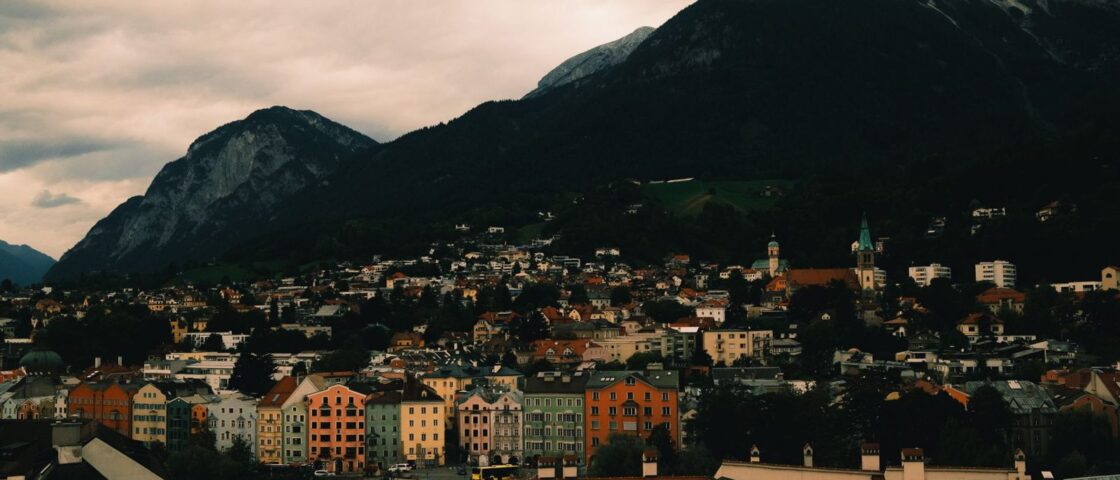
Innsbruck is about two hours from Munich by direct train, with roughly 8 to 10 direct services a day — which makes it the one Alpine city you can genuinely do as a day trip and also the one you will wish you had given two nights.
The reason is a single piece of infrastructure. Innsbruck has a funicular that starts in the middle of the old town and, via two cable cars, delivers you to a rock ridge at 2,256 metres with the whole city directly below your boots. Nowhere else in the Alps puts a serious mountain that close to a cathedral square. You can be drinking coffee under a Gothic arcade at ten and standing on a summit at eleven.
Here is the journey in detail, whether a day trip works or you should stay, what the mountain costs, and an honest account of what Innsbruck is and is not good at.
Munich to Innsbruck at a glance
| Option | Time | Cost | Frequency | Verdict |
|---|---|---|---|---|
| Direct train (Railjet / EC) | About 2 h, fastest 1h54 | Advance from about €22 (DB), flexible fare higher | ~8–10 direct a day | The answer |
| Day trip from Munich | About 4 h of travel, most of the day there | Train + €56 for the Nordkette return | — | Works, but tight |
| Two nights in Innsbruck | — | Add the Innsbruck Card, €79 for 48 h | — | The better trip |
| Bus | From about 2h10 | From ~€10–€20 | Around 13 a day | Only if the train is expensive |
| Driving | ~2 h | Fuel + Austrian vignette + Innsbruck parking | — | Only if you’re touring the Tyrol |
The journey
The line runs south from Munich across the Bavarian plain, into the mountains at Kufstein where it crosses into Austria, and then up the Inn valley with the Karwendel wall on the right and the Kitzbühel Alps on the left. It is one of the better two hours of scenery on the European network and it costs nothing extra.
- Roughly 8 to 10 direct trains a day. A Railjet takes about two hours, and the fastest services do it in 1h54. Most are ÖBB/DB Railjet or EuroCity; DB lists about 27 connections a day once you count those with a change, and those take longer.
- On board: the Railjet has second, first and business class, a proper restaurant car, power at every seat and free wi-fi. Second class here is better than a standard German ICE.
- Fares: advance tickets start from about €22 on DB’s site, and the flexible fare is higher. ÖBB Sparschiene advance tickets can be booked up to six months ahead — the gap to the flexible fare is large enough that booking in advance is worth the loss of flexibility.
- Sit on the right leaving Munich for the Inn valley and the Karwendel.
Book on oebb.at. ÖBB is the operator of record for the Austrian side and the Sparschiene contingent is theirs; DB sells the same trains and is often, though not reliably, dearer. Three to six weeks ahead is the sweet spot, and midweek departures are cheaper than Friday afternoons.
What does not work: the Bayern-Ticket. At €34 solo or €74 for five it is excellent inside Bavaria and it even reaches Salzburg and, in the Tyrol, Kufstein and the Außerfern, but it is not valid on Railjet or EC services and it does not go as far as Innsbruck. Do not plan around it. Our Munich travel passes guide sets out where it does apply.
Day trip or two nights?
A day trip is genuinely possible and it is the second-best version of this.
The day-trip shape: an early train out, arriving around 09:30 to 10:00; straight to the Hungerburgbahn and up the Nordkette for two hours; back down for lunch and the old town; the Bergisel ski jump in the afternoon if you have the legs; a train home around 18:00. That is about five hours of travel for seven hours on the ground, and it works — but it means choosing between the mountain and the museums rather than doing both.
The case for two nights: the mountain deserves a full day on its own, particularly if you walk any of it, and the Innsbruck Card at €79 for 48 hours only starts making sense over more than a day. Two nights also opens up the Tyrol beyond the city — the Stubai valley, Hall in Tirol, the Zillertal — which is where the region actually gets interesting.
Insider tip: check the Nordkette webcam before you leave Munich. The whole trip turns on visibility, and a €56 cable-car ticket into cloud is the most avoidable disappointment on this page. If the forecast is bad, Innsbruck’s museums and old town are still a good day — but you would be better off going to Salzburg instead, which does not depend on the sky.
The Nordkette: the reason to come
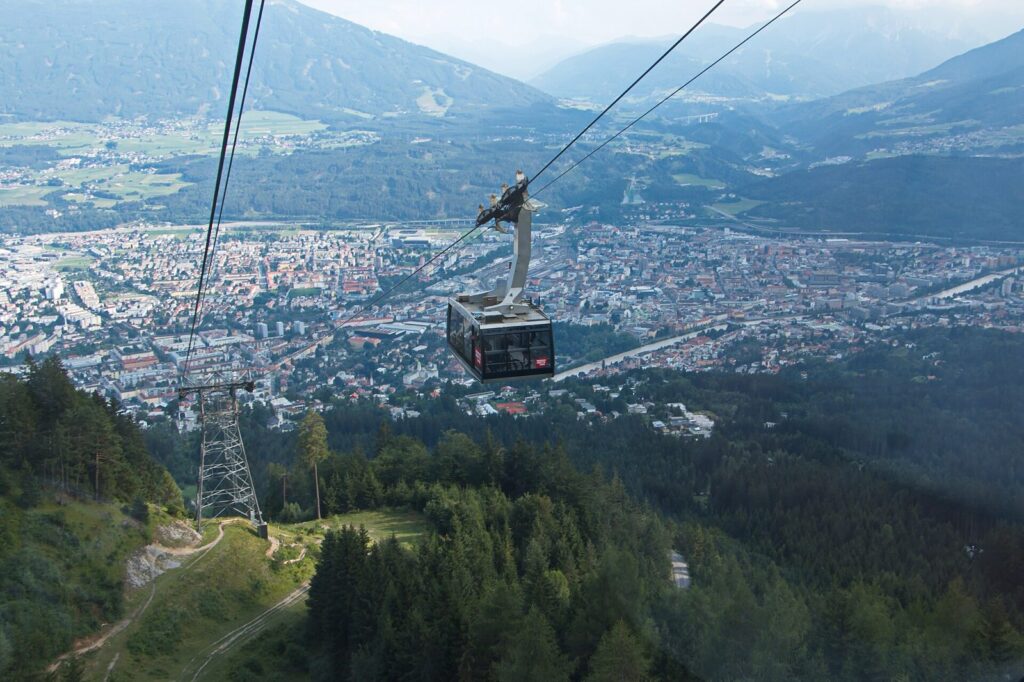
Three stages, one continuous journey, from the centre of town to a rock ridge above 2,250 metres.
- Stage one — the Hungerburgbahn. A funicular from the Congress station in the old town, calling at the Alpine Zoo, up to the Hungerburg. This is the Zaha Hadid section: four stations of curved, shell-like glass and concrete, opened in 2007, and one of the few pieces of star-architect infrastructure that is genuinely used by commuters rather than only admired.
- Stage two — the Seegrubenbahn to the Seegrube at 1,905 metres, where there is a restaurant, a terrace and the classic view straight down onto the city.
- Stage three — the Hafelekarbahn to Hafelekar at 2,256 metres, and a short walk up to the Hafelekarspitze summit at about 2,334 metres, where the ground drops away on both sides and you are looking at the Inn valley on one side and the Karwendel wilderness on the other.
Prices in 2026: tickets to the Hungerburg run €5 to €14, to the Seegrube €18.10 to €50.40, and to Hafelekar €20.20 to €56, depending on whether you buy singles, returns or combinations. A full return to the top comes in at €56 adult. The Innsbruck Card includes one full return covering all three sections.
The whole ascent takes about twenty-five minutes of travelling time. Allow three hours for the round trip with a stop at the Seegrube, and more if you walk — the ridge path from Hafelekar towards the Hafelekarspitze is short, exposed and superb, and there are longer descents on foot back to the Seegrube for anyone with proper footwear.
The unflattering part: it is expensive. Forty euros for a cable car is a lot, and the Seegrube terrace charges mountain-restaurant prices for mediocre food. Take a sandwich. And on a busy August Saturday the queue at the Congress station is substantial — go early, before ten.
The rest of Innsbruck
The old town
Small, arcaded, entirely walkable in an hour, and dominated by the Goldenes Dachl — a fifteenth-century balcony roofed with 2,657 gilded copper tiles, built by Emperor Maximilian I so he could watch tournaments in the square below. It is smaller than the photographs suggest and it is still worth ten minutes.
The Hofburg and the Hofkirche are the two substantial interiors. The Hofkirche holds Maximilian’s cenotaph surrounded by twenty-eight over-life-size bronze figures — the “Schwarze Mander”, black men — which is one of the strangest and most impressive pieces of Renaissance sculpture north of the Alps, and considerably more interesting than the Golden Roof.
Bergisel
The ski jump on the hill south of the city, rebuilt by Zaha Hadid in the early 2000s — the same architect as the Hungerburgbahn, and the two together make Innsbruck a small but genuine destination for modern architecture. There is a lift, a café at the top of the tower, and the view back down the inrun is properly vertiginous. It hosts a leg of the Four Hills Tournament every January.
Swarovski Kristallwelten
Out at Wattens, about twenty minutes away, and included on the Innsbruck Card. It is a corporate art installation attached to a crystal company, it is extremely popular, and opinion divides sharply — some people find it genuinely imaginative and others find it an expensive gift shop with a garden. If you are card-holding and have time, go and decide. If you are on a day trip, skip it; the mountain is a better use of three hours.
The Innsbruck Card
€69 for 24 hours, €79 for 48, €89 for 72 in 2026. It covers 22 or more museums and attractions, public transport, and — the item that carries the whole thing — one full return on the Nordkette across all three sections, plus the Bergisel ski jump, the Hofburg, the Alpine Zoo and Swarovski Kristallwelten.
Do the arithmetic honestly. The Nordkette alone is €56, Bergisel and the Hofburg add perhaps €20 between them, and transport a few euros more. On a single busy day that lands just above the €69 of the 24-hour card, so it roughly breaks even; over 48 hours at €79 the second day’s sights and transport come almost free, and the card is worth it if you use them. On a day trip where you are only doing the mountain, buy the cable car ticket on its own. We apply the same reasoning to Munich’s equivalents in our city card comparison.
Innsbruck in winter
This is where Innsbruck stops being a nice day out and becomes a serious proposition, and it is the answer to a question a lot of Munich visitors are actually asking.
Munich’s own day-trip ski areas are closer to home: Garmisch-Classic has 40 kilometres of piste, and Brauneck, Sudelfeld and Spitzingsee are the other nearby options. The MVV-Skipass makes them frictionless — €64.50 to €79 including the train and the lift pass — and for a single day from Munich that is the right choice. See skiing near Munich.
But Innsbruck sits inside a ring of ski areas of a completely different order. The Nordkette rises straight out of the city and has some of the steepest lift-served terrain in Europe; the Stubai glacier, Axamer Lizum, Kühtai and Patscherkofel are all short bus rides, and a single regional lift pass covers a spread of them. For three days or more with skiing as the point of the trip, base yourself here rather than commuting from Munich — five hours a day on trains is not a holiday.
Innsbruck has hosted the Winter Olympics twice, in 1964 and 1976, and the infrastructure shows it. The Christmas markets in the old town in December are also excellent and considerably less crowded than Munich’s — see the Munich markets for the comparison.
Eating, and the cost of the day
Tyrolean food is closer to Bavarian than either side likes to admit, and the differences are worth knowing. Tiroler Gröstl — fried potato, beef and onion with an egg on top — is the regional dish and it is exactly what you want after a morning at 2,300 metres. Kaspressknödel, flattened cheese dumplings in a clear broth, are the other one. Speck here is the South Tyrolean smoked ham rather than the Bavarian bacon, and it is better.
Prices are broadly similar to Munich in the old town and noticeably cheaper a few streets out. The mountain restaurants are the exception: the Seegrube terrace charges what a captive audience at 1,905 metres will pay, and a plate of Gröstl up there costs roughly double what it costs in the Altstadt. Carrying a sandwich up is entirely normal and nobody minds.
A realistic day-trip budget per person: €30 to €60 for the return train booked ahead, €56 for the Nordkette return, and €25 to €40 for food — call it €110 to €155. That is comparable to a Zugspitze day from Munich, which runs to €112 for the Bayern-Ticket plus a summit return, or €94.50 with the MVV Garmischer Sommerticket. Our Munich trip cost guide puts both in the context of a whole trip.
Practicalities across the border
- No border control. Both countries are in Schengen and the train does not stop for passports at Kufstein — but carry ID anyway, because spot checks on this corridor do happen and have become more frequent.
- Same currency, same plugs, same EU roaming. A German SIM works in Austria at no extra cost; see our SIM and wi-fi guide.
- The German is different. Tyrolean dialect is broad and the vocabulary shifts — Jänner for January, Erdäpfel for potatoes, Semmel for a bread roll. Bavarian is closer to it than standard German is. Our phrases guide covers the Bavarian versions.
- Tipping works the same way as in Munich: round up and say the total as you hand over the money, roughly five to ten per cent. See money and tipping.
- Driving needs a vignette. Austria requires a motorway toll sticker bought before you cross, and the Brenner motorway carries an additional toll on top. The fines for travelling without one are substantial and the checks are real. See driving in Munich for why a car is the wrong answer here anyway.
- Sunday closing applies, and rather more strictly than in Germany. Innsbruck’s shops shut, with station and petrol-station exceptions.
Beyond Innsbruck: the Tyrol
- Hall in Tirol, fifteen minutes east, is a medieval salt town with an old centre larger than Innsbruck’s and about a tenth of the visitors. If Innsbruck’s Altstadt feels crowded, go here.
- The Stubaital, a valley running south-west from the city, is the classic Tyrolean side trip — a glacier at the top, villages the whole way up, and a bus that goes there.
- Seefeld, on the line north towards Garmisch, is a high plateau resort and — importantly — sits on the Mittenwaldbahn, which is one of the most spectacular railway lines in Europe and connects Innsbruck to Garmisch-Partenkirchen. Taking the train from Munich to Garmisch and then on to Innsbruck over the Mittenwaldbahn is slower than the direct route and a much better journey.
- The Brenner and onwards. Innsbruck is the northern gate of the Brenner Pass, and the Railjet continues south to Verona every two hours, of which two a day carry on to Venice. The travel from Munich hub covers the wider network, and Munich to Vienna is the eastbound equivalent of this route.
Innsbruck versus Munich’s own mountains
Worth being direct about this, because the two compete for the same day in your itinerary.
| Innsbruck | Garmisch and the Zugspitze | |
|---|---|---|
| Travel from Munich | About 2 h, ~8–10 direct trains a day | 1h20–1h26, hourly RB6 |
| Ticket | Advance from about €22; Bayern-Ticket not valid | Bayern-Ticket €34 / €74 for five |
| Highest point | Hafelekar station 2,256 m (summit ~2,334 m) | Zugspitze, 2,962 m — Germany’s highest |
| Mountain cost | €56 return | €78 return, or €94.50 with travel via the Sommerticket |
| The city | A real Alpine capital with museums and architecture | A resort town. Pleasant, not a destination |
| Verdict | Better if you want a city and a mountain | Better if you want only the mountain, and cheaper to reach |
If you have one mountain day in a Munich trip, take Garmisch — it is faster, cheaper and higher, and the Zugspitze is a genuinely great mountain. If you have two, make the second one Innsbruck, because it is a different kind of day rather than the same day again. And if you have three, go to the Bavarian Alps hub and pick a valley.
Frequently Asked Questions
How long is the train from Munich to Innsbruck?
About two hours by Railjet, with the fastest services doing it in 1 hour 54 minutes. There are roughly 8 to 10 direct trains a day, mostly ÖBB/DB Railjet and EuroCity, running München Hauptbahnhof to Innsbruck Hauptbahnhof via Kufstein and up the Inn valley. No change is needed.
Can you do Innsbruck as a day trip from Munich?
Yes, and it is a good one. At about two hours each way by Railjet, an early train leaves you most of the day on the ground for roughly four hours of travel. The realistic day-trip plan is the Nordkette in the morning, the old town and lunch after, and a train home around 18:00. What you cannot do in a day is the mountain and the museums and Swarovski. For that, stay two nights.
How much does the train cost?
Advance tickets start from about €22 on DB’s site, and the flexible fare is higher. ÖBB Sparschiene tickets are sold on oebb.at and can be booked up to six months ahead, so book as early as you can for the best chance of the cheap fares. Midweek and midday departures are cheaper than Friday afternoons.
Is the Bayern-Ticket valid to Innsbruck?
No. It covers regional trains within Bavaria and, unusually, as far as Salzburg, but it is not valid on Railjet or EuroCity services and it does not extend into the Tyrol. It costs €34 for one person or €74 for up to five and is the right ticket for Garmisch, Füssen, Nuremberg and Salzburg — not for this journey.
How much does the Nordkette cable car cost?
A full return to the top is €56 for an adult in 2026. Individual section prices in 2026 run €5 to €14 to the Hungerburg, €18.10 to €50.40 to the Seegrube at 1,905 m, and €20.20 to €56 to Hafelekar at 2,256 m (the summit just above is about 2,334 m), depending on singles, returns and combinations. The Innsbruck Card includes one full return across all three sections.
Is the Innsbruck Card worth it?
Over 48 or 72 hours, yes — €79 or €89 against a Nordkette return at €56 plus 22 other attractions and transport. Over 24 hours at €69 it roughly breaks even and only pays if you are moving fast. On a day trip where the mountain is the whole plan, buy the cable-car ticket alone and skip the card.
Should I ski from Munich or from Innsbruck?
For one day, ski from Munich — the MVV-Skipass bundles the train and lift pass from €64.50 and you are back for dinner. For three days or more, base yourself in Innsbruck: the Nordkette, Stubai glacier, Axamer Lizum, Kühtai and Patscherkofel are all a short bus ride away and comfortably larger than anything on the Bavarian side. Commuting daily from Munich to Austrian ski areas is the worst of both.
What is there to do in Innsbruck besides the mountain?
The arcaded old town with the Goldenes Dachl, the Hofburg, and the Hofkirche with Maximilian’s cenotaph and its twenty-eight over-life-size bronze figures — the most impressive thing in the city after the Nordkette. The Bergisel ski jump, rebuilt by Zaha Hadid in the early 2000s, has a lift and a café at the top. Swarovski Kristallwelten at Wattens divides opinion sharply. Hall in Tirol, fifteen minutes east, has a bigger medieval centre and far fewer people.
Is Innsbruck better than Garmisch as a day trip?
Different rather than better. Garmisch is faster to reach at 1h20, cheaper because the Bayern-Ticket covers it, and higher — the Zugspitze is 2,962 m against 2,256 m at Hafelekar’s top station, or about 2,334 m on the summit just above. Innsbruck gives you a real Alpine city with an old town, museums and two Zaha Hadid buildings alongside the mountain. If you only have one mountain day, take Garmisch. If you have two, make the second Innsbruck.
Where to go next
Innsbruck is one of several cities Munich reaches in a morning — travel from Munich ranks them, with Vienna at four hours and Prague the one where the bus wins. For the mountains closer to home, the Bavarian Alps from Munich, the Zugspitze and the best day hikes cover the summer, and skiing near Munich the winter. If you are still shaping the trip, day trips from Munich puts every option in order.
Related Guides
- Travelling On from Munich: Trains, Buses and Road Trips — the cluster hub
- Munich to Prague: Train, Bus and the Best Route — Very high volume; SERP is booking sites with weak editorial
- Munich to Berlin: Train vs Flight vs Bus — Head term with a genuine decision to resolve
- Munich to Vienna: Complete Travel Guide — Same pattern, and it also catches the Munich-versus-Vienna audience
Photo Credits
Nordkettenbahn above Innsbruck: Blick auf Innsbruck von der Nordkette 04 by Kstipek, CC BY-SA 4.0, via Wikimedia Commons.