Munich to Berlin: Train vs Flight vs Bus
The ICE Sprinter does it in 3h53 from €17.99, city centre to city centre. The full comparison with the flight and the bus, the door-to-door arithmetic, and how to get the cheap fare.
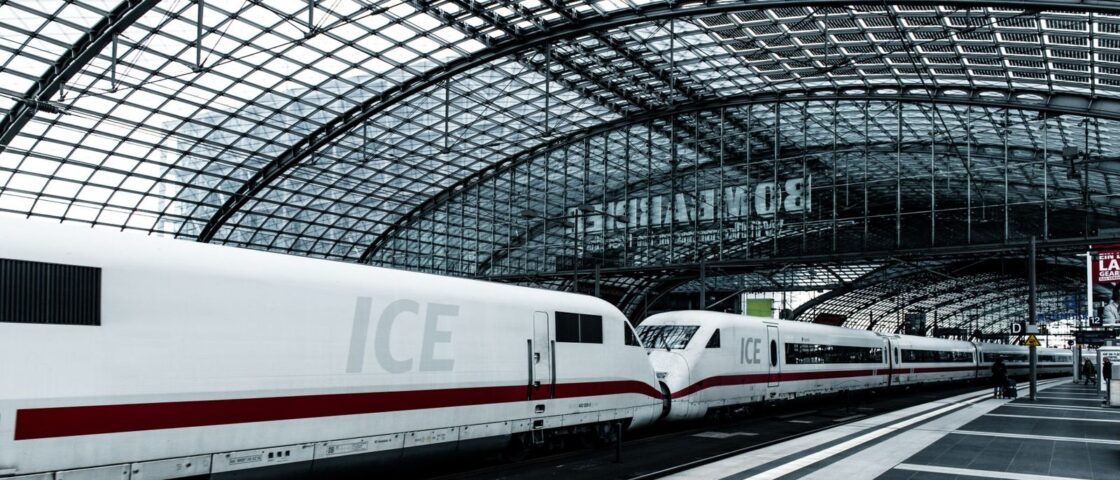
Take the train. The ICE Sprinter does Munich Hauptbahnhof to Berlin Hauptbahnhof in 3 hours 53 minutes with one stop at Nuremberg, there are up to twenty-nine services a day, and booked three to six weeks ahead it starts at €17.99. There is no serious argument for anything else unless you are on a very specific kind of budget or a very specific kind of schedule.
The flight looks faster on paper — about an hour in the air against nearly four hours on rails — and it is not. Munich Airport is in Zone 5, forty to forty-five minutes out on the S1 or S8, and Berlin’s airport is not in Berlin either. Add check-in, security and two airport transfers and the honest door-to-door total lands somewhere around four and a half to five hours, from a suburb to a suburb, for more money.
Here is the full comparison with real numbers, the two situations where the bus or the plane genuinely wins, and how to get the cheap train fare rather than the expensive one.
Munich to Berlin at a glance
| Train | Flight | Bus | |
|---|---|---|---|
| Journey time | 3h53 (Sprinter) ~4h33 standard ICE | ~1 hour airborne | From 6h45 |
| Door to door | ~4 hours, centre to centre | ~4½–5 hours | ~7 hours |
| Cheapest advance fare | €17.99 Super Sparpreis | Varies wildly | ~€17–€25 |
| Frequency | Up to 29 a day, 16 of them Sprinters | Several daily | 16 a day |
| Arrives at | Berlin Hbf, city centre | An airport outside the city | A coach station, not the centre |
| Luggage | Whatever you can carry, free | Charged, weighed, checked | One hold bag, usually included |
| Work on board | Table, socket, wi-fi, no seatbelt sign | Barely | Socket and wi-fi, cramped |
| Verdict | Take this one | Only for a tight connection | Only if the fare gap is large |
The train, in detail
Munich–Berlin is Germany’s busiest long-distance rail corridor and it shows in the service. The high-speed line through Thuringia cut the journey dramatically when it opened, and the route now supports up to 29 ICE services a day, of which 16 are ICE Sprinters.
| Service | Time | Stops | Note |
|---|---|---|---|
| ICE Sprinter | 3h53 | Nuremberg only | The one to book. 16 a day. |
| Standard ICE | ~4h33 average | Nuremberg, Erfurt, Halle or Leipzig and others | Often cheaper; the extra 40 minutes is rarely the deciding factor |
What you get for the fare: a table seat if you want one, a power socket, wi-fi that works most of the time, a bistro car, and the ability to stand up and walk about whenever you please. Second class on an ICE is more comfortable than business class on a short-haul flight, and that is not a stretch.
Insider tip: seat reservations are optional on German long-distance trains and cost a few euros extra. On a Friday afternoon, a Sunday evening or any day during a school holiday, pay it. On a Tuesday morning, do not bother — the train will be half empty and you can sit where you like.
Getting the cheap fare, not the expensive one
Deutsche Bahn’s pricing has three broad tiers and the difference between them is enormous — the same seat on the same train can cost €18 or €160.
- Super Sparpreis — from €17.99. Cheapest, tied to one specific train, non-refundable. If you know exactly when you are travelling, this is the one.
- Sparpreis — from €21.99. Also tied to a specific train but with more flexibility and a cancellation option for a fee.
- Flexpreis. Valid on any train that day. Several times the price. Buy this only if your plans are genuinely uncertain.
The rules for getting the low fare are simple and almost everybody breaks at least one of them:
- Book three to six weeks ahead. The cheap contingent on each train is finite and it sells out — this is airline-style yield management, not a fixed price.
- Avoid Friday afternoon and Sunday evening. The whole country moves on those two slots and the fares reflect it.
- Look at early morning and midday departures. Reliably the cheapest of the day.
- Check the slower standard ICE. Forty extra minutes often buys a considerably lower fare.
- Book direct with Deutsche Bahn. Third-party sites add fees for the same ticket.
Two things that do not help. The Deutschlandticket is a monthly regional-transport subscription and it is not valid on ICE or any long-distance train — it will not get you to Berlin. And the Bayern-Ticket, excellent though it is for day trips within Bavaria, stops at the state border and is not valid on ICE either. Our guide to Munich travel passes explains which pass covers what.
The flight, and the arithmetic nobody does
An hour in the air sounds decisive. Here is the honest ledger for a flight, starting from a hotel near Marienplatz.
| Step | Time |
|---|---|
| Marienplatz to Munich Airport, S1 or S8 | 40–45 min |
| Arrive before departure, bag drop and security | 60–90 min |
| In the air | ~60 min |
| Disembark, walk, baggage reclaim | 20–40 min |
| Airport into central Berlin | ~30 min plus waiting |
| Realistic total | ~4½–5 hours |
And note that a Zone M day ticket does not cover the airport run. Munich Airport sits in Zone 5, so you need a Zone M–5 single or the Airport–City–Day–Ticket on top — see our Munich airport to city guide for the options and prices.
So when should you fly? Two cases, and only two:
- You are connecting onward from Berlin and the flight is part of a single booked itinerary with your luggage checked through.
- You are already at Munich Airport — arriving from elsewhere with a long layover — in which case you are past the expensive part of the ledger. Our guide to hotels near Munich Airport covers that scenario.
Outside those two cases the flight costs you more money, more hassle and roughly the same amount of time, with an emissions bill several times the train’s. It is a bad deal presented as a fast one.
The bus
FlixBus runs 16 departures a day between Munich and Berlin, from about 6 hours 45 minutes, with fares starting somewhere in the €17 to €25 range. You get wi-fi, a power socket and a reserved seat.
The honest assessment: when the train fare is €17.99 and the bus fare is €19, the bus makes no sense at all — you are paying the same money for three extra hours in a coach seat. The bus only wins when you have left it late, the cheap rail contingent has sold out, and the ICE is quoting €90 while the bus is still €25. That happens, and on that day the bus is the right answer.
Two other things in its favour. Overnight departures let you skip a hotel night, which changes the arithmetic more than the fare does. And coach stations are usually cheaper to reach than airports at both ends. Our Munich on a budget guide takes the same approach to the rest of a trip.
Note the contrast with our Munich to Prague route, where the bus genuinely beats the train — five hours against five and a half, with about ten departures a day and fares from €17 — because there is no fast rail link over the Czech border. Munich to Berlin is the opposite case: the rail line is one of the best in Europe and the bus has nothing to exploit.
Driving
It is roughly 600 km on the A9 and, allowing for the fact that German motorway traffic between Nuremberg and Leipzig is not the free-running autobahn of legend, you should budget six hours plus stops rather than the five your satnav promises.
Do not do it for the journey alone. Fuel and tolls on the return will comfortably exceed two advance rail fares, Berlin parking is expensive and awkward, and you will arrive tired. Driving makes sense only if you are stopping somewhere on the way — Nuremberg, Bamberg, Leipzig, the Thuringian forest — or continuing beyond Berlin into a region where a car is genuinely useful. See driving in Munich for the general rules, including the low-emission Umweltzone sticker requirement in German city centres.
What four hours on an ICE is actually like
People who have not travelled by train in Germany tend to picture something between a commuter service and a long-haul flight. It is neither, and the journey itself is a decent part of the case for taking it.
You leave München Hauptbahnhof and run north across the flat Bavarian plain to Ingolstadt, then onto the high-speed line into Nuremberg — an hour and five minutes, and the point at which most of the passengers who are not going all the way get off. North of Nuremberg the train joins the newer high-speed route that opened at the end of 2017 and drives straight through the Thüringer Wald in a sequence of long tunnels and high viaducts. It is the most impressive piece of engineering on the trip and it goes past mostly in the dark, which is a slight shame.
After Erfurt the country opens out into Saxony-Anhalt and Brandenburg — flatter, emptier, more wind turbines — and then you are sliding into Berlin Hauptbahnhof on the upper level, above the city, with the Spree and the government quarter out of the window.
Practically:
- The bistro car is fine and expensive. A pretzel and a coffee from the Hauptbahnhof concourse before you board costs a third as much and tastes better. Munich’s station has a good bakery on almost every corner of it.
- Alcohol on board is entirely normal and nobody will look at you for opening a beer at eleven in the morning.
- Quiet coaches (Ruhebereich) exist and are enforced by other passengers with a rigour that visitors find startling. If you plan to take calls, do not sit in one.
- Wi-fi is free in both classes. It works well in the flat sections and drops in the Thuringian tunnels.
- Announcements are in German and English on this route.
- First class buys you wider seats, an at-seat service and a quieter carriage. On a four-hour journey it is a defensible upgrade; on the Sparpreis tiers the gap is often smaller than you would expect.
The uncomfortable caveat: German long-distance punctuality is not what its reputation suggests. Delays of twenty to forty minutes on this corridor are unremarkable and construction work regularly forces diversions and longer running times. Do not book a Berlin theatre ticket for ninety minutes after your scheduled arrival, and if you are connecting to a flight, leave a real margin.
Luggage, children, bikes and dogs
This is where the train quietly wins by a much larger margin than the timetable suggests.
| Train | Flight | |
|---|---|---|
| Luggage | Whatever you can carry aboard. No weighing, no fee, no reclaim. | Charged, weighed, size-limited, and reclaimed at the far end |
| Children | Travel free or very cheaply with a parent on DB long-distance | Full fare from a young age |
| Bicycles | Carried on many ICE services with a reservation | Boxed, charged, and frequently damaged |
| Dogs | Small ones free in a carrier; larger ones at a child’s fare, muzzled | Complicated and expensive |
| Liquids | No rules whatsoever | 100 ml, in a bag |
The children’s rule deserves emphasis because it changes the whole calculation for families. On Deutsche Bahn long-distance services, children travelling with a parent or grandparent are carried free or at a nominal fare up to a generous age limit — they still need to be included in the booking so that they get a seat, but they do not need a fare. No airline offers anything comparable. Check the current age thresholds when you book, since DB has adjusted them before.
Bikes are worth a line of their own. Munich is one of Germany’s better cycling cities and Berlin is another, and taking your own bike between them is genuinely practical — see cycling in Munich for the local network. You need a bicycle reservation on ICE services that carry them, and not every train does, so book that at the same time as the ticket.
Which to pick: a short decision list
- Booking more than three weeks ahead? Train, Super Sparpreis, ICE Sprinter. Done.
- Booking this week and the rail fare has spiked above about €70? Compare the bus. If it is under €30, take the bus.
- Travelling overnight to save a hotel night? Bus.
- Connecting to a long-haul flight out of Berlin on one ticket? Fly.
- Travelling as a family of four? Train — children travel free or very cheaply with a parent on DB long-distance, which no airline matches.
- Want to work for four hours? Train, with a reserved table seat.
- Stopping in Nuremberg, Bamberg or Leipzig? Train, and break the journey — most Sparpreis tickets do not allow it, so buy two separate tickets.
Breaking the journey
The best version of Munich to Berlin is not a single journey at all. Every Sprinter stops at Nuremberg, 1 hour 5 minutes from Munich, and Nuremberg is a genuinely good overnight: the reconstructed old town, the Kaiserburg, the documentation centre at the Nazi party rally grounds and the courtroom where the trials were held. Our Nuremberg day trip guide covers it as a day, and it works even better as a stopover.
Further north, standard ICE services call at Erfurt and at Leipzig or Halle. Leipzig in particular repays a night — Bach’s Thomaskirche, the Nikolaikirche and the 1989 peaceful revolution, and a music scene that punches far above the city’s size.
Buy the legs as separate tickets rather than one through fare. Two Super Sparpreis tickets often cost less than one, and they let you stop where a single ticket will not.
Arriving in Berlin
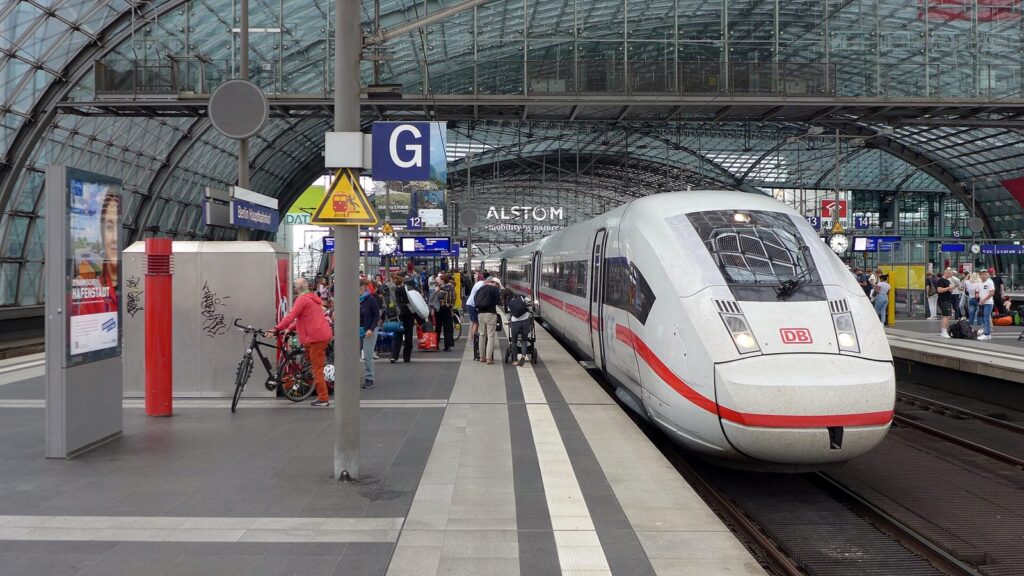
Berlin Hauptbahnhof is the largest station in Germany and it is right in the middle of the city — a five-storey glass box where the north–south and east–west lines cross at right angles on different levels. It is genuinely worth ten minutes of looking at before you leave it.
From there the Brandenburg Gate is two S-Bahn stops or a twenty-five-minute walk south along the Spree; the Reichstag is closer still. Berlin’s transport system is a single fare zone arrangement with day tickets much like Munich’s, and everything you learned on the Munich U-Bahn and S-Bahn transfers directly — same ticket-machine logic, same validation habit, same honour system with inspectors.
One cultural note for anyone travelling in this direction. Munich and Berlin are not variations on a theme; they are opposites that happen to share a country. Munich is conservative, prosperous, tidy and Catholic, with the Alps an hour away. Berlin is poorer, larger, scruffier and far stranger. Visitors who love one frequently do not love the other, and that is fine — it is the most interesting contrast in Germany and worth four hours of your time to see.
How many days you need at the other end
Four hours each way makes Berlin an overnight trip at minimum and a poor day trip. Anyone considering going up and back in a day is looking at eight hours in transit for perhaps six on the ground, which is not a sensible use of a rail fare.
Two nights is the realistic floor. Berlin is roughly nine times the area of Paris and its sights are genuinely spread out — the Museum Island, the Wall memorial at Bernauer Straße, the Reichstag dome, Charlottenburg, Kreuzberg and Neukölln are not a walkable cluster in the way Munich’s Altstadt is. Three nights is better.
The shape most people should use, if Munich is the base: a Thursday morning Sprinter north, three nights in Berlin, a Sunday afternoon train back. Sunday returns are pricier, so if the budget matters, come back on the Monday morning instead — the fare difference frequently exceeds the cost of the extra hotel night. And remember that shops shut across Germany on Sundays in Berlin exactly as they do in Munich, so a Sunday is a museum-and-park day in either city.
Working the other way round — a Berlin visitor coming south for the Munich half — our two days in Munich and one day in Munich itineraries are built for exactly that arrival, both starting from the Hauptbahnhof rather than the airport.
Frequently Asked Questions
How long is the Munich to Berlin train?
3 hours 53 minutes on an ICE Sprinter, which stops only at Nuremberg. Standard ICE services average around 4 hours 33 minutes with more stops. Both run from München Hauptbahnhof to Berlin Hauptbahnhof, city centre to city centre.
How much does the Munich to Berlin train cost?
From €17.99 one way on a Super Sparpreis and €21.99 on a Sparpreis, both booked in advance and tied to a specific train. Flexpreis, valid on any train that day, costs several times more. Book three to six weeks out and avoid Friday afternoons.
Is it faster to fly from Munich to Berlin?
No, not door to door. The flight is about an hour in the air, but Munich Airport is 40–45 minutes out in Zone 5, security and bag drop add another 60–90 minutes, and Berlin’s airport is outside the city too. The realistic total is four and a half to five hours against 3h53 on the Sprinter.
How many trains a day run between Munich and Berlin?
Up to 29, of which 16 are ICE Sprinters. This is Germany’s busiest long-distance corridor, so if you miss one there is another shortly behind it — though your Sparpreis ticket is tied to the train you booked.
Can I use the Deutschlandticket or a Bayern-Ticket?
No to both. The Deutschlandticket covers regional and local transport only and is not valid on ICE. The Bayern-Ticket is regional travel within Bavaria and also excludes ICE and EC services. Neither will get you to Berlin.
Is the bus worth it?
Only when the rail fare has spiked. FlixBus runs 16 a day from about 6h45 and fares start around €17–€25 — but if the train is also €18, the bus is three extra hours for nothing. Its real uses are late bookings and overnight departures that save you a hotel night.
Should I reserve a seat?
Yes on Fridays, Sundays, public holidays and during school holidays — the few euros buy you a guaranteed table. No on a weekday morning outside those periods, when the Sprinter is comfortably below capacity and you can choose your own seat.
Can I stop in Nuremberg on the way?
Not on a single Sparpreis ticket, which is tied to a specific train. Buy Munich–Nuremberg and Nuremberg–Berlin as two separate advance tickets instead; it often costs less than one through fare and it gets you a night in one of Bavaria’s most interesting cities. Nuremberg is 1 hour 5 minutes from Munich.
Where to go next
Our travel from Munich pillar covers every onward route from the city — Vienna in about four hours, Zurich in three and a half, Innsbruck in around two and a half, and a direct train over the Brenner to Venice. Day trips by train handles the shorter hops, and if you are still shaping the Munich half of the trip, start with the itineraries hub and getting to Munich.
Related Guides
- Travelling On from Munich: Trains, Buses and Road Trips — the cluster hub
- Munich to Prague: Train, Bus and the Best Route — Very high volume; SERP is booking sites with weak editorial
- Munich to Vienna: Complete Travel Guide — Same pattern, and it also catches the Munich-versus-Vienna audience
- Munich to Innsbruck and the Tyrol — Short hop with both day-trip and onward-travel demand
Photo Credits
ICE at Berlin Hauptbahnhof: ICE 4 Tz 9236 in Berlin Hauptbahnhof, 2024 (01) by Bahnfrend, CC BY-SA 4.0, via Wikimedia Commons.