Munich to Prague: Train, Bus and Which to Take
The train takes 5h30, the coach 5h from EUR 17 - but a group of three or more should still take the train. Routes, tickets, operators and the arithmetic that decides it.
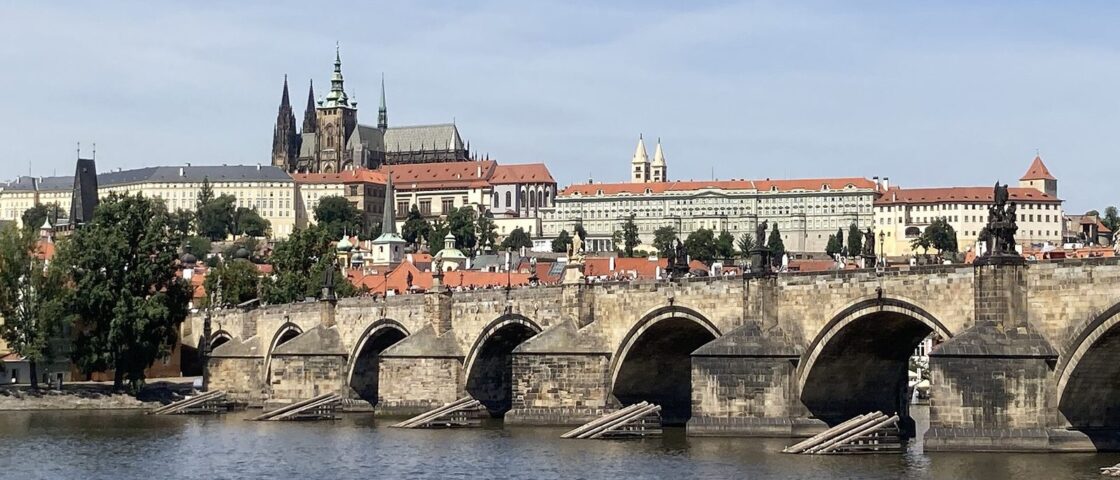
The Munich to Prague train takes about five and a half hours, runs on regional services rather than anything high-speed, and is — for most travellers — the slower and less comfortable of the two options. The coach does it in roughly five hours, about ten times a day, from €17.
That is an unusual thing for a travel guide to say, and it is worth saying plainly, because the assumption that European rail always beats European coach travel is correct almost everywhere in Europe and wrong on this specific route.
There are still good reasons to take the train, and this guide sets out both properly: the route, the ticket types that make rail cheap for groups, the coach operators and what separates them, and how to decide which suits your trip.
Munich to Prague at a glance
| Train | Coach | |
|---|---|---|
| Journey time | ~5h30 | ~5h |
| Departures per day | A handful of regional workings | About 10 |
| Cheapest fares | From around €18 one way; Bayern-Böhmen-Ticket €35 for the first traveller | From €17 booked ahead |
| Changes | Usually one, at Schwandorf or Plzeň | None |
| Comfort | Walk about, table seats, buffet on some services | Fixed seat, one or two stops |
| Scenery | Much better — Bohemian Forest, Regensburg, Plzeň | Motorway |
| Luggage | Unlimited, carried on | Limited by the hold allowance |
| Best for | Groups, scenery, flexibility | Speed, price, simplicity |
Why there is no fast train
Munich and Prague are only about 380 km apart, which by European standards ought to be a three-hour ride. It is not, and the reason is geography and history in roughly equal measure.
The direct line between the two cities crosses the Bohemian Forest — hilly, thinly populated, and for forty years the frontier between NATO and the Warsaw Pact. The Iron Curtain ran through it. Cross-border rail links were cut or run down to almost nothing, and the investment that electrified and straightened lines elsewhere in western Europe never arrived here. Substantial stretches of the route are still single-track and unelectrified.
What that means in practice is a regional railway doing an international job. It is not a bad railway; it is simply not built for speed, and no amount of rolling stock fixes a winding single-track alignment.
The train route
The rail corridor runs Munich – Regensburg – Schwandorf – Furth im Wald, crossing into Czechia there, then on through Plzeň to Prague. Services are operated partly by alex, the Länderbahn’s regional brand, and partly by DB and Czech operators.
There are direct workings as far as Plzeň — two a day, departing Munich at around 09:01 and 17:01, plus a midday departure with a change at Schwandorf. From Plzeň, Prague is a straightforward onward connection. Total journey time is around five and a half hours.
Timetables on this route change with the annual December revision more than most, so check the live timetable rather than trusting these times, including this guide’s.
What you see out of the window
This is the train’s real argument. The route passes through Regensburg, whose medieval centre is a UNESCO World Heritage site and which has the oldest stone bridge in Germany; then across the Oberpfalz; then through the wooded hills of the Bohemian Forest and down into Plzeň, home of the original Pilsner. It is a genuinely handsome five hours and it is nothing like a motorway.
Insider tip: the strongest version of this journey is not doing it in one go. Break it at Regensburg — about 1h30 from Munich — for a night or even an afternoon. It is one of the best-preserved medieval cities in Germany, it is almost entirely absent from Anglophone itineraries, and it turns a long transfer day into part of the trip. Plzeň works the same way for beer-minded travellers.
Breaking the journey at Regensburg
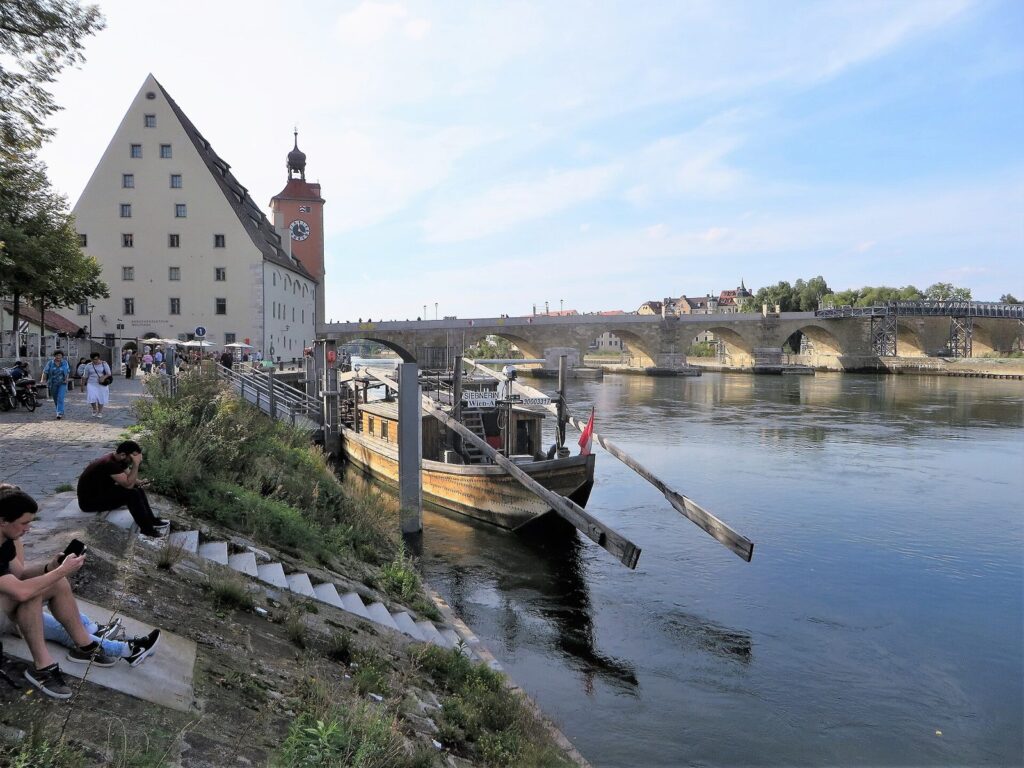
Regensburg escaped the bombing that flattened most German cities of its size, so what stands is the real thing rather than a reconstruction: a dense medieval core of merchants’ towers, narrow lanes and a Gothic cathedral, on the Danube at its northernmost point.
The Steinerne Brücke, the twelfth-century stone bridge, is the reason the city exists — it was for centuries the only reliable crossing of the Danube for a very long way, and the wealth that came from controlling it built everything else. Beside it, the Historische Wurstkuchl has been grilling sausages over charcoal for something close to nine hundred years, which makes it a plausible claimant to the oldest continuously operating restaurant in the world. Six sausages with sauerkraut and their own mustard, eaten at a bench by the river, is the correct order.
Half a day covers the centre comfortably. A night lets you see it after the day visitors leave, which is when a medieval city is worth being in. If you are already deciding between Bavarian stopovers, our Rothenburg guide covers the other main contender — Rothenburg is prettier and more visited, Regensburg is larger, more lived-in and on your way.
The obvious catch: breaking the journey means two travel days rather than one, and on a short trip that is a real cost. It works well on ten days and badly on five.
Rail tickets: the group deals are the point
Because this is a regional route rather than a long-distance one, it is covered by regional day-ticket products — and those are priced aggressively for groups in a way that flips the coach-versus-train arithmetic completely.
| Ticket | Price | Covers |
|---|---|---|
| Bayern-Böhmen-Ticket | €35 first traveller, +€10.60 each additional | Regional trains across Bavaria and into Bohemia — a full day, all changes included |
| Prag Spezial | Varies; from around €18 one way | Regional services (DB, alex, OPB, agilis) Munich–Regensburg–Schwandorf–Furth im Wald, and Czech railways onward to Prague |
| DB Intercity bus | From €29 | DB’s own coach, Munich–Prague |
Work through the arithmetic for a group of four. The Bayern-Böhmen-Ticket costs €35 plus three lots of €10.60 — about €67 for four people, one way, on any train, no advance booking. Four coach seats at the €17 advance fare cost €68, and that is the cheapest coach fare, tied to a specific departure, with luggage limits.
So: a group of three or more should take the train. A solo traveller or a pair should probably take the coach. That single distinction is the most useful thing in this guide.
For the wider Bavarian ticket logic, see our budget transport in Munich guide.
The coach: Flixbus and RegioJet
Two operators run this route, plus DB’s own service, and they are not the same product.
| Operator | Frequency | Fares | Character |
|---|---|---|---|
| Flixbus | Many departures, early morning to midnight | From €17 well ahead; can exceed €50 on the day | Widest choice of times; most volatile pricing |
| RegioJet | Two a day, occasionally three | From €17, notably steadier | Reserved seats, on-board service, the better ride |
| DB Intercity bus | Limited | From €29 | Bookable through the German rail system |
RegioJet is the one to book if the timing works. It is a Czech operator that runs its coaches closer to a train service than a bus — allocated seats, staff who come round, drinks included on some services — and its pricing is far less prone to the last-minute spikes that make Flixbus expensive. The catch is that there are only two or three departures a day.
Flixbus is the one to book if you need a specific departure time, which is most people. Just book early: the gap between a €17 advance fare and a €50-plus walk-up on this route is large enough to matter.
Where the coaches leave from
This catches people out every single day, so it is worth its own paragraph.
Long-distance coaches leave from the ZOB at Hackerbrücke, not from the Hauptbahnhof. It is one S-Bahn stop or about ten minutes’ walk west of the main station. Allow twenty minutes to get there and find the right bay — the ZOB is a multi-level structure with a lot of platforms and no obvious logic to the numbering when you are in a hurry.
In Prague, coaches generally arrive at Florenc, which is on the metro and about ten minutes from the old town.
One caveat on the group tickets: Bavarian regional day tickets generally carry a weekday start-time restriction — the standard Bayern-Ticket is not valid before 09:00 Monday to Friday — and the 09:01 departure from Munich is unlikely to be a coincidence. Confirm the exact validity window before you plan around an early train.
Doing it by car
Driving takes roughly four hours on a good day, which makes it the fastest option on paper. It is rarely the right one.
- The Czech Republic requires a motorway vignette, now sold electronically and tied to your number plate. Buy it before you cross; driving on Czech motorways without one is an on-the-spot fine.
- Prague is a bad city to have a car in. The centre is restricted, parking is expensive and scarce, and the public transport is excellent and cheap. You will park it on the first evening and not touch it again.
- Hire cars frequently carry cross-border restrictions. Check your agreement — some German rental agreements exclude the Czech Republic or charge a substantial cross-border fee.
- You cannot drink. The Czech Republic operates a zero-tolerance drink-driving limit, which in a country known for its beer is a meaningful constraint.
Hire a car for the Bavarian countryside if you want one, and take the coach or train to Prague. Our travelling on from Munich guide covers the driving rules across the region.
The journey itself
Five hours is long enough that the small things matter.
- Take food. Regional trains on this route do not reliably have a buffet, and the coaches sell snacks at best. Buy at the Hauptbahnhof, which has supermarkets open on Sundays when the rest of Germany is shut.
- Wi-fi is unreliable on both, and it drops entirely across the border and through the Bohemian Forest, where mobile coverage is patchy. Download whatever you plan to read or watch.
- Power sockets are standard on the coaches and hit-and-miss on regional trains. Bring a battery pack.
- Toilets exist on both. The train’s are better and you can get up whenever you like, which over five hours is not a trivial advantage.
- The coach makes one or two stops, generally around fifteen minutes. They are not optional bathroom breaks so much as the only ones.
- Validate nothing. German and Czech long-distance tickets are checked on board; there is no platform barrier and no stamping machine to worry about.
Insider tip: if you are taking the train and travelling in a group of three or more on the day ticket, sit in the four-seat bays with a table rather than spreading out. Five hours across a table with food and cards is a pleasant afternoon; five hours in airline-style seats is an endurance exercise, and it is the same train.
Crossing the border
Germany and the Czech Republic are both in the Schengen area, so there are normally no routine border checks on either the train or the coach. Spot checks happen and you should have your passport or ID accessible, but nobody will stop the vehicle.
- Currency changes. The Czech Republic uses the koruna, not the euro. Some places in Prague accept euros at a poor rate; use a card or withdraw koruna. Avoid the exchange booths in tourist areas entirely — the rates are notorious.
- Cards work widely in Prague, more so than in Munich.
- Mobile roaming is EU-wide for EU plans; UK and non-EU travellers should check their tariff, as the Czech Republic is a separate zone on some plans.
- Prague is materially cheaper than Munich — food, beer and accommodation are all meaningfully lower, which is worth knowing when budgeting a multi-city trip.
Our travelling on from Munich guide sets the cost differences out across the whole region.
Arriving in Prague
Where you land depends on how you travelled, and the two arrival points are not equivalent.
By train you arrive at Praha hlavní nádraží, the main station, which is a ten-minute walk or one metro stop from Wenceslas Square and about twenty minutes on foot from the Old Town Square. The station has an art nouveau hall upstairs that is worth two minutes of your time on the way out.
By coach you arrive at Florenc, the main bus station, on metro lines B and C and about ten minutes from the old town. It is functional rather than pleasant and there is no reason to linger.
Two things to do in the first twenty minutes, both of which save money and irritation:
- Get koruna from a bank ATM, not an exchange booth. Prague’s tourist-area exchange offices are notorious, and the advertised rate is frequently not the rate you get. Decline any “dynamic currency conversion” offer at an ATM and let your own bank do the conversion.
- Buy a transport ticket properly. Prague’s metro, tram and bus network is cheap, extensive and time-based, and it is checked by plain-clothes inspectors who issue on-the-spot fines. Validate when you first board.
Do not take an unbooked taxi from either arrival point. Use an app or the official ranks.
What the price difference means
Prague is meaningfully cheaper than Munich across almost everything a visitor buys, and the gap is large enough to change how you plan a two-city trip.
Beer is the clearest illustration and the one everybody quotes: a half-litre in an ordinary Prague pub costs a fraction of what a litre costs in a Munich beer hall, and the beer is at least as good. Accommodation, restaurant meals and taxis follow the same pattern. Museums and public transport are cheap in both.
The practical consequences:
- Weight the nights towards Prague if the budget is tight. Three nights in Prague and two in Munich costs less than the reverse and gives you more evenings out.
- If you are travelling during Oktoberfest, when Munich hotel rates roughly triple, the case for spending more of the trip in Prague becomes overwhelming. See our hotel booking tips.
- Do not let the price difference set your expectations for Munich. Munich is expensive to sleep in and surprisingly cheap to see — museums are €1 on Sundays, the parks and the Eisbach wave are free, and a day ticket is €10.10. Our Munich on a budget guide covers it.
One thing Munich does better, and it is worth saying: the beer gardens. Prague’s pubs are excellent and its outdoor drinking is not in the same category as eight thousand seats under chestnut trees at the Hirschgarten. See our beer halls and breweries guide before you leave.
Which should you take?
| If you are… | Take | Why |
|---|---|---|
| Travelling alone | Coach | Cheaper, faster, more departures |
| A couple | Coach, marginally | Two advance fares still beat the rail group ticket |
| Three or more | Train | The Bayern-Böhmen-Ticket’s additional-traveller rate wins outright |
| Carrying a lot of luggage | Train | No weight limit, no hold, nothing to check |
| Wanting to see the country | Train | Regensburg, the Bohemian Forest, Plzeň |
| Booking last minute | Train | Regional fares do not spike the way coach fares do |
| Prone to travel sickness | Train | Five hours on a winding motorway is a long time |
| On the tightest possible budget | Coach, booked early | €17 is hard to beat |
The one option nobody should take is flying. Munich Airport is 40 to 45 minutes out of the city in Zone 5, Prague’s airport is a bus ride from the centre, and once you add check-in and security to a fifty-minute flight you have spent longer than the coach for several times the money and a great deal more carbon.
Making it part of a longer trip
Munich and Prague pair well because they are so different — one wealthy, orderly and Catholic-baroque, the other layered, cheaper and considerably stranger. Five hours apart is enough distance for the contrast to land.
Two routings that work better than a straight there-and-back:
- Munich → Nuremberg → Prague. Nuremberg is 1h05 from Munich on the ICE and roughly 3h35 from Prague by coach, which breaks the long leg neatly and adds a genuinely good medieval city. Our Nuremberg guide covers it.
- Munich → Regensburg → Plzeň → Prague, all by train, over three or four days. This is the slow version and the most rewarding one, and it uses the scenery the coach skips entirely.
Give Prague at least two nights. It is a compact city and a day is not enough, and coming from Munich you will want an evening to recalibrate to the prices before you start making decisions.
And before you go anywhere — our Munich itineraries guide sets out how many days Munich itself needs first. Cutting the city to a day and a half to buy an extra night in Prague is a trade most people regret.
Frequently Asked Questions
How long is the Munich to Prague train?
About five and a half hours, on regional services via Regensburg, Schwandorf, Furth im Wald and Plzeň. There is no high-speed line — much of the route is single-track and unelectrified — and most journeys involve one change. The coach does the same trip in roughly five hours.
Is there a direct train from Munich to Prague?
There are direct workings as far as Plzeň, departing Munich at around 09:01 and 17:01, with a straightforward onward connection to Prague. A single train the whole way is not the norm. Check the live timetable — this route’s services change with the annual December revision more than most.
Is the train or the bus better from Munich to Prague?
It depends on group size. Alone or as a couple, the coach — faster, cheaper, about ten departures a day from €17. Three or more people should take the train, because the Bayern-Böhmen-Ticket costs €35 for the first traveller and only €10.60 for each additional one, which undercuts four coach fares. The train also has better scenery and no luggage limit.
How much is the Munich to Prague train?
From around €18 one way on the Prag Spezial fare. The Bayern-Böhmen-Ticket is €35 for the first traveller plus €10.60 for each additional person, valid on regional trains for a full day including all changes — which makes it outstanding value for groups and unnecessary for solo travellers.
Where do buses to Prague leave from in Munich?
The ZOB at Hackerbrücke, one S-Bahn stop or about ten minutes’ walk west of the Hauptbahnhof — not from the main station itself. This is the most common reason people miss their coach. Allow twenty minutes and find your bay early. In Prague, coaches usually arrive at Florenc.
Do I need my passport between Munich and Prague?
Both countries are in Schengen, so there are no routine border checks on either the train or the coach. Spot checks do happen, so carry your passport or ID somewhere accessible. Note that the Czech Republic uses the koruna rather than the euro.
Can I do Prague as a day trip from Munich?
No. Five hours each way leaves you almost no time in the city, and Prague is not a place to see in three hours. Give it two nights minimum. If you want a shorter version of the same journey, break it at Regensburg — 1h30 from Munich, medieval, and largely unvisited by English-speaking travellers.
Should I fly from Munich to Prague?
No. The flight is under an hour, but Munich Airport is 40 to 45 minutes out in Zone 5, Prague’s airport needs a bus into the centre, and check-in and security absorb the rest. Door to door it is no faster than the coach and considerably more expensive.
Where to go next
For the full picture of onward journeys — Vienna, Berlin, Zurich and the Brenner route into Italy — see our travelling on from Munich guide. If you would rather stay closer, day trips from Munich covers what is reachable and back in a day, and getting around Munich handles the city network you will use to reach the station.
Related Guides
- Travelling On from Munich: Trains, Buses and Road Trips — the cluster hub
- Munich to Berlin: Train vs Flight vs Bus — Head term with a genuine decision to resolve
- Munich to Vienna: Complete Travel Guide — Same pattern, and it also catches the Munich-versus-Vienna audience
- Munich to Innsbruck and the Tyrol — Short hop with both day-trip and onward-travel demand
Photo Credits
Regensburg: 2018 Schifffahrtsmuseum Regensburg 4 by Bärwinkel,Klaus, CC BY-SA 4.0, via Wikimedia Commons. Prague Castle and Charles Bridge (top image): Prague Castle and Charles Bridge over Vltava by Mattsjc, CC BY-SA 4.0, via Wikimedia Commons.