One Day in Munich: The Perfect 24-Hour Itinerary
An hour-by-hour plan for a single day in Munich, entirely on foot and about EUR 15 in admission - with honest notes on the Glockenspiel and what to leave out.
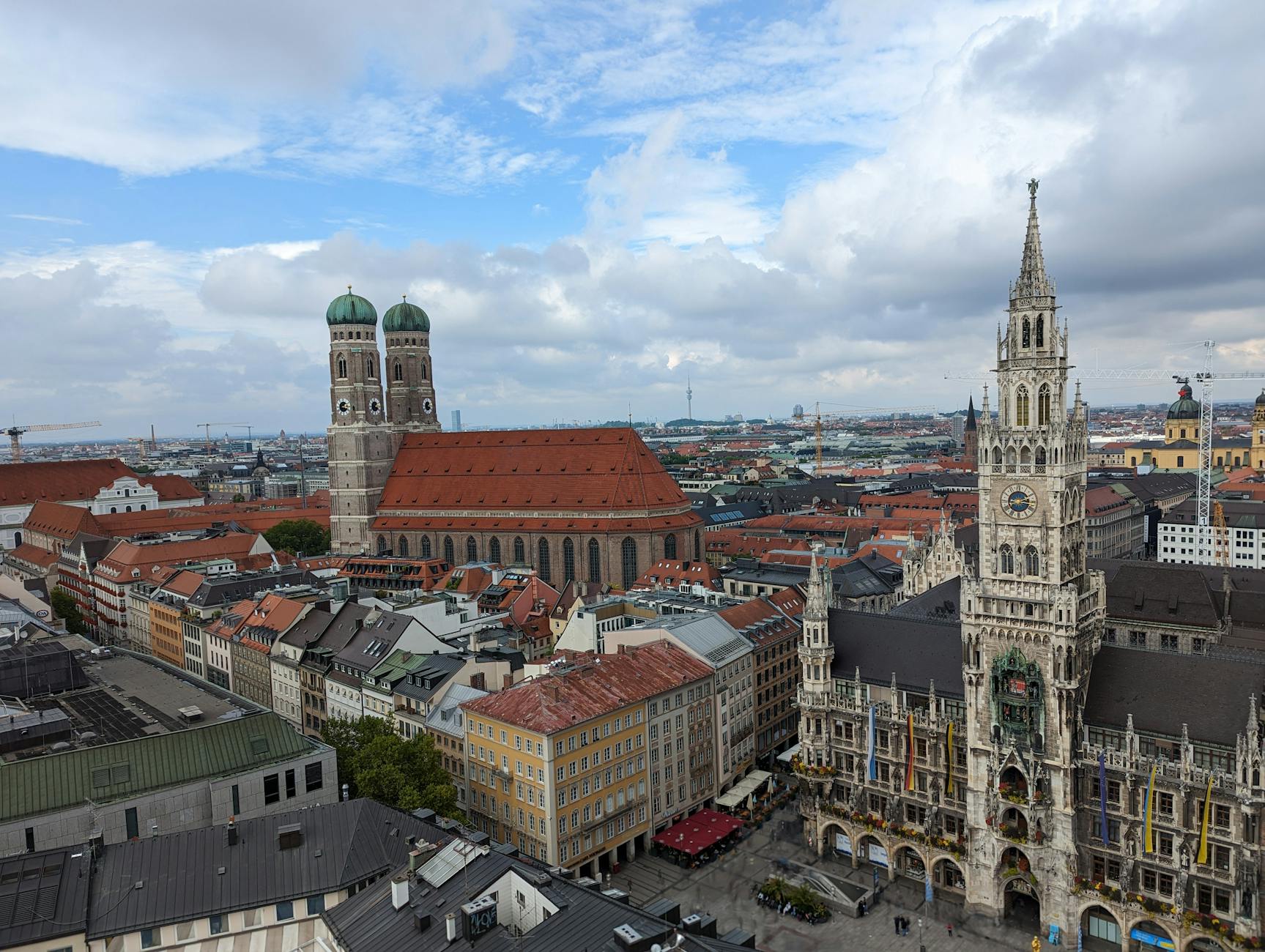
One day in Munich means the Altstadt and one thing beyond it. That is the honest answer, and any itinerary that promises you Marienplatz, Nymphenburg, the Deutsches Museum, the BMW Welt and a beer garden in twenty-four hours is describing a day spent on the U-Bahn.
The good news is that Munich is unusually well suited to a single day. The old town is compact — Marienplatz to the Residenz to the Hofgarten is under a kilometre — and the one thing worth adding beyond it, the English Garden, starts where the Hofgarten ends. You can do this entire itinerary on foot, and you barely need a ticket.
What follows is a tested hour-by-hour plan, with the things worth paying for, the things to skip, and what changes if your one day falls on a Monday or a Sunday — because in Munich, that matters more than in almost any other European city.
1 day in Munich at a glance
| Time | Where | Cost |
|---|---|---|
| 09:00 | Marienplatz and the Neues Rathaus | Free |
| 09:20 | Alter Peter tower — 306 steps | ~€5 |
| 10:00 | Viktualienmarkt | Breakfast, ~€5 |
| 11:00 | The Glockenspiel | Free, about 15 minutes |
| 11:20 | Frauenkirche and the Altstadt lanes | Free |
| 12:15 | The Residenz | ~€10 |
| 14:00 | Hofgarten into the English Garden | Free |
| 15:00 | The Eisbach wave | Free |
| 16:00 | Chinesischer Turm beer garden | ~€10–15 |
| 18:30 | Dinner in the Altstadt | ~€20–30 |
Before you start: which day is it?
Munich’s week is more uneven than most, and if you have exactly one day, the day of the week reshapes it.
| Day | What changes | Adjustment |
|---|---|---|
| Monday | Alte Pinakothek, Lenbachhaus, Glyptothek and Museum Brandhorst all close. The Residenz, Nymphenburg and the Deutsches Museum stay open. | Follow this itinerary exactly — it is already a palaces-and-Altstadt day. |
| Sunday | Shops shut across Germany. Viktualienmarkt stalls close. But the state museums charge €1. | Swap the Residenz for the Alte Pinakothek at €1, and eat breakfast at a café rather than the market. |
| Saturday | Everything open; the market at its best; the centre at its busiest. | Start at 08:30 to get ahead of the crowd. |
| Tue–Fri | Everything open and comparatively quiet. | The ideal day. No changes needed. |
Insider tip: if you are choosing which day to give Munich and have any flexibility, make it a Sunday. The €1 museum admission at the Bavarian state collections is the best value in the city by a wide margin, and shops being shut costs you nothing on a one-day visit. The only real loss is the Viktualienmarkt stalls.
09:00 — Marienplatz
Start here because everything starts here. Marienplatz has been the city’s central square since 1158, and the Neues Rathaus that dominates it is a Victorian-era neo-Gothic building rather than a medieval one — a fact that surprises people, and does nothing to make it less impressive. It is one of the more theatrical town halls in Europe.
At nine in the morning the square is close to empty. By eleven it will not be. Use the hour.
09:20 — Up the Alter Peter
St. Peter’s, the oldest church in the city, has a tower with 306 steps and no lift, and it costs around €5. This is the best five euros you will spend in Munich.
The climb is genuinely hard work up a narrow spiral, and the platform at the top is small and railed. What you get is the whole Altstadt laid out below — the Neues Rathaus front-on, the Frauenkirche’s two domed towers, the green of the English Garden to the north, and on a clear day the wall of the Alps along the southern horizon.
Do it first thing. The queue builds through the morning, the staircase is single-file in both directions, and by midday you can wait half an hour to start climbing. Our Munich viewpoints and photo spots guide covers the alternatives, though the Olympiaturm is closed and is expected to reopen during 2027.
10:00 — Breakfast at the Viktualienmarkt
Two minutes’ walk south of Marienplatz, the Viktualienmarkt is a permanent open-air food market that has been trading since 1807. It is touristed and it is also genuinely used by locals, which is a balance most central European city markets have lost.
Eat a Leberkässemmel — a slab of warm Bavarian meatloaf in a bread roll, about €4 — standing up, which is how it is done. If you want to sit, the market’s beer garden is the one place in Munich where bringing your own food is openly encouraged: you buy a drink and eat what you carried in from the stalls. An Obatzda plate, the paprika-spiked cheese spread, runs to around €9.
Yes, a beer at ten in the morning is normal here, particularly if it is a Weißbier with a Weißwurst. Nobody will look at you. Our Viktualienmarkt guide covers the stalls worth finding.
11:00 — The Glockenspiel
Back to Marienplatz for the 11:00 performance. The Glockenspiel in the Rathaus tower runs at 11:00 and 12:00 daily, plus 17:00 from March to October, and lasts about 15 minutes. Forty-three bells, thirty-two figures, a jousting tournament and a coopers’ dance.
Now the honest part: it is not very good. It is slow, the figures are small and far away, and a quarter of an hour is a long time to stand with your neck bent among several hundred people doing the same thing. It is a mechanical curiosity rather than a spectacle, and the crowd is the most impressive part of it.
You should still watch it once, because it is the thing Munich is known for and you will be asked. But watch it from the far end of the square with a coffee rather than pressing into the middle, give it five minutes, and move on when you have had enough. Nobody is checking.
11:20 — The Frauenkirche and the Altstadt lanes
Three minutes west, the Frauenkirche is Munich’s cathedral and its defining silhouette — two brick towers with green copper domes that look like nothing else in Germany, capped that way in the sixteenth century when the money for proper spires ran out. Inside it is vast, plain and bright, largely because it was gutted in the war and rebuilt with restraint. Entry is free.
From there, walk the lanes rather than the main shopping street. Kaufingerstraße is the pedestrianised retail artery and it is the same chain shops as everywhere; the streets either side of it are where the city is. Head north-east towards the Residenz and let yourself get slightly lost — the Altstadt is small enough that you cannot get properly lost, and the Munich walking guide has a fuller route if you want one.
If churches interest you, the Asamkirche on Sendlinger Straße is a ten-minute detour and worth it — a tiny, violently ornate late baroque chapel built by two brothers as their private church, and a complete contrast to the Frauenkirche. See Munich’s churches.
12:15 — The Residenz
The Residenz was the seat of the Wittelsbachs, who ruled Bavaria for seven hundred years, and it is the one paid interior worth your single day. The residence museum is around €10, and it stays open on Mondays when the art museums do not.
The set piece is the Antiquarium: a barrel-vaulted Renaissance hall, 66 metres long, painted end to end and lined with classical busts. It is the largest Renaissance interior north of the Alps and it does not photograph in a way that conveys it.
Insider tip: the Residenz is enormous and the full route will eat three hours you do not have. Take the shorter marked circuit, spend your time in the Antiquarium and the Ancestral Gallery, and leave. On one day, ninety minutes here is right. Our Residenz guide has the full layout for anyone with more time.
On a Sunday, swap this for the Alte Pinakothek at €1 — one of the great old-master collections in Europe, and at that price the strongest argument in the city. See the Pinakothek museums and free and cheap museums in Munich.
14:00 — Hofgarten into the English Garden
Walk out of the Residenz into the Hofgarten, the formal renaissance garden behind it, and keep going north-east. Within ten minutes the formal garden becomes the English Garden, which runs roughly 5 km north from the edge of the city centre and is larger than Central Park.
This transition — a royal palace, a formal garden, then open parkland with a river running through it, all on foot in a quarter of an hour — is the best thing about Munich’s geography and the reason a one-day itinerary works here.
15:00 — The Eisbach wave
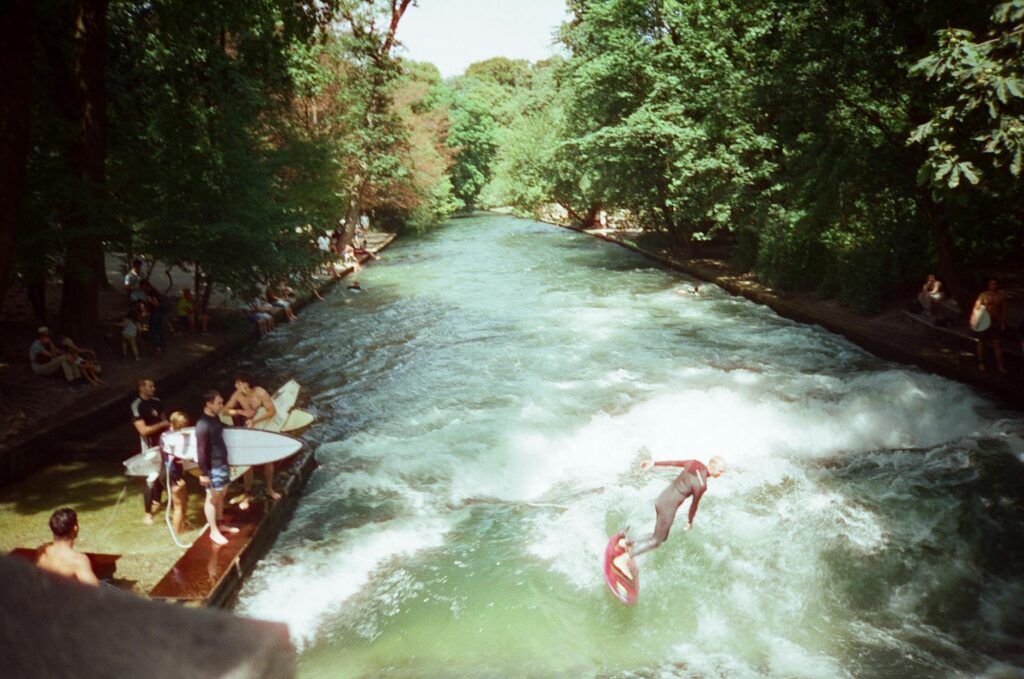
At the southern tip of the English Garden, where the Eisbach channel runs under the Prinzregentenstraße bridge, the water hits a submerged obstruction and throws up a standing wave about a metre high. Surfers queue on the bank, drop in one at a time, ride until they fall, and climb out downstream to rejoin the line.
They do this all year, including in January, in wetsuits, with snow on the bank. It is free, it runs continuously, and it is the single most surprising thing in Munich. Fifteen minutes on the bridge parapet is one of the best-spent quarter hours of the day.
Do not consider having a go. The wave is fast, shallow over concrete and genuinely advanced, and the queue is policed by locals with limited patience.
16:00 — A beer garden
Twenty minutes north through the park brings you to the Chinesischer Turm, a wooden pagoda with several thousand seats around it under chestnut trees. This is the classic English Garden beer garden and it is where the day should end up if the weather allows.
Two conventions to know. Beer gardens have a self-service section and a waited section, usually distinguished by whether the tables have cloths — the self-service side is cheaper and faster. And in a genuine beer garden you may bring your own food, though not your own drink, which is why you will see Munich families arriving with cool boxes and laying out a full spread.
If it is raining, the alternative is a beer hall in the centre — the Hofbräuhaus is the famous one, and it is enormous, loud and almost entirely visitors. Locals go elsewhere. Our best beer gardens and beer halls guides cover where.
18:30 — dinner and the evening
Walk back south out of the park and eat in the Altstadt or just outside it. The rule for dinner in Munich is simple and it holds almost everywhere: the restaurants with a view of Marienplatz are the worst value in the city. Walk five minutes in any direction and both the price and the cooking improve immediately.
What to order if you want the local thing rather than the international thing:
- Schweinshaxe — roast pork knuckle, crackling, dark beer gravy, potato dumpling. Enormous, and the definitive Munich plate.
- Schweinsbraten — the roast pork version, less theatrical and frequently better.
- Weißwurst — the white veal sausage, with sweet mustard and a pretzel. Traditionally eaten before noon and never after, a rule locals still half-observe. You peel the skin off; you do not eat it.
- Obatzda — the paprika cheese spread, with a pretzel, if you want something light after a heavy afternoon.
- Käsespätzle — the vegetarian default, and a good one.
Afterwards, on a single day, do not go looking for nightlife — you will not find the good version of it in the hours you have, and the centre’s late bars are not where Munich actually drinks. Walk the Altstadt instead. The Frauenkirche, the Residenz façade and the Neues Rathaus are all lit at night, the square is quiet by ten, and it is a much better city after dark than it looks in a guidebook photograph. If you do want a drink, the Glockenbachviertel and the streets around Gärtnerplatz are fifteen minutes south and are where the bars worth finding are. See our Munich nightlife guide.
If Munich is a stopover
A great many one-day Munich visits are layovers or a gap between trains, and the logistics are worth setting out because they are unusually favourable here.
- From the Hauptbahnhof, Marienplatz is two S-Bahn stops or a fifteen-minute walk down Kaufingerstraße. You can start this itinerary within twenty minutes of arriving.
- From the airport, the S1 and S8 take 40 to 45 minutes into the centre. The airport is in Zone 5, so you need a Zone M–5 single or the Airport–City–Day–Ticket, not a plain Zone M day ticket.
- Left luggage at the Hauptbahnhof is the thing that makes this work. Drop the bags on arrival and collect them on the way back — do not spend your one day pulling a suitcase across cobbles.
- Six hours is the workable minimum for a stopover. That gets you the tower, the market, the Glockenspiel and the walk through the English Garden, with the Residenz cut.
- Allow an hour to get back to the airport at the end, plus the usual check-in margin. The S-Bahn is reliable but it is not fast.
Our Munich airport to city guide covers the transfer options in full, including the express bus.
What to skip on one day
Being useful here means being blunt about what does not fit.
- Nymphenburg Palace. Twenty minutes each way on tram 17 plus a couple of hours inside. It is excellent and it is a half-day. Not on one day.
- The Deutsches Museum. Around 25,000 m² of exhibition space and a three-hour realistic minimum. It would consume your afternoon entirely.
- BMW Welt and the museum. Out at Olympiazentrum, and a specialist interest.
- Dachau. Absolutely not on a one-day trip. It needs half a day minimum and the right frame of mind, and squeezing it between a beer garden and a Glockenspiel does the place a disservice.
- A day trip anywhere. If you have one day in Munich, spend it in Munich. The Alps and the castles will still be there.
- The Hofbräuhaus, unless you want to say you went. It is a functioning tourist attraction rather than a beer hall, and there are better ones five minutes away.
Two variations on the day
The itinerary above is the general-purpose version. Two groups should adjust it.
With children
Cut the Residenz — ninety minutes of state rooms is a hard sell — and put the Deutsches Museum in the afternoon instead, accepting that it will take three hours and end the day there. It is one of the great science museums and it is built for children in a way the palaces are not. Keep the Alter Peter climb, which children generally enjoy far more than adults do, and keep the Eisbach. The English Garden has space to run, which by mid-afternoon is worth more than any interior. See our Munich with kids guide.
If it rains all day
Munich has around 130 wet days a year, so this is a live possibility. Keep the morning as written — the market is covered enough and the Frauenkirche is indoors — then extend the Residenz to the full circuit rather than the short one, and finish in a beer hall rather than a beer garden. The Alter Peter climb is still worth it in rain; the view is worse and the queue is much shorter. Skip the Eisbach only if it is genuinely torrential, because the surfers will be there regardless and watching them in the rain is arguably better.
Practicalities
- You barely need transport. This entire itinerary is walkable. If you do want a ticket, the Zone M day ticket is €10.10, and for two or more people the group day ticket is much better value than two singles.
- The airport is in Zone 5 and a Zone M ticket does not reach it. The S1 and S8 take 40–45 minutes.
- Carry cash. Many beer gardens, market stalls and smaller restaurants are cash-only or card-reluctant.
- Left luggage at the Hauptbahnhof makes a one-day stopover far easier — drop the bags in the morning, collect them on the way out.
- Total admission for this day is about €15 — the tower and the Residenz. Munich is cheap to see and expensive to sleep in.
For the wider network and the zone system, see getting around Munich; for the cheap version of everything, free things to do in Munich.
Frequently Asked Questions
Is 1 day in Munich enough?
Enough to see the Altstadt properly and get a real sense of the city, yes. Not enough for the museums, the palaces or a day trip. Munich rewards three days; one day gives you the historic centre, the English Garden and a beer garden, which is a genuinely good day and about a third of what the city has.
What is the best thing to do with one day in Munich?
Climb the Alter Peter first thing for about €5 — 306 steps, no lift, and the best view in the city. After that, the Residenz for the Antiquarium, the Viktualienmarkt for lunch, and the walk from the Hofgarten through the English Garden to the Eisbach wave.
Can I visit Neuschwanstein on a day trip from Munich if I only have one day?
You can, and you should not. Neuschwanstein is a ten to twelve hour day door to door and you would see nothing of Munich at all. If the castle is the priority, give it its own day and accept that you are not visiting Munich on this trip.
Is the Glockenspiel worth seeing?
Once, briefly, from the edge of the square. It runs at 11:00 and 12:00 daily plus 17:00 from March to October, and takes about a quarter of an hour. It is a mechanical curiosity rather than a spectacle, and standing in the crush for the full performance is not a good use of a short day.
Do I need public transport tickets for one day in Munich?
Probably not — the whole central itinerary is walkable. If you do need one, a Zone M day ticket is €10.10, and two or more people should buy the group day ticket instead of separate singles. Remember the airport sits in Zone 5 and needs a different ticket.
What happens if my one day is a Monday?
The major art museums close — the Alte Pinakothek, the Lenbachhaus, the Glyptothek and Museum Brandhorst. The Residenz, Nymphenburg and the Deutsches Museum stay open, so a Monday should be an Altstadt-and-palaces day, which is exactly what this itinerary already is. No changes needed.
Where should I eat with only one day?
Breakfast standing up at the Viktualienmarkt — a Leberkässemmel is about €4. Afternoon at a beer garden, where you may bring your own food but not your own drink. For dinner, avoid the restaurants directly on Marienplatz and walk five minutes in any direction; the price drops and the quality rises immediately.
If you find you have longer
A second day adds Nymphenburg and a museum; a third adds a day trip. Our Munich itineraries guide sets out how many days the city actually needs and what each one should hold. For the individual sights, things to do in Munich covers the full list, and if the mountains are calling, start with the Bavarian Alps from Munich.
Related Guides
- Munich Itineraries: How Many Days Do You Need? — the cluster hub
- 2 Days in Munich: The Ideal Weekend Itinerary — Biggest single itinerary term
- 3 Days in Munich: Complete Day-by-Day Itinerary — Second-biggest; the third day is a day trip, so it links hard into that pillar
- 4 and 5 Days in Munich: Extended Itinerary with Day Trips — Long tail with almost no dedicated pages competing
- One Week in Munich and Bavaria: 7-Day Itinerary — Captures the Bavaria trip planner; feeds the onward-travel pillar