Fasching and Easter in Munich
Munich's carnival is small, but the Tanz der Marktweiber is unmissable. The 2027 dates, what to eat, and the 70-hour Easter dance ban nobody warns you about.
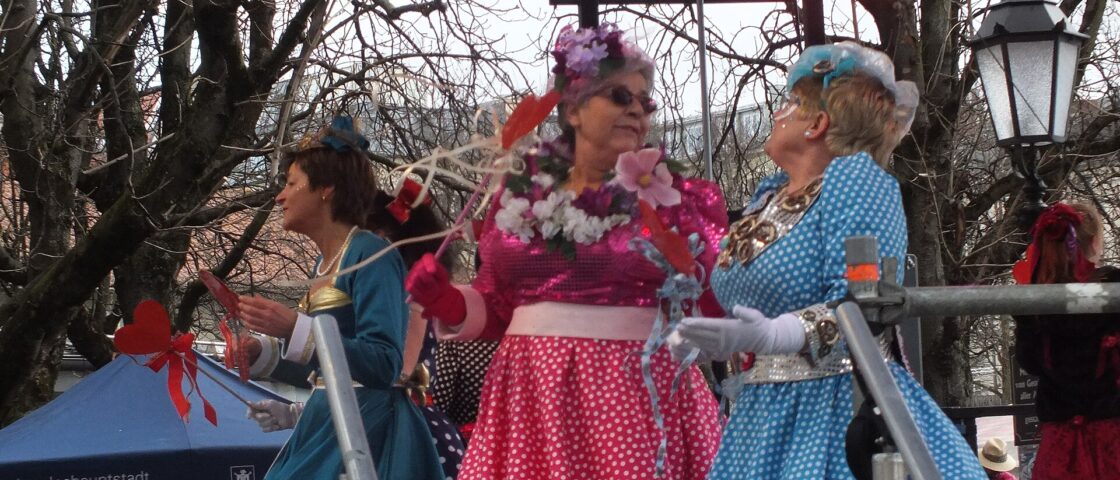
Munich’s carnival is small, and anyone who tells you otherwise is selling something. If you want German Fasching at full volume, go to Cologne or Mainz. What Munich has instead is one genuinely extraordinary hour — the Tanz der Marktweiber on the Viktualienmarkt, 11:00 on Shrove Tuesday — and a spring calendar that is more interesting than the carnival itself.
Easter, meanwhile, comes with a trap that catches visitors every single year: Bavaria shuts its dance floors for roughly seventy consecutive hours from the small hours of Maundy Thursday to midnight on Holy Saturday. Not reduced hours. Closed. It is written into state law and it is enforced.
Here are the 2027 dates, what actually happens on each of them, what to eat, and what the eight weeks between Fasching and the Frühlingsfest look like if you are planning a spring trip.
Fasching Munich and Easter 2027 at a glance
| Date | Event | Where | Worth it? |
|---|---|---|---|
| 11 Nov, 11:11 | Fasching season formally opens | Citywide, largely symbolic | A footnote |
| 5 Jan 2027 | Narrhalla Inthronisation — the Fasching royal couple crowned | Marienplatz | Charming, short |
| Sun 31 Jan 2027, 13:13 | Damische Ritter Faschingszug (the parade) | Isartor → Rosental → Kaufingerstraße | Yes, if you’re here |
| 7–9 Feb 2027 | “München narrisch” open-air stages | Marienplatz and Stachus | Patchy |
| Tue 9 Feb 2027, 11:00 | Tanz der Marktweiber | Viktualienmarkt | The one to see |
| Wed 10 Feb 2027 | Aschermittwoch — it all stops at once | — | A quiet day |
| 26 Feb – 21 Mar 2027 | Starkbierzeit, the “fifth season” | Nockherberg and the beer halls | Better than Fasching |
| 25–27 Mar 2027 | Gründonnerstag, Karfreitag, Karsamstag — dancing banned | Citywide | Plan around it |
| Sun 28 Mar 2027 | Ostersonntag | — | Everything shut |
| 16 Apr – 2 May 2027 | Frühlingsfest, the “little Oktoberfest” | Theresienwiese | Yes |
| 24 Apr – 2 May 2027 | Maidult | Mariahilfplatz, Au | Yes, if you like markets |
Why Munich’s Fasching is quieter than the Rhineland’s
The short answer is that Bavaria already has Oktoberfest.
Carnival in the Rhineland — Cologne, Düsseldorf, Mainz — is the one great annual release in cities that do not otherwise have a sixteen-day beer festival, and it grew accordingly: a week of street parties, million-strong parades, a whole industry of clubs and songs and satirical sessions. Munich never needed that, because its calendar was already full. What survived here is a more courtly and more domestic version, run by traditional societies with names like the Narrhalla and the Damische Ritter, and centred on balls rather than streets.
The result is a Fasching that is fun to be caught up in and not worth planning a trip around. If you are in Munich in early February you will have a good time. If you are choosing when to come and carnival is the reason, go north.
The season formally opens on 11 November at 11:11 — the eleventh minute of the eleventh hour of the eleventh day of the eleventh month, a joke about the futility of counting that has been running for two centuries. In Munich almost nothing happens on that date. The real programme starts in January.
The Tanz der Marktweiber — the one unmissable hour
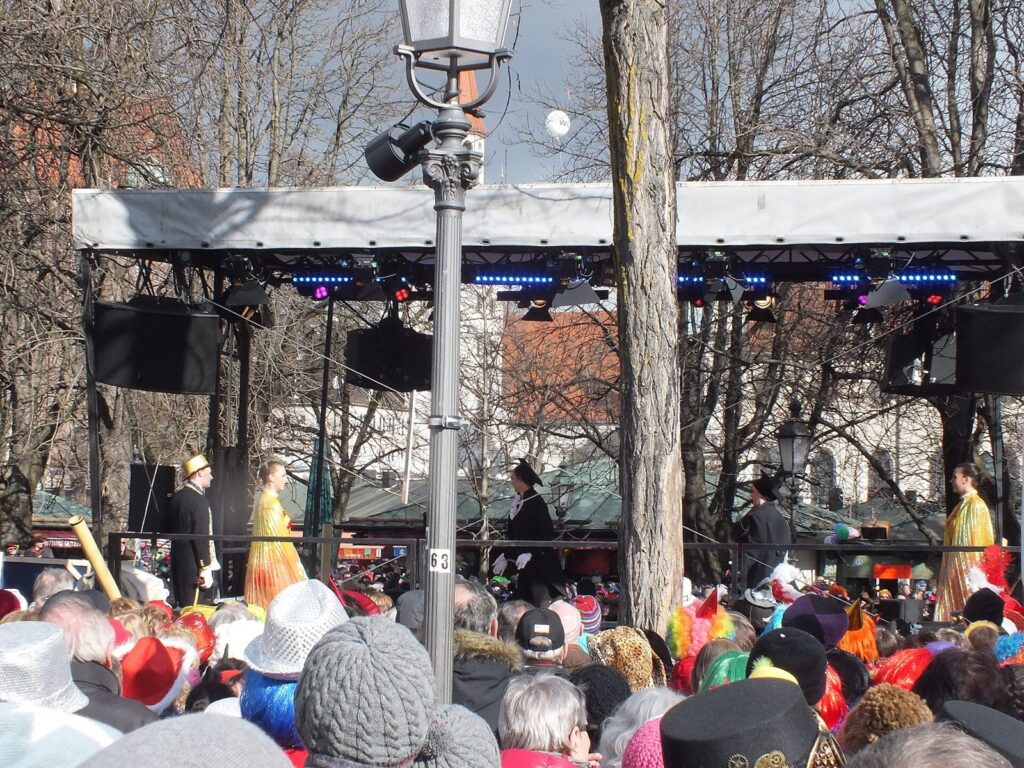
Faschingsdienstag, 9 February 2027, 11:00, Viktualienmarkt.
The market women of the Viktualienmarkt — the actual stallholders, many of whom have worked the same pitch for decades — put on elaborate costumes and perform a choreographed dance on a stage in the middle of their own market. It has run for more than thirty years. Thousands of people turn up. It is broadcast locally. And it is genuinely, unironically delightful in a way that very little organised municipal fun manages to be, because the performers are not entertainers: they are the women who sold you cheese yesterday.
Practicalities, because it fills:
- Arrive by 10:15 at the latest for anywhere near the stage. By 10:45 you are watching over shoulders.
- The maypole end and the beer garden give the best sightlines. The narrow aisles between stalls do not.
- Come in costume or do not — both are entirely normal, and Munich’s Fasching costume tradition is far looser than Cologne’s.
- Stay afterwards. The market keeps going, the beer garden is open, and the hour after the dance is the best atmosphere the Viktualienmarkt has all year. Our Viktualienmarkt guide covers what to eat there.
Insider tip: the same morning, the “München narrisch” stages on Marienplatz and Stachus are running their programme. Do the Marktweiber at eleven and then walk two minutes to Marienplatz — it is the only day of the year the two squares work as a single event.
The rest of the Fasching programme
The parade — Sunday 31 January 2027, 13:13
The Damische Ritter — the “daft knights” — run Munich’s Faschingszug jointly with the Narrhalla, setting off at 13:13 (the numbers matter to them) from the Isartor, through the Rosental and into Kaufingerstraße. Floats, bands, costumes, sweets thrown into the crowd.
Honestly assessed, it is a good local parade rather than a spectacle. It takes under an hour to pass. Kaufingerstraße gives you the most room; the Isartor start is the most atmospheric and the least crowded, because most people wait further along.
The Inthronisation — 5 January 2027, Marienplatz
The Narrhalla crowns its Fasching prince and princess on Marienplatz in the first week of January. It is short, formal, and mostly of interest to Münchners, but it is free, it is on the main square, and if you are in the city over the New Year period it is a glimpse of a tradition tourists almost never see. Related, and rather grander, is New Year’s Eve in Munich a few days earlier.
The balls
This is where Munich’s Fasching actually lives. Through January and early February the city runs a dense programme of Faschingsbälle — the traditional societies’ own balls, the famous Ball der Filmschaffenden, professional and student balls, and a long tail of neighbourhood events. Most are ticketed and many need booking weeks ahead. Almost none are aimed at visitors, which is precisely why they are worth the effort if you can get into one.
What to eat
Fasching food in Bavaria is deep-fried and unapologetic, and it appears in every bakery from January.
- Krapfen — the Bavarian doughnut, filled with apricot jam and dusted with sugar. Not a Berliner; do not call it one here. Bakeries produce them in industrial quantities through the season and the good ones sell out by mid-morning.
- Auszogne (also Kiachl) — a hand-stretched fried dough disc, thin and crisp in the middle with a thick puffed rim, eaten with sugar or with sauerkraut. This is the older, more rural sweet and it is much harder to find.
- Schmalznudeln — the same family, and the Café Frischhut near the Viktualienmarkt has been frying them since the 1970s, opening early and closing when they run out.
- Prügeltorte and Faschingskrapfen with liqueur fillings appear at the fancier end.
Then on Ash Wednesday, the whole thing inverts. Aschermittwoch is a fish day — the traditional meal is herring, and restaurants across the city put a Heringsessen on the menu. It is the formal end of the eating as well as the dancing. More on the wider food calendar in our traditional Bavarian food guide.
Starkbierzeit: the season that beats Fasching
If you are choosing a late-winter fortnight in Munich, choose this one. Starkbierzeit 2027 runs from 26 February to 21 March.
It is Munich’s “fifth season”, and it exists because of Lent rather than in spite of it. The Paulaner friars, who came to Munich from Italy in 1627 at the invitation of Duke Maximilian I and established a monastery brewery in 1634, brewed a strong malty beer to sustain them through the fast — liquid bread. They called it Sankt-Vater-Bier, which became Salvator. The doppelbock style proper dates from a 1774 recipe by brewmaster Valentin Stephan Still, known as Brother Barnabas. Modern Salvator is 7.9% ABV, and it does not taste like it.
The Nockherberg festival has run since 1861 — eight days at Paulaner’s Salvatorkeller in the Au, with the Derblecken, a televised ritual in which a cabaret performer in the role of a Lenten preacher mocks Bavaria’s senior politicians to their faces while they sit there and take it. Every major brewery joins in with its own -ator: Maximator (Augustiner), Triumphator (Löwenbräu), Optimator (Spaten), Animator (Hacker-Pschorr), Delicator (Hofbräu).
It is a better festival than Munich’s carnival by some distance, it is barely on the international radar, and the full detail is in our Starkbierfest guide. Two Maß of doppelbock is not two Maß of Helles — pace yourself.
Easter, and the seventy-hour dance ban
This is the single most useful thing on this page, and almost no visitor guide mentions it.
Bavaria designates nine stille Feiertage — quiet days — in state law, under Article 3 of the Bayerisches Feiertagsgesetz: Aschermittwoch, Gründonnerstag, Karfreitag, Karsamstag, Allerheiligen, Volkstrauertag, Totensonntag, Buß- und Bettag and Heiliger Abend. On those days public entertainment events are restricted and, in practice, dancing is prohibited.
- The ban generally begins at 02:00 on the day in question and ends at midnight.
- On Karfreitag and Karsamstag it begins at 00:00 — the whole day, both days.
- On Christmas Eve it begins at 14:00.
Stack those together over Easter and you get the notorious block: the ban starts at 02:00 on Gründonnerstag and does not lift until midnight at the end of Karsamstag, which is roughly seventy continuous hours. Munich’s clubs close. Live music venues cancel or reschedule. Bars stay open but the dance floor does not operate. Enforcement in Munich sits with the KVR, the district administration office, and it is not theoretical — venues get fined.
In 2027 that means from 02:00 on Thursday 25 March until midnight on Saturday 27 March. If nightlife is part of your trip, do not book that weekend. Our Munich nightlife guide and best nightclubs cover what is open the rest of the year.
What is open at Easter
- Karfreitag (26 March 2027) and Ostermontag (29 March) are full public holidays. Shops shut. So does almost everything except restaurants, cafés and museums.
- Ostersonntag (28 March) is a Sunday, so the usual German Sunday rules apply: most shops are closed, with exceptions such as the Hauptbahnhof, the airport, bakeries and petrol stations. Viktualienmarkt stalls shut.
- Museums mostly stay open across the Easter weekend, and the €1 Sunday at the Bavarian state collections still applies on Easter Sunday — one of the better-value days in the Munich year. See free and cheap museums in Munich.
- Beer gardens open for the season around Easter if the weather cooperates, which is the real signal that Munich’s spring has started. Where to go.
- Church music is the genuine Easter offering here — the Frauenkirche, St. Peter and the Theatinerkirche all run substantial programmes through Holy Week, and they are free. Our guide to Munich’s churches covers the buildings.
Do your shopping on Maundy Thursday. Between Good Friday and Easter Monday there are effectively three closed days out of four, and the supermarkets on the Wednesday and Thursday before Easter are the busiest they get all year outside Christmas.
Where to be, and where not to bother
A short, opinionated ranking of everything above, for anyone with limited time in late winter.
| Worth building a day around | Worth an hour if you’re passing | Skip |
|---|---|---|
| Tanz der Marktweiber, Shrove Tuesday 11:00 | The Damische Ritter parade | The 11 November season opening — nothing happens |
| Starkbierzeit at the Nockherberg | Narrhalla Inthronisation on Marienplatz | Chasing a Munich club night over Easter weekend |
| Frühlingsfest, especially the two firework Fridays | Easter church music in the Altstadt churches | Expecting Cologne-scale street carnival |
| Maidult at Mariahilfplatz | Ash Wednesday Heringsessen | Booking the Easter weekend for nightlife |
There is one more thing worth knowing about this stretch of the year, and it is the weather. Munich in February and March is cold, grey and frequently wet, with sunset around 17:30 in mid-February and daylight improving fast through March. Beer gardens do not reliably open until Easter and can stay shut into late April in a bad year. That is not a reason to avoid the city — it is a reason to build the trip around indoor things and treat any warm afternoon as a bonus. Our Munich winter guide and weather and packing guide set out what to expect and what to bring.
Insider tip: hotel rates in the first half of February and the first half of March are among the lowest Munich sees all year — a fraction of what the same room costs during Oktoberfest, when rates roughly triple. If cost is the constraint and nightlife is not, this is the season to come. See hotel booking tips and what a Munich trip actually costs.
What comes next: the Frühlingsfest
16 April to 2 May 2027, on the Theresienwiese. The kleine Wiesn, running since 1965, always starting on a Friday in mid or late April and always after Easter.
Two tents, over a hundred showmen, a Ferris wheel, a flea market of about 80,000 m² on the first Saturday, a classic-car show on the first Sunday, and two firework displays on consecutive Fridays at 22:00. Beer in 2026 was €13.50 a Maß in the Festhalle Bayernland and €14.50 in the Hippodrom — about a euro under Oktoberfest’s €14.80 to €15.90, with a fraction of the crowd and no need to reserve a table months ahead.
For anyone who wants the Wiesn experience without the Wiesn scrum, this is the answer, and our Frühlingsfest guide has the full programme. Overlapping it at the end of April is the Maidult at Mariahilfplatz in the Au, 24 April to 2 May 2027 — one of three Auer Dult fairs a year, nine days each, and the place Munich goes for second-hand crockery and traditional goods. See vintage and flea markets in Munich.
Frequently Asked Questions
When is Fasching in Munich in 2027?
The season opens on 11 November at 11:11 and the main week runs from Faschingssonntag on 7 February 2027 to Faschingsdienstag on 9 February, ending on Ash Wednesday, 10 February. The parade is earlier, on Sunday 31 January at 13:13, and the Narrhalla crowns its royal couple on Marienplatz on 5 January.
What is the Tanz der Marktweiber?
The market women of the Viktualienmarkt performing a choreographed dance in elaborate costume on their own market, at 11:00 on Shrove Tuesday — 9 February in 2027. It has run for over three decades and draws thousands. It is the single best thing about Munich’s carnival, and the performers are the stallholders themselves rather than hired entertainers. Arrive by 10:15 for a view.
Is Munich a good place for carnival?
Not compared with Cologne, Düsseldorf or Mainz, where carnival is the city’s biggest annual event. Munich’s version is smaller, more ball-based and more traditional — enjoyable if you happen to be here, but not a reason to plan a trip. Munich’s equivalent release valve is Oktoberfest in September, and its best late-winter festival is Starkbierzeit rather than Fasching.
Are the clubs really closed at Easter in Munich?
Yes. Bavaria’s stille Feiertage law bans dancing from 02:00 on Maundy Thursday until midnight at the end of Holy Saturday — roughly seventy continuous hours. In 2027 that is 02:00 on Thursday 25 March to midnight on Saturday 27 March. Clubs close, live music is rescheduled, and the city’s KVR enforces it with fines. Bars remain open; the dance floors do not.
When is Easter 2027?
Easter Sunday falls on 28 March 2027. Maundy Thursday is 25 March, Good Friday 26 March, Holy Saturday 27 March and Easter Monday 29 March. Good Friday and Easter Monday are full public holidays in Bavaria with shops closed, and Easter Sunday is a Sunday, so effectively three of the four days have no shopping.
What do people eat during Fasching?
Krapfen — the Bavarian jam doughnut — by the ton, from every bakery from January onward. Also Auszogne, a hand-stretched fried dough disc with a puffed rim, and Schmalznudeln. Then on Ash Wednesday it inverts into a fish day, with Heringsessen — herring dishes — on menus across the city as the formal start of Lent.
Is Munich worth visiting in February or March?
Yes, and it is one of the cheapest periods of the year for hotels. Museums are quiet, Starkbierzeit runs from late February, the Alps are still in full winter, and Therme Erding and the historic baths make sense in a way they do not in July. What you will not get is beer-garden weather, which usually starts around Easter. See the best time to visit Munich for the full comparison.
Do I need a costume for Munich’s Fasching?
No. Munich’s costume tradition is much looser than the Rhineland’s — plenty of people at the Tanz der Marktweiber are in ordinary clothes, and nobody will comment either way. The exception is the balls, which have their own dress codes, usually formal rather than fancy dress. If you do want something, the traditional-costume shops covered in our dirndl and lederhosen guide stay open through the season.
Where to go next
The whole year is laid out in our Munich events calendar, and the two spring festivals that matter most have their own guides: Starkbierfest in late February and March, and the Frühlingsfest in April. For the wider tradition behind all of it, see Bavarian traditions, and if you are building a trip around a date, Munich festivals and events ranks them against each other.
Photo Credits
Tanz der Marktweiber: Wzwz Tanz der Marktweiber 2018 01 by Wzwz, CC0, via Wikimedia Commons.
Related Guides
- Munich Events Calendar: What’s On Month by Month — the cluster hub
- Munich Frühlingsfest: The Spring Oktoberfest — April demand spike, thin SERP, direct Oktoberfest-cluster synergy
- Starkbierfest: Munich’s Strong Beer Season — March gap in the calendar with beer-cluster crossover
- Munich Pride (CSD): Dates, Route and What to Expect — Pairs with the existing LGBTQ+ nightlife post; strong seasonal spike
- Tollwood Summer Festival Guide — We cover the winter edition only, so this is an obviously half-finished topic