Auer Dult: Munich’s Traditional Fairs and Markets
Munich's oldest market fair: crockery, antiques and a few old rides on the Mariahilfplatz, three times a year and free. The 2026 and 2027 dates, hours, food and how to get there.
The Auer Dult is Munich’s oldest market fair: nine days of crockery, antiques, junk, kitchen gadgets and a handful of old-fashioned rides on the Mariahilfplatz in the Au, held three times a year, and entry is free. The autumn edition, the Kirchweihdult, runs from Saturday 17 to Sunday 25 October 2026, daily from 10:00 to 19:00.
If you have only ever seen the Oktoberfest, recalibrate. There are no beer tents the size of aircraft hangars here, no reservations, no Maß queues and no one in a rented dirndl for the photographs. The Dult is where Munich people buy a new set of soup bowls, a stone-pine pillow for their grandmother and a 1950s tin toy they did not know they wanted, then eat a grilled mackerel on a stick under the chestnut trees. It is the city at its least performed, and it is one of the best free afternoons Munich has.
This guide covers the 2026 and 2027 dates, what is actually on sale, what to eat, how to get there without a car (you cannot park), and how the Dult compares with Munich’s bigger festivals. For the year as a whole, start with the Munich events calendar.
Auer Dult at a glance
| What it is | A traditional market fair: crockery, household goods, antiques and collectables, with a small funfair and beer gardens |
| Where | Mariahilfplatz, in the Au, around the Mariahilfkirche — on the east bank of the Isar |
| Kirchweihdult 2026 | Saturday 17 – Sunday 25 October |
| Hours | Stalls from 10:00, rides from 10:30. Kirchweihdult closes at 19:00; the May and July Dults run to 20:00 |
| Entry | Free |
| Size | About 250 stalls on roughly 22,000 m² |
| Getting there | Tram 18; bus 52 to Mariahilfplatz or bus 62 to Schweigerstraße; U1/U2 to Fraunhoferstraße or Kolumbusplatz and walk. No parking |
| Family day | Tuesday, with reduced prices on the rides |
| 2027 dates | Maidult 24 April – 2 May · Jakobidult 24 July – 1 August · Kirchweihdult 16 – 24 October |
| Time needed | Two hours to walk it properly; half a day if you browse the antiques and stay to eat |
Auer Dult dates for 2026 and 2027
There are three Dults a year, each lasting nine days and each running Saturday to the Sunday of the following week. They take their names from the church calendar rather than the weather, which tells you something about how old they are.
| Dult | 2026 | 2027 | Character |
|---|---|---|---|
| Maidult | 25 April – 3 May (finished) | 24 April – 2 May | The spring opener; overlaps the Frühlingsfest |
| Jakobidult | 25 July – 2 August (finished) | 24 July – 1 August | High summer, longest evenings, the original Dult’s name |
| Kirchweihdult | 17 – 25 October | 16 – 24 October | Autumn colour, shorter hours, the most local crowd |
The Kirchweihdult is tied to Kirchweih, the church-consecration festival that Bavaria keeps on the third Sunday of October. In the countryside that weekend still means a goose dinner and fried Auszogne; in Munich it means the autumn Dult. In 2026 that Sunday is 18 October, the second day of the fair.
Insider tip: the Maidult and the Frühlingsfest on the Theresienwiese overlap. The Frühlingsfest usually runs for about two weeks into early May, and the 2027 Maidult runs 24 April to 2 May, so a late-April visitor can do the junk market in the morning and the beer tents in the evening. Our Frühlingsfest guide covers the second half of that day.
Opening hours and the best time to go
Sales start at 10:00 every day and the rides at 10:30. The Maidult and Jakobidult close at 20:00; the Kirchweihdult closes an hour earlier, at 19:00, because by late October it is dark well before then and the square empties as the temperature drops.
When to go depends on what you want from it.
- Weekday mornings are for serious browsing. The antiques dealers have time to talk, the crockery tables have not yet been picked over, and you can walk the aisles without shuffling.
- Saturday and Sunday afternoons are for atmosphere. The square fills with families, prams, dogs and grandparents, the beer gardens are full and the Kettenflieger (chair swing) runs constantly. It is genuinely crowded from about 13:00 — MVG has added extra trams on line 18 on Dult weekends in recent years for this reason; check mvg.de.
- Tuesday is family day, with cheaper rides.
- The last hour is when the light goes gold behind the church spire in October, and when the food stalls are at their busiest. It is not a reliable time for bargains; plenty of stallholders have been doing this for decades and pack up rather than discount.
The opening Saturday of the Kirchweihdult is lively but not overwhelming; weekend afternoons are the busiest. If you can choose only one slot, take a weekday between 10:00 and 13:00, then stay for lunch.
What you can actually buy
Around 250 stalls, and they sort themselves roughly into three trades. Knowing which you came for saves an hour.
The crockery market
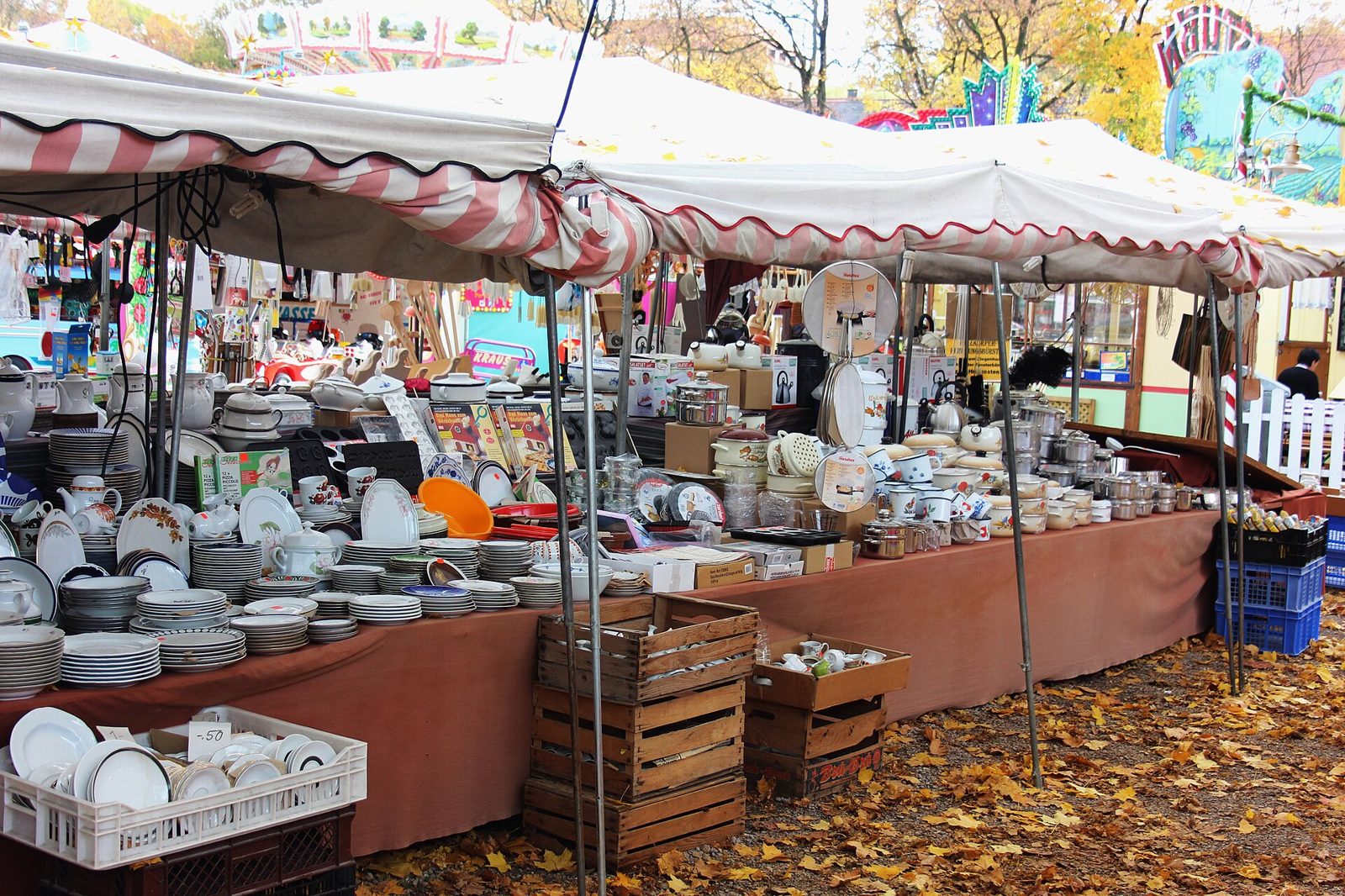
This is the heart of the Dult and the thing it has been known for longer than anyone can remember: long trestle tables stacked with plates, bowls, jugs, stoneware, porcelain and ceramics, much of it sold by the piece. Munich households have replaced broken dinner services here for generations, and it remains the best place in the city to buy a single matching saucer rather than a boxed set of twelve. Expect plain white restaurant-grade porcelain, blue-and-white stoneware, enamel, baking dishes and the hand-painted rustic patterns that look right in a Bavarian kitchen and slightly mad anywhere else.
Antiques, vintage and collectables
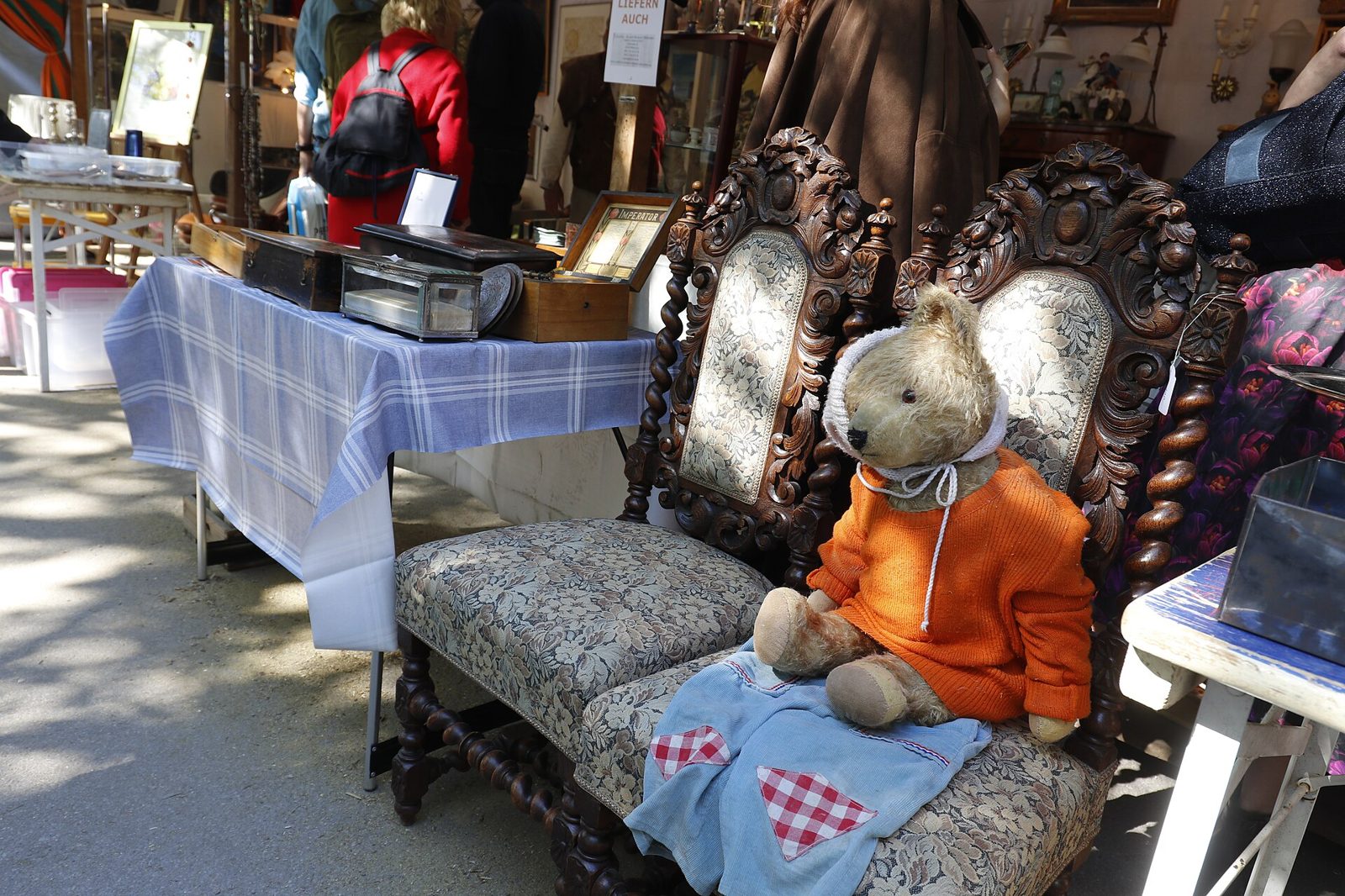
The second trade is old things: antiques, curiosities, Asian art, vintage clothing, painted farmhouse furniture, old jewellery and historic toys — tin cars, wind-up robots, dolls with unsettling eyes. Pewter-lidded stoneware beer mugs turn up on almost every second table. This is the part of the Dult that visitors photograph most and buy from least, partly because a carved oak chair does not fit in hand luggage.
Be realistic about prices. These are professional dealers, not house-clearance amateurs, and they know what a Jugendstil vase is worth. You will not find a Meissen figurine for €5. You will find fair prices for small, characterful pieces — an old beer stein, a postcard album, a framed print of the Frauenkirche from before the war — and on a bigger purchase it does no harm to ask politely whether there is room on the price.
Household goods, gadgets and Bavarian odds and ends
The third trade is the one that keeps the Dult from turning into a museum: basketware, toys, curtains, felt slippers, spices, jams, accessories for Tracht (traditional dress), cosmetics, cleaning products and Zirbenkissen, small cushions stuffed with stone-pine shavings that Bavarians swear help them sleep. There is a whole lane, the Neuheiten-Gasse, devoted to kitchen and household novelties, many of them sold by live demonstration — juicers, peelers, miracle cloths. It is half shop, half street theatre, and it is the most Munich thing on the square precisely because nobody is doing it for tourists.
If you want a souvenir that is not a plastic Maßkrug from a Marienplatz shop, this is where to find it. A hand-thrown stoneware bowl, a blue-and-white enamel jug or a stone-pine cushion costs less here than in the city-centre shops and has the advantage of being something a Munich person might actually own. For other ideas see what to bring home from Munich.
The rides: small, old and fine for an hour
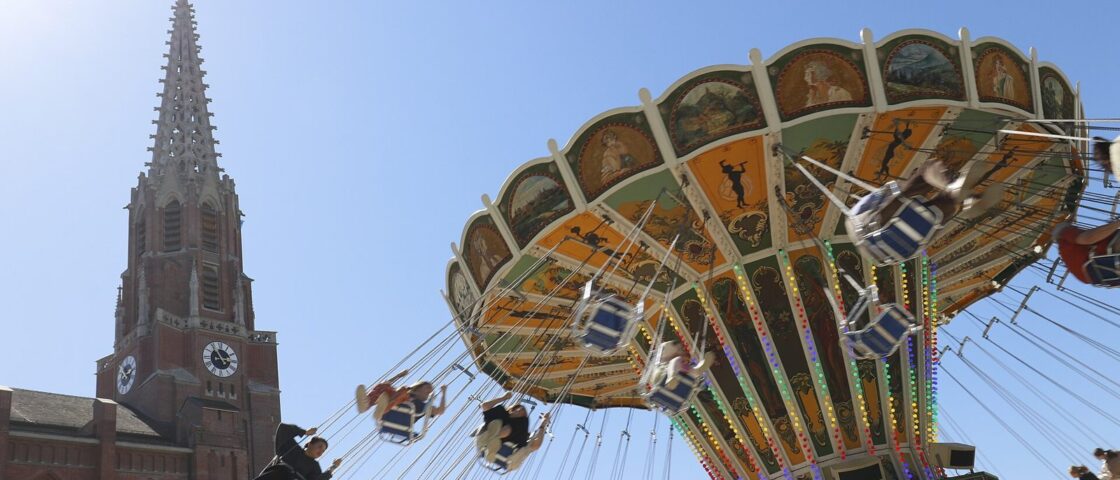
The funfair side of the Dult is modest, and that is the point. Expect bumper cars, a Kettenflieger chair swing (the one in the photograph at the top of this page, wheeling in front of the church spire), a small Russenrad — a traditional wooden-style wheel — and throwing stalls where children knock over tins for a soft toy. There has been a Ferris wheel on the square in recent years too.
This is not the Oktoberfest. There are no 80-metre drop towers or loops, nothing you queue for, and nothing that will impress a teenager who has been to a theme park. For children under about ten it is close to ideal: compact, unhurried, cheap by festival standards, and especially good on Tuesday, family day, when the showmen cut their prices. A barrier-free toilet on the north side of the square, changing areas and buggy parking are provided. The broader picture for families is in Munich with kids.
What to eat and drink at the Dult
Food at the Dult is fair food, and the best of it is excellent. The Dult beer gardens serve Munich beer alongside the classics:
- Steckerlfisch — a whole mackerel or char grilled on a stick over charcoal. Eat it with your hands, mind the bones, and order it with a pretzel.
- Brathendl — half a roast chicken, the standard Bavarian fair meal.
- Bratwürstl and Fischsemmel — sausages and fish rolls for eating on the move.
- Cheese specialities, from raclette-style stands to Obatzda.
- Auszogne — the Kirchweih doughnut, a ring of yeast dough stretched thin in the middle over the knee (the traditional way) and fried. The October Dult is the right moment for one.
- Dampfnudeln — steamed yeast dumplings, usually with vanilla sauce.
- Bavesen (also written Pofesen) — bread slices filled with jam, dipped in egg and fried; a rustic cousin of French toast.
- Crêpes, sweet stalls, and a Dult café for coffee and cake.
Prices vary by stall and change each season, so read the boards. A sit-down lunch of chicken or fish with a beer will cost noticeably less than the same meal at the Oktoberfest, where both are priced for the crowd. If the Bavarian dishes are new to you, our guide to traditional Bavarian food explains what you are looking at.
Insider tip: bring cash. Card payment isn’t possible at every stall, and the organisers point you to the two ATMs, one at the Mariahilfkirche and one in the rides area. There are also two free drinking-water fountains on the square, one on Rupert-Stöckl-Platz opposite the church and one at the Dult office on Liesl-Karlstadt-Platz.
How to get to the Auer Dult
Do not drive. The organisers are blunt about it: there is no parking at all around the Dult. The only spaces are reserved disabled bays on the north side of the square during the fair. Everything else is public transport, a bike or your feet.
| Route | Stop | Notes |
|---|---|---|
| Tram 18 | Near the square | The stop is at the square. MVG has run extra trams between Sendlinger Tor and St.-Martins-Platz on Dult weekends in recent years; check mvg.de |
| Bus 52 | Mariahilfplatz | The stop the organisers name for the square |
| Bus 62 | Schweigerstraße | A short walk to the square |
| U1 / U2 | Fraunhoferstraße or Kolumbusplatz | Then a short walk; Fraunhoferstraße means crossing the Isar on foot, which is the nicer approach |
| Bike | — | Free bike parking in the north and south parts of the Mariahilfplatz |
From Marienplatz the walk is the best way in: down past the Viktualienmarkt, across the Isar and into the Au, all on the flat. It shows you how close this supposedly out-of-the-way neighbourhood is to the old town. A Zone M day ticket at €10.10 (€10.80 from January 2027) covers every route above if you are doing more than two journeys that day.
Roadworks around the Mariahilfplatz can change tram and bus routing, so check the MVG app before you set out and allow a few extra minutes.
A short history: from 1310 to the Mariahilfplatz
A Dult was originally a church festival: a feast in honour of a saint, held around a church, with market stalls set up for the pilgrims. Over the centuries the word slid to mean the fair rather than the feast, and the Munich Dult is a long-lived example.
- 1310 — the first recorded Munich Dult, the Jakobidult, is held on the Anger, today’s St.-Jakobs-Platz, in the old town. The Jewish Museum and the Münchner Stadtmuseum now stand on that square.
- 1791 — the Dult begins moving between sites around the city.
- 1796 — Elector Karl Theodor grants the village of Au, then outside Munich, the right to hold a Dult twice a year.
- 1799 — the May and October Dults settle around the Mariahilf pilgrimage church. The name “Auer Dult” dates from here.
- 1854 — the Au is incorporated into Munich, bringing the Dult into the city with it, along with a market for used household goods and old clothes.
- 1905 — the Jakobidult moves from Haidhausen’s Johannisplatz to the Mariahilfplatz, and all three Dults have been held there ever since.
- 1943–1946 — the Dult is cancelled because of the war.
- 2020 — the Maidult and Jakobidult are cancelled in the pandemic, the first break since the war.
The church at the centre of it all, the Mariahilfkirche, is the red-brick neo-Gothic building whose spire you see from across the river. It was built in the 1830s. During the Dult the parish holds short organ recitals, “Orgel um Drei”, at 15:00 on Wednesdays, Saturdays and Sundays, around 20 minutes long, and an organ concert on the evening of Saturday 24 October at 19:15. Twenty minutes of organ music in a cool church is a good antidote to the crowd outside.
The Au: what else is nearby
The Au sits low on the east bank of the Isar, under the escarpment that rises to Giesing and Haidhausen. For centuries it was a district of craftsmen, day labourers and flood-prone streets outside the city walls — which is why a market for second-hand goods ended up here and not on Marienplatz. Today it is a quiet residential neighbourhood, and the Dult is the main reason most visitors set foot in it. Our guide to the Au and Isarvorstadt has the wider picture.
A Dult visit pairs naturally with three things within walking distance:
- The Deutsches Museum, on its island in the Isar, about a 15-minute walk north-west. Do the Dult in the morning and the museum after lunch; it is open daily 09:00–17:00 (closed on a few holidays) and costs €16 for adults. See our Deutsches Museum guide.
- The Nockherberg, up the hill to the south-east, home of the Paulaner beer hall and of the strong-beer season every spring. Our Starkbierfest guide explains why Munich drinks doppelbock in Lent.
- Haidhausen, up the slope to the east, with its French Quarter streets and some of the best neighbourhood restaurants in the city. See the Haidhausen guide.
Walking back along the Isar towards the Deutsches Museum at dusk, with the Dult lights behind you, is one of the nicest short walks in Munich in October.
Auer Dult vs Oktoberfest, Frühlingsfest and the flea markets
| Auer Dult | Oktoberfest | Frühlingsfest | |
|---|---|---|---|
| Main point | Market: crockery, antiques, household goods | Beer tents and big rides | Beer tents and rides, smaller scale |
| When | Three times a year, 9 days each | Mid-September to early October, 16 days or more | Mid-April to early May |
| Where | Mariahilfplatz, the Au | Theresienwiese | Theresienwiese |
| Entry | Free | Free | Free |
| Crowd | Mostly local, all ages | Global, young, loud | Mostly local, younger |
| Reservations | None needed | Essential for tent tables at weekends | Useful at weekends |
| Time needed | 2–4 hours | A day, or several | An afternoon and evening |
The honest summary: if you want a party, the Dult will disappoint you. If you want to see how Munich people spend a Saturday when they are not putting on a show for visitors, it is better than either festival. It is also a far better junk-shopping experience than most of the city’s weekend flea markets, simply because of its scale and the number of professional dealers — though the flea markets are cheaper. Our round-up of Munich vintage shops and flea markets covers the alternatives, and the Oktoberfest guide covers the other end of the spectrum.
Practical tips for a good Dult visit
- Bring a sturdy bag and some newspaper if you plan to buy crockery. Stallholders wrap, but not always for a flight home.
- Check your airline’s hand-luggage rules before you buy a stoneware Maßkrug. A full-size one is heavier than it looks.
- Dress for October. The Kirchweihdult can be T-shirt weather at noon and cold by 18:00; the square is open to the sky. Our Munich weather and packing guide has the month-by-month detail.
- Go round twice. The square is laid out in loose lanes and it is easy to miss a whole row; the antiques cluster in some lanes and the crockery in others.
- Take a look inside the Mariahilfkirche, especially if the organ is playing.
- Book the guided tour if you want context. Munich’s tourist office runs an “Erlebnistour Auer Dult” of about two hours with tastings and a ride on the historic Ferris wheel. Check dates and price on muenchen.travel; the route is only partly accessible.
Combined with a free church, a free market and a walk along the river, a Dult visit is also a strong entry in any list of free things to do in Munich — your only spending is lunch and whatever ends up in your bag.
After the Kirchweihdult: what comes next
The Kirchweihdult closes the city’s folk-fair year. After 25 October, Munich’s outdoor calendar goes quiet for a month before the Christmas season. The Marienplatz Christkindlmarkt opens on 20 November 2026, earlier than usual, and runs to 24 December; check each market’s own site for its opening date. Our guide to the Munich Christmas markets ranks them, and the Tollwood winter festival on the Theresienwiese is the alternative for anyone who likes their mulled wine with a side of theatre. The next Dult is the Maidult, from 24 April 2027.
Frequently Asked Questions
When is the Auer Dult in 2026?
The last Dult of 2026 is the Kirchweihdult, from Saturday 17 to Sunday 25 October. The Maidult (25 April – 3 May) and Jakobidult (25 July – 2 August) have already taken place this year.
When are the Auer Dult dates for 2027?
Maidult 24 April – 2 May, Jakobidult 24 July – 1 August and Kirchweihdult 16 – 24 October 2027, according to the organisers. Each starts on a Saturday and ends on the Sunday of the following week.
Is the Auer Dult free?
Yes. There is no admission charge. You pay only for what you buy, eat and ride.
What are the Auer Dult opening hours?
Stalls open at 10:00 and rides at 10:30 every day. The Kirchweihdult in October closes at 19:00; the Maidult and Jakobidult close at 20:00.
How do I get to the Auer Dult?
By tram 18, by bus 52 to Mariahilfplatz or bus 62 to Schweigerstraße, or by U1/U2 to Fraunhoferstraße or Kolumbusplatz followed by a short walk. There is no parking near the square, so do not drive.
Is the Auer Dult like the Oktoberfest?
Not really. The Dult is first a market, selling crockery, antiques and household goods, with a small funfair and beer gardens on the side. There are no big beer tents and no large thrill rides. It is calmer, more local and better for young children.
Can you pay by card at the Auer Dult?
Some stalls take cards and many smaller ones prefer cash. Bring enough to cover lunch and small purchases; card payment isn’t possible at every stall.
Which Dult is the best one to visit?
For a first visit, the one you are in town for — they share the same stallholders and layout. The Jakobidult has the long summer evenings; the Kirchweihdult has autumn colour, chestnut trees and the most local feel; the Maidult can be combined with the Frühlingsfest.
More Munich festivals and seasons
The Dult is one of a string of fairs and festivals that shape the Munich year. The Munich events calendar lays them all out month by month; from there, the Frühlingsfest and the strong-beer season are the spring highlights and the Christmas markets the winter one. If you are browsing for things to take home, the Viktualienmarkt is a short walk back across the river.
Dates, hours and transport checked in October 2026 against auerdult.de, the City of Munich’s official Dult site.
Photo Credits
Chair swing and Mariahilfkirche: Auer Dult 2026-04 3328 by H-stt, CC BY-SA 4.0, via Wikimedia Commons. Crockery stall: 002 Auerduld Kirchweihdult 2013 by Usien, CC BY-SA 3.0, via Wikimedia Commons. Antiques stall: Auer Dult 2026-04 3351 by H-stt, CC BY-SA 4.0, via Wikimedia Commons.
Related Guides
- Munich Events Calendar: What’s On Month by Month — the cluster hub
- Munich Frühlingsfest: The Spring Oktoberfest — April demand spike, thin SERP, direct Oktoberfest-cluster synergy
- Starkbierfest: Munich’s Strong Beer Season — March gap in the calendar with beer-cluster crossover
- Fasching and Easter in Munich — February to April gap with a distinctive Bavarian tradition angle
- Munich Pride (CSD): Dates, Route and What to Expect — Pairs with the existing LGBTQ+ nightlife post; strong seasonal spike