Tegernsee and Schliersee: Bavaria’s Lake Country
Tegernsee from Munich by hourly BRB train, the Bräustüberl, boats and the Wallberg, and why the quieter Schliersee next door is worth a day of its own.
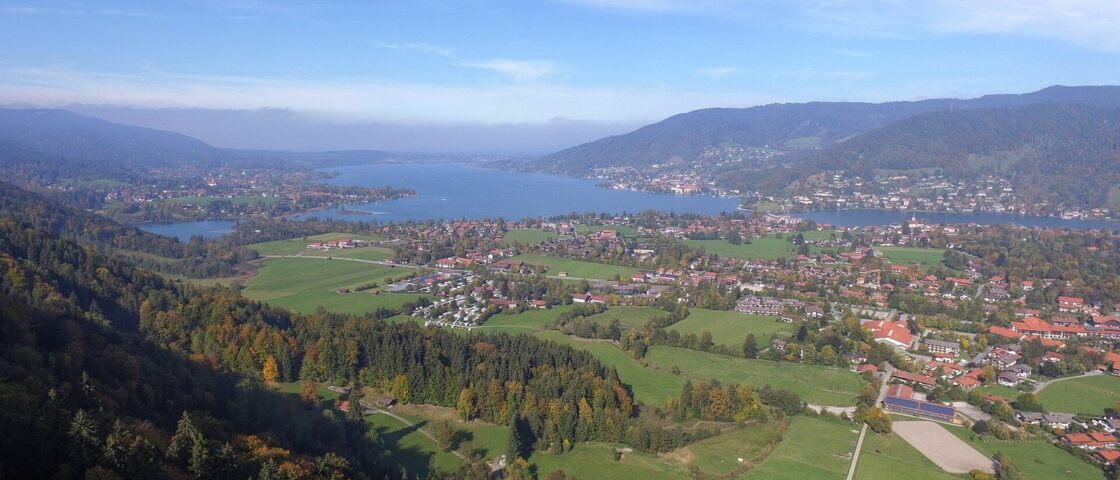
Getting to the Tegernsee from Munich is one of the easiest day trips in Bavaria: an hourly BRB regional train from München Hauptbahnhof runs straight to the lakeside town of Tegernsee in a little over an hour, and a Bayern-Ticket at €34 for one person (€44 for two) covers it there and back. The Schliersee, the smaller lake one valley east, is on the same network and just as easy to reach.
That is the logistics. The real question is which lake, and the answer depends on what you want from the day. The Tegernsee is the polished one — a ducal brewery in a former monastery, lake boats, a cable car to 1,620 metres, villas, Porsches and prices to match. The Schliersee is smaller, cheaper, more lived-in and, on a summer Sunday, a great deal calmer. Most visitors should do the Tegernsee first.
One thing before you go, because this guide is going up in November: the Wallbergbahn is closed for its autumn overhaul from 4 November to 4 December 2026, and the Markus Wasmeier open-air museum at the Schliersee closed for the season on 8 November. Both lakes are still very much worth the trip in late autumn — just plan around those two.
Tegernsee and Schliersee at a glance
| Tegernsee | Schliersee | |
|---|---|---|
| Train from Munich | BRB RB57 to Gmund or Tegernsee, hourly | BRB RB55 (Bayrischzell line) to Schliersee |
| Ticket | Bayern-Ticket €34 for one, €44 for two (weekdays from 09:00); Deutschlandticket valid | |
| The big draw | Herzogliches Bräustüberl, lake boats, the Wallberg | A quieter lake, the Schliersbergalm, the Wasmeier open-air museum |
| Lift | Wallbergbahn, closed 4 Nov–4 Dec 2026, winter season from 5 Dec | Schliersbergbahn, daily 08:30–18:00 from November to April |
| On the water | Bayerische Seenschifffahrt, round trips €14.50 and €19.50 | Smaller and quieter, best on foot |
| Feel | Wealthy, busy, very well run | Local, low-key, cheaper |
| Best for | A first visit, beer, a boat and a big view | A walk, a quiet lunch, a second visit |
Getting to the Tegernsee from Munich
The Bayerische Regiobahn (BRB) runs the whole Oberland network south of Munich, and its RB57 is the Tegernsee line. Trains leave from München Hauptbahnhof, call at Donnersbergerbrücke, Harras and Solln on the way out of the city, then Holzkirchen, Schaftlach and Gmund before ending at Tegernsee station, a few minutes’ walk from the lake. There is a train an hour.
The detail that catches first-timers: the BRB runs its Oberland trains joined together out of Munich and splits them on the way, with different sections going to Tegernsee, Lenggries and Bayrischzell. Check the destination shown on your carriage before you settle in, not just the board on the platform. Sit in the wrong section and you end up in a different valley.
For the Schliersee you want the RB55 towards Bayrischzell, which runs via Holzkirchen and Miesbach to Schliersee station, right on the north shore. The Wasmeier museum is further along the same line at Neuhaus.
Engineering works: the BRB has announced timetable changes on individual days between 2 November and 10 December 2026 on both the Tegernsee and the Bayrischzell lines, and a new timetable starts on 13 December 2026. Check the BRB journey planner or its construction-works page on the morning you travel.
Which ticket
- Bayern-Ticket: €34 for one person in second class, then €10 for each extra traveller up to five (€44 for two, €54 for three). Valid all day on regional trains across Bavaria, from 09:00 on weekdays and from midnight at weekends and on public holidays. Not valid on ICE or IC trains, which do not run on these lines anyway.
- Deutschlandticket: €63 a month in 2026, valid on the BRB. If you already have one, the trip costs nothing extra.
- Before 09:00 on a weekday the Bayern-Ticket is not valid, so either travel a little later or buy a normal ticket.
Our guide to Munich travel passes goes through the alternatives in more detail, and day trips from Munich by train covers the other routes the Bayern-Ticket opens up.
Insider tip: if you are staying overnight in the Tegernsee valley, ask your hotel for the Gästekarte. With it (or the TegernseeCard) the buses around the lake are free, which turns Gmund, Bad Wiessee, Rottach-Egern and Kreuth into one connected day out. Day-trippers pay the normal bus fare.
Driving is possible, but on a sunny weekend the roads into the valley and the parking at the lake fill up early and the queue back to Munich in the late afternoon is part of the experience nobody enjoys. The train is genuinely the better option here.
The Tegernsee: what the day actually looks like
The lake is ringed by five places, and they are not interchangeable. Tegernsee itself, on the east shore, is where the train ends, the monastery stands and the Bräustüberl pours. Gmund at the northern tip is the quieter first stop on the line. Rottach-Egern at the southern end is the money — boutiques, smart hotels, the Wallberg cable car and the onion-domed church of St. Laurentius on its little peninsula. Bad Wiessee on the west shore is a spa town of clinics and promenades, and Kreuth runs up the valley behind it towards the Austrian border.
A sensible first visit is simple: train to Tegernsee, the monastery and the Bräustüberl for lunch, a boat across or down the lake, a walk along the shore, and the train home. In winter, add the Wallberg if it is running. That is a full and very pleasant day, and it does not need more planning than that.
The unflattering truth is that the Tegernsee knows exactly how desirable it is. Hotels in Rottach-Egern and lakeside cafés are not cheap, and on a hot Saturday in July the shore path between Tegernsee and Rottach is close to a procession. If you can only go at a weekend in high summer, go early and leave before the afternoon rush. In November, by contrast, you have most of the place to yourself.
Schloss Tegernsee and the Herzogliches Bräustüberl
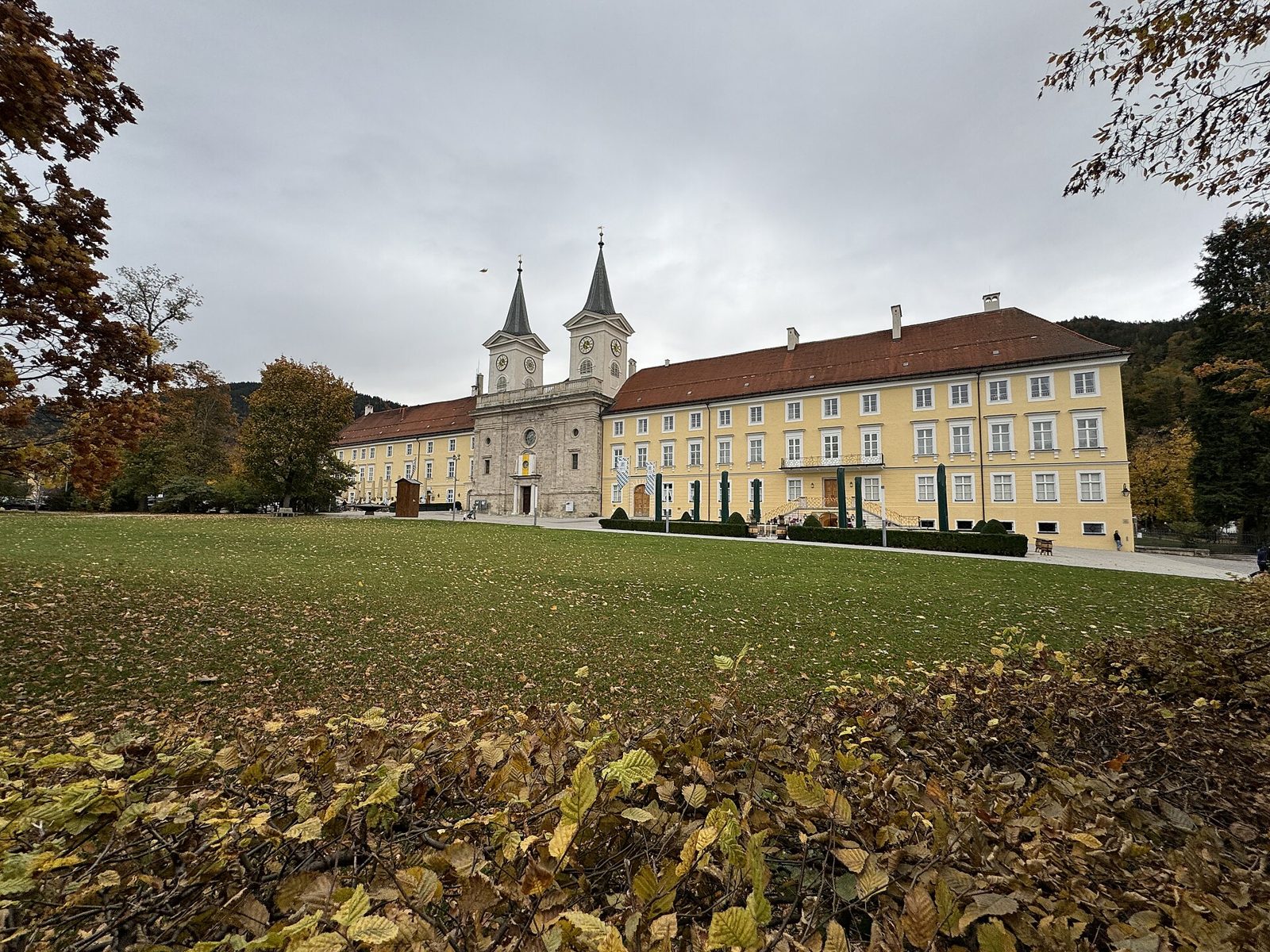
The big yellow complex on the east shore was a Benedictine monastery, founded in the 8th century, and became a Wittelsbach residence after secularisation. Today it is Schloss Tegernsee, still owned by the ducal branch of the family, and it houses a grammar school, the parish church of St. Quirinus and — the reason most people come — the Herzogliches Brauhaus Tegernsee and its tap room, the Herzogliches Bräustüberl.
The Bräustüberl is, quite simply, one of the best beer halls in Bavaria, and the locals never stopped using it. Vaulted rooms, long scrubbed tables, regulars’ tables you should not sit at uninvited, beer in heavy mugs and a menu of roast pork, Weisswurst and Brotzeit plates. In good weather the terrace in front of the building fills up from late morning. It is open daily from 10:00 to 22:00, with the kitchen serving until 21:30, and the Bräuladl shop, just across the way, is open daily from 10:00 to 18:00.
Arrive before noon or after 14:00 if you want a table without hovering. At the peak of a summer Sunday it is loud, crowded and slow — that is the point of it, but go in knowing. If you like it, our guide to Munich’s beer halls and breweries has the city equivalents, and the best beer gardens in Munich covers summer drinking closer to home.
The Tegernsee valley museum, five minutes from the Bräustüberl pier, opens only from June to early October (closed Mondays and Tuesdays), so do not plan around it on a winter visit.
Boats on the Tegernsee
The Bayerische Seenschifffahrt, the state-run lake fleet, sails the Tegernsee all year. The boats are the best way to see how the villages fit together, and they double as transport: you can hop off, walk a stretch of shore and pick up a later boat.
| Round trip | Lines | Duration | Adult fare | Breaks allowed |
|---|---|---|---|---|
| Grand tour | A, B | about 90 min | €19.50 | Two |
| Southern tour | C, D | about 60 min | €14.50 | One |
The winter timetable runs until 30 April 2027, with fewer sailings than in summer; the summer timetable starts on 1 May 2027. On a short November day, check the last departure from the far side of the lake before you set off on a walk, because you do not want to be the person on the Bad Wiessee pier watching the final boat leave from the wrong jetty.
The best combination for a first visit is a boat from Tegernsee to Gmund-Seeglas and the walk back along the shore. Or the reverse: take the train to Gmund, walk, and reward yourself at the Bräustüberl at the end.
The Wallberg: the big view, when it is running
The Wallbergbahn in Rottach-Egern is the Tegernsee’s mountain. A cabin ride of about 15 minutes lifts you to the plateau station at 1,620 metres, a short walk below the 1,722-metre summit. From the top the whole lake lies beneath you and, on a clear day, the main ridge of the Alps fills the southern horizon. It is the best view in the valley.
The catch is timing. The cable car closes twice a year for maintenance, and the autumn closure falls exactly when this guide goes up:
- Autumn revision: closed 4 November to 4 December 2026.
- Winter season: 5 December 2026 to 29 March 2027, daily 08:45–16:30.
- Spring revision: closed 30 March to 16 April 2027.
Ticket prices are on the Wallbergbahn’s own site, including a combined lake-and-summit ticket with the boats. Check them, and the day’s status, before you go; in strong wind the cabins stop.
In winter, the Wallberg is about the toboggan run. The natural run from the top station back to the valley is 6.5 kilometres long, and the Wallbergbahn describes it as one of the longest and most demanding natural toboggan runs in Germany. The word demanding matters. This is not a gentle family slope: it is steep in places, icy in others, and it runs only when there is enough snow. Sled hire is at the valley station. Take it seriously and it is one of the best winter afternoons you can have within reach of Munich. Our guide to skiing near Munich covers the ski areas nearby, including Spitzingsee-Tegernsee.
If you would rather walk than ride, the hike up from Rottach-Egern takes around two and a half hours, but in winter that is a job for people with the right footwear and some experience.
A sauna on the lake: monte mare Seesauna
For a cold-weather visit, the monte mare Seesauna Tegernsee is the best reason to stay later. It is a sauna complex on the shore with its own boat pier, called Seesauna, so you can arrive by boat. It is open Monday to Saturday 10:00–22:30 and Sunday 10:00–21:00, with sauna time ending half an hour before closing.
- 2 hours €28, 3 hours €33, 4 hours €38, 5 hours €43, day ticket €50
- Each plus a €5 online reservation ticket
- Booking online is compulsory at weekends, on public holidays and in the Christmas holidays
It is a textile-free German sauna in the usual way. If that is new to you, read our guide to German sauna etiquette first, and see Bavaria’s spa towns for Bad Wiessee’s iodine-sulphur baths and the other spa resorts within reach of Munich.
The Schliersee: the quieter lake next door
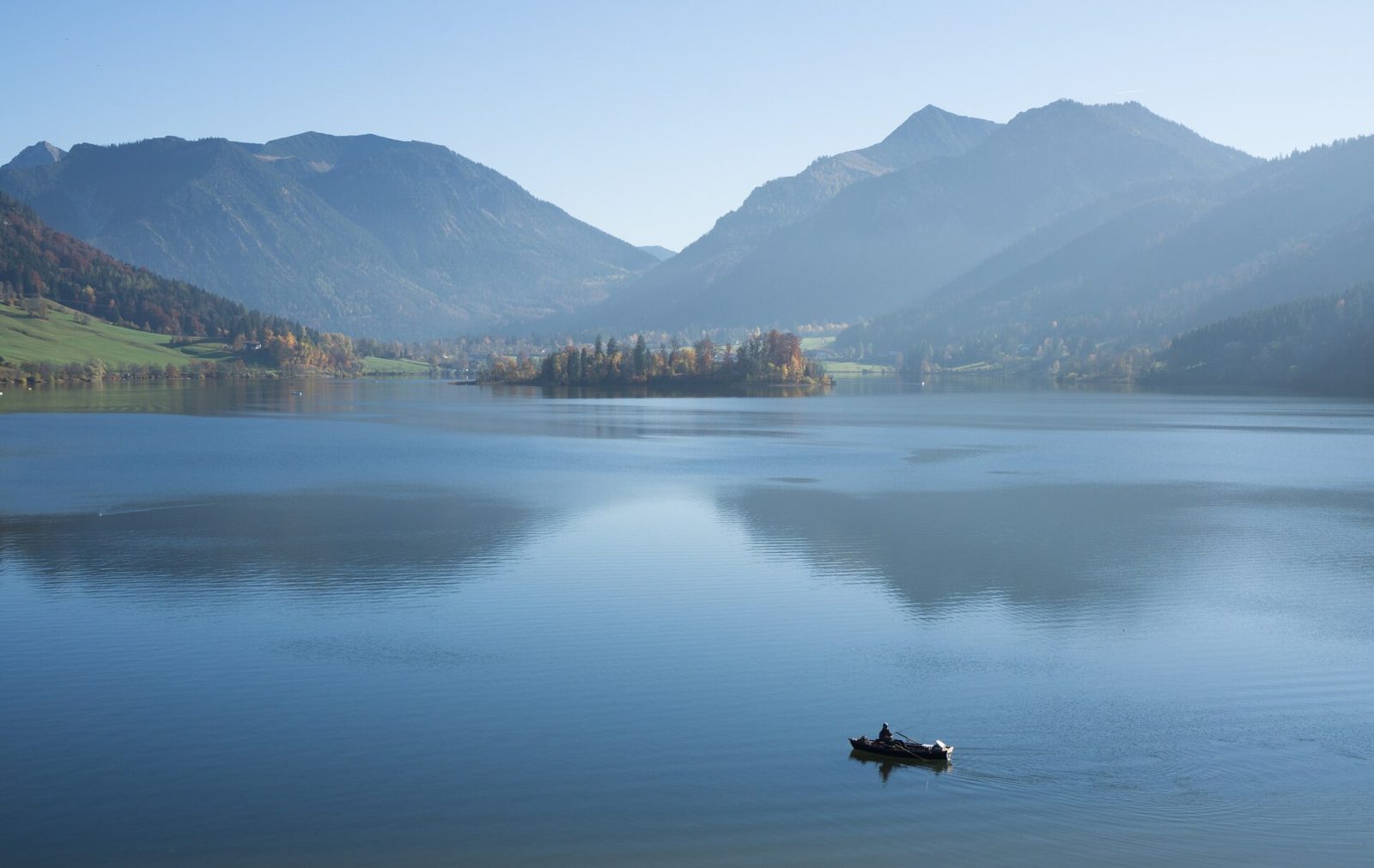
If the Tegernsee is the lake people photograph, the Schliersee is the one they live beside. It is smaller, the town at its northern end is an ordinary working Bavarian market town with a parish church, a supermarket and a station on the shore, and the lake itself has a single wooded island, the Wörth, in the middle.
What it lacks is a single headline attraction, and that is both its weakness and its charm. You come to the Schliersee to walk the shore path, eat in a lakeside inn without booking a week ahead, and sit on a bench looking at the water. A full lap of the lake on foot is a relaxed half-day.
The Schliersbergalm
Above the town, the Schliersbergbahn cable car climbs to the Schliersbergalm, a mountain inn with a view straight down the length of the lake. From November to April it runs daily from 08:30 to 18:00, every quarter of an hour; from April to October it runs until 22:00. There is a summer toboggan run that operates in dry weather, and adventure golf.
Be clear about what this is. The Schliersbergalm is a family day out with a view, not a mountain experience — it sits barely above the town. Children love it. Adults who want a summit should go elsewhere. But unlike the Wallberg, it keeps running through November, which makes it the easy option for a late-autumn trip. Prices are on the Schliersbergalm’s website.
The Markus Wasmeier open-air museum
At Neuhaus, at the southern end of the lake, former Olympic ski champion Markus Wasmeier has assembled a village of old farmhouses rescued from around the Oberland and rebuilt with their gardens, workshops, animals and an inn. It is the most interesting thing to do at the Schliersee and much better than its slightly theme-park name suggests: the buildings are real, and the craftsmanship on show is the genuine article.
It is seasonal. The 2026 season ran from 28 March to 8 November, Tuesday to Sunday 10:00–17:00, and it is now closed for the winter. The exception is its small Christmas market, Wasmeiers Weihnachtsmarktl, on 5, 6, 12 and 13 December 2026. Check wasmeier.de for admission prices and the 2027 opening date.
Spitzingsee, higher up
South of the Schliersee a road climbs to the Spitzingsee, a small high lake surrounded by ski lifts and mountain inns. In winter it is one of the ski areas covered in our skiing guide; in summer it is a starting point for walks to the Rotwand and Bodenschneid. Buses run up from Schliersee and Neuhaus — check the regional bus timetable for the day you go, as winter and summer services differ.
Walking between the lakes: the Prinzenweg
The two lakes are linked by one of the classic walks of the Bavarian pre-Alps. The Prinzenweg starts at Schliersee station and crosses the ridge to the Tegernsee. Schliersee’s tourist office gives it as about 14.6 kilometres and around three and a half hours of walking, with 655 metres of ascent and 707 of descent, topping out at 1,322 metres. Graded medium.
The beauty of it is logistics: start at one BRB station and finish at another, so there is no need to retrace your steps. Take the RB55 to Schliersee in the morning, walk over, eat at the Bräustüberl and catch the RB57 home from Tegernsee. Allow longer than the walking time for stops and the descent, and in late autumn start early — daylight is gone by about half past four, and the upper sections can be muddy or icy. Our guide to hiking near Munich has more walks reachable by train.
Less ambitious: the panorama path between Gmund and Tegernsee is an easy walk with views across the water, and the high path from Tegernsee to Rottach-Egern is a shorter option.
Which lake should you choose?
The short version: first visit, choose the Tegernsee. It has the Bräustüberl, the boats and, from December, the Wallberg, and it is the one people mean when they say “the lakes south of Munich”. Its downside is crowds and cost at peak times.
Choose the Schliersee if you have already done the Tegernsee, if you are travelling with young children who will love the Schliersbergalm, or if your idea of a good day out involves fewer people and a long walk. In summer, add the Wasmeier museum.
Do both by walking the Prinzenweg, which is the best day of the three if you are fit and the weather holds.
| If you want… | Go to |
|---|---|
| A classic Bavarian beer hall | Tegernsee (Herzogliches Bräustüberl) |
| A boat trip | Tegernsee |
| A summit view | Tegernsee (Wallberg, from 5 December) |
| An easy lift with children in November | Schliersee (Schliersbergalm) |
| A quiet lakeside walk | Schliersee |
| A sauna with a lake view | Tegernsee (monte mare Seesauna) |
| A proper hike | The Prinzenweg between the two |
For other options in the same direction, our guide to lakes near Munich compares the Starnberger See, the Ammersee and the rest, and the Bavarian Alps from Munich sets these lakes alongside the Zugspitze, Garmisch and Berchtesgaden.
Winter and Advent at the lakes
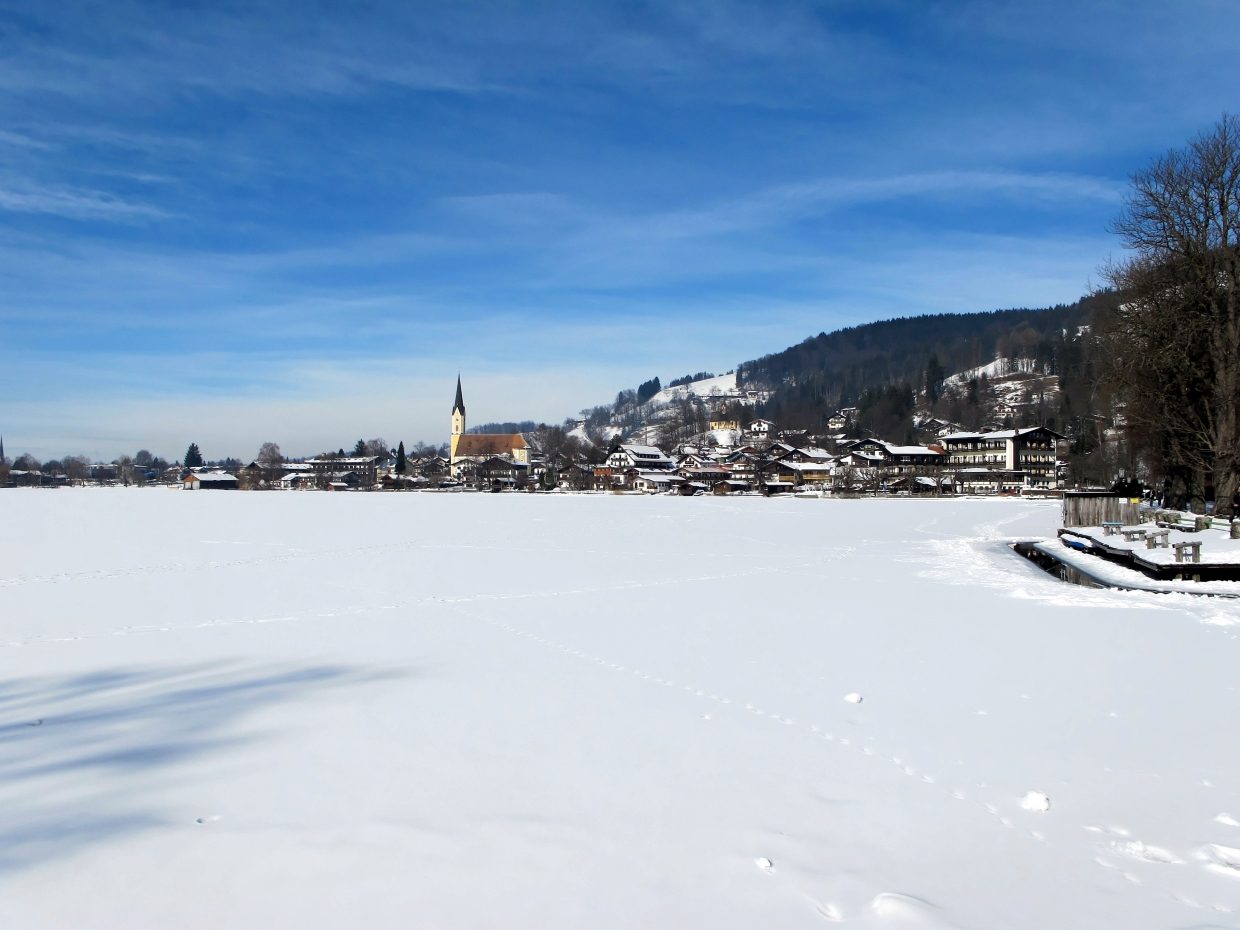
The lakes do not shut down in winter; they just change pace. The boats keep running on the winter timetable, the Bräustüberl stays open every day, the Schliersbergbahn runs through the season and, from 5 December, the Wallberg reopens with its toboggan run once the snow arrives.
In Advent, the villages around both lakes hold their own small Christmas markets, and they are far gentler than Munich’s crowded Marienplatz. Dates and venues change from year to year, so check the event calendars on tegernsee.com and schliersee.de before you go; Wasmeier’s market at Neuhaus is on 5, 6, 12 and 13 December 2026. For the city side of the season, see our guide to Munich’s Christmas markets and the Munich winter guide.
The thing to plan around in winter is daylight. In November and December, the sun drops behind the mountains in the mid-afternoon, and once it does the temperature at the lake falls fast. Do your walking and the lift in the morning, keep the Bräustüberl or the sauna for later, and catch a train back in the dark.
Frequently Asked Questions
How do I get to the Tegernsee from Munich?
Take the BRB RB57 from München Hauptbahnhof to Tegernsee station. Trains run hourly and the journey takes a little over an hour. Make sure you are in the section of the train going to Tegernsee, because the trains split on the way. A Bayern-Ticket (€34 for one, €44 for two) or a Deutschlandticket covers it.
Is the Tegernsee worth a day trip from Munich?
Yes — it is one of the best. A train, lunch at the Herzogliches Bräustüberl, a boat on the lake and a shore walk make a full, easy day. It is less dramatic than the Zugspitze or Königssee, but much easier and far more relaxing.
Tegernsee or Schliersee — which is better?
Tegernsee for a first visit: more to do, the brewery and the boats. Schliersee for a quieter, cheaper day, a lakeside walk or young children. If you are fit, walk the Prinzenweg between them and do both.
Is the Wallbergbahn open in November?
Not in 2026. It is closed for maintenance from 4 November to 4 December 2026, and the winter season runs from 5 December 2026 to 29 March 2027, daily 08:45–16:30. The Schliersbergbahn at the Schliersee runs daily through November.
Do the Tegernsee boats run in winter?
Yes. The Bayerische Seenschifffahrt runs a reduced winter timetable until 30 April 2027, and the summer timetable starts on 1 May. The grand round trip costs €19.50 and the southern round trip €14.50.
Can you swim in the Tegernsee?
Yes, in summer, from the public lidos and bathing spots around the shore. The water is cold even in July and August, coming as it does off the mountains. Outside summer, the monte mare Seesauna is the warmer way to enjoy the lake.
How long is the walk from Schliersee to Tegernsee?
The Prinzenweg is about 14.6 kilometres, with 655 metres of ascent, and Schliersee’s tourist office gives about three and a half hours of walking. Allow most of a day with stops. It starts at Schliersee station and ends near Tegernsee, so you can take the train both ways.
Can I see both lakes in one day without hiking?
You can, but it is a scramble. The lakes are on different branches of the BRB network, so going from one to the other by public transport means a regional bus over the hill or a train back towards Holzkirchen. Pick one lake per day unless you are walking the Prinzenweg.
Where to go next
The Tegernsee and Schliersee are the gentle end of the Bavarian Alps from Munich. For something higher, see the Zugspitze from Munich; for a lake with a palace on an island, Chiemsee and Herrenchiemsee. The full list of rail-friendly escapes is in day trips from Munich.
Photo Credits
Featured image: Tegernsee from Ringberg Castle 2018 by Birds-eye, CC BY-SA 4.0, via Wikimedia Commons.
Schloss Tegernsee: Tegernseer Braustüberl 1 20 30 48 471000 by RudolfSimon, CC BY-SA 4.0, via Wikimedia Commons.
Schliersee in autumn: Schliersee Fisher by Andi Scharfstein, CC BY 3.0, via Wikimedia Commons.
Schliersee in winter: Schliersee WinterAnsichtA by Bbb, CC BY-SA 3.0, via Wikimedia Commons.
Related Guides
- The Bavarian Alps from Munich: Complete Mountain Guide — the cluster hub
- Zugspitze from Munich: Germany’s Highest Peak — Major untargeted head term; SERP is tour operators, no authority guide
- Garmisch-Partenkirchen Day Trip from Munich — Top-five Munich day trip with no page on the site
- Best Day Hikes Near Munich (Reachable by Train) — Strong year-round volume; competitors are hotel-chain blogs
- Skiing Near Munich: Best Resorts for a Day on the Slopes — November to March traffic the site currently captures none of