Sport in Munich: Stadiums, Surfing and Getting Active
A football city with a river you can surf in. FC Bayern tickets and the €25 Arena tour, the second club that gives you the better afternoon, the closed Olympiaturm, the SAP Garden, and how to actually get active here.
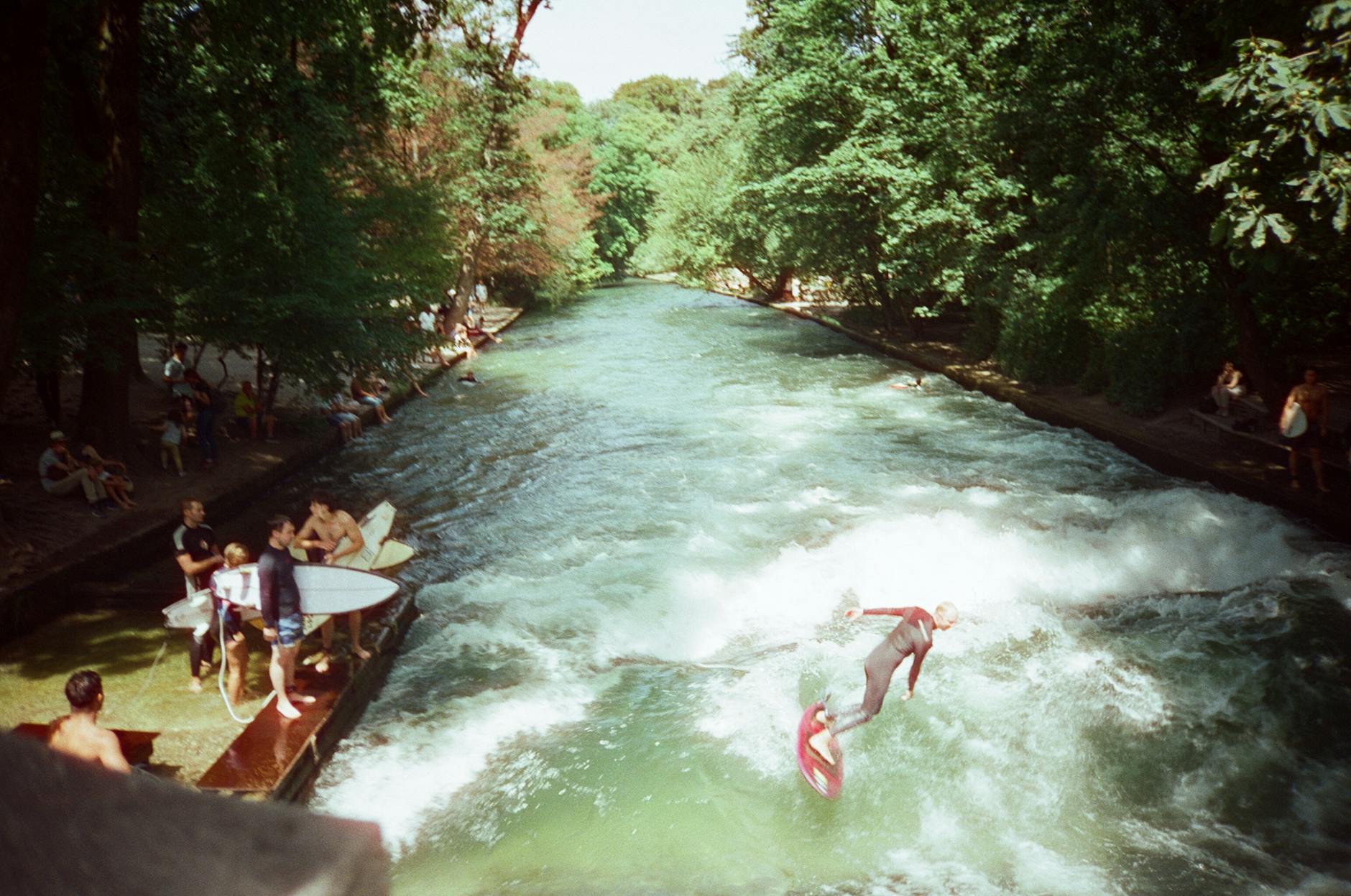
Munich is a football city with a river you can surf in. Those two facts cover most of what visitors want from sport here, and they pull in opposite directions: one is a €25 stadium tour and a ticket you probably cannot get, the other is free, happens at the edge of a public park, and runs in January.
Munich sports divide neatly into the two halves this guide covers — watching and doing. Where to see FC Bayern and why the second-division club across town gives you the better afternoon; what survives of the 1972 Olympic park and what has closed; how to actually get on a bike, into the Isar, or up a climbing wall without a membership. Prices and journey times are current for September 2026.
Munich sports at a glance
TOKEN_HERO| What | Where | Cost | Worth it? |
|---|---|---|---|
| FC Bayern match | Allianz Arena (U6 Fröttmaning) | Highly variable; hard to obtain | Yes, if you can get in legitimately |
| Allianz Arena tour + museum | Allianz Arena | €25 adult, €11 child 6–13 | Yes — the best wet-weather sports option in the city |
| TSV 1860 match | Grünwalder Stadion, Giesing | Cheap, and usually available | Yes — the better atmosphere, honestly |
| Ice hockey / basketball | SAP Garden, Olympiapark | Moderate | Yes, especially in winter |
| Watching the Eisbach surfers | English Garden, south tip | Free | Yes. Non-negotiable. |
| Olympiapark grounds | U3 Olympiazentrum | Free to walk | Yes — but the tower is shut until 2027 |
| Cycling the Isar | Riverside paths | Rental from a few euros an hour | Yes — the single best active day here |
| Swimming the Isar | Flaucher, south of the centre | Free | Yes, with caution about the current |
FC Bayern and the Allianz Arena
The Allianz Arena holds 75,024 people, sits north of the city at Fröttmaning, and glows red from the motorway on match nights. It is a genuinely striking building — a cushion of inflated plastic panels that changes colour — and it is about twenty minutes from Marienplatz on the U6, which runs direct to Fröttmaning station. From the station it is a ten-minute walk across an elevated esplanade, with the stadium in front of you the whole way.
Getting a ticket, honestly
Here is the part other guides skate over. FC Bayern sells out. The overwhelming majority of seats go to members and season-ticket holders, and the general-sale allocation for a Bundesliga fixture disappears in minutes. If you are visiting for a week and want to see Bayern play, your realistic options are:
- The club’s own ticket exchange, where members resell at face value. This is the legitimate route and it requires patience and repeat checking rather than luck.
- A less glamorous fixture — a midweek DFB-Pokal tie or an early-season league match against a smaller side. Availability is far better than for the marquee games.
- Accept that you will not get in and do the stadium tour instead.
What you should not do is buy from a street tout or an unofficial resale site. The club voids tickets it identifies as resold outside its own platform, and personalised tickets are checked. People are turned away at Fröttmaning every match weekend having paid several hundred euros. This is not a scare story; it is the stated policy.
The tour and the museum
The combined FC Bayern Museum and Arena Tour costs €25 for an adult (14+), €22 concession and €11 for a child aged 6–13; under-sixes are free but still need a ticket. It runs 120 to 150 minutes and takes you into the bowl, the tunnel, the dressing rooms and the press area. The museum alone is €12, and a museum-plus-Arena-View ticket, which gets you a look at the interior without the full walk-round, is €19. The museum opens 10:00 to 18:00 with last entry at 17:15.
Insider tip: book the tour for a non-match day. On match days the stadium tour is either cancelled or heavily curtailed, and the museum fills with people killing three hours before kick-off. A Tuesday morning is close to empty.
The honest verdict: at €25 this is good value if you care about football and poor value if you do not. The museum is unusually well made — it takes the club’s history seriously, including the uncomfortable parts — but it is a football museum, and no amount of design saves that for someone who is indifferent to the sport.
TOKEN_ARENATSV 1860 and the Grünwalder: the better afternoon
Munich has a second club, and for a visitor it is frequently the more rewarding one.
TSV 1860 München — the Löwen, the Lions — play at the Grünwalder Stadion in Giesing, south-east of the centre. It is an old ground with terracing, concrete steps, a roof over part of it and houses visible over the stand. The club has spent years in the lower divisions and the crowd has the particular intensity of supporters who remember better and resent it.
Tickets are cheap and generally available. You stand. You can hear individual voices. There is no roof-mounted video wall telling you when to cheer. If what you want from a football afternoon is atmosphere rather than elite football, this is the one to pick, and it costs a fraction of the Arena.
Giesing itself is worth the trip — a working-class district that has gentrified partially and unevenly, with good cheap food around Silberhornstraße. See our Munich neighbourhoods guide for where it sits.
The Olympiapark, and what is closed
The 1972 Olympic park is one of the great pieces of post-war European architecture — Frei Otto’s tented roof strung on cables over the stadium and the swimming hall, an artificial landscape built on the city’s wartime rubble, and the whole thing still in daily use rather than abandoned. It is free to walk around, on the U3 to Olympiazentrum.
Read this before you plan a visit: the Olympiaturm is closed. The 291 m tower with the revolving restaurant and the 190 m observation platform has been shut since 1 June 2024 for fire-protection works and the replacement of both passenger lifts, and the operator does not expect to reopen it until October 2027. A great many guides and listings still describe going up it. You cannot.
The free substitute is better than it sounds. The Olympiaberg, the grass hill immediately south of the stadium, was built from rubble and gives you the whole park, the city skyline and — on a clear day — the Alps along the southern horizon. It costs nothing, it is open at all hours, and sunset from the top is one of the genuinely good free things to do in Munich.
The Olympiastadion itself holds 63,118 and no longer has a permanent football tenant, but it hosts concerts, athletics and occasional fixtures. Our 1972 Olympics guide covers the architecture and the memorial to the eleven Israeli athletes and the German police officer killed in the attack, which is a serious site and should not be treated as a photo stop. The surrounding district is covered in our Olympic quarter guide.
TOKEN_OLYIce hockey and basketball at the SAP Garden
The newest venue in the city opened on 27 September 2024 in the Olympiapark. The SAP Garden holds 10,796 for ice hockey and 11,500 for basketball, and it is the shared home of EHC Red Bull München in the DEL and FC Bayern Basketball in the BBL and EuroLeague. It replaced the old Olympia-Eishalle, which has closed.
For a visitor this is the easiest live sport to get into in Munich. Tickets for both are obtainable in a way Bayern football tickets simply are not, the arena is twenty minutes from the centre on the U3, and a DEL hockey night is loud, fast and cheerful. If you are in Munich between September and April and want to watch something live, start here rather than with football.
The building also contains three separate ice rinks used by clubs, schools and the public, so it is a place to skate as well as to watch.
Surfing the Eisbach
At the southern tip of the English Garden, where the Eisbach channel passes under the Prinzregentenstraße bridge, the water hits a submerged obstruction and throws up a standing wave about a metre high. People surf it. They surf it in a queue, one at a time, dropping in from the bank, riding until they fall, and climbing out downstream to rejoin the line. They surf it in January, in wetsuits, with snow on the bank.
This is the best free spectacle in Munich and it runs continuously, year-round, in all weather. The bridge parapet is the viewing gallery and there is usually a small crowd on it.
Should you have a go? Almost certainly not. The Eisbach is fast, cold and shallow over a concrete bed, the wave is a genuinely advanced one, and the local surfers police the queue with some firmness. It is not a beginner’s wave and it is not a place to learn. Watch it, and if you want to actually surf, the gentler Floßlände wave further south is the one that beginners use — and even that assumes you can already surf.
Cycling: the thing to actually do
If you do one active thing in Munich, make it this. The city is flat, comprehensively laned, and has a continuous green corridor running through the middle of it.
The classic route follows the Isar south from the centre, past the Deutsches Museum, out to the Flaucher where the river braids into gravel islands and the city stops feeling like a city. The path is unbroken, mostly car-free, and you can keep going for as long as you like — the truly committed continue to the Isar lakes and come back by S-Bahn. North, the same river takes you through the English Garden, roughly 5 km of park running from the edge of the centre.
Rental is cheap and available everywhere, including the city’s own dockless scheme. A few rules that catch visitors out:
- Cycle lanes are compulsory where they exist, and cycling on the pavement is an offence that Munich pedestrians will point out to you loudly.
- Lights are legally required after dark and the police do enforce it.
- Do not cycle after beer. Germany applies drink-driving limits to bicycles, and the penalties reach into driving-licence territory.
Our cycling in Munich guide has the routes and rental detail; Munich’s parks and gardens covers where the paths lead.
TOKEN_ISARRunning and swimming
Runners have it easy here. The English Garden gives you an uninterrupted 5 km each way on soft paths, and the Isar embankments run for far longer than most people will want. The park is busy on summer evenings and near-empty at seven in the morning, which is the better hour anyway.
Swimming splits three ways:
- The Isar, free, around the Flaucher and the gravel banks south of the centre. Munich swims in its river and has done for generations. The current is stronger than it looks and the water is cold even in August — stay near the bank, and do not swim after heavy rain.
- The lakes — Starnberger See about 40 minutes on the S6, Ammersee about 50 on the S8. Proper lidos, proper swimming, easy day out. See our lakes near Munich guide.
- The public baths. The Müller’sches Volksbad, an art nouveau bathhouse on the Isar, is worth visiting for the architecture as much as the swim. The Dantebad has an outdoor pool heated through the winter, so you can swim outside in the snow.
Anyone travelling with children will find the Munich with kids guide more use for the family pools and the shallower river spots.
Climbing, and the indoor options
Munich is the headquarters of the German Alpine Club and the closest large city to the Northern Limestone Alps, which shows. There is a serious climbing and bouldering scene, the halls are large and modern, and day passes are normal — you do not need a membership to walk in, hire shoes and climb for an afternoon.
This is also the sensible wet-weather fallback. Munich has around 130 wet days a year, concentrated in June and July, and a bouldering hall is a better answer to a washed-out afternoon than a fourth museum.
Bouldering — climbing at low height over thick mats, with no rope and no partner — is the format that suits a visitor best, because it needs no equipment beyond hired shoes and no second person. Roped climbing in a hall generally requires you to demonstrate that you can belay, which is a reasonable ask and an awkward one if you are alone.
Insider tip: halls are at their emptiest on weekday mornings and genuinely unpleasant between about 18:00 and 21:00 on weekdays, when the entire Munich office population arrives at once. Go before lunch.
For real rock, the mountains start about an hour south — see the Bavarian Alps from Munich guide for the routes and the rail connections.
Kit, rental and where to buy it
Munich is one of the best-supplied outdoor cities in Europe, for the obvious geographical reason. The concentration of Alpine retailers here is unusual, and prices on European brands are frequently better than at home for visitors from the UK or North America — boots, shells and packs in particular.
Practical notes for a short trip:
- Ski and board hire is cheaper and easier at the resort than in the city. Hire at Lenggries or Garmisch, not at Hauptbahnhof, and you avoid carrying skis on a regional train.
- Climbing shoes are hired at the hall for a couple of euros. Do not buy a pair for one afternoon.
- Bikes are the exception — rent in the city, since that is where you will use one.
- Shops shut on Sundays across Germany, outside the Hauptbahnhof and the airport. If you need kit for a Sunday mountain day, buy it on Saturday.
Our Munich shopping guide covers where the outdoor retailers cluster and the Sunday closing rules in more detail.
Winter sport from the city
You can leave Munich after breakfast, ski, and be back for dinner. Brauneck at Lenggries is about 1h05 on the BRB with a cable car from the village; Sudelfeld and Spitzingsee are reachable on the same line with a bus at the end; Garmisch-Classic and the Zugspitze glacier are 1h20 away by train.
The unflattering truth is that none of these is a destination ski area by Alpine standards. If skiing is the reason for your trip, you want the Tirol. If you happen to be in Munich in February and fancy a day on snow, they are entirely good enough and the transport is trivially easy.
In the city itself, ice skating appears at the SAP Garden rinks and at seasonal outdoor rinks; the Olympiapark hill is used for sledging whenever there is enough snow, which is not every year. The Munich winter guide covers the season properly.
Matchday practicalities
German football operates on conventions that surprise visitors arriving from England, Spain or the United States. None of them is complicated, but getting them wrong costs you an hour.
- The stadium is cashless. Food and drink at the Allianz Arena run on a stored-value card that you top up and can refund afterwards. Bring a bank card; do not turn up with a wallet of notes expecting to buy a beer.
- Yes, there is beer, and yes, you drink it in your seat. Alcohol at German grounds is normal in a way it is not in England. It is generally sold as a low-alcohol variety at league matches.
- Standing terraces exist. The Südkurve at the Arena is a standing section and is where the organised support sits — or rather, does not sit. It is loud, it is co-ordinated, and it is not where you take small children.
- Arrive ninety minutes early. Not for the atmosphere, though that helps, but because 75,000 people funnel through one U-Bahn station and the security check is thorough. Bags larger than A4 are generally refused.
- Leaving takes an hour. The U6 back into town after a full house is a slow, packed business. Many locals walk one stop up the line or simply have a beer near the ground for forty minutes and let it clear.
Kick-off times follow the Bundesliga pattern: Friday evening, Saturday afternoon at 15:30 for most fixtures, Saturday evening, and Sunday afternoon. The Saturday 15:30 slot is the classic one and the best for a visitor, because the whole day arranges itself around it.
Insider tip: if you cannot get a ticket, watch the match in a bar rather than a hotel room. Munich takes public viewing seriously, the beer halls put screens up, and the atmosphere in a packed Wirtshaus during a big fixture is a genuine experience in its own right. Our beer halls and breweries guide covers the ones that do it properly.
The annual sporting calendar
Beyond the weekly fixtures, a handful of events are worth timing a trip around — or worth knowing about so you are not caught out by the hotel prices they cause.
| Event | When | Where | For visitors |
|---|---|---|---|
| BMW Open (ATP 500, clay) | 11–19 April 2026 | MTTC Iphitos, Aumeister | Small, walkable, genuinely good tennis. Easy tickets by ATP standards. |
| Bundesliga season | August to May | Allianz Arena / Grünwalder | Winter break through most of January |
| DEL ice hockey season | September to April | SAP Garden | The easiest live sport to get into |
| Munich Marathon | 11 October 2026 | City-wide, finishes in the Olympiastadion | One of Germany’s five largest; finishing on the Olympic track is the draw |
| Oktoberfest | Mid-September to early October | Theresienwiese | Not sport, but it triples hotel rates and overlaps the marathon |
The BMW Open is the underrated one. It is an ATP 500 clay tournament held at a compact tennis club on the northern edge of the English Garden, with a total prize fund of around €2.56 million, and it is small enough that you can watch top-fifty players on an outside court from a few metres away. For anyone who has only seen tennis at a Grand Slam, the scale is a revelation.
The Munich Marathon on 11 October 2026 is worth knowing about even if you are not running: the route closes central streets for much of a Sunday morning, and the finish inside the Olympiastadion means the Olympiapark is busy from early. Note that it falls just after Oktoberfest, so the city is at its most expensive across that whole stretch. The Munich festivals and events guide maps the full year.
A sporting day in Munich, planned
If you want one day that covers the ground properly, this is the order that works. It assumes no fixture, which is the situation most visitors are in.
- 09:30 — U6 to Fröttmaning. The Arena tour and museum on a weekday morning, before the coach groups. Two and a half hours.
- 12:30 — back south on the U6, change for the U3 to Olympiazentrum. Lunch in the park.
- 13:30 — the Olympiapark. Frei Otto’s roof, the 1972 memorial, and up the Olympiaberg for the view. Ninety minutes, more if the weather is good.
- 15:30 — U3 to the centre, then walk into the English Garden. The Eisbach wave at the southern tip, twenty minutes of watching, then north through the park.
- 17:00 — the Chinesischer Turm beer garden if it is warm, or the Seehaus on the Kleinhesseloher See.
Total transport cost: one Zone M day ticket at €10.10. Total admission: €25 for the Arena tour, and nothing else. That is a full, varied day for €35 a head, which is unusual value in a western European capital-sized city.
Swap the Arena morning for a bike along the Isar if the weather is exceptional — see the Munich itineraries guide for how a sporting day fits into a longer trip.
What it costs
| Activity | Price | Note |
|---|---|---|
| Watching the Eisbach wave | Free | Year-round, all weather |
| Olympiapark grounds and Olympiaberg | Free | Tower closed until October 2027 |
| Isar swimming and running | Free | Flaucher and the gravel banks |
| FC Bayern Museum only | €12 | Open 10:00–18:00, last entry 17:15 |
| Museum + Arena View | €19 adult | Interior view without the full tour |
| Museum + Arena Tour | €25 adult / €11 child 6–13 | 120–150 minutes; book a non-match day |
| Bike rental | A few euros per hour | Dockless schemes and shop rental both work |
| City day travel (Zone M) | €10.10 | Covers the U6 to the Arena and the U3 to Olympiapark |
A group of two or more should look at the group day ticket rather than two singles — the difference over a few days is substantial. Our budget transport guide works through the combinations, and getting around Munich explains the zone system that catches people out on the way to the airport.
What is overrated
- Paying a tout for a Bayern ticket. Voided at the gate, no recourse, several hundred euros gone. The club’s own exchange or nothing.
- Planning a day around the Olympiaturm. It is shut until October 2027 and a surprising number of published itineraries have not noticed.
- Trying to surf the Eisbach as a beginner. Cold, shallow, concrete, and a queue of people who will not be pleased.
- Booking a stadium tour on a match day. Curtailed or cancelled, and the museum is at its worst.
- Treating a Munich ski day as a ski holiday. Fine as an add-on, disappointing as a purpose.
Frequently Asked Questions
How do I get to the Allianz Arena from Munich city centre?
Take the U6 north to Fröttmaning, roughly twenty minutes from Marienplatz, then walk about ten minutes across the esplanade. On match days the U6 runs extra services and is extremely crowded in both directions — allow far longer than the timetable suggests for the journey home. A Zone M day ticket at €10.10 covers it.
How much is the Allianz Arena tour?
The combined FC Bayern Museum and Arena Tour is €25 for adults aged 14 and over, €22 concession and €11 for children aged 6–13, with under-sixes free but ticketed. It lasts 120 to 150 minutes. The museum on its own is €12, and museum plus Arena View is €19.
Can I go up the Olympiaturm?
No. The tower has been closed since 1 June 2024 for fire-safety works and lift replacement, and the operator expects it to stay closed until October 2027. Climb the Olympiaberg instead — it is free, it is a ten-minute walk up a grass hill, and on a clear day it gives you the city skyline with the Alps behind it.
Can you really surf in Munich?
Yes, on a standing wave in the Eisbach channel at the southern edge of the English Garden, all year round including mid-winter. It is a well-established scene with an orderly queue. It is not suitable for beginners — the water is fast, cold and shallow over concrete — so most visitors watch from the bridge, which is free and endlessly entertaining.
Where do EHC Red Bull München and FC Bayern Basketball play?
Both play at the SAP Garden in the Olympiapark, which opened on 27 September 2024 and holds 10,796 for ice hockey and 11,500 for basketball. It replaced the Olympia-Eishalle. Take the U3 to Olympiazentrum. Tickets are far easier to obtain than FC Bayern football tickets.
Is it safe to swim in the Isar?
Munich swims in the Isar routinely, particularly around the Flaucher, and the water quality is monitored. The risks are the current, which is faster than it looks and has caught out strong swimmers, and the temperature, which stays cold through summer. Stay close to the bank, avoid the days after heavy rain, and do not swim near weirs.
What is there to do in Munich for a sports fan when nothing is on?
The Allianz Arena tour and FC Bayern Museum, the Olympiapark and its 1972 architecture, and the Eisbach wave together make a full and satisfying day, and none of them depends on a fixture. Add a bike along the Isar and you have two.
Can I ski from Munich as a day trip?
Yes. Brauneck at Lenggries is about 1h05 by regional train with a cable car from the village; Sudelfeld, Spitzingsee, Garmisch-Classic and the Zugspitze glacier are all reachable the same day. A Bayern-Ticket covers the travel but never the lift pass. None of them is a destination resort, but as a day out they work well.
Where to go next
For the active side of the city beyond organised sport, outdoor activities in Munich covers the river, the parks and the seasonal options. If you are heading for the mountains, start with the Bavarian Alps from Munich. And if you are still working out how many days the city needs, our Munich itineraries guide sets out the realistic answer.
Every Guide in This Cluster
- Allianz Arena and the FC Bayern Museum: Visitor Guide — One of Munich’s biggest attraction terms and the site has nothing on it
- How to Get FC Bayern Tickets and See a Match — High volume and a genuinely confusing process, so there is room to beat resellers
- Eisbach Surfing: Munich’s River Wave Explained — Iconic, heavily searched, zero coverage on site
- Olympiapark Munich: Complete Visitor Guide — Only covered obliquely via the 1972 Olympics history post