Best Brunch in Munich
Munich does breakfast better than brunch, and knowing the difference saves your Sunday. Where to eat by neighbourhood, the Weisswurst rule, and what to skip.
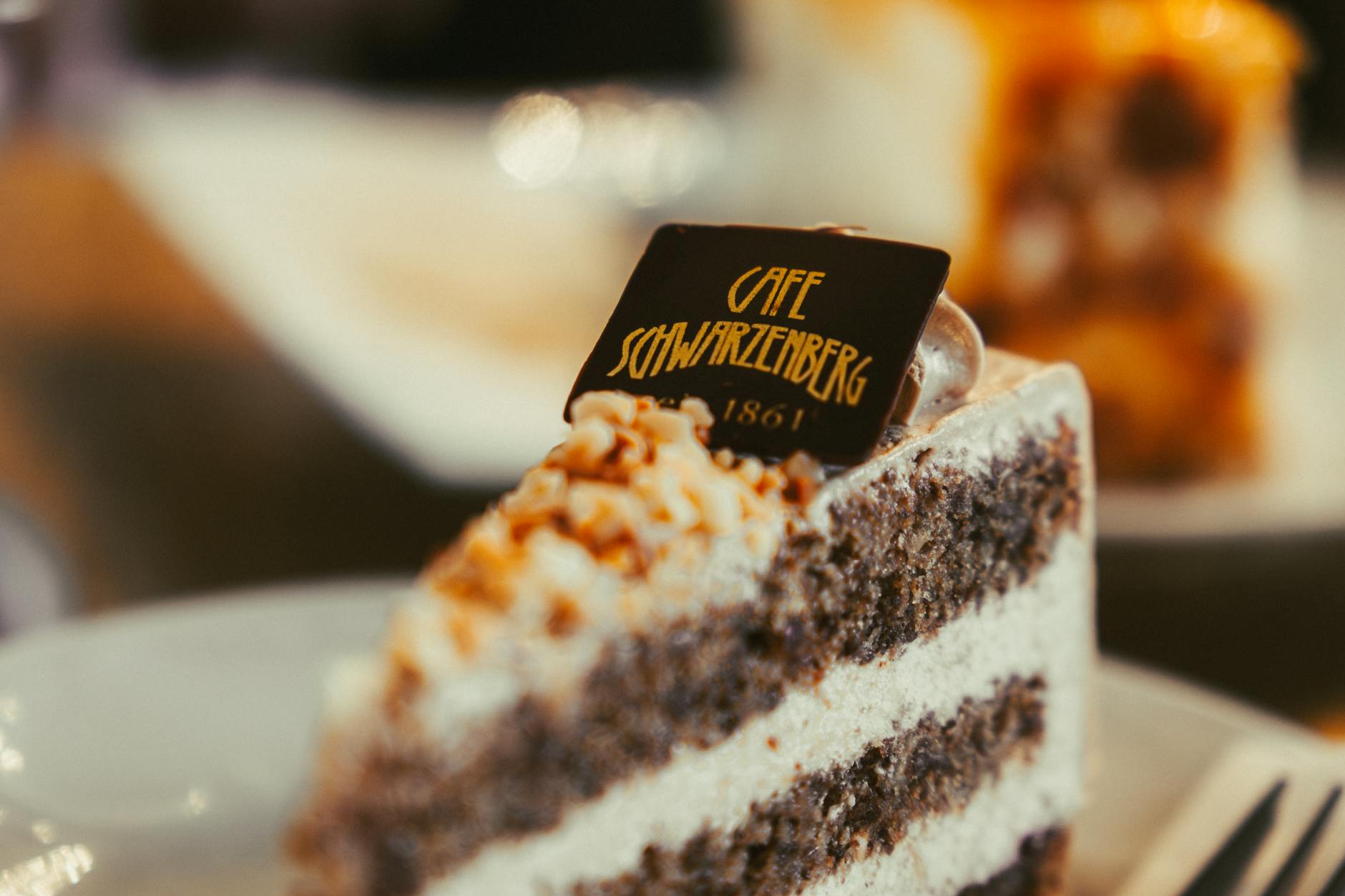
Munich does breakfast better than it does brunch, and understanding that distinction will save you a disappointing Sunday. What Germany has is Frühstück — a long, savoury, bread-centred meal that runs from eight until noon and is taken entirely seriously — and a lot of what gets marketed to visitors as “brunch” is that, with a later start time and a higher price.
The good news is that Frühstück is genuinely excellent, that Munich has one breakfast dish nowhere else in the world does properly, and that the city’s café culture is deeper than its reputation suggests. The bad news is that the Viktualienmarkt stalls shut on Sundays, most bakeries close by early afternoon, and the two most photographed brunch spots in the city are also the two least worth queueing for.
Here is where to eat, by neighbourhood, with the honest verdicts and the one meal you should not leave Munich without having.
Brunch Munich: the shortlist at a glance
| If you want | Go to | Where |
|---|---|---|
| The one Munich thing | Weisswurst before noon — Beim Sedlmayr or a Wirtshaus | By the Viktualienmarkt |
| A grand café | Café Luitpold, running since 1888 | Brienner Str. 11, Maxvorstadt |
| The best room | Café Marais, in an old haberdashery | Parkstraße 2, Westend |
| Vegan | Emmi’s Kitchen | Glockenbachviertel, Giesing, Schwabing |
| With children | Café Glückskind — play corner, half-price children’s portions | Seeriederstr. 9, Haidhausen |
| A roof terrace | Ruffini, self-managed Italian cantina | Orffstraße 22–24, Neuhausen |
| An enormous menu | Café Voilà, from 08:00 | Wörthstraße 5, Haidhausen |
| Breakfast at 06:00 | Bayerischer Hof — champagne, roof terrace | Promenadeplatz 2–6, Altstadt |
| Cheap and vegetarian | Café Ignaz | Georgenstraße 67, Maxvorstadt |
| Standing up, fried, at 8am | Café Frischhut for Schmalznudeln | Prälat-Zistl-Straße, by the market |
What a German breakfast actually is
If you order Frühstück in Munich you will get a plate or a board rather than a cooked dish: bread and rolls, butter, jam and honey, cold cuts, two or three cheeses, a boiled egg, and something fresh — tomato, cucumber, a bit of fruit. Coffee comes separately and is refilled. Scrambled eggs are an addition, not the centre.
Two consequences follow. First, it is savoury, slow and social — Germans sit over breakfast for two hours in a way that would be considered eccentric in London and normal here. Second, the quality of the meal is almost entirely the quality of the bread, which is why a mediocre-looking neighbourhood café can produce something far better than a smart hotel buffet.
The imported American brunch — bottomless mimosas, eggs Benedict, a queue — exists in Munich but it is a recent and fairly thin layer on top. Where it is done well it is usually in the Glockenbachviertel or Schwabing, and where it is done badly it is on a street with a view of Marienplatz.
Insider tip: “Frühstück bis 12” or “bis 14 Uhr” on a chalkboard is the thing to look for. Many Munich cafés serve breakfast until early afternoon on weekends and stop dead at that hour — turning up at 14:15 gets you the lunch menu, no negotiation.
The Weisswurst breakfast: the one you must do
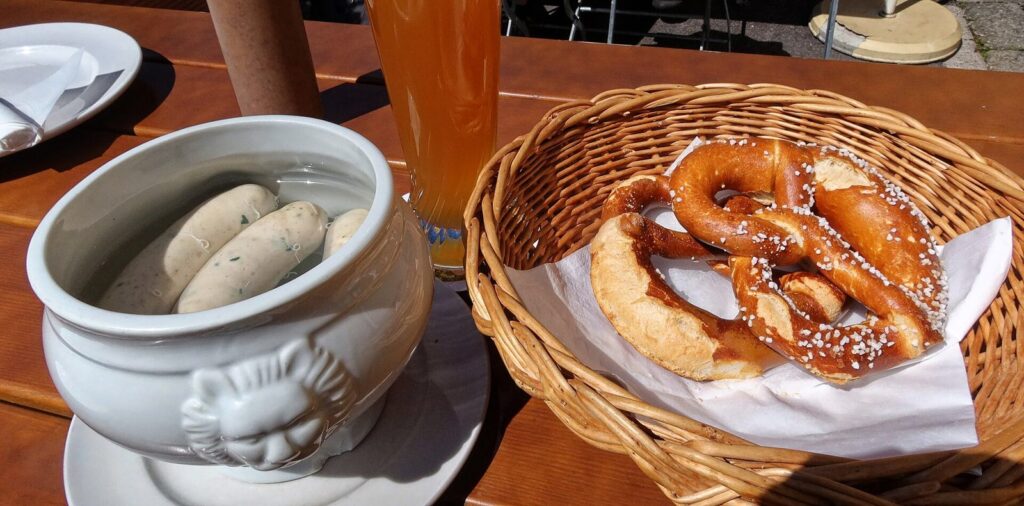
Two white veal sausages in a bowl of hot water, sweet mustard, a fresh pretzel, and a half-litre of wheat beer. At eleven in the morning. This is not a novelty — it is a genuine Munich institution and it is the single most distinctive meal in the city.
The rule you will hear repeated is that the Weisswurst must not experience the twelve o’clock bell. It is real, it is still observed, and the reason is freshness: before refrigeration the sausage was made at dawn, sold raw, and had to be in a pot of water the same morning. The composition is regulated — at least 51% veal, plus pork belly, cooked veal head meat, egg white, parsley, onion, pepper, mace and lemon powder, cooked for 25 minutes at 70°C, and about 12 centimetres long.
The origin story places it on 22 February 1857 at an inn called “Zum Ewigen Licht” on Marienplatz, where the innkeeper Joseph “Sepp” Moser is said to have run out of sheep casings and improvised. It is a lovely story and it is contested — Munich’s own city archivist has argued the sausage descends from the older Maibock-Wurst and may go back to at least 1814.
- Beim Sedlmayr, Westenriederstraße 14, a minute from the Viktualienmarkt, does what it calls the original Munich Weisswurst breakfast. It opens at 10:00 and is closed on Sundays, which catches out a lot of weekend visitors.
- Any proper Wirtshaus will do it well. The old-school beer halls do it as a matter of course, and it is one of the few things the Hofbräuhaus is genuinely good at — go at eleven in the morning rather than eight at night and it is a different, much better place.
- Café Lotti in Maxvorstadt and Trachtenvogl by the Gärtnerplatz both serve it alongside a normal breakfast menu, which is the compromise if half your party is not interested.
You peel them — either cut lengthways and roll the meat out of the skin, or the traditional method of biting and sucking, which is called zuzeln and which you will see Bavarians do without embarrassment. Full detail in our Weisswurst breakfast guide.
By neighbourhood
Altstadt and around the Viktualienmarkt
The centre is where breakfast is most expensive and most variable, and the good options are specific rather than general.
- Café Frischhut, on Prälat-Zistl-Straße at the edge of the market, has been frying Schmalznudeln — hand-stretched dough discs, crisp in the middle, thick at the rim — since the 1970s. It opens early, it closes when the dough runs out, there are about four tables, and it costs a couple of euros. This is the best two euros in the Munich food scene and it is not brunch in any sense.
- The Viktualienmarkt itself is the right move on a weekday morning: a coffee, a Leberkässemmel at about €4, an Obatzda plate at about €9, and the market’s beer garden under the maypole, which is the one place in the city where bringing your own food is openly encouraged. It is shut on Sundays. See our Viktualienmarkt guide.
- Bayerischer Hof on Promenadeplatz opens breakfast from 06:00 and does a champagne version on a roof terrace with city views. It is the grand-hotel option and priced accordingly; the early opening genuinely matters if you have a flight.
- Café Glockenspiel has the Marienplatz view and everybody knows it. The food is fine and the view is the product. Go once, at eleven, for the Glockenspiel itself — which runs at 11:00 and 12:00 daily, plus 17:00 from March to October — and do not expect the meal to be the point.
Glockenbachviertel and Gärtnerplatz
Munich’s best breakfast neighbourhood, and the one where the American-style brunch has actually taken root rather than being imitated.
- Trachtenvogl, Reichenbachstraße 47 — a former dirndl and lederhosen shop, kept as it was, with vintage furniture and hunting-lodge fittings. Vegan bowls, a Weisswurst breakfast, and an absurdly long hot chocolate list. It is scruffy, it is loud, and it is the most characteristic room in the district.
- Emmi’s Kitchen — entirely vegan, with branches in the Glockenbachviertel, Giesing and Schwabing. Tofu scramble, cinnamon buns, pancakes. Our vegetarian and vegan Munich guide has the wider picture.
- Wagners Juicery, Fraunhoferstraße 43 — smoothie bowls, soups, sandwiches, banana bread. The lightest option in a city that does not otherwise do light.
The area itself is worth the walk regardless — see our Glockenbachviertel guide.
Haidhausen
Across the Isar, quieter, and probably the best value of any central district.
- Café Voilà, Wörthstraße 5, opens from 08:00 with a very large breakfast menu including American and Scandinavian versions. This is the one to pick if your party wants five different things.
- Café Glückskind, Seeriederstr. 9 — a play corner, omelettes, pancakes, tarte flambée, and children’s portions at half price. If you are travelling with small children this is the answer, and it is a much less stressful one than trying to make a beer hall work at 09:30.
Combine it with the Wiener Platz market and the Franzosenviertel’s grid of nineteenth-century streets — the Haidhausen guide covers the walk.
Maxvorstadt and the museum quarter
- Café Luitpold, Brienner Str. 11 — a historic coffee house running since 1888, in the Viennese tradition, with fresh juices, mini white sausages and Bircher muesli. This is the grand café Munich still has, and it is a much better version of that experience than anything in the Altstadt.
- Café Lotti, Schleißheimer Str. 13 — regionally sourced, with yoghurt and fruit, muesli, and Weisswurst with a pretzel. Small and popular; go early.
- Brasserie Tresznjewski, Theresienstraße 72 — an extensive breakfast menu right by the Kunstareal, which makes it the obvious start to a museum day.
- Café Ignaz, Georgenstraße 67 — vegetarian and vegan, with salads, cheeses and pastries at very moderate prices. The student option, and none the worse for it.
All four sit within ten minutes of the Kunstareal, and the museums there charge a flat €1 on Sundays — breakfast at Tresznjewski followed by the Alte Pinakothek is one of the best-value mornings in the city. Note that most of the Kunstareal closes on Mondays. See the Pinakothek museums guide.
Westend and Neuhausen
- Café Marais, Parkstraße 2 in the Westend, occupies a preserved old haberdashery — the drawers, cabinets and fittings are still there and some of the stock is still for sale. Cereals, paninis, croissants, homemade cakes. It opens at 08:00 on weekdays and 10:00 on Sundays. It is the most atmospheric breakfast room in Munich and it is nowhere near the tourist trail.
- Ruffini, Orffstraße 22–24 in Neuhausen — a self-managed Italian cantina, collectively run, with its own bread, a proper bread basket with butter, jam, eggs, meats and cheese, and a roof terrace. Breakfast runs until noon on weekdays. It has been an institution in that neighbourhood for decades.
Both are ten to fifteen minutes from the centre on the U-Bahn and both are better than what you will find within sight of Marienplatz. Our best cafés in Munich guide goes further into the coffee side of this.
Schwabing, the English Garden and the kiosks
Schwabing was the bohemian quarter a hundred years ago and is an expensive residential one now, but it kept the café habit, and Leopoldstraße and the streets running off it are lined with places to sit outside from April.
The better move on a fine morning is the English Garden itself. Munich’s outdoor breakfast is not a restaurant thing — it is a kiosk thing. Bakery, coffee, a bench, and five kilometres of park running north from the edge of the city centre. The kiosks at the southern end near the Eisbach and the ones by the Kleinhesseloher See open early in season and do coffee, pretzels and pastries; the beer gardens at the Chinesischer Turm and the Seehaus serve from late morning and are perfectly happy to be a brunch destination even though nobody in Munich would call it that.
The Viktualienmarkt rule applies here too: the beer garden under the maypole is the one place in the city where bringing your own food is openly encouraged as long as you buy the drinks. Buy your breakfast at a bakery, carry it in, order a coffee or a wheat beer, and sit down. That is the cheapest good breakfast in Munich and it is entirely legitimate. See the best beer gardens for which ones allow it, and the Schwabing guide for the neighbourhood.
Insider tip: Munich’s bakeries — Rischart, Zöttl, and a hundred neighbourhood ones — open at six or seven and are the actual default German breakfast. A pretzel and a coffee standing at the counter costs a fraction of a café and takes four minutes, which is what most Münchners do on a weekday. Save the two-hour version for the weekend.
The Sunday problem
Sunday is the day everyone wants to brunch and the day Germany makes it hardest, so plan it.
- Shops are shut across Germany, apart from the Hauptbahnhof and the airport. That includes supermarkets and most bakeries after mid-morning.
- Viktualienmarkt stalls close. The square is open and the beer garden may be running, but the food stalls are not.
- Beim Sedlmayr is closed on Sundays, which is a genuine trap for anyone who has read about the Weisswurst breakfast and left it to the last morning.
- Cafés and restaurants are open, and Sunday breakfast is when they are busiest. Book, or arrive before 10:00.
- Café Marais opens at 10:00 on Sundays rather than 08:00 — a useful thing to know before walking to the Westend at nine.
The counter-argument is that Sunday is also the €1 museum day at the Bavarian state collections, so the shape of a good Munich Sunday is a long late breakfast followed by an afternoon in a gallery. Our free and cheap museums guide has the list, and the best time to visit Munich explains why arriving on a Thursday or Friday beats arriving on a Sunday.
What to skip
- Hotel buffets, almost universally. A €28 spread of industrial bread and steam-tray scrambled egg, when there is a café ten minutes away doing something far better for half of it. The exception is if breakfast is included in a rate you have already paid.
- Anything with a menu board in four languages within sight of Marienplatz. The rents on Kaufingerstraße and the Neuhauser Straße do not permit good value, and everything there is priced for a captive audience.
- “Bottomless” brunch deals. They exist in Munich but they are not what the city is good at, and you will pay a premium for a format it does not do naturally.
- Turning up at a popular café at 11:30 on a Sunday without a plan. Munich’s cafés are small and the city’s Sunday breakfast habit is entrenched. Either go at nine or accept a wait.
Frequently Asked Questions
What is a typical German breakfast?
Bread and rolls with butter, jam and honey, cold cuts, two or three cheeses, a boiled egg and something fresh, with coffee alongside. It is savoury rather than sweet and it is eaten slowly — two hours over breakfast is normal in Munich, not indulgent. Cooked dishes like scrambled eggs are additions rather than the centre of the meal, and the quality of the bread does most of the work.
Where is the best brunch in Munich?
For the room, Café Marais in the Westend, in a preserved old haberdashery. For the tradition, Café Luitpold on Brienner Straße, a coffee house running since 1888. For the neighbourhood atmosphere, Trachtenvogl by the Gärtnerplatz. For sheer choice, Café Voilà in Haidhausen. And for something you can only do here, a Weisswurst breakfast before noon at Beim Sedlmayr or any proper Wirtshaus.
Do you really have to eat Weisswurst before noon?
The rule is that the sausage must not hear the midday bell, and it is still widely observed — many places simply stop serving it at twelve. The reason is historical rather than superstitious: it was made at dawn, sold raw without refrigeration, and had to be cooked the same morning. Modern production has removed the necessity but not the convention, and ordering it at two in the afternoon marks you out.
Is brunch in Munich expensive?
Less than you might expect if you avoid the centre and hotel buffets. A neighbourhood café breakfast in Haidhausen, Neuhausen or Maxvorstadt is markedly cheaper than the equivalent in the Altstadt, and Café Ignaz in Maxvorstadt is explicitly at the moderate end. A Leberkässemmel at the Viktualienmarkt is about €4. Prices at individual venues change often, so treat any figure you read online as indicative. Our cheap eats guide covers the budget end properly.
Where can I get vegan brunch in Munich?
Emmi’s Kitchen is entirely vegan and has three branches — Glockenbachviertel, Giesing and Schwabing — doing tofu scramble, cinnamon buns and pancakes. Trachtenvogl runs vegan bowls alongside its Bavarian menu, Wagners Juicery on Fraunhoferstraße does smoothie bowls, and Café Ignaz in Maxvorstadt is vegetarian and vegan at moderate prices. Munich is better for this than its pork-and-beer reputation suggests.
Is anything open for breakfast early in Munich?
The Bayerischer Hof serves breakfast from 06:00, which is useful before an early train or flight. Café Frischhut by the Viktualienmarkt opens early and fries until the dough runs out. Café Marais and Café Voilà both open at 08:00 on weekdays. Bakeries open early across the city and a coffee and a pretzel standing at a counter is an entirely normal Munich breakfast.
Can you brunch with children in Munich?
Café Glückskind in Haidhausen has a play corner and children’s portions at half price, which makes it the obvious choice. Beer gardens are also genuinely child-friendly and most have a playground, though they get going later in the day. Our family restaurants guide and Munich with kids cover the rest.
Do I need to book brunch in Munich?
For Sunday, yes, or arrive before ten. Munich cafés are small, the Sunday breakfast habit is deeply established among locals, and popular places in the Glockenbachviertel and Haidhausen fill by eleven. Weekday mornings you can walk in almost anywhere. The grand-hotel breakfasts always take bookings and usually need one.
What is a Schmalznudel?
A hand-stretched disc of fried dough, thin and crisp in the middle with a thick puffed rim, dusted with sugar — also called an Auszogne or a Kiachl. Café Frischhut on Prälat-Zistl-Straße by the Viktualienmarkt has been making them since the 1970s and sells little else. It costs a couple of euros, there is nowhere much to sit, and it is one of the best things you can eat in Munich before nine in the morning.
Where to go next
Breakfast is one chapter of a much larger subject — our Munich food and beer guide is the place to start, with traditional Bavarian food for the dishes and the best cafés in Munich for the coffee. If you want someone to walk you through it, Munich food tours covers what is worth booking. And for the meal at the other end of the day, the best restaurants in Munich and Munich street food pick up where this leaves off.
Photo Credits
Weisswurst breakfast: 21.04.2023 MUC-Stammtisch-Erkundung 44 by Burkhard Mücke, CC BY-SA 4.0, via Wikimedia Commons.
Related Guides
- Hofbräuhaus Munich: What to Order and Is It Worth It — Munich’s single biggest attraction term and the cocoon has no dedicated page
- Weisswurst and the Bavarian Breakfast Explained — Named-dish query with a strong ritual and etiquette story in the noon rule
- Michelin-Star and Fine Dining in Munich — Only budget and mid-range dining are covered; the high end is missing