Eisbach Surfing: Munich’s River Wave Explained
The Eisbach wave reopened on 8 May 2026 after a fatal accident and a river-cleaning operation that erased it. How it works, the new rules, and whether you should get in.
Yes, the wave is open again — it reopened on Friday 8 May 2026, after thirteen months in which it was first closed by the city and then physically destroyed by a river-cleaning operation. If you read an article about Eisbach surfing written before that date, it is wrong about the most important thing.
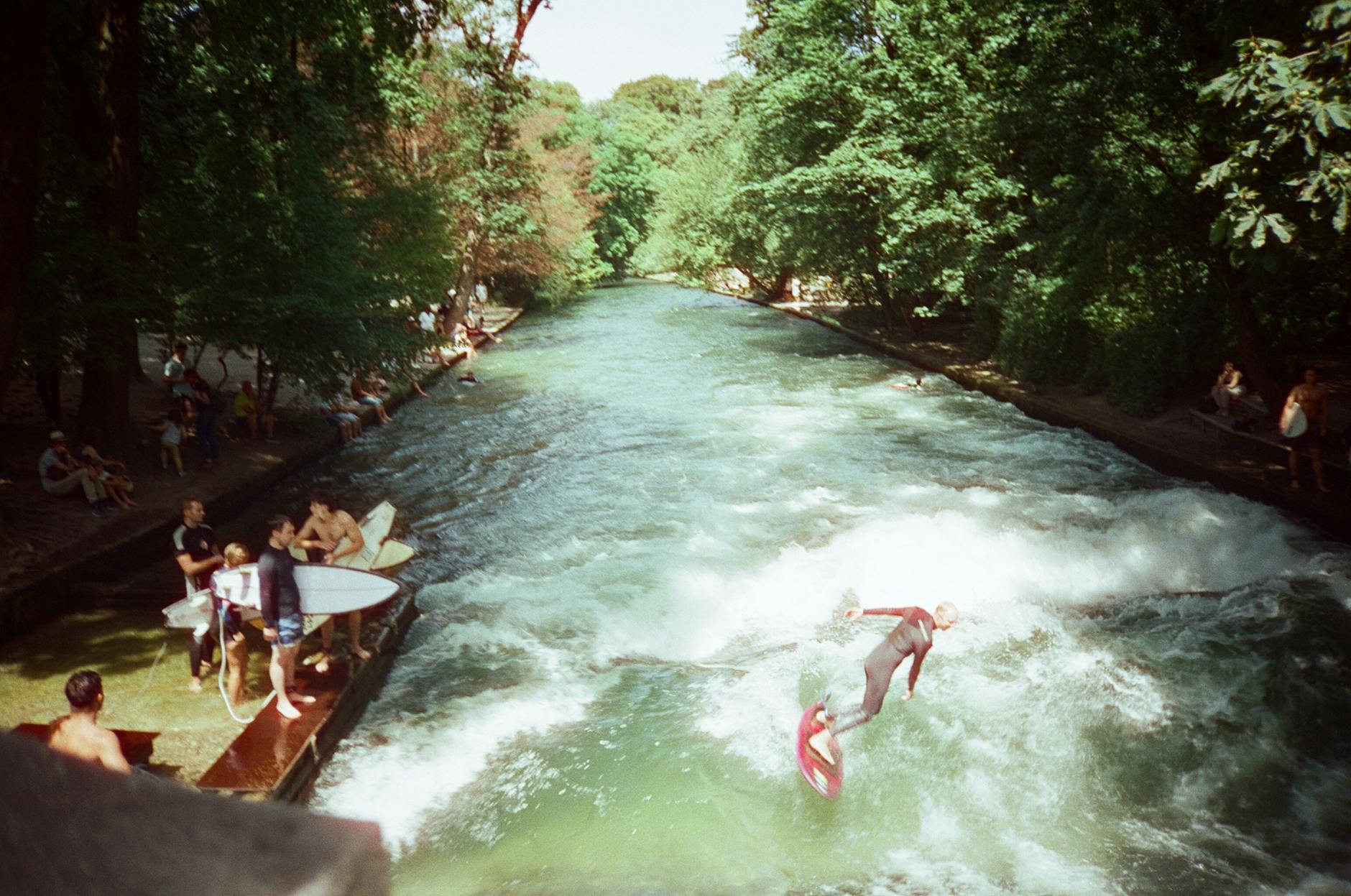
What you will find is a standing wave about a metre high, running under a road bridge at the southern tip of the English Garden, with a queue of wetsuited surfers on the bank and traffic going past thirty metres away. It runs in January. It runs at night, until the ban kicks in at ten. And it is a genuinely serious piece of water that has killed people, which is the part the postcards leave out.
Here is how the wave works, what happened to it, the rules as they now stand, where to watch from, and — if you are actually thinking of getting in — an honest account of whether you should.
Eisbach surfing at a glance
| Where | Under the Prinzregentenstraße bridge, southern tip of the English Garden, beside the Haus der Kunst |
| Getting there | U4/U5 to Lehel, then 6 min on foot · Tram 16 to Nationalmuseum/Haus der Kunst · 12 min walk from Marienplatz |
| Cost to watch | Free, always, no barrier, no ticket |
| Status | Open. Reopened 8 May 2026 under an amended city order |
| Current rules | Self-releasing leash mandatory · no surfing from 22:00 · not alone · posted signs binding |
| Wave | The E1, roughly a metre, expert only. The E2 downstream is gentler |
| Water | Cold year round — a few degrees above freezing in winter. Shallow: sometimes ~40 cm over concrete |
| Best time to watch | Weekday mornings for skill, weekend afternoons for crowds, winter for the photographs |
| Learners go to | The Floßlände in Thalkirchen — seasonal and flow-dependent, check first |
What the Eisbach actually is
The Eisbach — “ice brook” — is not a river. It is an artificial arm of the Isar, one of a network of canals dug to move water through the city, and it runs a fast, cold, shallow course north through the English Garden before rejoining the Isar. In summer people float down the lower stretches on their backs. At the southern end, at the Prinzregentenstraße bridge, the flow hits submerged obstacles and rears up into a standing wave that does not move.
That is the crucial distinction. An ocean wave travels and you travel with it. A river wave stays where it is while the water pours through it, so the surfer stays put too, held against a current running underneath them at speed. You do not ride it for eight seconds and paddle back; you drop in, hold position for as long as your legs and balance allow, and then fall off and get flushed downstream to the exit steps. Rides of a minute are good. Rides of several minutes happen.
The wave is roughly a metre high, which sounds modest until you register the channel it sits in: narrow, walled with stone, and in places carrying as little as 40 centimetres of water over concrete. There is no soft bottom and no run-out. That geometry is the whole story of both its appeal and its danger.
Fifty years of surfing a canal
Munich has been doing this since 1972, which makes it comfortably older than the river-surfing scene anywhere else. The Austrian Arthur Pauli is credited with the first ride, on 5 September 1972, not on the Eisbach at all but on the Isar raft channel at the Floßlände in Thalkirchen. The Eisbach came shortly after, and for the next four decades it was illegal.
Illegal in a specifically Munich way: tolerated, prosecuted in fits and starts, and surrounded by a folklore of surfers in neoprene sprinting through the English Garden with police behind them. The city’s position was that the Eisbach was a canal, not a leisure facility, and that anyone who drowned in it would be the city’s problem.
In 2010 the city gave in. It bought the land around the wave and, after a long campaign and a petition from the surf community, legalised the sport. Within a few years the wave was on the tourist board’s own promotional material and had become one of the three or four images that represent Munich abroad — alongside the Hofbräuhaus, the Frauenkirche and a Maß of beer. See Munich outdoor activities for the wider picture of what the city does with its water.
What happened in 2025: the closure and the disappearance
This is the part most guides have not caught up with, and it matters if you are planning a trip.
- April 2025 — the fatal accident. A 33-year-old woman drowned during a night-time winter session. Her leash is understood to have snagged, holding her under in a metre of freezing water while the current ran over her. The city closed the wave immediately.
- Through 2025 — the wave stayed shut. The legal question was not whether surfers wanted it open but whether the city could show it had taken reasonable steps to reduce the danger. Surfers spent the summer of 2025 assuming the closure was permanent and that the accident would be used as the pretext.
- 4 November 2025 — the wave was flattened. During river-cleaning works the riverbed obstacles that generated the wave were disturbed, and the standing wave simply stopped existing. This was announced by the authorities. For a period there was nothing to reopen: the Eisbach ran flat under the bridge.
- Winter and spring 2026 — it came back. Over months, the flow rearranged the bed and a stable, surfable wave re-formed on its own. Nobody engineered it.
- 8 May 2026 — reopened. Oberbürgermeister Dominik Krause issued an amended Allgemeinverfügung permitting surfing again under conditions, worked out in consultation with the surf associations IGSM and SCM.
The honest reading is that Munich came very close to losing the wave permanently and knows it. That is why the rules now have teeth, and why the signage carries a warning that vandalising it can trigger another closure.
The rules as they stand in 2026
These come from the city’s own order, not from a surf forum. They are enforceable.
| Rule | Detail | Why |
|---|---|---|
| Self-releasing leash | Mandatory. A conventional ankle leash is not compliant | A snagged leash in a shallow, fast channel is the specific mechanism that has killed people here |
| No surfing from 22:00 | The city order states the ban begins at 22:00; the practical window reported elsewhere is 22:00 to about 05:30 | Night sessions in cold water with nobody watching |
| Not alone | Solo surfing is prohibited | Someone has to be able to raise the alarm within seconds |
| Follow the posted signs | The notices at the wave are binding, not advisory | They change with water conditions |
| No fixings on the bridge or banks | The structures are protected | Damage, and the vandalism of signage, can trigger a fresh closure |
There is no permit, no fee and no register. The wave is self-policed, and the local surfers take that seriously — partly out of solidarity and partly because the alternative is losing it again. If you turn up without the right leash, someone will tell you.
Should you surf it? Almost certainly not
This is where most write-ups go soft, so here it is plainly: the E1 is not a wave for visitors, and being a competent ocean surfer does not qualify you.
The reasons are structural rather than snobbish.
- The entry is a jump, not a paddle. You step off the bank straight onto a moving wave face. There is no waiting, no positioning, no take-off you can practise. You either land it or you are in the water and going downstream.
- The channel is shallow and hard. Falling on an ocean wave means falling into water. Falling here can mean hitting stone. Head injuries and shoulder dislocations are the routine outcomes, and the surfers who ride it regularly have all had some.
- The queue is a real system. Surfers alternate banks and take strict turns. Dropping in out of order is not a faux pas, it is a collision risk in a two-lane channel, and the response will be immediate and unfriendly.
- Boards are specialist. Short, thick, finless or nearly so, and built to take impacts. An ocean board will not work and may not survive.
- The water is genuinely cold. A few degrees above freezing in winter. A 5/4 wetsuit with hood, boots and gloves is standard from November to March, and hypothermia — not drowning — is the more common way a session goes wrong.
If you want to ride a Munich river wave, the honest route is the E2 — the second, lower wave downstream where the channel widens and the flow slows — or the Floßlände at Thalkirchen, the original wave from 1972 and the recognised place to learn. The Floßlände is seasonal and depends on canal releases, so check that it is actually running before you travel out there; it is not a wave you can count on being present on any given day.
Insider tip: if you are serious, contact one of the Munich river-surf schools before you arrive rather than turning up with a board. They run sessions at the Floßlände, supply the right equipment, and — more usefully — will tell you honestly whether your ocean experience transfers. Most of the time the answer is that it partly does and the entry technique does not.
Watching it properly
For almost everyone, this is a spectator attraction, and it is a very good one. It costs nothing, it runs continuously, and it is fifteen minutes from Marienplatz.
- The bridge itself gives the head-on view straight down the wave. It is also where every phone in Munich is pointed, so expect three deep on a summer weekend.
- The downstream bank, on the English Garden side, gives you the side profile and the surfers’ faces, and it is where you can see the queue system working. This is the better photograph.
- The Haus der Kunst side catches morning light on the water.
When to come. Weekday mornings have the smallest crowds and, generally, the most competent surfers — the people who ride it before work. Weekend afternoons have the largest crowds on the bank and the longest queue in the water. Winter is the best time to watch: steam off the water, snow on the bank, and a handful of people in hooded wetsuits doing something that looks impossible. That contrast is the picture the Eisbach is famous for, and January delivers it.
Give it twenty minutes, not five. The rhythm of the queue, the falls, and the occasional very long ride are what make it interesting, and none of that is visible in a two-minute stop. Our Munich viewpoints and photo spots guide covers the framing, and the wave sits at the start of the walk described in Munich’s parks and gardens.
Getting there, and what to do next
| From | Route | Time |
|---|---|---|
| Marienplatz | On foot via Maximilianstraße and the Altstadtring | 12–15 min |
| Hauptbahnhof | S-Bahn or U4/U5 to Lehel, then 6 min on foot | ~15 min |
| Odeonsplatz | Through the Hofgarten and across Prinzregentenstraße | 10 min |
| Anywhere on tram 16 | Alight at Nationalmuseum/Haus der Kunst | Steps away |
The wave is the natural start of the classic English Garden walk. From the bridge, keep north and in about twenty-five minutes you reach the Chinesischer Turm beer garden; further on is the Kleinhesseloher See and the Seehaus. The garden runs roughly five kilometres north from the edge of the city centre, which makes it larger than Central Park and means you can walk for two hours without repeating yourself. Our best beer gardens in Munich covers where to stop, and the Munich walking guide strings it together with the Altstadt.
Directly across Prinzregentenstraße is the Haus der Kunst, and a short walk east is the Bayerisches Nationalmuseum — see Munich museums and culture. If you have come this far and the weather has turned, the Müller’sches Volksbad is fifteen minutes south along the river and is the most beautiful swimming pool in Germany.
The scene on the bank
The thing that surprises visitors is how organised it all is. There is no club, no membership and no roster, and yet the queue runs with the precision of a ski lift. Surfers alternate sides of the channel, one from the left bank, one from the right, and the order is held by nothing more than everyone watching everyone else. Newcomers who have been vouched for get folded in. Newcomers who have not, wait.
Behind that informality sit two organisations that did the actual work of keeping the wave: the IGSM, the Munich river-surf interest group, and the SCM, the city’s surf club. They were the parties the city negotiated the 2026 reopening conditions with, and they are the reason the rules are workable rather than performative — the leash requirement in particular came out of that room rather than being imposed on it.
The demographic is not what an outsider expects either. It skews older than an ocean line-up, it is close to evenly split between men and women, and a good proportion of the people riding at eight on a January morning are on their way to an office. Munich treats the Eisbach as commuting infrastructure with a wave attached.
Insider tip: do not ask a surfer to let you have a go, and do not put a drone up over the wave. Both happen constantly and both are met badly. Photographing from the bank is entirely fine and nobody minds; the surfers are used to being the most photographed people in Munich.
Munich’s other river waves
- E2, a short distance downstream of the main wave in the English Garden. Wider channel, slower water, smaller wave. This is where people learn on the Eisbach, and it is far less crowded because it is far less photogenic.
- Floßlände, Thalkirchen. About eight kilometres upstream at the end of the Ländkanal, and historically the first — Pauli surfed here in 1972. Gentler and the standard learners’ wave, but seasonal and dependent on canal flow. U3 to Thalkirchen. Verify it is running before you go.
- The Isar itself. Not a surf wave, but the stretch through the city was renaturalised in the 2000s into gravel banks and side channels, and in summer half of Munich is lying on it. It is the single most-used piece of public space in the city and costs nothing.
Frequently Asked Questions
Is the Eisbach wave open in 2026?
Yes. It reopened on 8 May 2026 under an amended city order, after being closed following a fatal accident in April 2025 and then flattened altogether by river-cleaning works in November 2025. The wave re-formed naturally over the following months and the city permitted surfing again with new safety conditions. Anything you read that says the wave is closed or gone predates May 2026.
Can a beginner surf the Eisbach?
No. The main wave, the E1, is an expert-only wave — a jump entry onto a fast, narrow channel that runs as shallow as 40 centimetres over concrete in places, with a strict queue and no margin for error. Experienced ocean surfers are not automatically qualified either, because the entry technique and the board are different. Beginners go to the Floßlände at Thalkirchen or the smaller E2 downstream, ideally through a local river-surf school.
Do you need a permit or a licence to surf the Eisbach?
No permit and no fee. But the city’s order imposes conditions that are legally binding: a self-releasing leash is mandatory, surfing is banned from 22:00, solo surfing is prohibited, and the posted signs at the wave must be followed. The scene is self-policing and enforces these itself, because a second serious incident could close the wave permanently.
How cold is the water?
Cold all year, and only a few degrees above freezing in winter — this is Alpine meltwater routed through the city. Winter surfers wear a 5/4 hooded wetsuit with boots and gloves. Even in August the Eisbach is bracing rather than pleasant, which is why the people floating down the garden’s lower reaches do it in short bursts.
Where exactly is the Eisbach wave?
Under the Prinzregentenstraße bridge at the southern tip of the English Garden, immediately beside the Haus der Kunst. U4 or U5 to Lehel and walk six minutes, or tram 16 to Nationalmuseum/Haus der Kunst. From Marienplatz it is a 12 to 15-minute walk. There is no entrance, no gate and no ticket — you simply arrive at the bridge.
When is the best time to watch the surfers?
Weekday mornings for the smallest crowds and often the strongest surfing. Winter for the best photographs — steam on the water and snow on the bank. Weekend afternoons in summer are the busiest, with a substantial queue in the water and three rows of onlookers on the bridge. The wave runs continuously, so there is no schedule to plan around.
How long is a ride on the Eisbach?
As long as you can hold your position. Because the wave stands still and the water moves through it, a ride ends when you fall or step off rather than when the wave breaks. A minute is a good ride; the best surfers hold it for several. Everyone then gets flushed downstream and climbs out to rejoin the queue, which is why turnover on a busy day is slower than it looks.
Is it safe to swim or float in the Eisbach?
Not at the wave — that stretch is fast, shallow and walled, and it is not a swimming spot under any circumstances. Further north in the English Garden people do float down the calmer sections in summer, and this is tolerated, but the current is stronger than it looks, exits are limited, and there are no lifeguards. If you want to swim properly, go to one of the lakes near Munich or to the Dantebad, a heated 50-metre outdoor pool that runs all winter.
Can you rent a board and try it?
Not at the Eisbach — there is no hire hut, no school and no supervision at the wave itself. River boards are short, thick and specialised, and the local shops that stock them expect you to know what you are buying. Lessons and hire exist through Munich’s river-surf schools and operate at the Floßlände, not the E1. Book before you travel; this is not a walk-up activity.
Where to go next
The wave is one item in a city that takes its outdoor life unusually seriously — see our Munich sports guide for the whole picture, from the Olympiapark to the Allianz Arena. If you are building a day around the English Garden, things to do in Munich places it in order, and free things to do in Munich lists what else costs nothing. For the Isar’s own swimming and cycling culture, cycling in Munich follows the river out of the city, and three days in Munich shows where an hour at the wave actually fits.
Related Guides
- Sport in Munich: Stadiums, Surfing and Getting Active — the cluster hub
- Allianz Arena and the FC Bayern Museum: Visitor Guide — One of Munich’s biggest attraction terms and the site has nothing on it
- How to Get FC Bayern Tickets and See a Match — High volume and a genuinely confusing process, so there is room to beat resellers
- Olympiapark Munich: Complete Visitor Guide — Only covered obliquely via the 1972 Olympics history post