Oktoberfest Cost 2026: Complete Budget Breakdown
How much does Oktoberfest cost in 2026? Detailed budget by day, including beer, food, rides, hotel and travel.

Oktoberfest cost in 2026 lands somewhere between a cheap day out and a credit-card nightmare, and which one you get is almost entirely about decisions you make before you ever step onto the Theresienwiese. A solo visitor who plans well can do a full day for around 90 euros. A couple on opening Saturday with no plan can spend 600 euros before lunch. This guide breaks the entire Wiesn budget down line by line for the 191st Oktoberfest (September 19 to October 4, 2026), so you can build a number that actually matches the trip you want.
We’ll cover the official 2026 prices on beer and food, ride costs, souvenir traps, Tracht rental versus purchase, hidden fees most tourists miss (Pfand, WC, ATM), realistic daily and weekly scenarios for solo travelers, couples and families, hotel and flight ranges, and the small habits that quietly halve your Oktoberfest cost without halving your fun. Entry is free; everything else is not.
Oktoberfest Cost 2026: Quick-Facts Table
| Item | 2026 price (official) |
|---|---|
| Entry to Theresienwiese | Free |
| Mass of festival beer (1 L) | 14.80 to 15.90 euros |
| Mass in the Oide Wiesn | 14.80 euros (Museumszelt, cheapest on the grounds) |
| Weissbier (1 L, the three tents that list it) | 17.40 to 18.40 euros |
| Half chicken (Hendl) | 15 to 18 euros |
| Pork knuckle (Schweinshaxe) | 22 to 27 euros |
| Brez’n (giant pretzel) | 5 to 8 euros |
| Olympia Looping ride | 12 to 15 euros |
| Solo day on-site | 90 to 140 euros |
| Couple day on-site | 180 to 280 euros |
| Family of four day on-site | 280 to 420 euros |
| Central hotel per night | 400 to 2,500 euros |
| Dirndl rental per day | 40 to 60 euros |
| Lederhosen rental per day | 45 to 80 euros |
Those quick-facts numbers are the spine of every breakdown below. If you want the festival dates, opening times and tap schedule, our companion guide on Oktoberfest dates and schedule covers all 16 days; for the bigger picture, start at our Oktoberfest Munich guide.
Beer Prices: The Mass, the Tasse, and the Radler
Beer is the single biggest line in any Oktoberfest cost calculation. Only the six Munich breweries — Augustiner, Hacker-Pschorr, Hofbräu, Löwenbräu, Paulaner and Spaten — are allowed to pour at the Wiesn, and each tent sets its own price within a narrow band. The city of Munich has now published the official 2026 tent list: a Mass runs 14.80 to 15.90 euros, averaging 15.61 euros across the grounds. That is up 2.38 percent on the 2025 average of 15.25 euros — a gentler rise than the 3 to 4 percent the Wiesn has averaged since 2022.
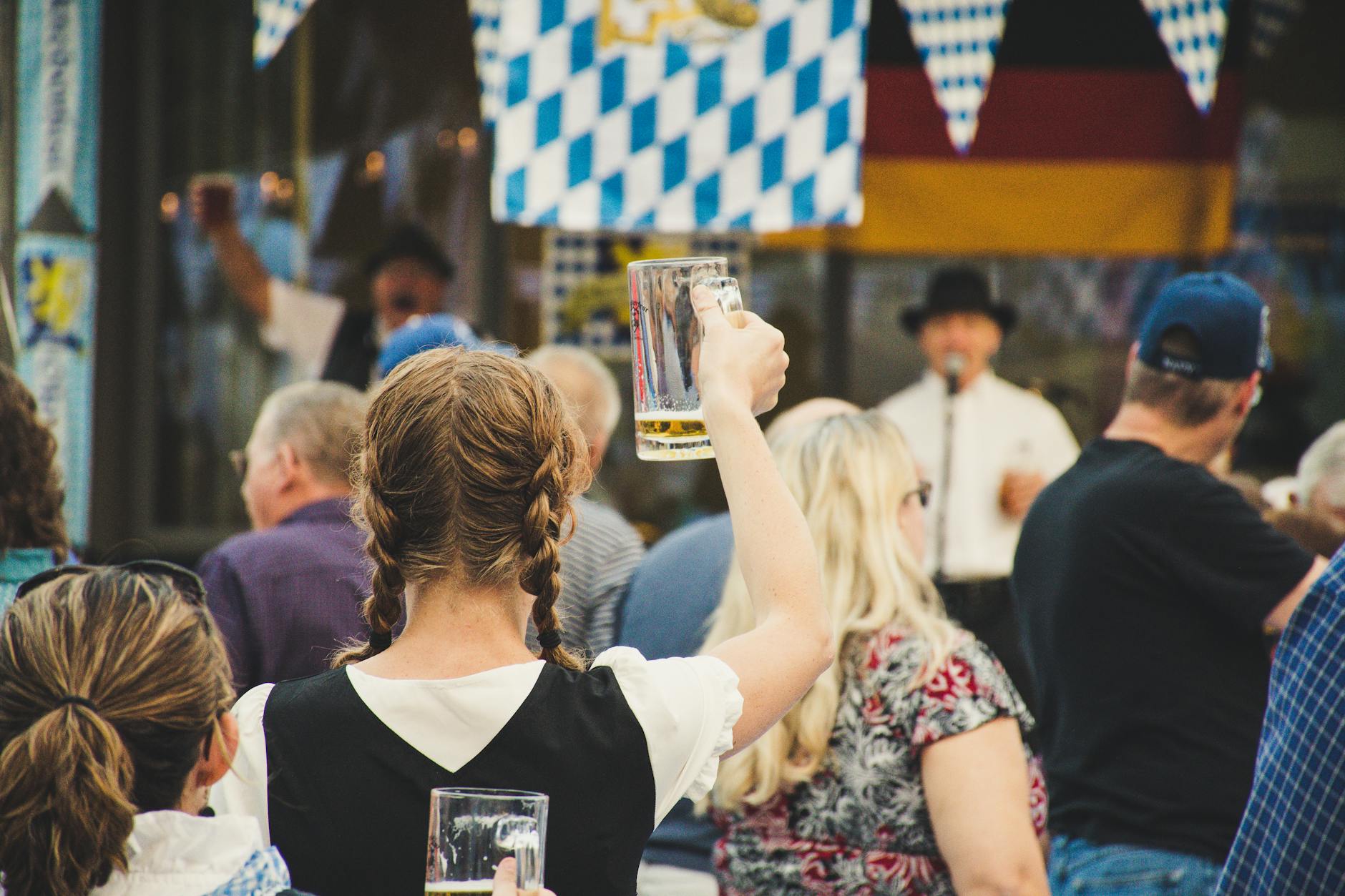
Mass (1-liter stein) — 14.80 to 15.90 euros
A Mass is the standard one-liter glass mug of Wiesn-Märzen, the special 6 percent ABV Oktoberfest brew. In 2025 the cheapest tents were the Augustiner-backed ones (Augustiner-Festhalle, Fischer-Vroni) at 14.50 euros, and the dearest sat at 15.80. For 2026 the official city list runs from 14.80 euros — the Museumszelt on the Oide Wiesn, and the Familienplatzl — up to 15.90 euros at the Armbrustschützen-Festzelt, the Bräurosl and the Löwenbräu-Festzelt. The cheapest big tent is the Augustiner-Festhalle at 14.90 euros, matched by the Wirtshaus im Schichtl. Most of the big tents cluster on one number, 15.80: Hofbräu, Paulaner, Hacker, Schottenhamel, Marstall, Ochsenbraterei, Käfer and Schützen all charge exactly that. Tip a euro or two on top — most Wiesn servers earn primarily from tips and a percentage of sales, so budget about 17 euros a liter all-in.
Weissbier — 17.40 to 18.40 euros a liter
Weissbier (wheat beer) is poured into a half-liter Tasse glass rather than a Mass, so it is cheaper per round and dearer per liter. The city lists it by the liter for comparison: 17.40 euros at the Marstall, 17.80 at Käfer Wiesn-Schänke and 18.40 at Kufflers Weinzelt — call it 8.70 to 9.20 euros for the half-liter glass you actually order. Useful when you want to switch styles mid-session or pace yourself; not the move if you’re trying to minimize cost-per-buzz. Note that Kufflers Weinzelt pours no Mass of Festbier at all — it is a wine tent, and Weissbier is the only beer on its list.
Radler — same price as Mass
A Radler is half Wiesn beer, half lemonade. Tents charge the full Mass price, so it’s not a way to save money; it’s a way to make it through nine hours of drinking. Order it after lunch if you’re settling in for the long haul. The same logic applies to Russ (wheat beer plus lemonade).
Non-alcoholic drinks — 5 to 11 euros
Table water is the real sting: the tents charge 8.00 to 15.33 euros a liter for it in 2026, and the Weinzelt’s 15.33 is dearer than a Mass of beer anywhere on the grounds. A Coke or apple juice (Apfelschorle) runs 5 to 7 euros for half a liter, and specialty mocktails or a Mass-sized soft drink jump to 9 to 11 euros. Alcohol-free beer is no help either — every tent prices it identically to the regular Mass. Designated drivers and minors pay nearly as much as drinkers; budget accordingly for a family.
Oide Wiesn — about a euro cheaper
The Oide Wiesn (“Old Wiesn”) is the historical section at the south end of the Theresienwiese, with traditional tents, vintage rides and a separate 4 euro entry fee. Its Museumszelt pours the cheapest Mass of the whole festival at 14.80 euros in 2026, a euro under the 15.80 that most big tents charge, and the music and pace are calmer. Best value for older travelers, families or anyone tired of the techno-Bavarian medley in the main tents.
Food at the Tents: Hendl, Schweinshaxe and the Big Plates
Tent food is restaurant-priced, but quality is generally high and the portions are huge. Order something hearty within the first two beers, or your Oktoberfest cost per hour will quietly run away from you while your tolerance does the same. Here’s what the main mains run in 2026.
- Halbes Hendl (half roast chicken) — 15 to 18 euros. The icon. Roughly half a million chickens are spit-roasted across the 16 days. Served with no sides; budget another 6 euros for Brez’n or potato salad.
- Schweinshaxe (pork knuckle) — 22 to 27 euros. The other icon. Crispy crackling, fork-tender meat, served with a dumpling or sauerkraut. Will defeat one person; great to split.
- Schweinebraten (roast pork with dumpling) — 18 to 22 euros. The midweek workhorse. A slice or two of pork, dark beer gravy, a Knödel.
- Ente (half roast duck) — 24 to 32 euros. Specialty of several large tents (especially Schottenhamel and Augustiner). Comes with red cabbage and Knödel; absolutely worth it once.
- Käsespätzle (cheese spätzle) — 13 to 17 euros. The default vegetarian option. Egg pasta baked with mountain cheese and crispy onions.
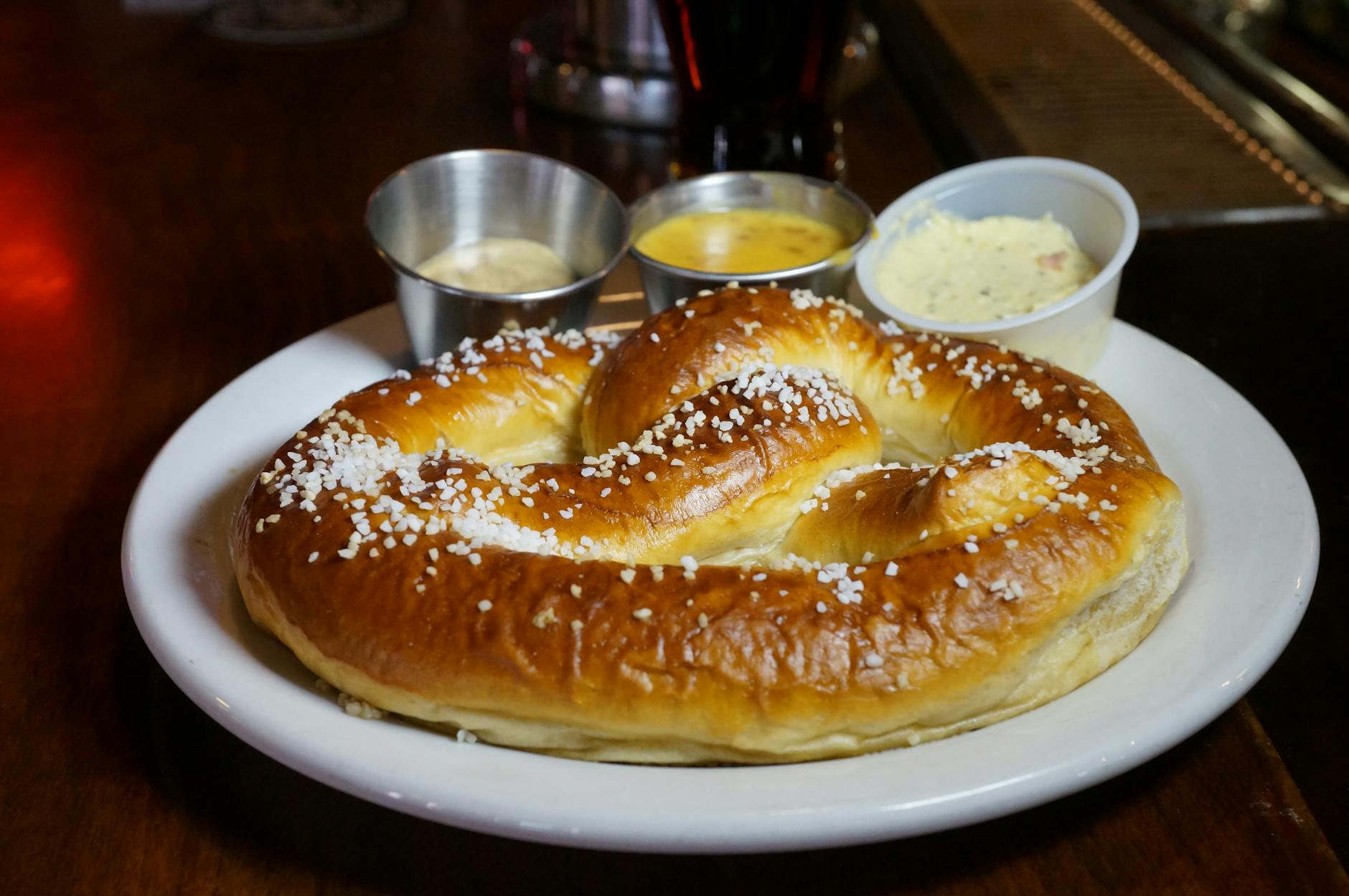
- Brez’n (giant pretzel) — 5 to 8 euros at the tents, 4 to 6 euros at outdoor stalls. The cheapest plate on the table; also the most photographed.
- Obatzda (cheese spread) with pretzel — 9 to 12 euros. Camembert-paprika spread, great with beer.
- Weisswurst with sweet mustard and pretzel — 9 to 13 euros. Only served before noon traditionally; almost every tent will still bring it after if you ask.
- Steckerlfisch (grilled mackerel on a stick) — 16 to 22 euros at the outdoor grills. Pure festival fare.
- Dessert (apple strudel, Kaiserschmarrn) — 10 to 14 euros.
Most tents run a Mittagstisch (lunch menu) on weekdays between roughly 11 a.m. and 2 p.m. with a daily special around 13 to 16 euros — usually Schweinsbraten or Käsespätzle. This is the single best Wiesn cost hack for sit-down food: same kitchen, same waitress, easily 5 to 8 euros off the regular menu.
Food at the Stalls: The Cheaper Lane
The Theresienwiese is ringed by outdoor stalls (Imbiss buden) selling festival classics for noticeably less than tent prices. If you’re not committed to a tent seat, this is where you eat.
- Bratwurst im Brötchen (sausage in a roll) — 5 to 7 euros. Two or three sausages laid into a crusty roll with sweet mustard.
- Käsekrainer (cheese-stuffed sausage) — 6 to 8 euros.
- Currywurst with chips — 9 to 12 euros.
- Steckerlfisch (mackerel on a stick) — 14 to 18 euros at the stalls; the queue is part of the experience.
- Schmalznudel (lard donut) — 4 to 6 euros. Hot, sugar-dusted, perfect at midnight.
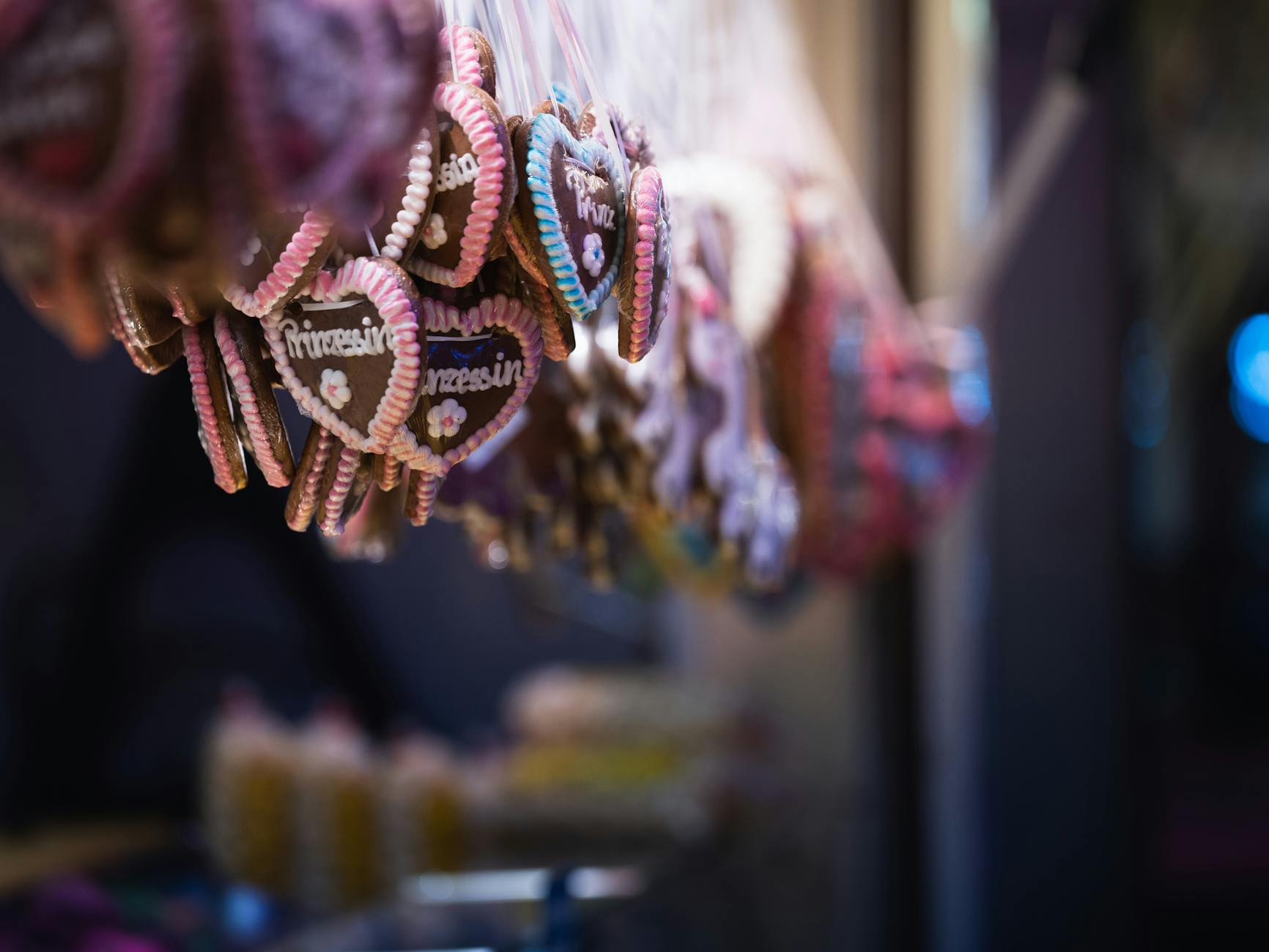
- Lebkuchenherz (gingerbread heart) — 5 euros small, 15 to 25 euros mid-size, 30 to 60 euros for big hand-piped statement pieces.
- Magenbrot (chocolate-spiced bread cookies) — 6 to 9 euros per bag.
- Roasted almonds (gebrannte Mandeln) — 5 to 8 euros for a small bag.
- Cotton candy and chocolate fruit skewers — 4 to 8 euros.
- Crepe or waffle with chocolate — 6 to 9 euros.
Eating two stall meals a day instead of two tent mains saves roughly 25 to 35 euros per person without leaving the Wiesn. The trade-off is no seat, no waitress, and the absolute certainty that you’ll spill mustard on whatever you’re wearing.
Ride Prices: Riesenrad, Olympia Looping and the Carnival Side
Oktoberfest is half folk festival, half traveling carnival. There are around 80 rides and attractions spread across the Theresienwiese, and they are a real budget line if you’re with kids — or with adults who decide after three Mass that the Olympia Looping is a great idea.
- Olympia Looping — 12 to 15 euros. The world’s largest mobile roller coaster, five loops, no helmet hair survives. The signature thrill ride of the festival.
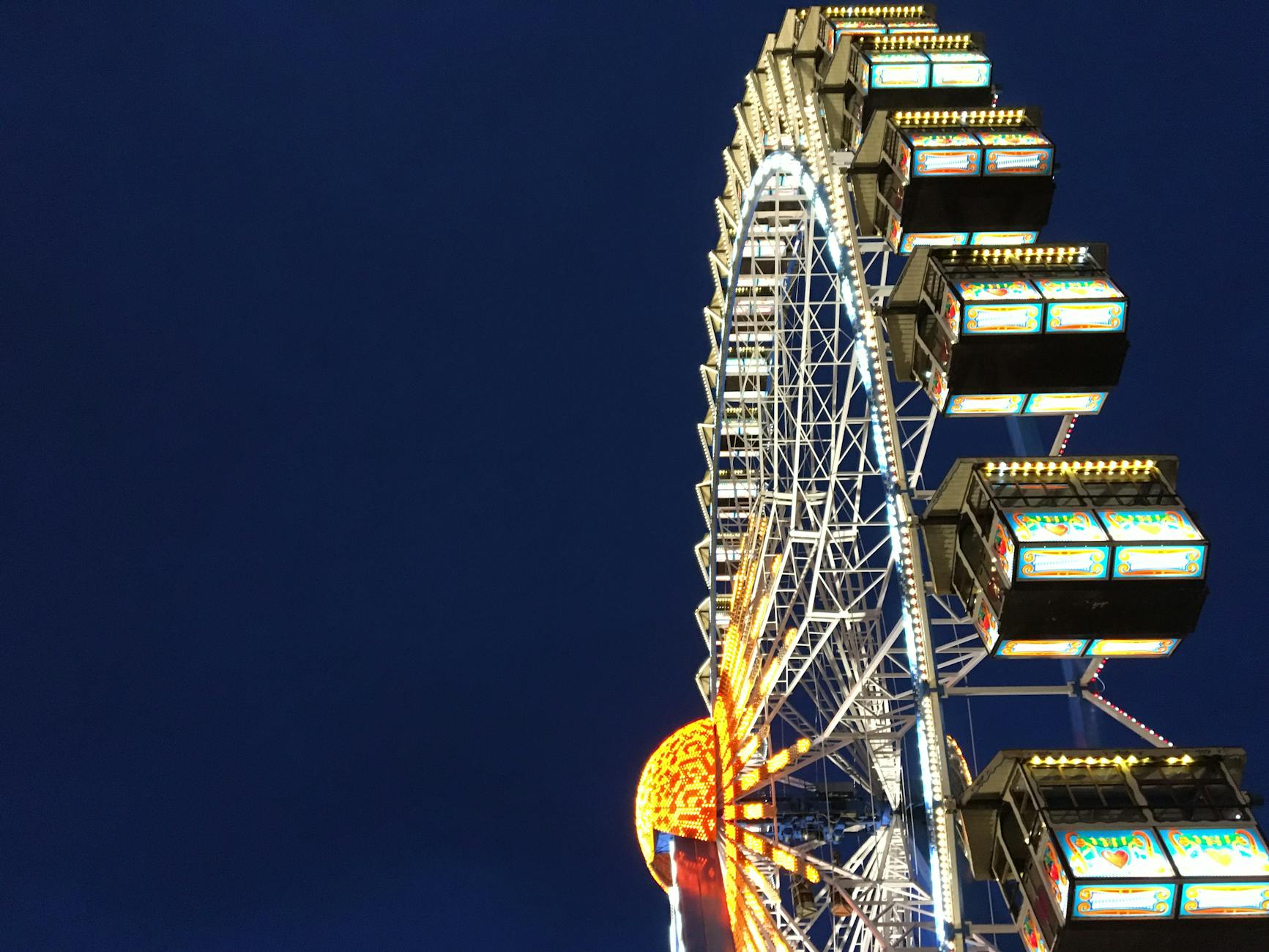
- Riesenrad (Willenborg’s Ferris wheel) — 8 to 10 euros. 50 meters up; the photo of Munich at dusk that every visitor wants.
- Krinoline — 4 to 5 euros. The lurching, swaying historic carousel with a live oompah band on the platform. Cheapest ride on the field and the most charming.
- Toboggan — 5 to 7 euros. The wooden treadmill conveyor classic; more entertaining to watch than ride.
- Münchner Rutschn — 4 to 5 euros. Giant wooden slide; kid-friendly.
- Geisterbahn (ghost train) — 6 to 9 euros. Indoor horror walkthrough.
- Family carousels and kiddie rides — 3 to 5 euros per ride.
- Bayern Tower / free fall — 9 to 12 euros.
- Wild Mouse, Predator and other coasters — 6 to 10 euros each.
- Auto-Scooter (bumper cars) — 4 to 6 euros per round.
- Skill stalls (shooting galleries, ring toss, hammer) — 3 to 6 euros per go, prizes generally not worth it.
A family of four doing two coasters, the Riesenrad and three kid rides will spend 80 to 120 euros on rides in a single afternoon. Tuesday is the official Familientag (family day), with reduced prices until 7 p.m. at rides and stalls — each operator sets its own discount rather than a flat 50 percent — plus cheap lunch menus in the tents until 3 p.m. If you’re traveling with kids, plan your big ride day around Tuesday.
Souvenirs: Maßkrug, Lebkuchenherz, Tracht
Souvenirs are where casual visitors really blow their Oktoberfest budget. The official Oktoberfest shop sells a different commemorative Maßkrug each year, and the limited-edition aura plus the wine-and-beer flush combine into expensive decision-making.
- Official Oktoberfest Maßkrug (year-stamped, stoneware) — 25 to 45 euros depending on size and lid.
- Official Maßkrug with pewter lid (“Zinndeckel”) — 60 to 110 euros.
- Plain souvenir Maßkrug from a stall — 12 to 20 euros.
- Lebkuchenherz (small, 8 cm) — 5 to 7 euros.
- Lebkuchenherz (medium, 20 cm) — 12 to 22 euros.
- Lebkuchenherz (large statement, 40+ cm) — 30 to 80 euros.
- Felt Trachten hat with feather — 35 to 90 euros depending on quality.
- Wiesn t-shirt — 18 to 30 euros.
- Trachten apron (worn over jeans, the lazy outfit) — 25 to 45 euros.
- Snow globe / Munich magnet pack — 8 to 15 euros.
- Bavarian beer-stein opener and bottle openers — 6 to 12 euros.
The Maßkrug glasses on the table inside tents are not yours to take. The official Wiesn-Krug with the year on it is a separate, paid-for souvenir; trying to walk out with a tent mug is theft and absolutely will get you stopped by security.
Tracht: Rent or Buy?
You don’t need a dirndl or lederhosen to enjoy Oktoberfest — but you’ll feel a step out of place in jeans, and most travelers end up wanting one. The question is rent versus buy.
Rental: 40 to 80 euros per day
Bavarian Outfitters, Dirndl-Leihen and a handful of seasonal pop-up shops near Hauptbahnhof rent full Tracht.
- Dirndl rental (dress, apron, blouse) — 40 to 60 euros per day; second-day at half price.
- Lederhosen rental (leather shorts, shirt, suspenders, optional vest, socks) — 45 to 80 euros per day.
- Kids’ Tracht rental — 25 to 40 euros per day.
- Deposit — usually 100 to 200 euros, refundable on return.
If you’re at the Wiesn for one day, rent. If you’re there for three days or more and care at all about the photos, do the math.
Buy: 150 to 600 euros, lasts a decade
A cheap H&M or C&A dirndl runs 80 to 130 euros and looks like it; you’ll spot it in photos. A proper midi dirndl from Angermaier, Wiesnkönig or Lodenfrey in cotton or linen with a real apron and blouse is 200 to 400 euros. Velvet, silk or hand-embroidered designer dirndls (Lola Paltinger, Schatzi Trachten) easily hit 500 to 1,500 euros.
Lederhosen are even more durable. Decent short or knee-length leather pairs cost 200 to 400 euros; premium hand-tooled or vintage Hirschleder (deerskin) pairs run 400 to 1,500 euros. Add 70 to 130 euros for a proper checked or linen shirt, 80 to 150 euros for a vest, 25 to 50 euros for socks (Loferl) and shoes (Haferlschuhe) at 130 to 250 euros. Lederhosen famously look better with age — many Bavarians wear the same pair for 20 to 30 years.
Rule of thumb: rent if it’s a one-time trip; buy entry-level (200 to 350 euros total) if there’s any chance you’ll come back, attend a German wedding or live near a big-city Oktoberfest abroad. For a full primer, see our guide on what to wear at Oktoberfest.
Hotel Costs: Where the Real Money Goes
Accommodation is by far the largest line item in any Oktoberfest trip. Munich hotels routinely run 3 to 5 times their off-peak rates during the Wiesn, and properties within walking distance of the Theresienwiese (Ludwigsvorstadt, Schwanthalerhöhe, Hauptbahnhof) sell out 9 to 12 months ahead.
| Category | Per night during Wiesn | Example properties |
|---|---|---|
| Camping (Stoke, Wies’n Camp) | 50 to 130 euros (tent or bunk) | Wiesn Camp, Stoke Travel, The Tent |
| Hostels | 70 to 160 euros (dorm bed) | Wombat’s, Euro Youth, Jaeger’s |
| Budget (2-3 star, outer ring) | 180 to 320 euros | Holiday Inn Express, Motel One |
| Mid-range (3-4 star, central) | 320 to 600 euros | NH Collection, Leonardo Royal |
| Upscale (4-5 star, walking distance) | 500 to 1,200 euros | Sofitel Bayerpost, Pullman, The Charles |
| Luxury (5-star icons) | 900 to 2,500+ euros | Bayerischer Hof, Mandarin Oriental, Vier Jahreszeiten |
| Apartment / Airbnb | 250 to 700 euros | Varies; mandatory 3-night minimums common |
The second weekend (the closing Friday-Sunday) is the most expensive of the festival, followed by opening weekend. Weekday nights (Sunday-Wednesday) are often 30 to 40 percent cheaper than Friday-Saturday at the same hotel. Properties out in Pasing, Riem, Garching or near the airport run about half of city-center rates and connect via the S-Bahn (15 to 35 minutes to Theresienwiese). For a deeper dive, see our guide on where to stay for Oktoberfest.
Camping and party packages
Wies’n Camp (Bavarianforest) and Stoke Travel run dedicated Oktoberfest party campgrounds with shuttles to the Theresienwiese, breakfast and DJ tents included. Packages run roughly 80 to 200 euros per person per night, with Stoke famous for an unlimited-sangria-and-beer add-on for around 15 euros a day. Great if you’re 22 and traveling with strangers; not great if you want to sleep more than four hours.
Travel to Munich
Flights and trains are the other big swing factor in the total cost of Oktoberfest trip from anywhere outside Bavaria.
- US East Coast direct flight — 700 to 1,400 euros round trip in economy if booked 4 to 8 months out; 1,200 to 2,200 inside two months.
- US West Coast direct or one-stop — 900 to 1,800 euros round trip.
- UK / Ireland — 80 to 250 euros round trip on EasyJet, Ryanair, BA, Lufthansa or Aer Lingus.
- Within Europe (Paris, Amsterdam, Vienna, Rome) — 80 to 300 euros round trip.
- ICE / Railjet train from elsewhere in Germany or Austria — 60 to 180 euros round trip in 2nd class.
- Flixbus from European cities — 30 to 90 euros round trip (15 to 50 each way).
- Munich Airport to Theresienwiese — S-Bahn S1 or S8 with a regular MVV day ticket at 9.20 euros (or a Streifenkarte strip ticket); about 45 minutes.
- MVV day ticket within Munich (single zone) — 9.20 euros.
- MVV group day ticket (up to 5 people) — 18 euros.
If you’re coming from outside Germany and not anchored to a Munich hotel, look at staying in Augsburg (35 minutes by Regio) or Ingolstadt (50 minutes). Hotels there during Oktoberfest run roughly 100 to 180 euros per night — half the Munich average — and a Bayern Ticket day pass for up to 5 people is 29 euros plus 11 euros per extra person, valid for the whole regional network.
Hidden Costs Most Tourists Miss
These line items don’t show up in any glossy Oktoberfest prices roundup, but they will show up on your bank statement.
- Pfand (cup deposit) — 2 to 5 euros on a glass Mass, 1 to 2 euros on bottled water or soft drinks. Refundable when you return the empty mug or bottle. Many visitors forget; that’s effectively a surcharge on every drink you carry outside.
- WC fees — Restroom kiosks just outside tents and at the field perimeter charge 0.50 to 1 euro per use. Inside the tents, restrooms are free; tip attendants 50 cents to 1 euro if there’s a plate.
- ATM fees — Most ATMs on the Wiesn grounds are private operators (Euronet, Cardpoint) charging 3 to 5 euros per withdrawal, plus your home bank’s foreign-currency markup. Pull cash from a German bank ATM (Sparkasse, HypoVereinsbank, Commerzbank) before you arrive at the Theresienwiese.
- Luggage storage — 5 to 10 euros per bag at the entry-gate lockers. Backpacks bigger than 3 liters and any roller bag are banned inside the festival grounds.
- Coat check inside tents — 2 to 3 euros per coat, often required after dark.
- Cigarette tax — If you smoke, expect 8 to 10 euros a pack and the realisation that German bars and tents are non-smoking. Designated outdoor zones only.
- Tips — 10 percent of the bill or 1 to 2 euros per Mass is standard. Hand it to the server when you pay; don’t leave coins on the table.
- Reservation minimums — A reserved table doesn’t cost extra in itself, but each seat carries a food and beverage voucher minimum of 55 to 70 euros (two Mass + a half chicken or equivalent). Twelve seats means 660+ euros minimum spend.
- Dynamic currency conversion — Some card terminals offer to charge you in dollars or pounds instead of euros. Always say no; the markup is 3 to 5 percent.
- Lost-and-found redemption — If your phone, wallet or coat ends up at the Wiesn Fundbüro, retrieval is free but trip-disrupting. Roughly 4,000 items end up there each year.
Daily Cost Scenarios: Budget, Moderate, Generous
Three honest pictures of what a day on the grounds looks like for one adult.
Budget day: about 90 euros
- 1 Mass with tip — 17 euros
- 1 Mittagstisch lunch special — 14 euros
- 1 Brez’n — 6 euros
- 1 bottle of water — 6 euros
- 1 stall snack (Bratwurst or Schmalznudel) — 6 euros
- 1 ride (Krinoline or carousel) — 5 euros
- MVV day ticket — 9 euros
- WC + Pfand buffer — 5 euros
- Souvenir small Lebkuchenherz — 6 euros
- Tip buffer — 5 euros
- Total: about 79 to 92 euros
Moderate day: about 130 euros
Two Mass with tips (34 euros), one tent main like Hendl with sides (22 euros), one stall snack (8 euros), two rides including the Riesenrad (20 euros), MVV day ticket (9 euros), souvenir Maßkrug (25 euros), water and tips (10 euros). Total: about 120 to 135 euros.
Generous day: 200+ euros
Three Mass with tips (51 euros), Schweinshaxe or Ente with sides (28 euros), Käsespätzle or shared starter (16 euros), dessert (12 euros), Olympia Looping and Riesenrad (25 euros), official Maßkrug with lid (90 euros), MVV (9 euros), tip buffer (15 euros). Total: about 245 to 275 euros. Add a reserved-table voucher minimum and you’re at 315+.
Weekly Cost: A Realistic 5-Day Oktoberfest Visit
Most international travelers do 4 to 5 nights. Here’s a realistic 5-day on-site spend for one moderate adult, excluding hotel and flights.
- Day 1 (arrival, half day on grounds) — 80 euros
- Day 2 (full festival day, weekday) — 120 euros
- Day 3 (full festival day, weekday with Tracht rental) — 165 euros (festival + 45 dirndl)
- Day 4 (full festival day, Saturday) — 180 euros
- Day 5 (half day, brunch + flight) — 70 euros
- On-site total: about 615 euros
Layer on accommodation and travel and a moderate 5-day trip from elsewhere in Europe lands at:
- Flights (Europe) — 200 euros
- Hotel (mid-range, 4 nights) — 1,600 to 2,400 euros
- On-site spending — 615 euros
- MVV transit — already included above
- Travel insurance — 25 to 60 euros
- Realistic 5-day Wiesn cost: 2,450 to 3,300 euros for one moderate adult
Family of Four: Oktoberfest Budget Breakdown
Two adults plus two kids aged 8 and 12, three days at the Wiesn including one Familientag (Tuesday).
- Adult Mass + meal Day 1 (each adult) — 48 euros × 2 = 96 euros
- Kid lunch + Schorle + Brez’n Day 1 (each kid) — 22 euros × 2 = 44 euros
- Rides Day 1 (4 family rides + Riesenrad) — 45 euros
- Day 2 (Familientag with discount): 4 coasters + 6 kid rides + ice cream + lunch — 95 euros family total
- Day 3: adult Mass + Hendl × 2 = 66 euros; kid meal × 2 = 38 euros; Olympia Looping + slides = 35 euros; souvenirs (2 Lebkuchenherzen + 1 plush) — 35 euros
- MVV group day tickets × 3 days — 54 euros total
- Tracht rental for adults (1 day) — 100 euros
- Souvenir Maßkrug (one official, year-stamped) — 35 euros
- WC + Pfand + tips buffer — 40 euros
- Family on-site total for 3 days: 680 to 820 euros
Add a mid-range family hotel at 450 to 700 euros per night × 3 nights (1,350 to 2,100 euros) and flights for four (1,500 to 4,000 euros from the US, 200 to 800 euros from Europe), and a family of four Oktoberfest trip lands somewhere between 3,500 and 7,000 euros total.
Couple Weekend Budget
Friday afternoon arrival, Sunday afternoon departure. Two nights, two full days plus a half day on grounds. One day in Tracht.
- Flights from London or Paris — 200 to 400 euros for two
- 2 nights mid-range central hotel — 800 to 1,200 euros
- Tracht rental for both (one day) — 95 euros
- Friday half day (1 Mass + meal each + small souvenir + transit) — 106 euros for two
- Saturday full day (2 Mass + Hendl + Schweinshaxe + 2 rides + 2 stall snacks + souvenir) — 272 euros for two
- Sunday morning brunch + departure (1 Mass shared + Weisswurst plate + last Lebkuchenherz) — 68 euros for two
- MVV transit (3 group day tickets) — 54 euros
- Tips buffer — 30 euros
- Couple weekend total: 1,625 to 2,225 euros
Solo Traveler Budget
A backpacker-style three-night solo trip flying budget into Munich.
- Flight from a European hub (Ryanair / EasyJet) — 100 to 200 euros round trip
- 3 nights at Wombat’s or Euro Youth dorm bed — 240 to 450 euros
- 3 full days on-site, moderate level — 350 to 420 euros
- One-day Tracht rental — 45 to 60 euros
- MVV transit (3 day tickets) — 27 euros
- Souvenir Maßkrug — 25 euros
- Tip + Pfand + WC buffer — 30 euros
- Solo total: 820 to 1,220 euros
Cash vs Card Strategy at Oktoberfest
For 2026, more tents than ever accept cards, but Oktoberfest is still a cash-first festival. The pragmatic approach.
- Carry 100 to 150 euros cash per person per day for tips, Pfand, WC, ride stalls and the dozen small vendors that don’t take cards.
- Twelve of the 17 large tents accept EC and contactless — Armbrustschützenzelt, Hacker-Festzelt, Hofbräu-Festzelt, Käfer Wiesn-Schänke, Kufflers Weinzelt, Marstall, Schottenhamel, Schützenfestzelt, Wildstubn, Winzerer Fähndl, Zum Stiftl, plus growing acceptance at Augustiner and Paulaner. Apple Pay and Google Pay are now live at most card-accepting tents.
- Contactless typically caps at 50 euros without a PIN. Anything bigger requires PIN entry; know your German PIN before the trip.
- Avoid Wiesn ATMs. They run private operator fees of 3 to 5 euros plus a poor exchange rate. Withdraw from a Munich bank ATM (Sparkasse, HypoVereinsbank, Commerzbank, Postbank) before walking onto the grounds.
- Use a no-FX-fee card for the tents that do accept cards. Wise, Revolut, Chase Sapphire, Capital One Venture, Amex Platinum all qualify. Always pay in euros, never in your home currency.
- Coin pile — Keep a separate purse or coin pocket for 50-cent and 1-euro coins for WC and stall purchases. You’ll burn 5 to 10 euros in coins per day without realizing.
Oktoberfest Beer Price History (2019 to 2026)
| Year | Mass price range | Average | Notes |
|---|---|---|---|
| 2019 | 10.80 to 11.80 € | 11.71 € | Last pre-pandemic Wiesn |
| 2020 | — | — | Cancelled (Covid-19) |
| 2021 | — | — | Cancelled (Covid-19) |
| 2022 | 12.60 to 13.80 € | 13.27 € | First Wiesn after the pandemic |
| 2023 | 12.60 to 14.90 € | 14.04 € | Energy and labor inflation |
| 2024 | 13.60 to 15.30 € | 14.59 € | First tent over 15 € |
| 2025 | 14.50 to 15.80 € | 15.25 € | +4.5% over 2024 |
| 2026 (official) | 14.80 to 15.90 € | 15.61 € | +2.38% over 2025, the mildest rise since 2022 |
Over 7 years, the average Mass has risen from 11.71 to 15.61 euros — a 33 percent increase, well above general German inflation. That trend is unlikely to reverse: the Munich breweries and tent operators absorb genuine cost pressure on barley, energy, wages and tent construction, and the Wiesn is a captive market.
When Prices Are Lowest and When They Peak
The Mass price doesn’t move within the 16-day festival — every tent posts a single price for the whole run — but hotel rates, ride deals, flights and overall crowd dynamics swing dramatically.
- Cheapest day to attend — Tuesday of the second week. Familientag rides (reduced until 7 p.m., discount set per operator), thinner crowds, weekday hotel rates, easy table walk-ins.
- Cheapest hotel nights — Sunday through Wednesday of either week, especially the Monday-Tuesday of week two.
- Most expensive hotel nights — Saturdays of either weekend, with the closing Saturday (October 3, 2026) typically peak.
- Cheapest ride days — Tuesday Familientag, plus weekday mornings before noon.
- Most expensive overall day — Opening Saturday (September 19, 2026), with the closing Sunday a close second.
- Best value for atmosphere — Thursday or Friday lunchtime of either week: full Wiesn vibe, sit-down access, weekday prices.
If your dates are flexible, fly in Saturday late, do Sunday-Tuesday at the festival, fly out Wednesday morning. You’ll skip the two priciest hotel nights, hit Familientag, and still get four solid Wiesn sessions. For an exact day-by-day map, check our Oktoberfest dates and schedule guide.
Tipping Culture at the Wiesn
Tipping isn’t optional at Oktoberfest. Wiesn servers (Bedienung) work brutal 12 to 14 hour shifts during the festival and earn primarily through a percentage of their sales plus direct tips — there is no fixed hourly wage in most tents. A good waitress carries 6 to 10 Mass in each hand (so 30+ kilos at a time) and walks 25 to 30 km per shift. They notice tips.
- Per Mass — 1 to 2 euros standard. So you order a 15.80-euro Mass and hand over 17 or 18 euros.
- Per main meal — 2 to 4 euros, or round up to the next 5 euros.
- For a long sit-down session — 10 percent of the total bill, handed over when you pay.
- WC attendants — 50 cents to 1 euro per visit if there’s a plate.
- Coat check / tent security — 1 to 2 euros if they’ve been helpful.
- Big spender hack — Tipping the server 5 to 10 euros up front when you sit down often unlocks faster service for the rest of the session. American visitors are particularly known for doing this and it works.
Tipping zero is socially unacceptable and remembered. If you genuinely can’t afford to tip, you can’t afford the tent — order food and drink at the outdoor stalls instead.
Budget Savings Hacks That Actually Work
Genuine ways to cut your Oktoberfest cost without ruining the experience.
- Stay outside Munich — Augsburg, Ingolstadt, Rosenheim, Regensburg or even Salzburg. Bayern Ticket for up to 5 people is 29 euros plus 11 euros per extra person, valid all day on regional trains. Saves 200 to 600 euros per night on hotels.
- Visit on Tuesday Familientag — Reduced ride prices until 7 p.m., family menu specials and noticeably thinner crowds.
- Eat the Mittagstisch — Lunch menu specials on weekdays between 11 a.m. and 2 p.m. save 5 to 8 euros on the same kitchen.
- Drink in the Oide Wiesn — The Museumszelt’s 14.80 Mass is a euro under the big-tent norm, though it takes four or five rounds to earn back the 4 euro entry. Go for the calmer room, not the discount.
- Eat at the outdoor stalls — Bratwurst-im-Brötchen at 6 euros versus tent Hendl at 18 euros saves 12 euros per meal.
- Share big plates — Schweinshaxe and Ente are huge. Order one between two people.
- Rent Tracht, don’t buy — If it’s a one-time trip, 50 euros a day beats 400 euros sitting in your closet.
- Bring your own water bottle — Drinking fountains exist on the grounds. Six euros saved per refill.
- Pre-load cash from a real bank ATM — Avoid 4-euro Euronet fees per withdrawal.
- Use a no-FX card — Wise, Revolut, Chase Sapphire all charge no foreign-transaction fees.
- Skip table reservations — Walk-in tables before 11 a.m. on weekdays are easy. Save the 70-euro-per-seat voucher minimum.
- Travel mid-week — Fly in Sunday, fly out Wednesday or Thursday. Hotels 30 to 40 percent cheaper.
- Buy souvenirs off-site — Real Bavarian gift shops in Altstadt sell almost identical Maßkrugs, magnets and Lebkuchenherzen at 20 to 30 percent under the Wiesn premium.
- Hostel + day-pass combo — Wombat’s or Euro Youth at 80 euros plus an MVV day pass beats a hotel room you’ll sleep in for four hours anyway.
The same thrift works for the rest of your stay: our Munich on a budget guide covers cheap beds, transport passes and the free sights outside festival season.
Common Oktoberfest Budget Mistakes
- Booking opening or closing weekend without checking weekday rates first.
- Buying flight tickets less than 8 weeks out at 1.5x to 2x the early-bird fare.
- Pulling cash from Euronet ATMs on the Wiesn grounds (4-euro fee plus poor rate).
- Not tipping the server on the first round and getting slow service all night.
- Reserving a table for 12 people then realizing the voucher minimum is 720 euros before anyone has ordered extras.
- Saying yes to “charge in dollars” on the card terminal (3 to 5 percent markup, every time).
- Forgetting to claim Pfand back on Mass mugs and water bottles you carried outside.
- Buying a designer dirndl at 600 euros in the festival hype and wearing it once.
- Walking out with a tent Maßkrug as a “souvenir” — that’s theft and tents do prosecute.
- Not budgeting for tips at all and ending up with awkward staring contests when you pay.
- Buying table water inside the tent at 8 to 15 euros a liter every round instead of one big bottle outside.
- Renting Tracht through an aggregator at 50 percent markup over the actual rental shop.
- Booking an Airbnb at a 3-night minimum during a 2-night trip and overpaying by 40 percent.
What Oktoberfest Cost a Generation Ago
For context on how fast prices have moved: a Mass cost 1.95 Deutsche Marks in 1985 (about 1 euro), 7.50 euros in 2005, 11.71 euros in 2019, 15.25 euros in 2025 and 15.61 in 2026. That’s a 7x rise in 40 years and a third more in the seven years since 2019. Hendl, Schweinshaxe and Brez’n have all roughly tracked beer inflation. Hotels and Tracht have moved faster — central Munich hotels during the Wiesn were 200 to 350 euros per night in 2015, comfortably 500 to 1,200 in 2026.
The Wiesn used to be a relatively cheap working-class festival. It is no longer. But it’s also still the most atmospheric beer festival on earth, and the cost premium pays for something genuinely unique. For more practical first-visit guidance, see our Oktoberfest first-timer tips and our overview of the Oktoberfest beer tents so you know which one fits your budget and crowd before you commit.
Oktoberfest Cost FAQs
How much does Oktoberfest cost per day in 2026?
Plan on 90 to 140 euros per solo person per day inside the festival, covering one or two Mass, a meal, a couple of small snacks, a ride or two and tips. A couple averages 180 to 280 euros per day, and a family of four with kids comes in around 280 to 420 euros. Add hotel, flights and Tracht on top of those numbers.
Is Oktoberfest free to enter?
Yes. Entry to the Theresienwiese and into all 17 large tents and 21 small tents is free. You only pay once you order food, beer, a ride or a souvenir. Reserved seating is technically free but requires a food and drink voucher minimum, normally around 55 to 70 euros per person.
How much is a beer at Oktoberfest 2026?
The city of Munich’s official list puts a 2026 Mass between 14.80 and 15.90 euros depending on the tent, averaging 15.61 euros — up 2.38 percent on 2025’s 15.25 average. The cheapest pour anywhere is 14.80 in the Oide Wiesn’s Museumszelt; the cheapest big tent is the Augustiner-Festhalle at 14.90; most big tents charge 15.80. Add a one to two euro tip per Mass.
Can you do Oktoberfest cheaply?
Yes, but cheaply still means roughly 60 to 80 euros per day on-site if you have one Mass, one meal and stay grounded. Stay outside Munich (Augsburg, Ingolstadt or Rosenheim) and ride the regional train in for under 30 euros round trip, eat at street stalls instead of inside tents, skip rides on weekends, and visit on a weekday before 5 p.m. when prices and crowds are both lower.
Do Oktoberfest tents take credit cards?
Twelve of the 17 large tents now accept German EC cards and most contactless credit cards (Visa, Mastercard, sometimes Apple Pay and Google Pay), often capped at 50 euros without a PIN. Smaller stalls, rides and souvenir stands remain cash-only. Always carry at least 100 to 150 euros in cash per person per day for tips, Pfand deposits and impulse buys.
How much should a couple budget for a 4-day Oktoberfest trip from the US?
Plan roughly 4,200 to 6,500 euros total for a couple flying from the US for four nights. That breaks down to 1,200 to 2,000 euros for flights, 1,200 to 2,400 euros for a mid-range central hotel, 1,000 to 1,500 euros for festival spending (food, beer, rides) and 300 to 500 euros for Tracht, transport and souvenirs. Luxury or opening-weekend trips can easily double that.
What is Pfand and how does it affect my Oktoberfest cost?
Pfand is a refundable deposit charged on glass Mass mugs, soft-drink bottles and some cups, typically 2 to 5 euros. You pay it on top of the drink price and reclaim it when you return the glass to the tent or stall. Many tourists forget to claim Pfand back; that’s effectively a hidden surcharge on every drink you take outside.
The Bottom Line on Oktoberfest Cost 2026
A realistic 4-night moderate Oktoberfest trip lands in the 2,500 to 4,500 euro range per person for travelers coming from elsewhere in Europe, and 4,500 to 8,000 euros per person from North America once flights are included. Strip that down to a hostel bed, a hostel-and-Bayern-Ticket combo, two Mass a day and stall meals, and a determined solo traveler can do four full days for under 1,200 euros all-in. Push the other direction with opening-weekend hotels, designer Tracht and reserved tables and a single couple can spend 10,000 euros without breaking a sweat.
The variables you actually control are: when you book, where you sleep, whether you visit weekdays, whether you rent or buy Tracht, whether you eat tent or stall, whether you bring cash, and whether you tip. Get those six right and the Oktoberfest cost stops being scary and starts feeling like the price of one of the most singular nights you’ll ever spend on a wooden bench.
For the rest of your Wiesn planning, start at our full Oktoberfest Munich guide, lock dates with our Oktoberfest dates and schedule rundown, pick your venue with the Oktoberfest beer tents breakdown, sort the room via where to stay for Oktoberfest, prep with our Oktoberfest first-timer tips, and dress the part with what to wear at Oktoberfest. Prost.