Allianz Arena Guide: Tours, Tickets and Match Days
EUR 25, two and a half hours, and one rule: not on a match day. Tour prices, the U6 to Froettmaning, the 2,760-cushion facade, and how to actually get an FC Bayern ticket.
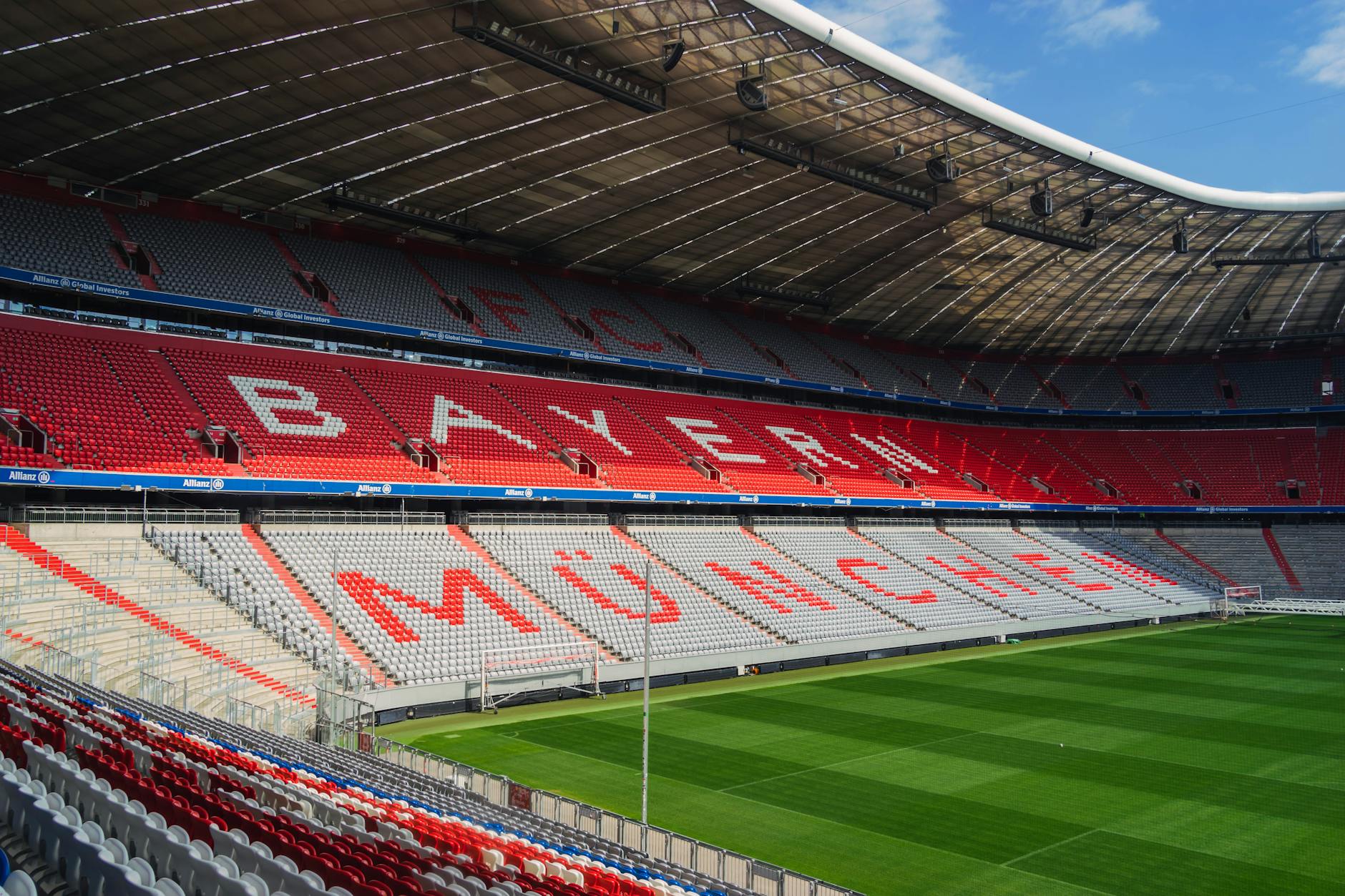
The Allianz Arena tour costs €25 for an adult, runs two to two and a half hours, and should be booked for a day with no match on. That last point saves people a wasted trip: on match days the stadium tour is cancelled or heavily curtailed, and the museum fills with several thousand people killing three hours before kick-off.
What you get for the money is a walk into a 75,024-seat bowl, down the players’ tunnel, through the dressing rooms and the press area, plus the FC Bayern Museum — which is unusually well made, and takes the club’s history seriously including the parts that do not flatter it.
This guide covers the prices, the U-Bahn, the architecture that makes the building worth seeing even if you do not care about football, and the honest question of whether it is worth €25 to someone who does not.
Allianz Arena tour prices and times
| Ticket | Adult (14+) | Concession | Child 6–13 |
|---|---|---|---|
| FC Bayern Museum + Arena Tour | €25 | €22 | €11 |
| FC Bayern Museum + Arena View | €19 | €17 | €11 |
| FC Bayern Museum only | €12 | — | — |
- Museum opening hours: 10:00 to 18:00, with last entry at 17:15.
- Tour length: 120 to 150 minutes for the combined ticket.
- Getting there: U6 to Fröttmaning, about twenty minutes from Marienplatz, then a ten-minute walk.
- Transport cost: a Zone M day ticket at €10.10 covers it, and a group day ticket is far better value for two or more.
Which ticket to buy
Three options, and the middle one exists for a reason people rarely explain.
Museum only, €12. The right choice if you have ninety minutes, a bad knee, or a genuine interest in the club’s history and none in seeing a dressing room. The museum is the better half of the experience for a lot of visitors.
Museum plus Arena View, €19. You get the museum and a look into the bowl from a viewing point, without the guided walk-round. This is the option for anyone short on time or unwilling to commit two and a half hours, and it delivers the single most striking moment — walking out and seeing 75,000 empty seats — for six euros less.
Museum plus Arena Tour, €25. The full thing: the tunnel, the dressing rooms, the press conference room, the pitch-side view. Worth the extra six euros if the behind-the-scenes access is what you came for, and not otherwise.
Insider tip: the honest recommendation for a mixed group — one football obsessive and two people being tolerant — is the €19 Arena View. It gets everyone the view, the museum absorbs the enthusiast for as long as they want, and nobody is trapped in a ninety-minute guided walk they did not choose.
Getting to the Allianz Arena
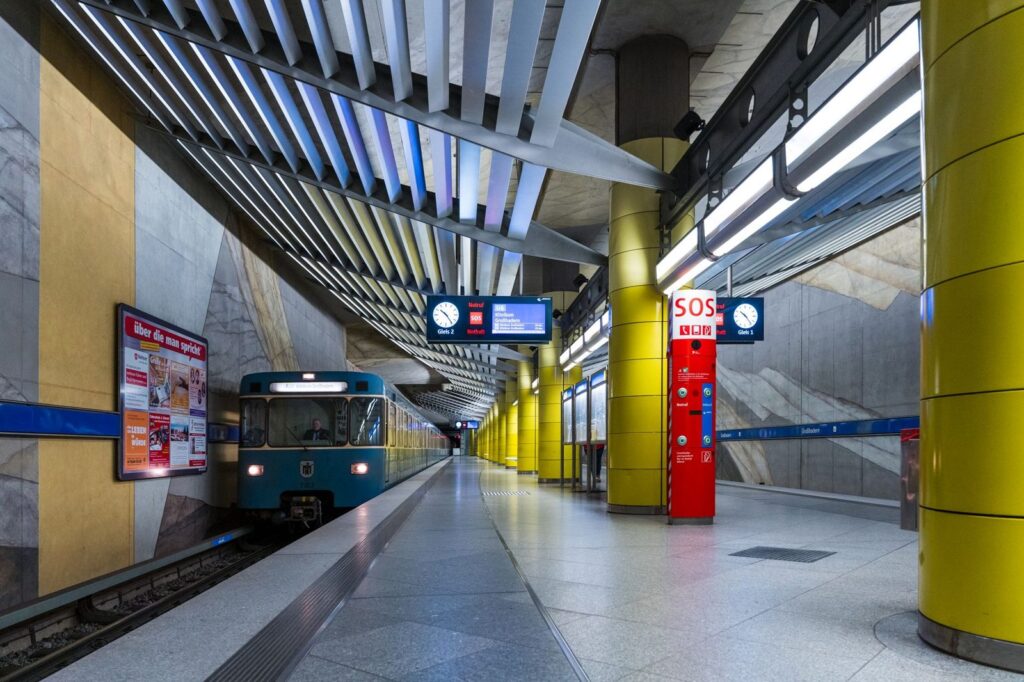
Take the U6 north to Fröttmaning. It runs direct from Marienplatz, Odeonsplatz and the Hauptbahnhof area, and takes about twenty minutes from the centre. From the station the stadium is a ten-minute walk across an elevated esplanade, with the building in front of you the whole way — which is, deliberately, one of the better architectural approaches to any stadium in Europe.
A Zone M day ticket at €10.10 covers the return journey and the rest of the city’s network. For two or more people, the group day ticket costs roughly double a single and covers up to five adults, which makes it the obvious buy.
Driving is possible — there is a very large multi-storey car park under the esplanade — and pointless. The U6 is faster, cheaper and does not involve leaving with 75,000 other cars. See our getting around Munich guide for the network.
The building itself
This is the part that justifies the trip for people with no interest in football, and most guides skip it in two sentences.
The Allianz Arena was designed by Herzog & de Meuron of Basel — the practice behind Tate Modern and the Beijing bird’s nest — with the foundation stone laid in 2002 and completion in 2005, at a total cost of around €340 million. It is one of the defining buildings of European stadium architecture and the reason every stadium built since has thought harder about its skin.
The facade is made of 2,760 inflated ETFE cushions covering about 66,500 m². ETFE is a fluorine-based plastic film — light, translucent, self-cleaning, and strong enough that a cushion of it can span a large frame with almost no supporting structure. The building has no glass and no cladding in any conventional sense; it has a quilted skin held out by air pressure.
Of those cushions, 1,056 are illuminated — arranged in 11 horizontal rows and 96 diagonal columns across roughly 26,000 m². Each one holds 24 individually addressable LED modules, which is about 300,000 LEDs in total, capable of sixteen million colours at forty frames a second.
The detail that makes it work is a restriction rather than a capability: the colour never changes within a single cushion. That was decided early, and it is why the facade reads as a clean diamond grid rather than a video screen. A building that could display anything is deliberately only allowed to display one colour per panel. Red for Bayern, blue when 1860 played here, white for the national team.
Insider tip: see it lit. The building is visible from the A9 motorway and from the U6 as it comes out of the tunnel, and it is a genuinely different object after dark from the pale grey cushion it is by day. If you are only doing the daytime tour, at least come back past it on an evening train.
What the tour actually covers
The guided walk-round takes you through the parts of a stadium that are ordinarily closed, in roughly this order:
- The bowl. Walking out into 75,024 empty seats is the moment, and it is worth the ticket on its own. Stadium interiors are far steeper and far more enclosed than television conveys.
- The players’ tunnel and the walk out to the pitch side.
- The dressing rooms, home and away — the away one notably plainer, which is not an accident anywhere in football.
- The press conference room, where you can sit behind the desk.
- The VIP and business areas, which are more interesting than they sound as an insight into how a modern club actually makes money.
Tours run in German and English. The route varies with what is happening in the building — pitch work, an event setup, a Champions League preparation — so the exact sequence is not guaranteed, and the guides are upfront about that.
The FC Bayern Museum
The museum sits inside the stadium and is included in every ticket option. It is considerably better than club museums usually are.
The trophy hall is the obvious set piece and it is genuinely absurd — the volume of silverware a club of this size accumulates does not fit on a shelf. But the more interesting material is historical: the club’s founding in 1900, its Jewish president Kurt Landauer, who was forced out by the Nazis, deported to Dachau, survived, went into exile and returned to lead the club again after the war. The museum does not skate over that period, and it deserves credit for it.
Allow ninety minutes if you are interested, forty if you are not. Signage is bilingual throughout.
The section that repays slow reading is the one on the club’s long, difficult relationship with success. FC Bayern spent decades as one German club among several before the Beckenbauer era, and the museum is candid about how much of the modern institution was built in the 1970s and how deliberately. It also handles the club’s rivalry with 1860 — which for most of the twentieth century was not obviously the smaller of the two clubs — with more generosity than you might expect.
What it does less well is the present. The recent-trophies section is a corporate exercise, and the further you get towards the current squad the more it reads like a sponsorship deck. Spend your time in the first two-thirds.
For children, the museum has interactive sections — a penalty-taking game, a commentary booth — that make it a considerably better rainy-afternoon proposition than a straight history museum would be. Our Munich with kids guide covers the alternatives when the weather closes in.
A short history of the stadium
Munich’s football moved north in 2005, and the move explains a lot about the building.
Before the Allianz Arena, both Munich clubs played in the Olympiastadion — Frei Otto’s 1972 masterpiece, and a poor football ground. The tented roof covered only part of the seating, the running track pushed spectators a long way from the pitch, and the acoustics that make it a fine concert venue make it a quiet stadium. It is a building everyone admires and nobody enjoyed watching football in.
The Allianz Arena is the direct answer: no track, steep stands, seating right on the touchline, and a roof over everyone. It was built for the 2006 World Cup, which it opened, and it has since hosted Champions League finals and European Championship matches. It is a purpose-built football ground in a way its predecessor never was, and the atmosphere difference is the whole point.
Both clubs moved in together, which is why the facade was designed to light blue as well as red. TSV 1860 subsequently left and returned to their old ground, the Grünwalder Stadion in Giesing, so the Arena is now Bayern’s alone. The blue lighting capability remains, unused, built into 300,000 LEDs — which is either a nice piece of history or an expensive monument to a failed marriage, depending on which half of Munich you ask.
The tour guides will tell you the 1860 half of this story with some relish. Our 1972 Olympics guide covers the stadium they left behind.
Eating, drinking and the practical bits
Fröttmaning is not a neighbourhood. It is a U-Bahn station, an enormous car park, a recycling hill and a stadium, on the northern edge of the city where Munich stops. There is nothing to walk to.
- Eat before or after, not there. Catering inside the stadium on a tour day is limited and priced accordingly. Have lunch in the centre or at the Olympiapark afterwards.
- The stadium is cashless on match days, running on a top-up card system you can refund at the end. On tour days a card works normally.
- Bags larger than A4 are generally refused on match days and the security check is thorough. Tours are more relaxed but do not bring a suitcase.
- The club shop at the stadium is the largest of them, and prices are the same as the city-centre branches — so buy here only if you want the range.
- Photography is allowed throughout the tour and the museum, without flash in some sections.
On accessibility: the Arena is a modern building and the tour route is largely step-free, with lifts to the main levels. Some parts of the behind-the-scenes route involve stairs and the guides will route around them if asked in advance — contact the operator rather than turning up and hoping. The U6 station and the esplanade are both step-free.
The hill you can see next to the car park is Fröttmaninger Berg, a capped landfill site with a chapel on top and a walking path up it. It takes twenty minutes and gives you the stadium from above, which is the best free view of the building there is. Almost nobody does this. Our Munich viewpoints and photo spots guide covers the rest.
When to go
| When | What it is like |
|---|---|
| Weekday morning, no match | The best time. Close to empty, full tour route, no queue. |
| Weekday afternoon | Busier with school and coach groups; still fine. |
| Weekend, no match | Busy. Book a slot in advance. |
| Match day | Avoid. Tour cancelled or curtailed; museum packed. |
| Day before a Champions League match | Route often restricted — pitch and dressing rooms may be closed. |
A Tuesday morning is close to the ideal. Our Munich sports guide covers the fixture calendar and the rest of the city’s sporting venues.
If you want to see a match instead
Worth being direct about this, because the tour is frequently the consolation prize.
FC Bayern sells out. The overwhelming majority of seats go to members and season-ticket holders, and general-sale allocations for a league fixture disappear in minutes. Your realistic routes in are the club’s own ticket exchange, where members resell at face value and which rewards patient repeat checking, or a lower-profile fixture — a midweek cup tie or an early-season game against a smaller side.
Do not buy from a tout or an unofficial resale site. The club voids tickets identified as resold outside its own platform and checks personalised tickets at the gate. People are turned away at Fröttmaning every match weekend having paid several hundred euros. This is stated policy rather than a rumour.
If you do get in, three practical notes. The stadium is cashless — food and drink run on a stored-value card you top up and can refund. The Südkurve is the standing section where the organised support gathers, and it is loud, coordinated and not where you take small children. And allow ninety minutes to arrive and an hour to leave, because 75,000 people funnel through a single U-Bahn station.
For the alternative, Munich’s second club plays at the Grünwalder Stadion in Giesing, where tickets are cheap, available, and the atmosphere is arguably better. See our neighbourhoods guide for the district.
Booking, and what can go wrong
The tour runs on timed slots and the museum on general admission, which means two different booking behaviours in one building.
- Book the tour slot online in advance, particularly at weekends and in school holidays. Slots in a given language are limited and the English ones go first.
- Museum-only tickets rarely need booking outside peak periods — you can generally walk up.
- Check the fixture list first. This is the thing that catches people out: a Champions League match the following evening can close the pitch and the dressing rooms even though the stadium is not in use that day.
- Arrive fifteen minutes before your slot. Tours leave on time and there is no catching up.
- Events other than football — concerts, corporate hire, pitch relaying in summer — also restrict the route. The operator publishes closures, but not always far ahead.
If your slot is cancelled or curtailed, the operator normally offers a downgrade to the Arena View price or a refund of the difference. Ask — it is not always volunteered.
Insider tip: summer is the quiet season for football and the busy season for pitch work. Between the end of the Bundesliga in May and its restart in August, the ground is frequently being relaid, which is the period when tours are most likely to be restricted and least likely to be full. If you are visiting in July, buy the museum ticket and treat any pitch access as a bonus.
A half-day, planned
The Arena on its own is an awkward length — too long for a morning, too short for a day, and stranded at the end of a U-Bahn line with nothing around it. Pairing it with the Olympiapark solves that, and the two are four stops apart with one change.
| Time | What |
|---|---|
| 09:40 | U6 from the centre to Fröttmaning |
| 10:00 | Museum and Arena Tour, first slot of the day |
| 12:30 | Optional: twenty minutes up the Fröttmaninger Berg for the view back |
| 13:00 | U6 south, change to the U3 for Olympiazentrum |
| 13:30 | Lunch, then the Olympiapark — Frei Otto’s roof and the 1972 memorial |
| 15:30 | Up the Olympiaberg. Free, and the best panorama available while the tower is shut |
| 16:30 | BMW Welt, opposite, which is free to enter |
| 18:00 | U3 back to the centre |
That is two landmark buildings, a park, a memorial and a panorama for about €35 a head, which is unusual value. For where the rest of the city fits around it, see our things to do in Munich guide.
Is it worth €25?
The straight answer: yes if you like football, no if you do not, and the architecture is a genuine third reason that sits between the two.
- Football fans: comfortably worth it. Two and a half hours, real access, and one of the best club museums in Europe.
- Architecture and design interest: worth it, but consider the €19 Arena View. The building’s significance is mostly external and you can appreciate the ETFE skin from the esplanade for nothing.
- Families: good value at €11 a child, and the tour is well pitched for older children. Under-tens may find 150 minutes long.
- Rainy day in Munich: one of the better indoor options, and it fills a whole afternoon.
- No interest in football at all: spend the €25 on the Residenz and the Alte Pinakothek instead. No amount of good design saves a football museum for someone who is indifferent.
Combining it with the rest of the day
Fröttmaning is at the northern end of the U6 and the Olympiapark is a short hop away on the U3, which makes an obvious pairing: the Arena in the morning, the Olympiapark after lunch.
That gives you two of the most significant pieces of architecture in modern Munich in a single day — Frei Otto’s 1972 tented roof and Herzog & de Meuron’s 2005 cushion facade, thirty years and an entire philosophy apart. The Olympiapark is free to walk around, though note that the Olympiaturm has been closed since June 2024 and is expected to reopen during 2027; until then, climb the Olympiaberg instead, which is free and gives you the city with the Alps behind it.
Also on the U3 at Olympiazentrum: the SAP Garden, which opened in September 2024 and hosts ice hockey and basketball, and BMW Welt and the BMW Museum, which are free and paid respectively and directly opposite. Our Olympic quarter guide covers the area, and the 1972 Olympics guide the history.
Frequently Asked Questions
How much is the Allianz Arena tour?
The combined FC Bayern Museum and Arena Tour is €25 for adults aged 14 and over, €22 concession and €11 for children aged 6–13. Under-sixes are free but need a ticket. Museum plus Arena View is €19, and the museum alone is €12.
How long does the Allianz Arena tour take?
Between 120 and 150 minutes for the combined museum and tour ticket. The museum on its own takes about ninety minutes if you read the displays, forty if you do not. Add roughly an hour of travel each way from the city centre.
How do I get to the Allianz Arena?
Take the U6 to Fröttmaning, about twenty minutes from Marienplatz, then walk ten minutes across the esplanade. A Zone M day ticket at €10.10 covers it. Do not drive — the U-Bahn is faster and there is nothing to gain from a car.
Can I do the tour on a match day?
Generally not. On match days the stadium tour is cancelled or heavily curtailed and the museum is crowded with people waiting for kick-off. Check the fixture list and book a non-match weekday — a Tuesday morning is close to ideal.
What is the Allianz Arena’s capacity?
75,024. The stadium was designed by Herzog & de Meuron and completed in 2005 at a cost of around €340 million.
Why does the Allianz Arena change colour?
The facade is built from 2,760 inflated ETFE cushions, of which 1,056 are lit from within by around 300,000 LEDs. Historically red meant FC Bayern, blue meant TSV 1860 and white meant the German national team. The colour is never varied within an individual cushion, which is why the building reads as a diamond grid rather than a screen.
Can I get FC Bayern tickets as a tourist?
It is difficult. Most seats go to members and season-ticket holders and general sale disappears in minutes. The club’s own ticket exchange, where members resell at face value, is the legitimate route and rewards repeat checking. Avoid touts and unofficial resale sites entirely — the club voids those tickets and turns people away at the gate.
Is the Allianz Arena worth visiting if I do not like football?
The building is genuinely significant architecture and worth seeing from the outside, ideally lit at night, for nothing. Whether the €25 interior tour is worth it is a different question, and for someone with no interest in the sport the answer is probably no — the €19 Arena View is the better compromise if you are going anyway.
Where to go next
For the wider sporting city — the Eisbach wave, the Olympiapark, cycling the Isar and the SAP Garden — see our Munich sports guide. If you are building a full day around the north of the city, the Olympic quarter is one U-Bahn change away, and our Munich itineraries guide covers how it fits into a longer trip.
Related Guides
- Sport in Munich: Stadiums, Surfing and Getting Active — the cluster hub
- How to Get FC Bayern Tickets and See a Match — High volume and a genuinely confusing process, so there is room to beat resellers
- Eisbach Surfing: Munich’s River Wave Explained — Iconic, heavily searched, zero coverage on site
- Olympiapark Munich: Complete Visitor Guide — Only covered obliquely via the 1972 Olympics history post