Munich 1972 Olympics: History, Tragedy & Lasting Legacy
The Munich 1972 Olympics changed sport forever. History, the massacre, Olympiapark today, and what to visit in 2026.
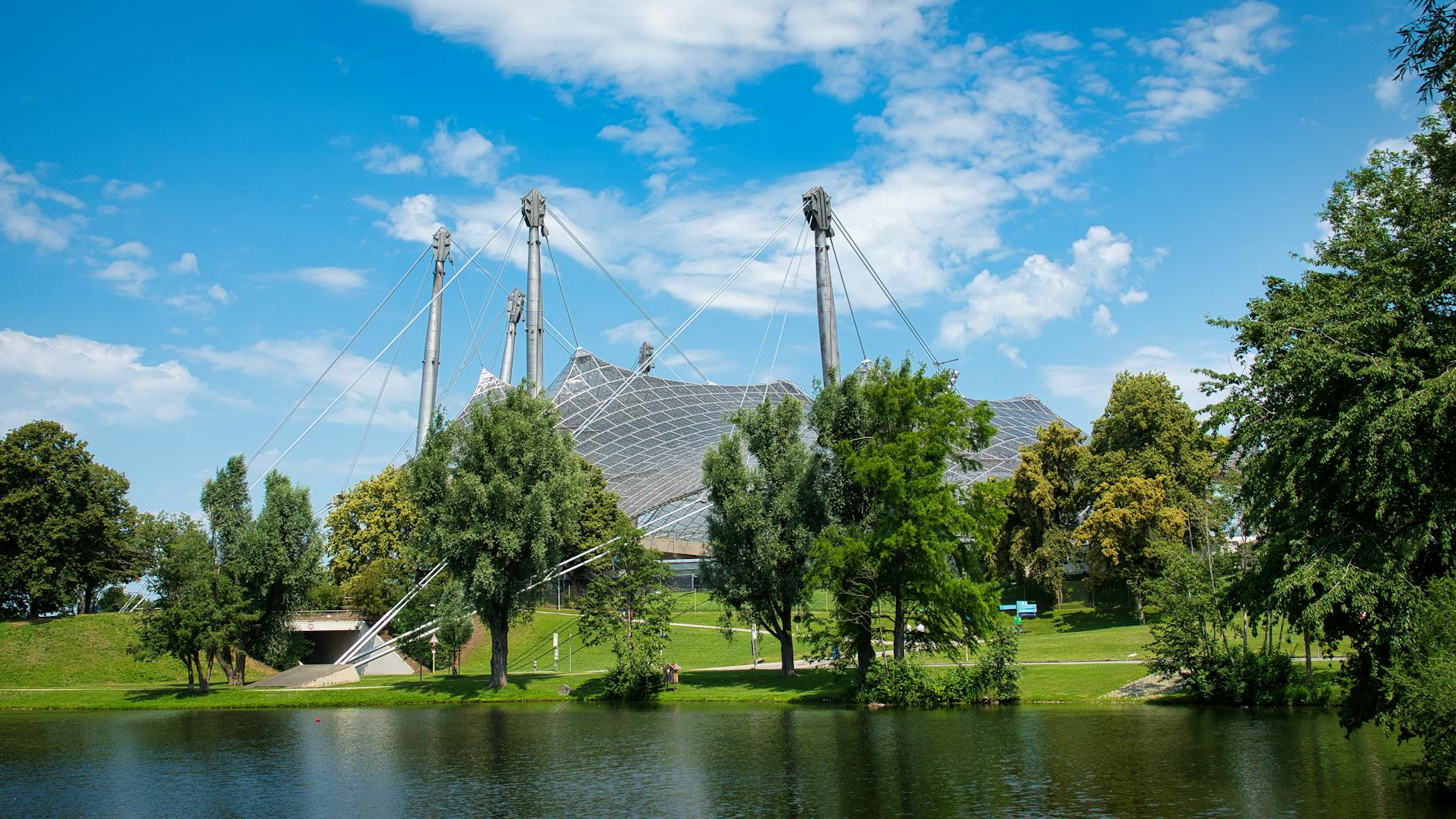
The Munich 1972 Olympics were meant to be West Germany’s joyful reintroduction to the world. Twenty-seven years after the fall of the Third Reich, the Federal Republic chose the colour pastel, the dachshund Waldi as mascot, and Frei Otto’s billowing tent roofs to project an image of openness — “die heiteren Spiele,” the Cheerful Games. For 10 days, it worked. Then on September 5, 1972, a Palestinian terror cell broke into the Olympic Village and the Munich 1972 Olympics became history’s most consequential Games for entirely different reasons. This guide walks through what happened, what survives in Olympiapark today, and where to pay respects — useful both as a visitor’s primer and as historical context for anyone exploring Munich’s modern landscape.
Munich 1972 Olympics at a Glance
| Detail | Fact |
|---|---|
| Games dates | August 26 – September 11, 1972 |
| Nations | 121 |
| Athletes | 7,134 (1,059 women, 6,075 men) |
| Events | 195 in 21 sports |
| Motto | Die heiteren Spiele (The Cheerful Games) |
| Mascot | Waldi the dachshund — first Olympic mascot |
| Identity designer | Otl Aicher |
| Main architects | Behnisch & Partner with Frei Otto |
| Main venue | Olympiastadion (capacity 80,000) |
| Cost | ≈DM 1.97 billion (~€7.5 billion today) |
| U-Bahn today | Olympiazentrum (U3) |
Why Munich Got the 1972 Olympics
On April 26, 1966, the IOC voted in Rome to award the XX Olympiad to Munich, edging out Madrid, Montreal and Detroit. The bid was led by Mayor Hans-Jochen Vogel and supported by Bavarian premier Alfons Goppel. The political subtext was unmistakable: Germany wanted these Games to undo the optics of the 1936 Berlin Olympics, the Nazi propaganda spectacle 36 years earlier. The bid won, the press release was light on overt politics, and a 280-hectare site north-west of central Munich — until then a flat training ground heaped with WWII rubble — was earmarked for the new Olympic Park.
The “Cheerful Games” Concept
Every visual decision contradicted 1936. Where Berlin used monumental neoclassicism and martial reds, Munich chose pastel green, blue, orange and silver. Where Berlin staged Riefenstahl-style athletic worship, Munich’s Olympic identity — designed by Ulm-school graphic designer Otl Aicher — used playful pictograms and Univers typography. Where 1936 deployed armed soldiers as security, 1972 relied on unarmed “Olys,” the cheerful sky-blue-uniformed stewards. Even Waldi the dachshund was a deliberate softening: the mascot of the Games of openness was literally a friendly Bavarian dog. The architectural team made the same statement in stone, steel and cable: open buildings, glass surfaces, an artificial lake, an artificial hill made from war rubble — symbols of democracy, transparency and renewal.
Olympiapark Architecture: The Tent Roofs That Changed Stadium Design
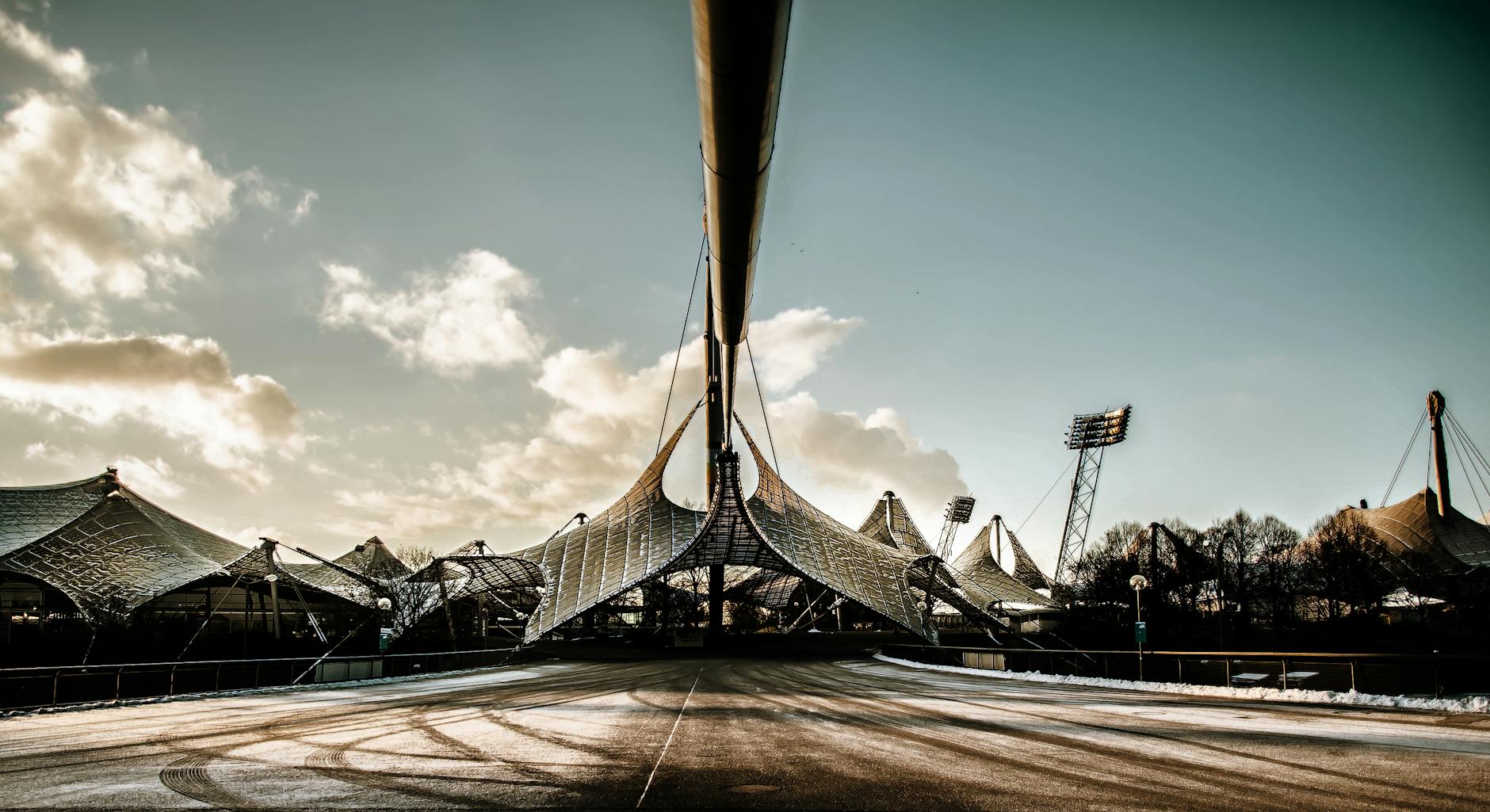
The defining Munich 1972 Olympics image is Frei Otto’s roof — a vast, cable-net acrylic-glass canopy that swoops over the Olympiastadion, Olympiahalle and Schwimmhalle as if the buildings had been wrapped in a single transparent fabric. Behnisch & Partner won the competition with Otto handling the lightweight structural engineering. It was the first stadium roof of its kind, requiring computers (then exotic) for the tension calculations. The roof transformed how architects worldwide thought about big-span structures and inspired everything from airports to the Allianz Arena two generations later. Below the canopy, the venues sit half-buried in landscaped embankments so that no one structure dominates the skyline. The whole composition reads as a city in a park rather than a park around a city.
Olympiastadion
The 80,000-seat athletics and football venue hosted the opening ceremony, track-and-field events and football final. FC Bayern Munich and TSV 1860 München shared it as a home stadium until 2005 when Bayern moved to the Allianz Arena. It still hosts concerts (Rolling Stones, Bruce Springsteen, Adele have all played here), American football and amateur events. Stadium roof tours run year-round.
Olympiaturm (Olympic Tower)
The 291-metre TV and observation tower is Munich’s tallest structure. The viewing platform at 190 m gives 360-degree panoramas as far as the Alps on clear days. Adult admission in 2026 is €13. The revolving restaurant 181 First Class sits a level below the platform.
Olympiaberg (Olympic Hill)
The 60-metre artificial hill in the south of the park is heaped from WWII rubble — a deliberate transformation of war debris into recreation. The summit gives the best free view in Munich. Locals come for sunrise yoga, kite-flying and free open-air concerts in summer.
Olympic Village (Olympisches Dorf)
The athletes’ village — terraced housing, pedestrianised concourses, raised car-free decks — became a radical urban-design template. After the Games it was converted into student housing and middle-class apartments; today around 6,000 people live there. The site is open to walk through, with the Connollystraße section preserved as both heritage and memorial.
Athletic Highlights of the Munich 1972 Olympics
For 10 days the Games delivered on their promise. American swimmer Mark Spitz won seven gold medals — every event he entered — a record that stood for 36 years until Michael Phelps broke it. Soviet gymnast Olga Korbut, 17 years old and 1.55 m tall, performed routines no one had attempted in major competition: back somersaults on the balance beam, the “Korbut Flip” on uneven bars. She won three golds, charmed global television audiences and is credited with transforming gymnastics from elegance-led to acrobatic. Lasse Virén of Finland completed the 5,000 m/10,000 m double after falling mid-race. Soviet basketballer Aleksandr Belov hit the most controversial buzzer-beater in Olympic history to win the men’s final against the USA in three contested final seconds. West Germany finished fourth on the medal table with 13 golds — its best Summer Games haul.
The Munich Massacre, September 5–6, 1972
Around 4:30 am on September 5, eight members of the Palestinian militant group Black September climbed the perimeter fence of the Olympic Village and entered the Israeli team’s quarters at Connollystraße 31. In the assault that followed, wrestling coach Moshe Weinberg and weightlifter Yossef Romano were killed resisting the attackers. Nine other Israeli team members — coaches, judges and athletes — were taken hostage. The terrorists demanded the release of 234 Palestinian and other prisoners held by Israel, plus safe passage out of West Germany.
Negotiations between West German authorities, Israeli prime minister Golda Meir’s government, and the attackers stretched through the day. Television cameras carried the standoff live to an estimated 900 million viewers — the largest TV audience in history at that point. Late that evening the hostages and their captors were flown by helicopter to Fürstenfeldbruck airbase, west of Munich, ostensibly to board a flight out of Germany. There, a botched West German police rescue operation — too few snipers, no armoured vehicles, no professional counter-terrorism unit — collapsed into a gun-and-grenade firefight. By 12:30 am on September 6, all nine remaining Israeli hostages, one German police officer (Anton Fliegerbauer), and five of the eight attackers were dead. Three terrorists were captured.
The Games were suspended for 34 hours — the first major interruption in Olympic history. IOC President Avery Brundage announced “The Games must go on,” a phrase that still sparks debate. The memorial service in the Olympiastadion was attended by 80,000 people. The athletic events resumed, but the cheerful spirit was over.
Aftermath and Long-Term Consequences
The Munich massacre rewired three things permanently. First, Olympic security: every subsequent Games has been built around counter-terrorism architecture, armed perimeters and intelligence-led screening. Second, German counter-terrorism: the disaster at Fürstenfeldbruck — exposed as having no specialist unit — triggered the founding of GSG 9, now one of the world’s most respected counter-terror forces, in April 1973. Third, Israeli foreign policy: the Mossad launched Operation Wrath of God, a decade-long campaign of targeted assassinations of those it judged responsible. The captured terrorists were released by West Germany seven weeks later after a Lufthansa plane was hijacked — a release whose details remained controversial for decades.
In 2022, on the 50th anniversary, German President Frank-Walter Steinmeier publicly asked forgiveness from the victims’ families and Germany agreed to a €28 million compensation settlement after decades of family advocacy and partial denials of responsibility.
Memorials You Can Visit Today
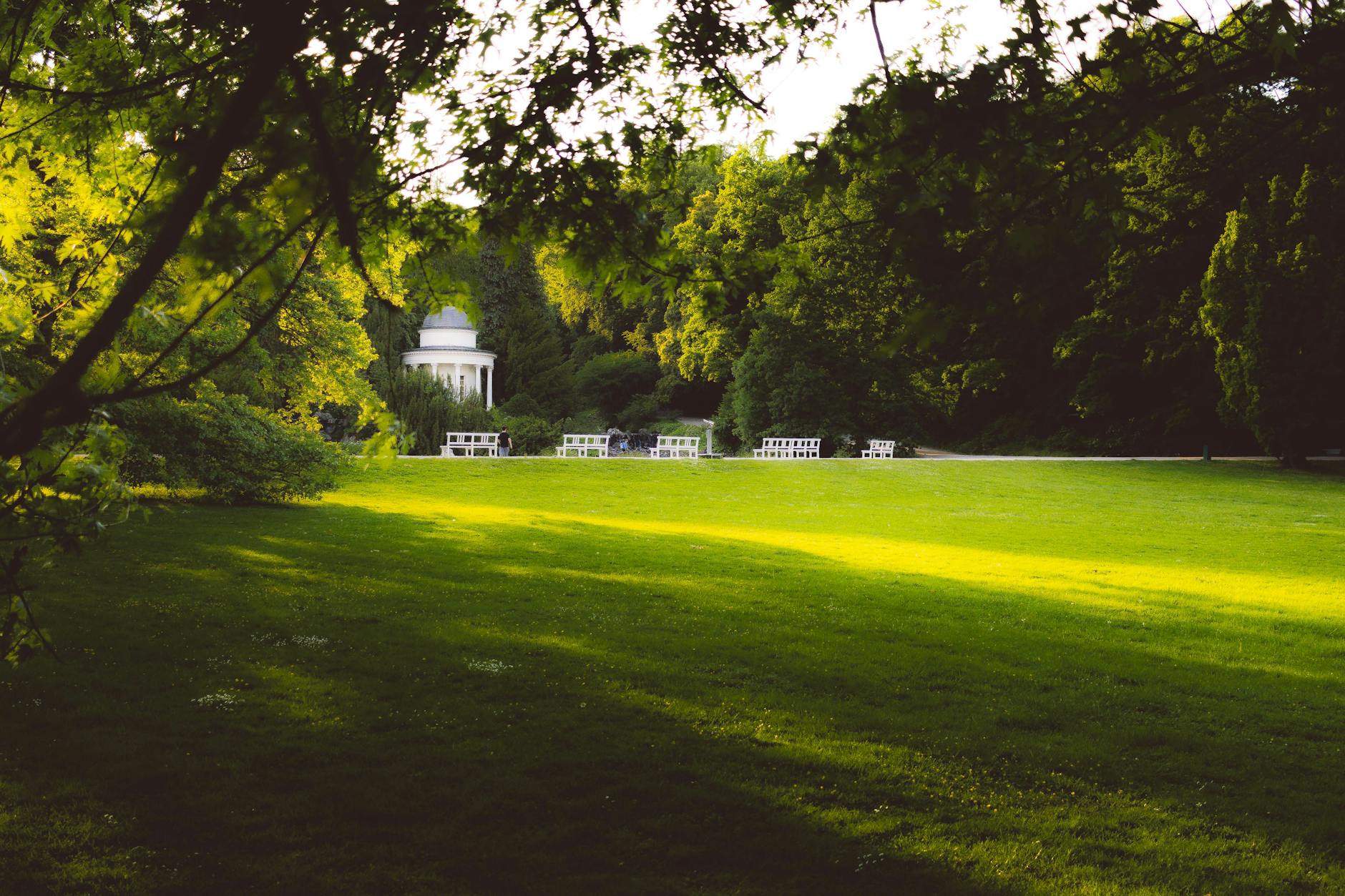
- Erinnerungsort Olympia-Attentat (Place of Remembrance): Opened September 6, 2017 by Presidents Reuven Rivlin of Israel and Frank-Walter Steinmeier of Germany. A 60-metre cut into the Olympic Park’s grass embankment houses a pavilion with photographs and biographies of the 11 Israeli victims and Officer Anton Fliegerbauer, plus a multimedia presentation of the 1972 events. Free, open daily. Designed by Brückner & Brückner Architekten.
- Connollystraße 31 Memorial Plaque: A modest stone plaque on the wall of the actual building where the attack began, listing the names of the murdered athletes and coaches in German and Hebrew.
- Israeli Memorial Stone: A simple stele near the Olympic Stadium, installed in 1995, with an inscription in Hebrew, German and English.
- Fürstenfeldbruck Air Base Memorial: Outside Munich, the site of the failed rescue has a memorial wall — visitable by appointment.
- Jewish Museum Munich: Hosts permanent and rotating exhibitions on Jewish life in Bavaria, including content on the massacre. Free entry to the synagogue forecourt; €6 to the museum.
Olympiapark Today: What to See and Do
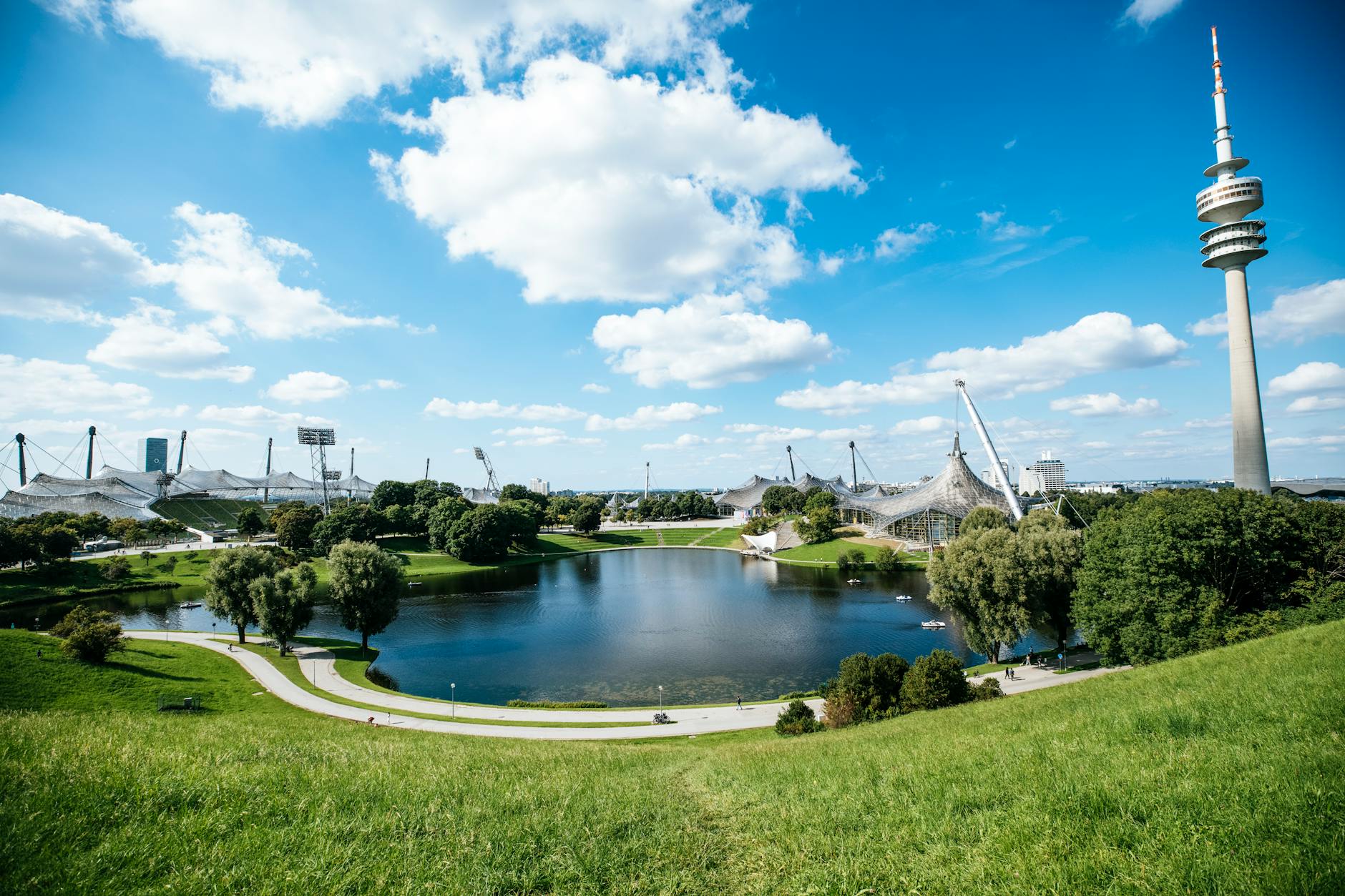
Five decades after the Munich 1972 Olympics, Olympiapark is Munich’s largest single leisure destination. Roughly 230 million visitors have used it since the Games. Activities and attractions you can do today:
- Olympic Tower observation deck — €13 adult, panoramic views, open daily 9:00–23:00
- Olympic Stadium Roof Tour — 90-minute guided climb on the tent roof, harnessed (€55, weather-dependent, summer)
- SEA LIFE Munich — large aquarium at the park’s edge (€23 adult)
- Olympic Lake and pedalo rental — summer only
- Open-air rock concerts — Theatron summer programme is free; major acts play the stadium
- Olympic Walk of Stars — handprints of musicians who have performed here
- Olympia Eissport-Zentrum — public ice-skating year-round
- BMW Welt and BMW Museum — directly across the street; combine in a half-day
- Self-guided Olympia walk — free map available from the Olympia Service Centre
- Bavarian Olympic Trail (Olympia-Pfad) — a 30-station information path through the park
- Hellabrunn-style mini-zoo on Olympia Mountain — small petting zoo, free
How to Get There
Take U3 to Olympiazentrum — 12 minutes from Marienplatz. From Hauptbahnhof, take the U1 to Rotkreuzplatz then change. The park is open 24 hours; individual attractions have their own hours. Allow a half-day minimum to combine memorial visits with one ticketed attraction (Olympic Tower or stadium tour).
Combining Olympiapark with BMW Welt
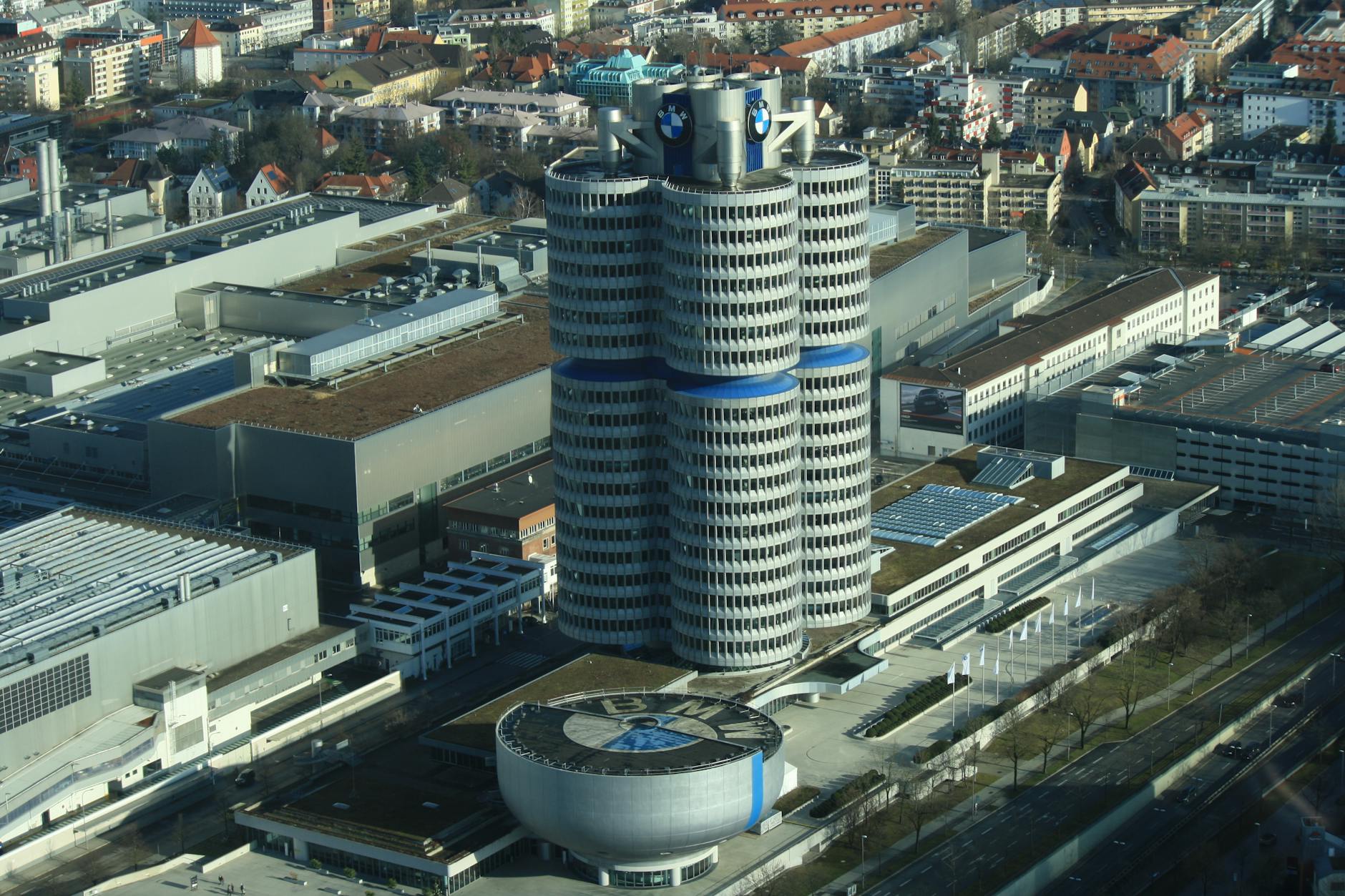
The BMW Vierzylinder (the four-cylinder headquarters tower designed by Karl Schwanzer) and the curving BMW Museum next door also opened in 1972 — Munich’s industrial showpiece timed to the Games. Across the street, BMW Welt (Coop Himmelb(l)au, 2007) is free to enter. The natural visit pattern: morning at the BMW complex, lunch in the park, afternoon at the Olympic Tower and memorial.
Munich 1972 Olympics FAQs
When did the Munich 1972 Olympics take place?
August 26 to September 11, 1972 — 17 days of competition across 195 events in 21 sports.
Where did the Munich massacre happen?
The hostage-taking began at Connollystraße 31 inside the Olympic Village. The final, fatal shoot-out happened at Fürstenfeldbruck air base, around 30 km west of Munich.
Can I visit the Olympic Stadium today?
Yes. The Olympiastadion is open to ticketed visits, with general access on event days and dedicated stadium and roof tours running year-round. FC Bayern Munich moved out in 2005, but TSV 1860 still uses adjacent facilities and major concerts use the stadium.
What was Waldi the dachshund?
The first official Olympic mascot — a striped Bavarian dachshund designed by Otl Aicher’s team. Waldi was meant to embody the cheerful, friendly tone of the Games. Today’s Olympic mascot tradition starts here.
Is there a single official memorial?
The Erinnerungsort Olympia-Attentat in Olympiapark, opened in 2017, is the main official memorial. The Connollystraße 31 plaque is the historical site itself.
The 21 Sports of the Munich 1972 Olympics
The 1972 Games featured 21 sports across 195 events. Athletics, swimming, gymnastics and basketball dominated the global broadcast; archery and handball returned to the Olympic programme after multi-decade gaps; team handball debuted at this Games (a German invention re-entering the Olympics for the first time as a Summer event). The other sports: boxing, canoeing, cycling, equestrian, fencing, football, hockey, judo, modern pentathlon, rowing, sailing, shooting, volleyball, water polo, weightlifting, wrestling and yachting. Each sport had its own facility built or refurbished for the Games. The Olympic Park concentrated athletics, swimming, gymnastics, judo, wrestling and basketball; football took place across 21 stadiums in Munich, Augsburg, Nuremberg, Regensburg and Passau; rowing at Oberschleißheim Regatta Course (still in use today); shooting in Hochbrück; equestrian at Nymphenburg Palace grounds and Riem.
Mark Spitz: The Defining Athletic Story
Mark Spitz arrived in Munich at age 22, having won two golds at the 1968 Mexico Games but having underperformed his pre-Olympic predictions. The 1972 Munich 1972 Olympics turned that around dramatically. Across the eight days of swimming competition, Spitz won seven gold medals — the 100m and 200m freestyle, 100m and 200m butterfly, 4×100m and 4×200m freestyle relays, and 4×100m medley relay. Every race was a world record. The seven-gold haul stood unbroken for 36 years until Michael Phelps won eight at Beijing 2008. Spitz left Munich on September 5 — the day of the hostage crisis began — and never returned to the Olympics as an athlete.
Olga Korbut and the Gymnastics Revolution
The 17-year-old Soviet gymnast arrived in Munich relatively unknown. By the end of the Games she had won three gold medals (team, balance beam, floor exercise) and one silver. More important than the medals: her routines redefined what gymnastics could be. The “Korbut Flip” on uneven bars — a back-handspring rebound — had never been performed in major competition. Her tearful collapse after a beam error became the first widely-televised emotional sports moment, watched by 300+ million viewers globally. Korbut single-handedly shifted gymnastics from a sport of elegance and balance to one of acrobatic risk. Romanian Nadia Comăneci’s perfect-10 routines at Montreal 1976 built directly on Korbut’s Munich foundation.
The Soviet-American Basketball Final
The 1972 men’s basketball gold-medal game between the USA (undefeated in Olympic basketball, 62-0 since 1936) and the Soviet Union ended in one of sport’s most disputed finishes. After regulation, with the score 49-48 to the Soviets, three seconds were put back on the clock by the head of FIBA — twice — until Soviet center Aleksandr Belov caught a full-court pass and scored at the buzzer to win 51-50. The American team refused to accept their silver medals in protest; the medals remain in a vault in Lausanne to this day. The game ended the USA’s 36-year Olympic basketball dominance and sparked decades of FIBA officiating reform.
Otl Aicher’s Olympic Identity Design
The single most enduring legacy of the Munich 1972 Olympics is its visual identity. Otl Aicher, working from the Ulm School of Design, created the pictograms used to mark every sport and venue. His pictograms — abstract, geometric, instantly readable across language barriers — became the global standard for sports and wayfinding signage, used in every subsequent Olympic Games and adapted for airports, train stations and Olympic-style events worldwide. The Univers font he chose, the pastel colour palette of blue/orange/silver/green, and the spiral Speerträger logo by Coordt von Mannstein together built one of the strongest visual identities in 20th-century design. Munich’s Pinakothek der Moderne now houses the original design archive. Visit the design floor for a deeper look at how the Munich 1972 Olympics design system shaped everything after.
Waldi the Dachshund: The First Olympic Mascot
Waldi was the first official mascot in modern Olympic history — a striped Bavarian dachshund created by Otl Aicher’s team in 1969. He came in five rainbow stripes (blue, green, yellow, orange, blue) representing both the Olympic rings and Munich’s pastel design language. The dachshund choice was deliberate: a friendly, low-to-the-ground, family-companion breed, the visual opposite of the more military symbology Berlin had used in 1936. Waldi-shaped souvenirs flooded Munich during the festival; original 1972 Waldi figures are now collector items selling for €100+. Every Olympics since has had an official mascot — Pyrenean Eagle Schuss for Grenoble 1968 Winter Games came first, but Waldi was the first for a Summer Olympics.
Walking Tour of Olympic Sites
A two-hour self-guided walk from U-Bahn Olympiazentrum lets you see the major sites in sequence. Start at the U-Bahn exit and head south to the Olympic Lake and Olympic Tower (10 minutes; the tower observation deck adds €13 and 30 minutes if you go up). Continue south to the Olympiastadion (10 min; stadium roof tours are weather-dependent). From there, walk the embankment up to the Erinnerungsort Olympia-Attentat memorial (15 min). Continue across the park to the Olympic Village’s Connollystraße 31 memorial plaque (20 min walking through residential streets that are now home to 6,000 people). End at BMW Welt (15 min walk, free entry). Total time with stops: 2–3 hours, plus any ticketed attraction time.
Olympic Park Beyond the 1972 Games
After the Games, Munich made an unusual choice: rather than tear the venues down or convert them to other uses, the city kept the entire park as an open public space. The stadium hosted FC Bayern Munich and TSV 1860 München until 2005, when Bayern moved to the Allianz Arena and 1860 followed for a few seasons before returning to a smaller stadium. The Schwimmhalle is still a public pool. The Olympic Hall hosts concerts and trade fairs. The 1972 Olympic Village converted into mixed-income housing (a unique example of Olympic urbanism actually working long-term). Throughout the year, the Olympic Park hosts free concerts (Theatron series in summer), the SommerTollwood festival in July, the Munich Marathon, ice-skating in winter, and open public access to all green areas. It’s one of the most-visited public spaces in Bavaria.
For where to watch and play sport in Munich today, see our Munich sports guide.
Plan Your Visit
The Munich 1972 Olympics sit at the intersection of triumph and tragedy in modern German history. Olympiapark today carries both. This guide is part of our deeper Munich history and architecture pillar; for related sites see our guides to Munich’s WWII history and memorials, BMW Museum and BMW Welt, the complete history of Munich, and Munich architecture.