Munich Christmas Market Food and Drinks: Complete Eating Guide
Complete Munich Christmas market food guide. Glühwein, Lebkuchen, Bratwurst, Feuerzangenbowle and more festive treats.
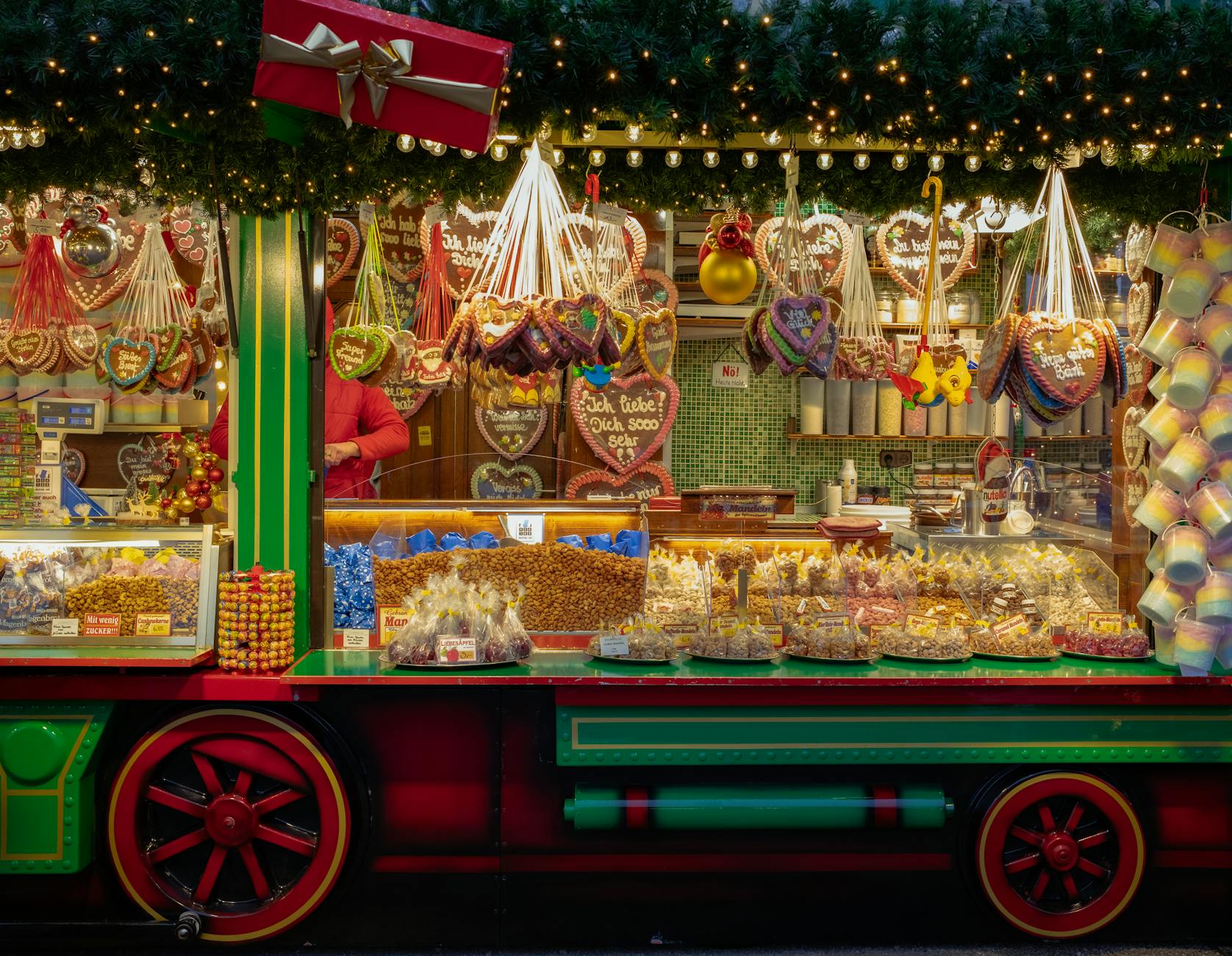
Munich Christmas market food is the real reason locals start ducking out of the office at four o’clock all through Advent. The wooden stalls around Marienplatz, Tollwood, and a dozen smaller squares pump out clouds of cinnamon-laced steam, charcoal smoke from grilled Bratwurst, and the unmistakable caramel scent of roasting almonds. This 2026 guide walks you through every classic drink (Glühwein, flaming Feuerzangenbowle, Eierpunsch), every savory snack (Nürnberger sausages, sizzling Reiberdatschi, Käsespätzle), and every Christmas sweet worth the calories — plus the Pfand cup system, etiquette, dietary tips, and three suggested food crawls.
Quick Guide: What to Expect
| Detail | What to Know |
|---|---|
| Drink price (per mug) | €3.50–€6 (Glühwein, punch, hot chocolate) |
| Food price (per portion) | €5–€12 (Bratwurst, Käsespätzle, Flammkuchen) |
| Cup deposit (Pfand) | €3–€5, fully refundable on return |
| Best market for foodies | Tollwood (organic, world cuisine, vegetarian/vegan) |
| Most classic Bavarian fare | Marienplatz Christkindlmarkt |
| Most unusual food | Mittelaltermarkt at Wittelsbacherplatz (mead, game stews, fire-roasted meat) |
| Cash or card? | Bring cash — most food stalls do not take cards |
| Vegetarian options | Plentiful at Tollwood, limited at traditional markets |
| Tipping | Not expected; locals round up €0.50–€1 |
| Best time to eat | Early dinner (17:00–19:00) — peak atmosphere, fresh-off-the-grill food |
Hot Drinks: The Soul of a Munich Christmas Market
Hot drinks are why German Christmas markets exist. You arrive frozen, wrap your fingers around a ceramic mug, and ten minutes later you’re warm enough to wander again. Munich serves the full pantheon.

Glühwein (Mulled Wine) — €3.50–€5
The universal Munich Christmas market drink. Glühwein Munich is red wine warmed with cinnamon, clove, star anise, orange peel, and sugar — steaming, never boiling. White Glühwein (Weißer Glühwein) is increasingly popular and tastes lighter, with citrus and apple notes. Expect to pay around €5 for the wine itself, plus a refundable cup deposit. Ask for it “mit Schuss” (“with a shot,” usually rum or amaretto) for an extra €1 and an extra punch.
Kinderpunsch — €3.50–€4.50
Alcohol-free “children’s punch,” but order it without shame as an adult — it’s a fruity blend of apple juice, black tea, orange, cinnamon, and clove, served just as hot and twice as drinkable. Designated drivers, pregnant visitors, kids, and anyone on their fourth market of the day all rely on it. Every Glühwein stall serves it.
Feuerzangenbowle — €6–€7
The theater of Christmas market drinks. A rum-soaked sugar cone (the “Zuckerhut”) is suspended over a cauldron of Glühwein on an iron tongs (“Feuerzange”), set alight, and dripped molten-caramel-and-rum into the wine below. Munich’s most famous Feuerzangenbowle setup runs behind the Schrannenhalle at Blumenstraße 22, between the Viktualienmarkt and the Hochbunker, daily from late November through January 6. The huge bronze cauldron is wreathed in flames, the spiced rum fumes drift across the alley, and you’ll smell it before you see it. A 2026 must-do.
Eierpunsch — €4.50–€5.50
Germany’s eggnog-style hot punch: egg yolks whisked with sugar, white wine, and rum until thick and faintly custardy, served topped with whipped cream and cinnamon. Richer than Glühwein and deeply satisfying after a cold tram ride. Available at most central markets including Marienplatz and the Residenz.
Bayrischer Glühpunsch — €4.50–€5.50
The Bavarian style: a fruit-forward punch made with red or white wine, black tea, orange and lemon juice, rum, and warming spices. Less wine-heavy than Glühwein, fruitier and a touch sweeter — locals consider it the refined cousin. Look for stalls labeled “Bayrischer Punsch” at Marienplatz and Schwabing.
Glühbier (Mulled Beer) — €4.50–€6
Yes, mulled beer — Bavaria, after all. Dark Bavarian beer (often Dunkel or Weißbier) warmed with honey, cinnamon, clove, and vanilla. A polarizing drink: regional, traditional, and not at all what Munich’s beer purists expect. Try it at the Mittelaltermarkt — order a small mug.
Heisser Hugo / Heisser Aperol — €5–€6.50
The trendy newcomers. Heisser Hugo turns the cold elderflower-Prosecco cocktail into a hot mug with white wine, elderflower syrup, and mint. Heisser Aperol warms the bitter-orange spritz with orange juice and spices. Photogenic and beloved by Munich’s younger crowd — the Pink Christmas market is their spiritual home.
Heisse Schokolade mit Amaretto — €4.50–€6
Thick Bavarian hot chocolate, sometimes made with real melted chocolate, laced with Amaretto and topped with cream. Order “mit Sahne” for the whipped-cream tower. A great option for people who don’t love Glühwein.
Jagatee (Hunter’s Tea) — €4.50–€6
An Austrian-Alpine import: hot black tea spiked with rum, red wine, fruit juice, and spices. The rum is the dominant note — a serious warmer. Common at Alpine-themed and medieval markets including Wittelsbacherplatz.
Met (Mead) — €4–€6
Honey wine served hot in clay goblets, almost exclusively at the Mittelaltermarkt at Wittelsbacherplatz. Sweet, viscous, surprisingly strong — costumed vendors pour from heavy oak barrels into thick earthenware mugs that feel like they belong in a Tolkien novel.
The Pfand Cup System Explained
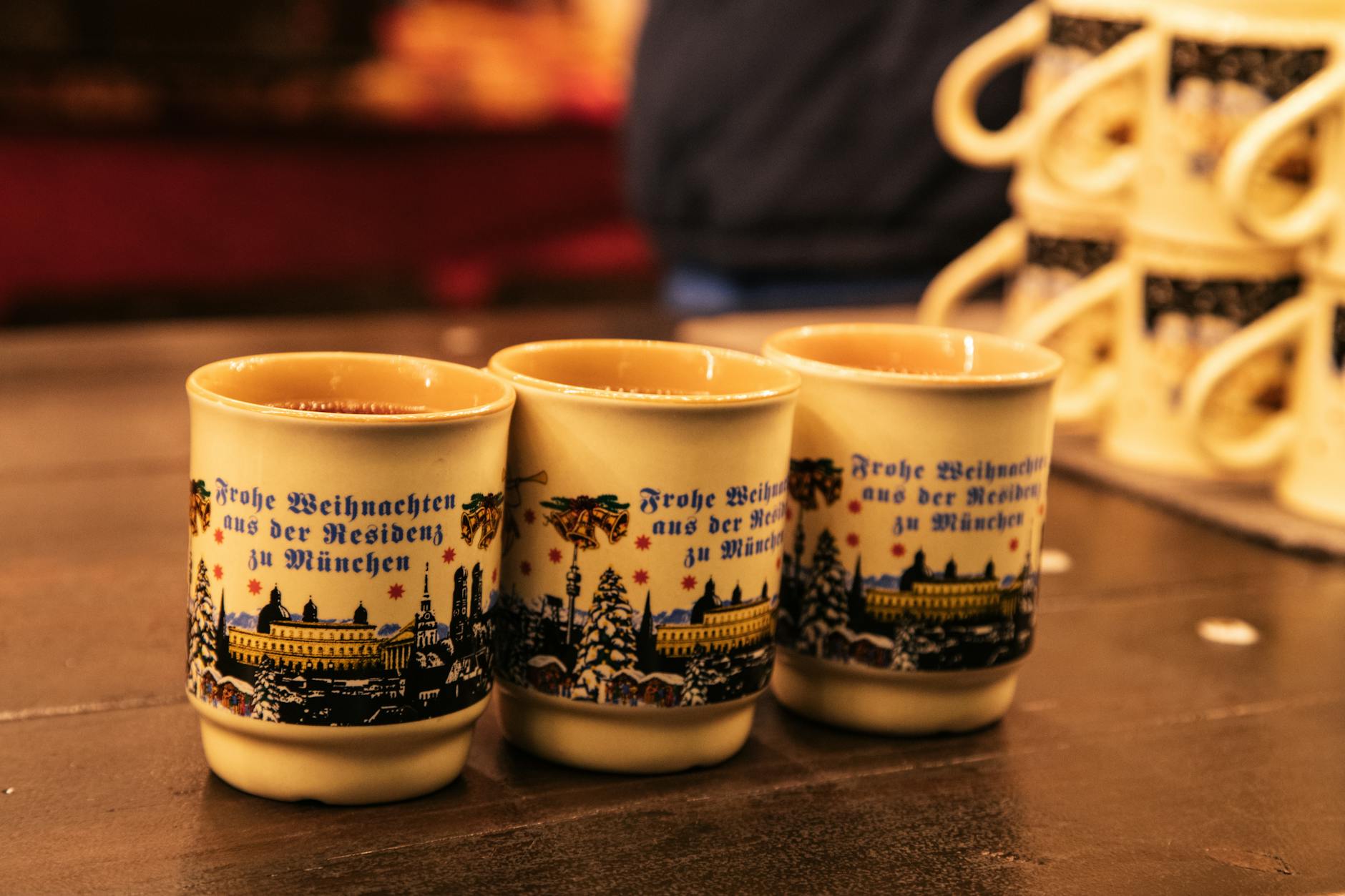
Here’s the system that catches every first-time visitor off-guard. When you order Glühwein, the price includes a separate refundable deposit (“Pfand”) for the ceramic mug — typically €3–€5 at Munich’s markets. You pay it up front; when you return the mug to any drinks stall at the same market, you get the deposit back.
How the Pfand Works in Practice
- You pay: Drink price (e.g., €5) + Pfand (e.g., €4) = €9 total at the counter
- You drink, you wander, you warm up: Carry the mug with you while you browse stalls — no rush
- You return: Hand the mug to any drinks vendor at the same market and they refund the €4 in cash
- Or you keep it: Want the mug as a souvenir? Just don’t return it. The €4 you already paid is yours to walk away with
- Refills: Hand your mug to a vendor and ask for a refill — you pay only the drink price, no second Pfand
Cup-Collecting Culture and Etiquette
Each Munich market mints its own mug design every year. Many locals and visitors keep one mug from each market — a cheaper, more authentic souvenir than anything else you’ll bring home. Just remember the Pfand isn’t refunded between different markets: a Tollwood mug must be returned at Tollwood. Etiquette: tip out the dregs and give the mug a quick wipe with your napkin before returning it.
Savory Food: Twelve Must-Try Dishes
Bratwurst — €4–€6
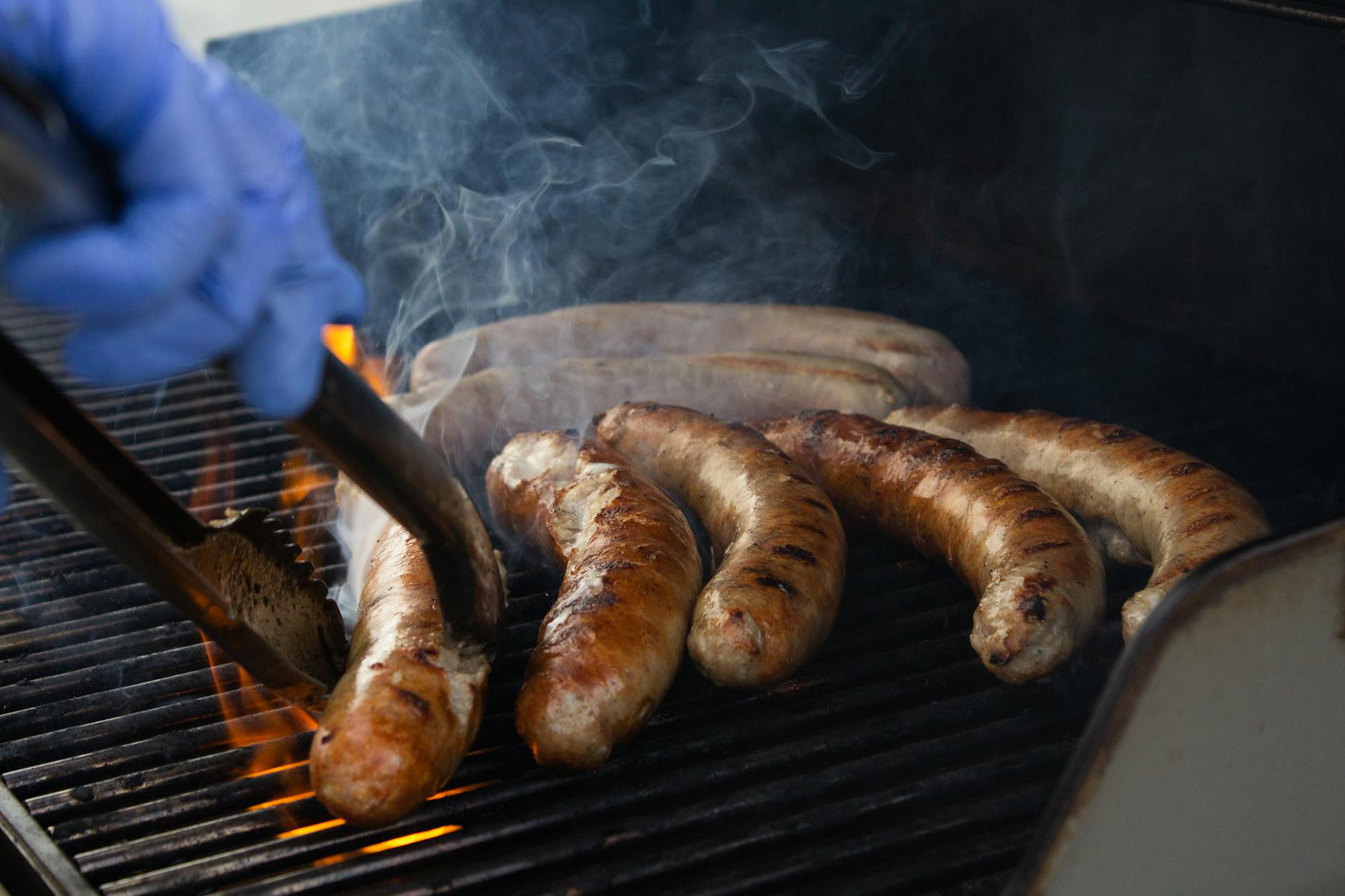
The single most iconic Christmas market food. Munich vendors typically grill three regional styles. The Nürnberger Rostbratwurst is small (7–9 cm, ~25 g), pork-based, seasoned with marjoram, usually served “Drei im Weggla” — three sausages in a bun with mustard. The longer Thüringer Rostbratwurst (15–20 cm) is a coarser pork-and-beef sausage seasoned with marjoram, caraway, and garlic. The Bayerische Bratwurst is the local style, fatter and milder. All three are charcoal-grilled, snap when you bite them, and demand a dollop of mustard (süßer Senf is sweet, scharfer Senf is hot).
Currywurst — €5–€7
A Berlin import firmly entrenched at Munich markets: sliced grilled Bratwurst smothered in curry-spiked tomato sauce and dusted with curry powder. Often served with fries or a roll. A reliable kid-pleaser.
Weisswurst — Hardly Ever at the Market
Munich’s most famous sausage, but rarely seen at Christmas markets. Weisswurst is a delicate veal-and-pork white sausage eaten before noon and considered “spoiled by the church bells” past midday. Christmas markets peak after dark, so vendors don’t bother. For authentic Weisswurst, head to a Munich beer hall in the morning — see our traditional Bavarian food guide.
Käsespätzle — €7–€10
Bavaria’s cheese-pasta hybrid: soft, rough-edged egg noodles tossed with melted Bergkäse or Emmentaler and topped with crispy fried onions. Look for vendors stirring giant copper pans over open flame. The ultimate cold-weather comfort food and a great vegetarian option.
Kartoffelpuffer / Reiberdatschi — €4–€6
Two names, one dish: grated raw potato pancakes pan-fried golden and crispy on big oiled griddles. “Reiberdatschi” is the Bavarian dialect name, from “Erdäpfel” (earth apple). Order two or three with a generous spoonful of cold apple sauce (“Apfelmus”) — the sweet-savory contrast is unbeatable.
Champignonpfanne — €6–€9
Mushroom pan: button mushrooms sautéed with onion, garlic, and herbs, finished with cream and served with a bread roll for mopping. A staple vegetarian option, shockingly satisfying on a freezing night.
Schupfnudeln mit Sauerkraut — €7–€9
Finger-shaped potato dumplings pan-fried golden and tossed with sautéed sauerkraut and bacon bits (vegetarian versions skip the bacon). A Swabian specialty — earthy, sour, and warm.
Flammkuchen — €6–€9
The Alsatian flatbread that conquered every German market: paper-thin dough topped with crème fraîche, onion, and lardons, baked in a wood-fired oven. Vegetarian versions use mushrooms or goat cheese. Crisp, smoky, and easy to eat one-handed while you walk.
Raclette — €7–€10
Swiss cheese melted under a heat lamp and scraped onto a roll, baked potato, or dark bread, finished with cornichons and pickled onions. Look for the half-wheel of cheese under a glowing red bulb. Indulgent and worth the wait.
Steckerlfisch — €10–€14
Whole mackerel or trout brined, threaded on a wooden stick, and slow-grilled upright over a charcoal trench — a Bavarian beer-garden classic that migrates to winter markets. Served with lemon and brown bread. Find it at Tollwood and Schwabing.
Rehragout / Wildgulasch — €9–€12
Slow-cooked venison or wild boar stew, dark with red wine and juniper, served over Spätzle or with dark bread. The Mittelaltermarkt at Wittelsbacherplatz cooks game dishes over beechwood fires — the most atmospheric place in Munich to eat them.
Maroni (Roasted Chestnuts) — €4–€5 for 150 g
Sweet chestnuts roasted in a rotating drum over hot coals, served in a paper cone you peel with cold fingers. The smell is unmistakable and ancient. Eat standing up, immediately, while they’re too hot to handle.
Pretzels (Brez’n) — €3–€5
A giant warm Bavarian Brez’n, often split horizontally and slathered with cold salted butter (“Butterbrez’n”). Cheese-melted (Käsebrez’n) and ham-and-cheese varieties too. The perfect Glühwein companion and the cheapest serious snack on the market.
Leberkäse Semmel — €4–€6
A thick slice of warm Bavarian “meat loaf” (it contains neither liver nor cheese) shoved into a crusty roll with mustard. Working-Munich’s classic quick lunch — one of the heartiest hot snacks at any market, particularly Marienplatz and the Residenz.
Sweets and Pastries: The Christmas Baking Tradition

Lebkuchen — €3–€15
Lebkuchen — German gingerbread — is the heart of Christmas baking. The most prized variety is Nürnberger Elisenlebkuchen, an EU-protected designation requiring at least 25% nuts, less than 10% flour, and production around Nuremberg. The result is dense, soft, fragrant with cinnamon and clove, glazed with chocolate or sugar, baked on thin edible wafers (“Oblaten”). At Munich’s markets you’ll see all forms: Elisen in tin boxes, chocolate-glazed slabs, and the iconic giant Lebkuchenherzen iced with messages like “Ich liebe Dich” — meant as sweet gifts rather than serious eating, though surprisingly good when fresh.
Magenbrot — €4–€6 per bag
Literally “stomach bread” — small soft glazed cookies spiced with cinnamon, clove, and anise, sold by weight in paper bags. Originally a digestive aid, now eaten by the fistful. Dangerously addictive.
Spritzgebäck — €5–€8
Piped buttery shortbread, often dipped half in dark chocolate or pressed with hazelnuts. Found at home-baking-style stalls run by Bavarian church groups and family bakeries.
Stollen — €15–€35 per loaf
Christmas bread heavy with butter, raisins, candied citrus peel, almonds, and rum, dusted thick with powdered sugar to represent the swaddled Christ child. The original Dresdner Christstollen is EU-protected and produced only by Dresden bakers — many Munich markets sell imported loaves. Bavaria has its own variations, sometimes with marzipan through the center (“Marzipanstollen”). Slice thin; one loaf lasts weeks.
Schmalznudeln / Auszogne — €3.50–€5
Bavaria’s doughnut, also called Ausgezogene Krapfen (“pulled doughnuts”) because the dough is hand-stretched with a translucent center and puffy edges, then deep-fried in lard and dusted with sugar. Café Frischhut by the Viktualienmarkt is legendary year-round; market stalls fry them fresh on the spot.
Schokofrucht — €4–€7
Strawberries, banana, grapes, and pineapple chunks skewered and dipped in warm dark, milk, or white chocolate, often rolled in sprinkles or nuts. Kid magnet and Instagram bait.
Gebrannte Mandeln — €4–€6 per cone
Candied roasted almonds — tumbled in giant copper pans with sugar, vanilla, and cinnamon until they’re crackling and amber. The smell of every German Christmas market. Sold warm in paper cones. Pecans, hazelnuts, cashews, and peanuts often appear too.
Krapfen — €2.50–€4
The Bavarian jelly doughnut — round, plump, deep-fried, filled with apricot jam (“Hiffenmark”) or vanilla custard, dusted with powdered sugar. Available throughout Advent.
Quarkbällchen — €3–€5
Small spherical fried doughnuts made with quark cheese in the dough, giving them a slightly tangy, very moist interior. Sold in paper cones dusted with sugar. Best eaten within ten seconds of frying.
Marzipan — €5–€20
Ground-almond-and-sugar paste shaped into miniature fruits, pigs (a Bavarian good-luck symbol), or potatoes (Marzipankartoffeln, dusted in cocoa to look like little spuds). The best comes from Lübeck in the north, but Bavarian and Austrian marzipan is excellent too.
Where to Find the Best of Each: Market by Market

Marienplatz Christkindlmarkt — Classic Mix
The widest variety of traditional Bavarian fare: Nürnberger Bratwurst, Leberkäse Semmeln, Brez’n, Schmalznudeln, Lebkuchen hearts, gebrannte Mandeln, Glühwein at half a dozen competing stalls. If you only visit one market, this is where to taste a representative slice of everything classic. See our Marienplatz Christmas market guide.
Tollwood Winter Festival — Foodie Heaven
Munich’s culinary outlier: every one of Tollwood’s 50+ food stalls has been 100% certified organic since 2003, and the market is famous for vegetarian and vegan options including Munich’s only Veggie Bratwurst. World cuisine runs from Indian Thali to Ethiopian wat to vegan ramen to organic Bavarian Käsespätzle. Heated festival tents mean you can sit down and eat properly. The 2026 Tollwood Winter Festival runs at Theresienwiese — full details in our Tollwood guide.
Pink Christmas (Glockenbachviertel) — Modern Twists
Munich’s LGBTQ+ Christmas market on Stephansplatz brings a younger, queerer, more creative edge to the drinks menu: Heisser Hugo, hot Aperol spritz, pink Glühwein, prosecco punches, plus contemporary food stalls with quirky takes on Flammkuchen and creative vegetarian dishes. Cabaret and drag shows around 19:00 most nights add the entertainment. See our alternative Christmas markets guide.
Mittelaltermarkt Wittelsbacherplatz — Medieval Feast
The most atmospheric food at any Munich market: mead poured from oak barrels into clay goblets, whole pigs slow-roasted over beechwood, Wildgulasch in iron cauldrons, Flammkuchen blistering on open hearths, Jagatee laced with so much rum it warms three layers at once. Costumed vendors, minstrels playing nearby, and a smoke-and-mead haze you’ll smell three blocks away.
Münchner Christkindlmarkt am Sendlinger-Tor-Platz
Smaller and more local than the Marienplatz market, with a tighter cluster of food stalls focused on Bavarian classics. The standout is a deeply respected Käsespätzle vendor who has worked the same patch for years. Less touristy, easier to find a standing table.
Vegetarian, Vegan, and Gluten-Free Options
Munich’s Christmas markets aren’t traditionally vegetarian, but the situation has improved dramatically. Tollwood is the clear standout — every stall is organic and most offer vegan and vegetarian dishes including the famous Veggie Bratwurst, plant-based Käsespätzle, vegan bowls, and dairy-free hot drinks. At traditional markets like Marienplatz and Residenz, reliable vegetarian options include Käsespätzle, Kartoffelpuffer (without bacon — confirm with the vendor), Champignonpfanne, Flammkuchen vegetarisch, Raclette, sweet Brez’n with butter, and most sweets.
Gluten-free options are harder to come by — sausages without buns, Raclette without bread, certain meat-and-cheese plates, candied nuts, chocolate-dipped fruit, and many wines (always confirm). Halal options are limited at traditional markets; Tollwood again offers the broadest spread including Middle Eastern stalls. Travelers with severe nut allergies should be especially careful: Lebkuchen, gebrannte Mandeln, Stollen, and many sweets all contain nuts, and cross-contamination at small wooden stalls is hard to avoid.
Eating Etiquette at a Munich Christmas Market
- Eat at standing tables: Most stalls have small standing tables (“Stehtische”) nearby where you can park your food, your Glühwein, and your gloves while you eat — they are first-come, first-served
- Sharing is normal: If a table has space and no one else is sitting at it, take it. If others are already there, ask “Ist hier noch frei?” (“Is this free?”) before joining
- Don’t hover: Eat, drink, leave — Munich markets are social but practical, and standing tables turn over every 15–20 minutes
- Cash is king: Bring €30–€80 in small bills and coins. Many food stalls don’t accept cards, especially at smaller markets
- Tipping: Not expected at counter-service stalls; rounding up €0.50–€1 is appreciated, especially if you’ve ordered a complicated drink
- Queue politely: Even when there’s no formal line, Munich vendors keep track of who arrived first — don’t try to wave money at the counter ahead of someone who came before you
- Trash: Bins are everywhere; throw away cones, napkins, and skewers in the bin, not on the cobblestones
Bringing Kids: What to Order
Munich’s markets are very kid-friendly. The essential children’s drink is Kinderpunsch — same warming spices, no alcohol, often served in collectible mugs. Heisse Schokolade (hot chocolate) without the Amaretto is the other reliable child order. Food-wise, kids tend to love Bratwurst in a bun (mild Bavarian style rather than spicy Thüringer), Käsespätzle, Kartoffelpuffer with applesauce, soft Brez’n with butter, Schokofrucht (chocolate-dipped fruit), gebrannte Mandeln, and Schmalznudeln. The Marienplatz Christkindlmarkt has a children’s craft area (Himmelswerkstatt) and a small carousel.
Markets Ranked by Food Quality
- Tollwood Winter Festival — broadest, freshest, most diverse, 100% organic
- Mittelaltermarkt Wittelsbacherplatz — most atmospheric and unusual (game, mead, fire-cooking)
- Marienplatz Christkindlmarkt — best classic Bavarian range
- Residenz Weihnachtsmarkt — high quality, refined, slightly upscale takes on classics
- Schwabing Weihnachtsmarkt — artisan and slightly bohemian — good Steckerlfisch and creative Käsespätzle
- Pink Christmas (Stephansplatz) — modern, creative, drinks-led
- Sendlinger-Tor-Platz — solid neighborhood quality, less crowded
Three Suggested Food Crawls
1. The Classic Bavarian Crawl (3 hours)
Start at the Marienplatz Christkindlmarkt with a Glühwein and a Nürnberger “Drei im Weggla.” Walk five minutes to the Viktualienmarkt and detour behind the Schrannenhalle for a flaming Feuerzangenbowle. Continue ten minutes to Wittelsbacherplatz for Rehragout in the medieval market with a clay-mug Met. Finish with Lebkuchen and gebrannte Mandeln back at Marienplatz.
2. The Foodie/Vegetarian Crawl (3 hours)
Take the U4/U5 to Theresienwiese and start at Tollwood Winter Festival. Eat your way through the world-cuisine tents — Veggie Bratwurst, vegan Käsespätzle, organic Flammkuchen — washed down with elderflower Glühwein. After two hours, take the U4 back into the Altstadt and finish with hot chocolate-and-Amaretto plus Schmalznudeln at Café Frischhut near the Viktualienmarkt.
3. The Sweet Tooth Crawl (2 hours)
Start at Marienplatz with Schmalznudeln from a stall and a Heisse Schokolade. Walk to the Lebkuchen specialists for an Elisenlebkuchen tin to take home. Detour to the Pink Christmas market at Stephansplatz for a Heisser Hugo and Schokofrucht. End at Wittelsbacherplatz for hot mead and a slice of Stollen.
Frequently Asked Questions
How much should I budget for food and drinks at a Munich Christmas market?
A full evening of grazing — two Glühweins, a Bratwurst, a serving of Käsespätzle or Reiberdatschi, and a sweet treat — costs roughly €25–€35 per person. Most Pfand cup deposits are refunded if you return the mugs.
Do Munich Christmas market stalls take credit cards?
Many do now, especially at the larger Marienplatz and Tollwood markets, but cash is still strongly preferred and many smaller food stalls remain cash-only. Bring €30–€80 in small notes and coins to be safe.
What is the Pfand and how do I get my money back?
The Pfand is a refundable deposit (€3–€5) for the ceramic mug your drink is served in. Return the empty mug to any drinks vendor at the same market and they’ll hand back your deposit in cash. Or keep it as a souvenir — you’ve already paid for it.
Where can I get vegetarian or vegan Christmas market food in Munich?
Tollwood Winter Festival is the gold standard — 100% organic with extensive vegan and vegetarian options including Munich’s only Veggie Bratwurst. At traditional markets, look for Käsespätzle, Kartoffelpuffer with applesauce, Champignonpfanne, vegetarian Flammkuchen, and Raclette.
Where is Munich’s best Feuerzangenbowle?
Behind the Schrannenhalle at Blumenstraße 22, between the Viktualienmarkt and the Hochbunker. The huge bronze cauldron with its wreath of flames operates daily from late November through January 6. It’s the city’s most photographed Christmas drink.
Are Munich Christmas markets safe for people with nut allergies?
Be cautious. Nuts (especially almonds and hazelnuts) are used heavily in Lebkuchen, Stollen, gebrannte Mandeln, marzipan, and many sweets. Cross-contamination at small stalls is hard to avoid. Stick to clearly nut-free items like plain Bratwurst, Brez’n, Käsespätzle, and Glühwein, and always tell the vendor about your allergy.
Eat Your Way Across Munich’s Advent
The point of a Munich Christmas market is to slow down, stand outside in the cold with strangers, and eat things you’d never make at home. Trust the smell — if a stall is wreathed in steam and surrounded by locals, order. Bring cash, bring gloves, bring an appetite. For more, see our complete Christmas markets guide, the Marienplatz Christkindlmarkt guide, our Tollwood overview, the alternative markets roundup, and the traditional Bavarian food guide for what to eat after December 24.